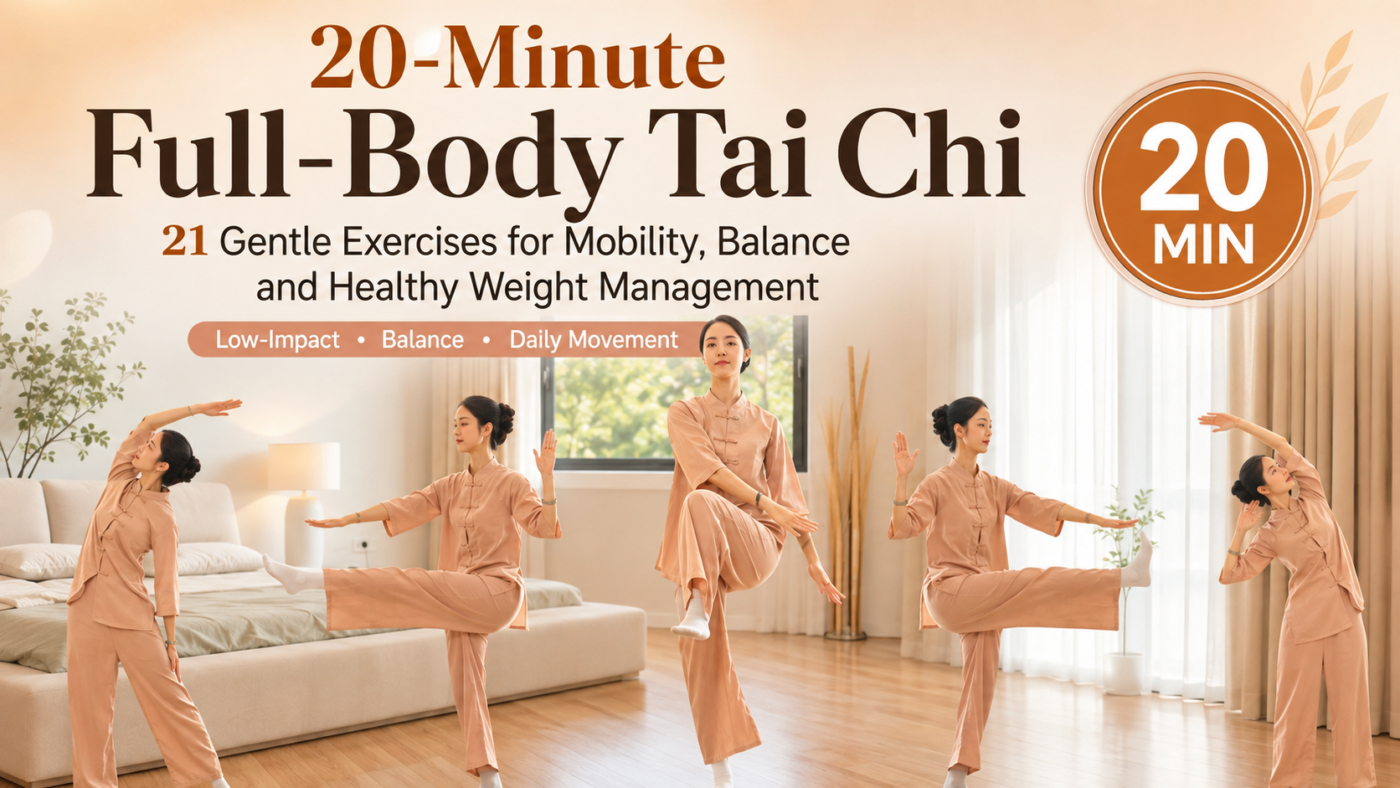
No running. No jumping. No complicated choreography.
A gentle 20-minute Tai Chi-inspired routine can still provide meaningful physical benefits, especially for adults who want a low-impact way to stay active, improve mobility, support balance, and increase daily energy expenditure.
The original routine repeatedly describes the movements as helping “burn belly fat,” “reduce visceral fat,” or “trim side fat.” Those claims need to be interpreted carefully. No single Tai Chi movement can selectively remove fat from the abdomen, waist, or internal organs. What these exercises can do is increase total-body movement, strengthen muscles, improve balance, reduce sedentary time, and contribute to overall energy expenditure. Combined with appropriate nutrition, sleep, and regular physical activity, that can support healthy weight management over time.
This 21-movement sequence combines marching, knee lifts, side bends, rotational stepping, controlled kicks, heel raises, arm swings, and coordinated full-body patterns into one accessible routine.
Why This Routine Works Well as Low-Impact Exercise
The movements are gentle, but they are not passive.
You repeatedly shift weight, lift the knees, rotate the torso, move the arms overhead, control the ankles, and coordinate the upper and lower body.
That can support:
Balance and stability
Hip mobility
Shoulder mobility
Core control
Lower-body strength
Postural awareness
Coordination
Light cardiovascular activity
Daily calorie expenditure
Reduced stiffness from prolonged sitting
For many adults, especially those who dislike high-intensity exercise, this kind of consistent moderate movement may be easier to maintain over the long term.
1. Natural Arm Marching
Stand tall and march comfortably in place.
Let the arms swing naturally with the opposite leg.
Keep the rhythm smooth rather than fast.
Breathe comfortably.
This simple movement warms the body and increases circulation through the working muscles.
Marching also trains basic coordination between the arms and legs.
If balance is uncertain, keep the knee lift low.
2. Knee-to-Elbow Raise
Raise one knee while bringing the elbows downward toward it.
Return to standing.
Repeat on the opposite side.
This movement engages the hips and abdominal muscles while requiring single-leg balance.
The cross-body pattern also challenges coordination.
It can strengthen the midsection, but it should not be considered a spot-reduction exercise for abdominal fat.
3. Knee Drive With Arm Swing
Reach both arms overhead.
Lift one knee while swinging both arms downward toward that side.
Return to center.
Repeat on the other side.
The diagonal movement engages the trunk, shoulders, and hips.
It also adds rotational movement through the torso.
Move slowly enough to stay upright and controlled.
4. Side Step With Overhead Reach
Step one foot to the side.
Reach the opposite arm overhead.
Return to center.
Repeat on the other side.
This creates a gentle stretch along the side of the torso while also shifting body weight laterally.
The movement can help maintain hip mobility and trunk flexibility.
Do not force the side bend.
5. Cross Lunge With Side Push
Step one foot diagonally backward.
At the same time, press the opposite arm across the body.
Return to the center.
Repeat on the other side.
This movement combines balance, lower-body control, trunk rotation, and shoulder movement.
Keep the backward step small if you are new to balance training.
6. Double Side Reach
Hold both hands near the sides of the head with the palms facing outward.
Lean gently toward one side.
Return to center.
Then reach one arm overhead as you bend toward the same side.
Repeat on the opposite side.
This mobilizes the waist, ribs, shoulders, and upper back.
The goal is to lengthen the side body without compressing the lower back.
7. Cross-Body Knee Elbow Lift
Place both hands near the sides of the head.
Lift one knee.
Bring the opposite elbow gently toward it.
Return to center.
Switch sides.
This is another useful cross-body coordination exercise.
It engages the trunk and hips while challenging balance.
The movement should be controlled rather than performed quickly.
8. Knee Lift With Heel Reach
Place one hand near the ear and the other hand at the waist.
Lift one knee and bring the opposite elbow toward it.
Then extend that leg backward and lower the hand toward the heel.
Return and repeat.
This combines hip flexion, hip extension, trunk control, and balance.
The backward leg movement also engages the glutes.
Use a smaller range if you feel unstable.
9. Cross Step With Arm Opening
Hold both hands in front of the body.
Step one foot diagonally backward while opening both arms outward.
Return.
Switch sides.
Opening the arms encourages chest and shoulder mobility.
The cross step adds rotational and balance demands.
Keep the knees soft rather than locked.
10. Overhead Side Sweep
Press the palms together and raise the hands overhead.
Lower both hands toward one side.
Lift them back overhead.
Then move to the other side.
The sweeping pattern keeps the torso moving through a gentle side-to-side range.
It also challenges shoulder mobility.
Avoid excessive side bending if you have back discomfort.
11. Step Back With Arm Lift
Reach both hands forward.
Step one foot backward while lifting both arms overhead.
Return.
Switch sides.
The backward step strengthens lower-body control.
The overhead arm movement adds a postural and shoulder component.
This is also a useful exercise for practicing changes in direction.
12. Front Kick Reach
Extend the arms to the sides.
Lift one leg forward.
Reach the opposite hand toward the foot.
Return.
Repeat on the other side.
The leg does not need to rise high.
A small controlled lift is enough.
This movement trains balance, hip mobility, and cross-body coordination.
Avoid forceful kicking.
13. Torso Twist With Heel Lift
Clasp the hands in front of the chest.
Rotate the torso toward one side while allowing the opposite heel to lift.
Return.
Switch sides.
This allows the hips to rotate more naturally with the trunk and reduces the temptation to force rotation through the lower back.
The movement engages the oblique muscles and improves rotational mobility.
14. Front Kick With Under-Foot Clap
Lift one leg forward.
Bring both hands downward toward or underneath the raised foot.
Return to standing.
Switch sides.
If you cannot comfortably reach beneath the foot, clap near the knee or shin instead.
The exercise combines balance, hip mobility, and upper-lower body coordination.
15. Folded Arms With Back Leg Lift
Fold the arms in front of the chest.
Turn gently toward one side.
Lift the opposite or same-side leg slightly backward according to your balance.
Return.
Switch sides.
This movement combines controlled rotation with hip extension.
The backward leg lift activates the glutes.
Avoid arching the lower back.
16. Cross Knee Curl
Lift one knee diagonally across the body.
Lower it.
Then bend that same leg backward into a gentle heel curl.
Switch sides.
This sequence challenges hip control, coordination, and balance.
It also keeps the legs moving continuously without jumping.
17. Knee Lift Pull-Down
Raise both arms overhead.
Lift one knee while pulling both elbows downward beside the body.
Return.
Switch sides.
The pull-down motion engages the upper back and shoulders.
The knee lift adds a balance and core challenge.
Keep the ribs controlled rather than leaning backward.
18. Side Knee Elbow Turn
Place both hands behind the head without pulling on the neck.
Lift one knee toward the side.
Bring the same-side elbow toward it.
Return the foot to the floor.
Then rotate the torso gently from side to side.
This combines lateral trunk movement with rotation.
Keep the range comfortable.
The hands can be placed across the chest if the neck or shoulders feel strained.
19. Cross Touch and Overhead Press
Bend forward from the hips.
Reach one hand toward the opposite foot.
Return toward standing.
Repeat on the other side.
Then press the arms outward and overhead.
This movement combines posterior-chain stretching, trunk rotation, and shoulder mobility.
If bending forward causes dizziness or back pain, reduce the range significantly.
20. Heel Curl With Row
Extend both arms forward.
Bend one leg backward, bringing the heel toward the body.
At the same time, pull both elbows backward.
Return.
Switch sides.
The heel curl activates the hamstrings.
The rowing motion strengthens the upper back and opens the chest.
This is one of the more complete full-body coordination exercises in the routine.
21. Relaxed Side Arm Swing
Finish by gently swinging the arms from side to side.
Allow the upper body to rotate naturally.
Keep the knees soft.
Do not force the motion.
This final movement helps reduce muscular tension and gradually lower the intensity of the session.
Think of it as a moving cooldown.
Can This Routine Reduce Visceral Fat?
Potentially as part of a broader lifestyle strategy, but not by itself.
Visceral fat is influenced by total body fat, dietary intake, physical activity, sleep, stress, alcohol use, age, genetics, and metabolic health.
Regular low-impact exercise can contribute to reducing total body fat and improving metabolic health when performed consistently.
However, statements such as “this movement burns visceral fat” are too specific.
A more accurate interpretation is that these exercises can increase physical activity and energy expenditure, which may support reductions in total and abdominal fat over time when combined with an appropriate overall lifestyle.
Why 20 Minutes Can Still Be Useful
Twenty minutes may sound short, but it can be meaningful when repeated regularly.
Consistency matters more than occasional intensity.
A routine like this can be especially useful for people who otherwise spend much of the day sitting.
Even a moderate session can:
Break up sedentary time
Increase movement volume
Challenge balance
Mobilize stiff joints
Engage large muscle groups
Encourage regular exercise habits
If 20 minutes feels difficult, start with 10.
If it becomes easy, increase the duration, range of motion, or weekly frequency rather than rushing the movements.
How Often to Practice
Many healthy adults can perform gentle mobility and balance work most days of the week.
A practical plan might include this 20-minute routine three to six days per week.
For better overall fitness, combine it with walking and at least two weekly sessions of progressive strength training.
The exact amount should depend on your health, age, fitness level, and recovery.
Who Should Modify the Routine?
Use additional caution if you have:
Significant balance problems
Recent surgery
Severe arthritis
Advanced osteoporosis
Persistent dizziness
Uncontrolled cardiovascular disease
Neurological conditions
Severe back or neck problems
Pain during ordinary walking or standing
In these situations, a clinician or qualified rehabilitation professional can help determine which movements are appropriate.
Final Thoughts
The strength of this routine is not that it promises rapid fat loss.
Its real value is that it makes movement approachable.
There is no running, no jumping, and no complicated choreography.
Instead, you repeatedly practice the things that matter for long-term physical function: standing control, weight shifting, balance, leg strength, hip mobility, shoulder movement, rotation, coordination, and steady activity.
Those qualities matter at every age.
And when the goal is healthy aging or weight management, a routine you can perform consistently is usually more valuable than an intense workout you quickly abandon.
FAQ
Can Tai Chi-style exercise help with weight loss?
It can contribute to overall physical activity and energy expenditure. Weight loss depends on total energy balance and lifestyle rather than one specific exercise type.
Can these exercises burn belly fat specifically?
No. Spot reduction is not supported by current evidence. The movements can strengthen the abdominal and trunk muscles, but fat loss occurs throughout the body.
Is this routine suitable for beginners?
Yes. Most movements can be performed with smaller ranges, slower speeds, and external support.
Is 20 minutes enough?
Twenty minutes can be useful, particularly when practiced regularly. More activity may provide additional benefits depending on your health and goals.
Can older adults do these movements?
Many older adults can perform adapted versions. Balance support, smaller steps, and gentler ranges may be appropriate.
Should the movements be fast?
No. Slow, controlled movement often improves balance and coordination more effectively than rushing.
Medical Disclaimer
This article is for educational purposes only and is not medical advice. Exercise needs vary according to age, health history, medications, balance, joint health, cardiovascular status, and other factors. Stop exercising if you experience chest pain, faintness, severe dizziness, unusual shortness of breath, sudden weakness, or sharp pain, and seek appropriate professional care when necessary.
This article is for general education and does not replace individualized care from a qualified health professional. Seek appropriate advice for persistent, severe, or concerning symptoms.
Read the full medical disclaimer