Why Your Arms Can Look Softer Over Time
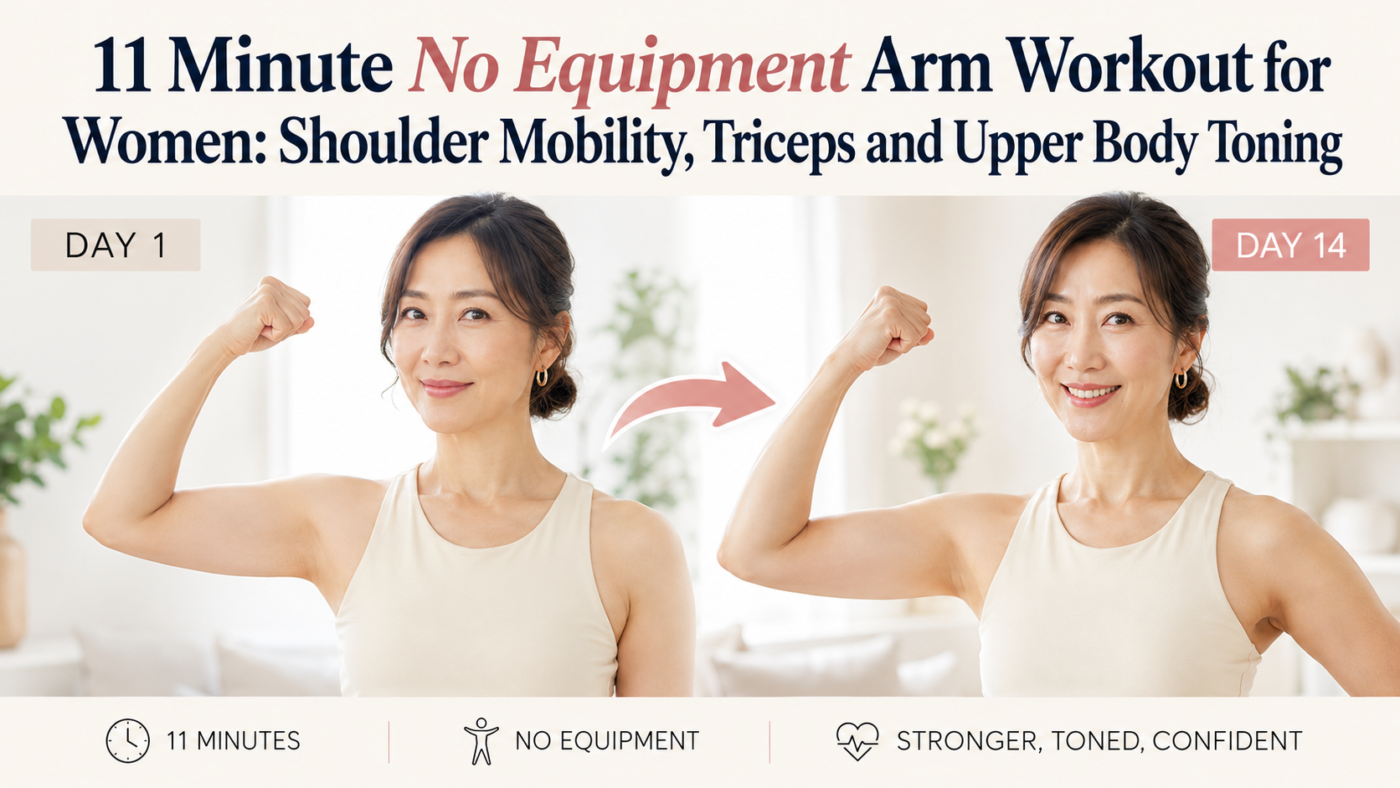
This arm workout for women is an 11 minute no equipment routine designed to train the shoulders, triceps and upper body while improving muscular endurance and mobility.Many women notice that their upper arms become softer or move more than they used to.
That does not automatically mean something is wrong.
The appearance of the arms depends on several factors, including muscle mass, body fat, skin elasticity, genetics, age and overall physical activity.
Changes in body composition can also become more noticeable during midlife.
Regular exercise can help maintain muscle and upper body function, but it is important to separate realistic benefits from exaggerated promises.
No single arm exercise can selectively remove fat from the upper arms.
What exercise can do is strengthen the muscles underneath, improve muscular endurance and help you stay physically active.
That is the goal of this short routine.
No Equipment Needed
This workout does not require dumbbells or machines.
The resistance comes primarily from repeated movement, arm position and muscular fatigue.
For beginners, that may be enough to make the shoulders and arms work surprisingly hard.
As you become stronger, however, you may eventually need additional resistance if your goal is continued muscle development.
For now, all you need is enough space to move your arms comfortably.
Begin With Shoulder Circles
Start by relaxing your arms and gently rotating the shoulders backward.
Keep the circles smooth.
Do not force the movement.
Allow the shoulder blades to move naturally along the ribcage.
After several repetitions, reverse direction.
Move the shoulders forward.
Continue breathing normally.
This is a simple way to warm up before more repetitive arm movements.
Why Shoulder Mobility Matters
The shoulder is one of the most mobile joints in the body.
It allows you to reach overhead, behind you, across your body and in many other directions.
When people spend long periods sitting or using computers and phones, they may notice that certain shoulder movements feel stiff.
Regular movement can help maintain comfort and familiarity with these ranges.
Shoulder circles are not a cure for every shoulder problem, but they are an easy place to start.
Wrist and Forearm Rotation
Next, hold one arm comfortably and rotate the wrist.
Move slowly in one direction.
Then reverse.
Allow a little forearm rotation as well.
Repeat on the opposite side.
This does not need to be intense.
The purpose is simply to move the wrist and forearm through a comfortable range before the harder exercises begin.
Be Careful With Detox Claims
The original video describes twisting the arms as a way to flush stuck lymph and old energy.
That is not an appropriate medical claim.
The lymphatic system functions continuously as part of fluid balance and immune function.
Normal muscle movement can support circulation and fluid movement, but arm twisting should not be treated as a detox therapy.
If someone has persistent swelling or diagnosed lymphedema, they need appropriate medical or therapeutic guidance.
Triceps Stretch
Raise one arm overhead.
Bend the elbow so the hand moves behind your head or upper back.
Use the opposite hand to gently support the elbow.
You may feel a stretch through the back of the upper arm.
Keep your neck relaxed.
Do not pull aggressively.
Hold briefly.
Then switch sides.
The goal is gentle preparation, not maximum flexibility.
Why the Triceps Matter
The triceps run along the back of the upper arm.
They help straighten the elbow and contribute to pushing movements.
Because the back of the arm is also where many people notice softness or movement, triceps exercises are commonly marketed as fat burning exercises.
That is misleading.
Training the triceps can strengthen the muscle.
It cannot force fat to disappear only from the tissue covering that muscle.
Backward Arm Movements
Bring both arms behind the body within a comfortable range.
Perform small controlled movements.
You may feel the back of the shoulders and upper arms working.
Keep your chest relaxed.
Avoid dramatically arching your lower back.
If the shoulders pinch or hurt, reduce the range.
A burning sensation in the muscle may develop as the exercise continues.
That is muscular fatigue.
It is not proof that arm fat is melting.
Gentle Arm Massage
The routine includes squeezing or massaging the upper arms.
You can do this if it feels comfortable.
Use light or moderate pressure.
Massage may create warmth and temporary relaxation.
It does not crush fat cells.
Body fat cannot be manually broken apart and eliminated by squeezing the arms.
Use massage for comfort rather than fat loss.
Behind the Back Arm Pulses
Move the arms behind you and perform small pulses.
Keep the movement controlled.
Do not throw your arms backward.
You may feel the shoulders and triceps working more as the repetitions continue.
Use a smaller range if necessary.
If fatigue causes poor posture or shoulder pain, stop and rest.
Behind the Back Clapping Exercise
The workout progresses into repeated movements behind the body.
Some people may be able to bring their hands very close together.
Others cannot.
That is fine.
Shoulder mobility varies considerably between individuals.
Do not force your hands together.
You can still challenge the muscles even if the hands remain apart.
The important part is controlled repeated movement.
Arm Extensions
Extend both arms outward.
Maintain a comfortable shoulder position.
The video includes turning the thumbs downward.
If that position causes shoulder discomfort, keep the hands neutral instead.
Exercise variations should fit your body.
There is no advantage to forcing a position that feels painful.
Repeated arm movements can challenge shoulder endurance even without weights.
Forward Punches
Move into a standing position if comfortable.
Bring your hands near your chest.
Punch one arm forward.
Return.
Then punch with the opposite arm.
Keep your elbows controlled.
Do not forcefully lock the joint at the end of each punch.
Start slowly.
Increase speed only if you can maintain good control.
Keep your shoulders relaxed rather than shrugging them toward your ears.
Why Punching Can Feel Hard Without Weights
Your arms still have weight.
Holding them away from the body and repeatedly accelerating and decelerating them requires muscular work.
As repetitions accumulate, the shoulders and arms may fatigue.
This can provide a useful muscular endurance challenge, especially for beginners.
However, it is not equivalent to progressive resistance training with heavier loads.
For continued strength development, more resistance may eventually be necessary.
Faster Punches
The routine becomes faster toward the end.
Speed increases the challenge.
But faster is not always better.
If your technique starts breaking down, slow down.
Do not sacrifice control for intensity.
Your shoulders should not begin moving chaotically.
Your lower back should not dramatically arch.
Your neck should remain relaxed.
Use a pace you can sustain safely.
Overhead Punches
For the final exercise, direct your punches upward.
Reach one arm toward the ceiling.
Then alternate.
Keep your ribs controlled.
Try not to lean excessively backward.
Do not lock the elbow aggressively.
This section can become tiring quickly.
Thirty seconds may be enough for a beginner.
Take breaks whenever necessary.
Your workout does not become more effective simply because you push through severe fatigue.
Why Arms May Shake
Your arms may shake during the final exercises.
This can happen when muscles become fatigued.
It can also occur during unfamiliar movements.
Mild fatigue related shaking is usually a sign that it is time to reduce the intensity or rest.
Stop immediately if shaking is accompanied by sharp pain, sudden weakness, dizziness, numbness or other concerning symptoms.
Can This Workout Remove Flabby Arms?
Not specifically.
Spot reduction is not a reliable strategy.
You cannot choose exactly where your body removes fat simply by exercising that area.
Fat loss depends on overall energy balance and is influenced by genetics, hormones and lifestyle.
What this routine can do is train the muscles of the shoulders and arms.
Over time, stronger muscles can contribute to a firmer appearance.
But visible results also depend on overall body composition and skin.
Can One Workout Make Your Arms Smaller?
A single session cannot produce meaningful fat loss from the arms.
Immediate measurements can change because of technique, fluid shifts, temporary muscle swelling or the way the tape measure is positioned.
Your arms may feel firmer after exercise because the muscles are temporarily more active and filled with blood.
That is not permanent fat loss.
Real changes require consistency over time.
Women in Midlife Can Still Build Strength
The video mentions perimenopause, and this is an important point.
Midlife is not a reason to stop strength training.
In fact, maintaining muscle becomes increasingly important as we age.
Women in their 40s, 50s and beyond can still improve strength and physical function with appropriate training.
A light no equipment routine is a useful starting point.
As it becomes easier, adding resistance bands or dumbbells can provide a stronger training stimulus.
The goal is not to recreate the arms you had at 20.
The goal is to build capable arms for the life you have now.
Can Women Over 50 Benefit?
Yes.
Regular strength and movement training can support physical function at many ages.
Women over 50 may especially benefit from training that helps maintain muscle mass and upper body strength.
Start at an appropriate level.
Progress gradually.
Use additional rest if needed.
Age does not mean you need to avoid exercise.
It means that training should be appropriate for your current ability.
How Often Should You Do This Workout?
Two or three sessions per week is a reasonable starting point for many beginners.
You can also perform a shorter version on other days.
If your arms are very sore after a session, allow them time to recover.
When the routine becomes easy, increase the challenge rather than endlessly repeating the same intensity.
Progressive overload is important for continued strength development.
How to Make the Workout Harder
Once the routine feels easy, you have several options.
Increase the duration slightly.
Use light resistance bands.
Add light dumbbells.
Perform wall push ups.
Progress to incline push ups.
Add rowing exercises.
Add overhead presses.
Increase repetitions gradually.
Do not add everything at once.
Progress step by step.
A Complete Arm Training Strategy
If your goal is stronger and more defined arms, combine different movement patterns.
Include pushing exercises.
Include pulling exercises.
Train the shoulders.
Train the triceps.
Train the biceps.
Train the upper back.
A balanced program is more useful than focusing only on one small area.
This 11 minute workout can be part of that larger plan.
Nutrition and Protein Matter
Exercise is only one part of body composition.
Protein helps support muscle repair and maintenance.
A balanced diet can support training and recovery.
If fat loss is a goal, overall calorie intake also matters.
Extreme diets are unnecessary.
There is no special food that specifically removes arm fat.
Consistency matters much more than gimmicks.
Do Not Punish Your Arms
The original video uses a lot of playful language about jiggly arms.
Humor can make exercise fun, but softness is normal.
Skin moves.
Fat moves.
Muscle moves.
That does not mean your arms are defective.
You can want stronger arms without treating your current body as a problem.
Exercise works better as a long term habit when it is based on capability rather than punishment.
A Better Progress Check
Instead of measuring your arms after every workout, track function.
Can you complete more repetitions?
Can you keep your shoulders controlled for longer?
Can you use heavier resistance?
Can you carry groceries more easily?
Can you reach overhead more comfortably?
Can you perform more push ups?
Those improvements tell you something meaningful about progress.
Appearance may change too, but performance is often a more reliable measure.
Who Should Modify the Workout?
Use smaller movements if you have shoulder stiffness.
Skip overhead exercises if they cause pain.
People with recent shoulder, elbow or wrist surgery should follow rehabilitation instructions.
Persistent shoulder pain, arm numbness, tingling or unexplained weakness deserves appropriate evaluation.
Stop immediately if an exercise causes sharp pain.
Muscle fatigue is acceptable.
Joint pain is not something to push through.
The Goal Is Stronger, More Useful Arms
An arm workout does not need magical promises.
It does not need to claim that fat disappears instantly.
It does not need to promise a complete transformation in 14 days.
The real value is much more practical.
You move your shoulders.
You train your arms.
You challenge muscular endurance.
You gradually become stronger.
Over time, those changes can improve both function and appearance.
That is a realistic goal worth pursuing.
Frequently Asked Questions
Can I tone my arms without weights?
Yes, especially if you are a beginner. Repeated bodyweight arm movements can challenge muscular endurance. Additional resistance may eventually be needed for continued strength development.
Can arm exercises remove upper arm fat?
No. Exercise cannot selectively remove fat from only one body area.
Can triceps exercises make the arms look firmer?
Strengthening the triceps can increase or maintain muscle under the skin. Visible appearance also depends on body fat, skin and genetics.
How long does it take to see results?
Noticeable strength and body composition changes typically require consistent training over weeks or months.
Can women over 50 build arm muscle?
Yes. Older adults can still respond to resistance training and improve strength.
Should my arms burn during this workout?
Muscular fatigue or burning can occur during repeated movements. Sharp joint pain is not normal.
Can massage remove arm fat?
No. Massage does not destroy or remove body fat.
Does arm twisting detox the body?
No. Arm movements should not be promoted as a detox treatment.
Can I do this routine every day?
A gentle version may be tolerated frequently, but harder training requires recovery. Two or three sessions per week is a reasonable starting point.
Do I need equipment?
No. This routine uses no special equipment.
This arm workout for women can be performed at home without dumbbells or machines.
For beginners, this arm workout for women can be modified by slowing the movements and taking more rest.
As this arm workout for women becomes easier, resistance bands or dumbbells can provide additional challenge.
Medical Disclaimer
This article is for general educational and informational purposes only and is not medical advice, diagnosis or treatment. Exercise suitability varies according to age, medical history, injuries and physical ability. Stop any movement that causes sharp pain, numbness, significant tingling, dizziness or worsening symptoms. Consult an appropriate healthcare or exercise professional if you have persistent shoulder, elbow, wrist or neurological problems before beginning a new exercise program.
This article is for general education and does not replace individualized care from a qualified health professional. Seek appropriate advice for persistent, severe, or concerning symptoms.
Read the full medical disclaimer