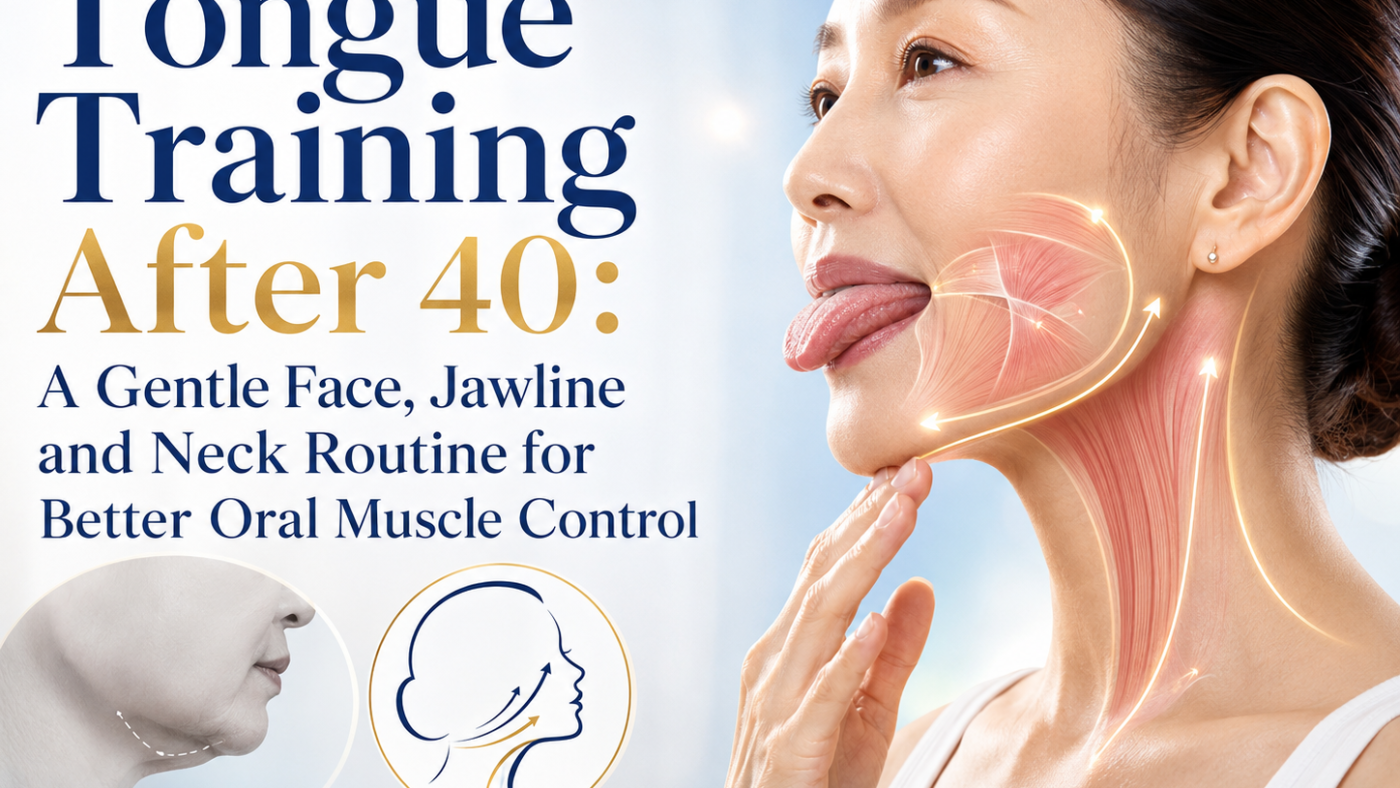
The tongue is easy to overlook.
Most people think of it only when they speak, eat, taste food or swallow. Yet the tongue is a highly active muscular organ that works together with structures throughout the mouth, jaw, throat and upper neck.
That is why tongue exercises can feel surprisingly demanding.
A few minutes of controlled tongue movement may create fatigue around the mouth, under the jaw or inside the cheeks, especially if you have never deliberately trained these movements before.
For adults over 40, this type of practice can be an interesting addition to a broader facial wellness routine.
But it is important to separate realistic benefits from exaggerated promises.
Tongue training cannot guarantee a permanently lifted face, erase wrinkles, reverse aging by 20 years or eliminate loose skin. It also cannot redesign facial anatomy overnight.
What it can do is train oral motor control, encourage awareness of the jaw and neck, stimulate saliva during active tongue movement, and provide gentle exercise for structures that participate in speech and swallowing.
Combined with relaxed neck and shoulder mobility, good posture, sleep, nutrition, sun protection and overall physical activity, it can become one small part of a healthy aging routine.
Why the Tongue Matters More Than Most People Realize
The tongue is not a single simple muscle.
It contains several intrinsic and extrinsic muscles that work together to change its shape and position.
These muscles help you:
Speak clearly.
Move food around the mouth.
Form a food bolus before swallowing.
Initiate swallowing.
Control pressure inside the mouth.
Maintain coordinated oral movement.
The tongue also interacts functionally with muscles beneath the jaw and around the throat.
Because these structures work together, tongue exercises may create noticeable sensations in the floor of the mouth, under the chin and around the jaw.
That does not mean the tongue directly “tightens the skin.”
Skin laxity is influenced by many factors, including age, collagen and elastin changes, genetics, sun exposure, smoking, body-weight changes, facial structure and hormonal changes.
Still, improved muscular control beneath the jaw may influence how the area feels and moves.
That is a more realistic way to understand the potential role of tongue training.
Can Tongue Training Sharpen the Jawline?
This is one of the most common claims surrounding tongue exercises.
The answer requires nuance.
Tongue exercises can train oral and suprahyoid muscle activity, especially when the tongue is moved strongly against resistance or positioned in specific directions.
That may improve muscle awareness and control.
However, a visible jawline depends on much more than tongue strength.
It is influenced by:
Bone structure.
Body-fat distribution.
Skin elasticity.
Subcutaneous tissue.
Posture.
Genetics.
Age.
Muscle tone.
Fluid retention.
Therefore, tongue exercises should not be presented as a guaranteed jawline-sculpting treatment.
A person may feel increased activation under the chin and around the mouth, but large cosmetic changes should not be expected from tongue movement alone.
The Relationship Between the Neck, Shoulders and Face
The original routine begins with neck and shoulder work before moving into tongue exercises.
That is a sensible sequence.
Many people hold substantial tension around the upper trapezius, neck and jaw.
Hours spent using phones, computers and tablets may encourage a forward-head posture and rounded shoulders.
This can create a feeling of compression around the neck and upper chest.
Before performing tongue exercises, it may be helpful to relax these areas.
Not because shoulder tension directly causes facial sagging, but because neck and jaw movement often feels easier when the surrounding muscles are not excessively tense.
Part 1: Gentle Neck Stretch
Sit or stand comfortably.
Keep your spine long without becoming rigid.
Place one hand lightly over the side or top of the head.
Slowly tilt your head to one side until you feel a mild stretch along the opposite side of the neck.
Do not pull aggressively.
Breathe slowly.
Allow the shoulder on the stretching side to remain relaxed.
Hold briefly, then return to center.
Repeat on the opposite side.
The goal is not maximum flexibility.
The goal is simply to reduce unnecessary tension before continuing.
Part 2: Shoulder Elevation and Release
Sit with your hands resting on your knees or thighs.
Slowly lift your shoulders toward your ears.
Hold for a few seconds while breathing normally.
Then release the shoulders downward.
Repeat several times.
You may feel the muscles around the upper back and shoulder blades becoming more noticeable.
This movement does not specifically “loosen the rhomboids” in isolation, because several muscles participate in shoulder elevation and stabilization.
Still, alternating tension and relaxation can help you become more aware of the shoulder girdle.
After several repetitions, let the shoulders rest naturally.
Part 3: Gentle Neck Massage
Using the fingertips, lightly massage the muscles along the sides and back of the neck.
Avoid pressing directly over the front of the throat.
Use slow circular movements.
If an area feels tender, reduce the pressure.
Pain is not evidence of “blocked lymph.”
Tenderness can result from many ordinary causes, including muscle tension, sensitivity, fatigue or irritation.
Massage should feel comfortable, not punishing.
Part 4: Preparing the Mouth and Tongue
Now move your attention to the mouth.
Relax the jaw.
Keep the teeth slightly apart rather than clenching them.
Let the lips rest naturally.
Take several easy breaths through the nose if comfortable.
Then begin moving the tongue slowly.
Before performing intense movements, notice how freely your tongue moves in each direction.
This simple awareness check can be useful because many people have never deliberately observed their tongue mobility.
Part 5: Pressing the Tongue Behind the Upper Lip
Place clean fingers gently on the skin above the upper lip.
From inside the mouth, press the tongue against the inner surface behind the upper lip.
Move the tongue slowly along the inside of the lip.
You may feel significant effort.
That is normal because this is an unusual movement for many people.
Do not continue until the tongue is severely painful.
Fatigue is acceptable.
Sharp pain is not.
The purpose is controlled movement, not punishment.
Does This Exercise Remove Wrinkles Above the Lip?
No exercise can reliably “destroy” wrinkles.
Upper-lip lines can develop because of aging, repeated facial movement, sun exposure, collagen loss, smoking history, genetics and changes in surrounding tissues.
Tongue movement may create temporary muscle activity beneath the area, but it should not be described as a wrinkle-removal treatment.
If cosmetic improvement is the goal, realistic expectations are important.
Think of this as an oral mobility exercise rather than a substitute for dermatologic or cosmetic treatment.
Part 6: Inner Cheek Tongue Massage
Place a clean finger gently against the outside of one cheek.
From inside the mouth, push the tongue toward the finger.
Slowly move the tongue along the inner cheek.
You can trace upward, downward or in small circles.
Then repeat on the other side.
This movement provides resistance to the tongue and activates the muscles involved in positioning it.
You may also notice increased saliva.
That is a normal response.
Why Tongue Movement Can Increase Saliva
Saliva is continuously produced by several salivary glands.
Eating, chewing, taste, smell and oral movement can all influence salivary secretion.
Tongue exercises may therefore make the mouth feel wetter.
Saliva is important.
It helps lubricate the mouth.
It assists swallowing.
It begins digestion of certain foods.
It protects oral tissues.
It helps buffer acids.
It contributes to oral antimicrobial defense.
But increased saliva from a short tongue routine should not be interpreted as a major “immune boost.”
That claim goes beyond what the exercise can reasonably be expected to do.
Part 7: Tongue Side-to-Side Exercise
Open the mouth comfortably.
Extend the tongue toward the right.
Return to center.
Then extend it toward the left.
Move slowly at first.
Avoid forcing the tongue as far as possible.
After several controlled repetitions, you may increase the rhythm slightly if the movement remains comfortable.
Continue for approximately 20 to 30 seconds.
Then rest.
This is one of the simplest ways to practice tongue directional control.
Part 8: Faster Rhythmic Tongue Movement
Once the side-to-side movement feels comfortable, repeat it at a slightly faster pace.
Right.
Left.
Right.
Left.
Keep the jaw relatively relaxed.
Try not to move the entire head.
The tongue should perform most of the work.
If you feel cramping, stop and rest.
There is no benefit to pushing through severe discomfort.
Part 9: Tongue Massage Along the Nasolabial Area
The nasolabial folds are the natural lines that run from the sides of the nose toward the corners of the mouth.
From inside the mouth, place the tongue against the inner cheek beneath this region.
Press outward gently.
Move the tongue slowly along the fold from inside.
Use your finger on the outside only as light guidance if desired.
Repeat on the other side.
This can produce a strong feeling of muscular activity.
However, it should not be interpreted as a method that permanently erases nasolabial folds.
Those folds are influenced by facial anatomy, fat compartments, skin quality and aging.
Part 10: Tongue Resistance Against the Cheeks
Place two fingers gently against one cheek.
Push the tongue outward against them from inside the mouth.
Hold for two to three seconds.
Relax.
Repeat several times.
Then switch sides.
This introduces simple resistance training.
Use only moderate pressure.
The goal is to challenge the tongue without irritating the tissues inside the mouth.
Part 11: Look Up and Extend the Tongue
Stand or sit upright.
Lift the chin only slightly.
Do not force the neck into a deep backward bend.
Extend the tongue forward.
Relax.
Repeat.
You may feel activity under the jaw.
Keep breathing normally.
People with neck problems should avoid aggressive extension.
A small range is enough.
Part 12: Tongue Left and Right With the Chin Slightly Elevated
If comfortable, maintain a gently lifted head position.
Move the tongue left.
Return to center.
Move right.
Continue slowly.
This variation may feel more demanding under the jaw than the earlier side-to-side movement.
Again, discomfort should remain mild.
Part 13: Tongue Circles
Close the lips gently.
Move the tongue around the inside of the mouth as though tracing a large circle behind the lips.
Move clockwise.
Try five to ten repetitions.
Then reverse direction.
This is one of the more demanding exercises in the routine.
The tongue may fatigue quickly.
That is fine.
Rest before continuing.
Part 14: Massage the Back of the Head and Upper Neck
Place the fingertips at the base of the skull.
Massage gently.
Many people store tension in this area.
While the tongue and upper neck participate in coordinated functions through complex neuromuscular relationships, it would be inaccurate to claim that massaging the back of the head directly “releases the tongue muscles.”
Instead, think of this step as a relaxation technique for the upper neck.
Use light pressure.
Avoid aggressive digging.
Part 15: Facial Relaxation
Once the tongue work is finished, relax the face.
Let the forehead soften.
Release the area between the eyebrows.
Allow the jaw to hang loosely for a moment.
Then close the mouth gently.
You can lightly lift the corners of the mouth into a comfortable smile.
The goal is not to hold an exaggerated expression.
Simply notice how the face feels after several minutes of movement.
A Simple Facial Awareness Exercise
Imagine the face becoming broader and more relaxed rather than tighter.
Soften the forehead.
Relax the eyes.
Release the jaw.
Keep the lips gentle.
Allow a small smile.
Breathe out slowly.
This type of facial awareness can be surprisingly useful for people who unconsciously clench the jaw or hold tension around the eyes and forehead.
Can Facial Exercises Prevent Sagging?
They should not be advertised that way.
Facial aging is a complex biological process involving skin, fat, ligaments, muscle, bone and connective tissue.
No simple exercise can guarantee that a face will “never sag.”
Some facial exercises may change muscle activation or muscle thickness over time, but the available research is still limited and does not justify dramatic anti-aging promises.
The safest conclusion is that facial and tongue exercises may support movement awareness and muscle engagement.
They are not a substitute for evidence-based skin care or medical treatment.
What About “70 Muscles Connected to the Tongue”?
This number should not be treated literally.
The human head and neck contain many interconnected muscles, but the statement that tongue exercise directly trains “70 muscles connected to the tongue” is not a standard anatomical description.
The tongue itself contains intrinsic muscles that change its shape and extrinsic muscles that move it.
Other muscles involved in swallowing, jaw stabilization and the floor of the mouth may also participate indirectly.
The system is complex.
But complexity does not require an exaggerated muscle count to make the exercise worthwhile.
Does Pressing a Painful Area Mean the Lymph Is Blocked?
No.
Pain or tenderness is not a reliable sign of lymphatic blockage.
Lymphatic function cannot be diagnosed by pressing a spot and checking whether it hurts.
Tenderness may come from:
Muscle tension.
Skin sensitivity.
Inflammation.
Overuse.
Nerve sensitivity.
A minor local injury.
If an area is swollen, unusually painful, persistently tender or changing in appearance, it is better to have it medically evaluated than to repeatedly press harder.
Can Facial Massage Improve Lymphatic Flow?
Gentle movement and properly performed manual lymphatic techniques can influence superficial fluid movement in certain circumstances.
But ordinary facial massage should not be described as a treatment for “blocked lymph.”
For healthy people, the lymphatic system is continuously functioning.
Light massage may temporarily reduce the feeling of puffiness in some individuals, especially when fluid retention is present.
The effect is generally modest and temporary.
Does Deep Pressure Work Better?
Not necessarily.
The lymphatic vessels near the skin are delicate.
More pressure is not automatically more effective.
In facial self-massage, gentle pressure is usually more appropriate than repeatedly pressing as deeply as possible.
If the technique causes significant pain, bruising, numbness or prolonged redness, the pressure is excessive.
Why Breathing Matters During Facial and Tongue Exercise
The original routine repeatedly emphasizes breathing.
That is one point worth keeping.
People often hold their breath when performing an unfamiliar or difficult movement.
This creates unnecessary tension.
Instead, continue breathing naturally while performing tongue resistance or facial exercises.
Slow breathing can also help prevent you from unconsciously tightening the shoulders, jaw and neck.
You do not need a special breathing pattern.
Simply avoid breath-holding.
A Practical 5-Minute Tongue and Face Routine
If you do not want to perform the entire routine, try this shorter version.
Begin with 30 seconds of gentle neck stretching.
Follow with 30 seconds of shoulder elevation and relaxation.
Perform tongue movements right and left for 30 seconds.
Rest for 15 seconds.
Perform tongue circles for 30 seconds in each direction.
Press the tongue against the inside of each cheek for 30 seconds per side.
Finish with 30 to 60 seconds of relaxed breathing and facial relaxation.
This is enough for a beginner.
Longer is not automatically better.
How Often Can You Train the Tongue?
Healthy adults can generally practice gentle tongue mobility frequently.
However, the tongue is still muscular tissue.
If it becomes very sore, irritated or fatigued, give it time to recover.
A reasonable starting point is several minutes once per day.
There is no evidence that aggressively training the tongue for long periods creates faster cosmetic results.
Moderation is more sensible.
Who Should Be Careful?
Stop the exercise and seek appropriate professional advice if you experience:
Persistent tongue pain.
Unexplained tongue weakness.
New difficulty swallowing.
Speech changes.
Persistent numbness.
A new lump.
Unexplained swelling.
Difficulty moving the tongue to one side.
Repeated choking.
Unexplained facial weakness.
These symptoms require assessment rather than cosmetic exercise.
People who have recently undergone dental work, oral surgery, jaw surgery, head and neck surgery or treatment for swallowing disorders should follow individualized professional guidance.
Tongue Training and Swallowing
Tongue-strengthening exercises are sometimes used clinically in carefully designed rehabilitation programs.
Speech-language pathologists may prescribe specific exercises for certain swallowing or oral-motor problems.
That does not mean a general beauty routine is equivalent to clinical therapy.
Clinical tongue exercises are chosen based on a person’s specific diagnosis and functional deficits.
If swallowing is becoming difficult, professional evaluation is much safer than self-prescribing increasingly intense exercises.
What Really Helps the Jawline and Neck Age Well?
If your goal is a healthier-looking neck and jawline over time, tongue training should be only one small part of the strategy.
More influential factors include maintaining a stable healthy body weight, avoiding smoking, protecting skin from excessive ultraviolet exposure, staying physically active, strength training, eating adequately, sleeping well and caring for overall skin health.
Posture and upper-body strength matter too.
A stronger back and better shoulder mobility can change how you carry the head and neck.
That can influence appearance without making unrealistic promises about reversing aging.
Healthy Aging Is More Than Looking Younger
There is nothing wrong with wanting to look refreshed.
But aging well should not become a daily battle against every wrinkle.
A more useful goal is to preserve function.
Can you chew comfortably?
Can you swallow easily?
Can you turn your neck without pain?
Can you breathe normally during movement?
Can you speak clearly?
Can you maintain strength and mobility?
Those are meaningful signs of healthy aging.
Appearance matters to many people, but function deserves at least equal attention.
The Most Valuable Part of This Routine
The greatest benefit may not be that your face suddenly looks decades younger.
It may be that you become aware of an area of the body you normally ignore.
You notice your tongue.
You notice your jaw.
You notice how tightly you hold your shoulders.
You notice whether you clench your teeth.
You notice your breathing.
You notice the tension around your neck.
That awareness can be surprisingly valuable.
Final Thoughts
The tongue is a powerful and highly coordinated muscular organ.
Training it can be challenging, interesting and useful for oral motor awareness.
But there is no need to turn a simple exercise into a miracle anti-aging treatment.
Tongue movement cannot erase every wrinkle.
It cannot guarantee a permanently lifted jawline.
It cannot unblock the lymphatic system simply because an area feels tender.
And it cannot stop facial aging.
What it can offer is a gentle practice involving oral control, facial awareness, breathing and neck relaxation.
That is already enough.
If you enjoy it, practice gently.
Stay consistent.
Do not force pain.
And remember that healthy aging is built from many small habits—not one miracle exercise.
Frequently Asked Questions
Can tongue exercises tighten the jawline?
They can activate muscles of the tongue and nearby oral structures, but there is not enough evidence to guarantee major jawline tightening or skin lifting.
Can tongue training remove a double chin?
No. A double chin may be influenced by genetics, body fat, skin laxity and anatomy. Tongue exercises do not selectively remove fat from beneath the chin.
Can tongue exercises remove nasolabial folds?
They may create temporary muscular activity around the mouth and cheeks, but they cannot reliably erase nasolabial folds.
Why does my tongue get tired so quickly?
Most people rarely move the tongue through large ranges or against deliberate resistance. Unfamiliar muscular activity can therefore create fatigue relatively quickly.
Is tongue soreness normal?
Mild fatigue can occur. Sharp pain, persistent soreness, numbness or weakness is not something to push through.
Can tongue exercises increase saliva?
Yes. Oral movement can stimulate salivary activity, so some people notice more saliva during the routine.
Does more saliva improve immunity?
Saliva contributes to normal oral defense, but a short tongue routine should not be claimed to meaningfully boost whole-body immunity.
Does painful facial massage mean blocked lymph?
No. Tenderness alone cannot diagnose a lymphatic blockage.
Should I massage deeply under the jaw?
Use caution. The neck contains important blood vessels, nerves and other structures. Gentle self-massage is safer than aggressive deep pressure.
Can I do this routine every day?
A gentle routine may be practiced regularly if it causes no pain or irritation. Allow recovery if the tongue or facial muscles become unusually sore.
Medical Disclaimer:
This article is for educational purposes only and is not medical advice. Tongue, facial and neck exercises should never cause significant pain, numbness, weakness or swallowing difficulty. Anyone experiencing persistent oral, facial, speech or swallowing symptoms should seek assessment from an appropriate healthcare professional.
This article is for general education and does not replace individualized care from a qualified health professional. Seek appropriate advice for persistent, severe, or concerning symptoms.
Read the full medical disclaimer