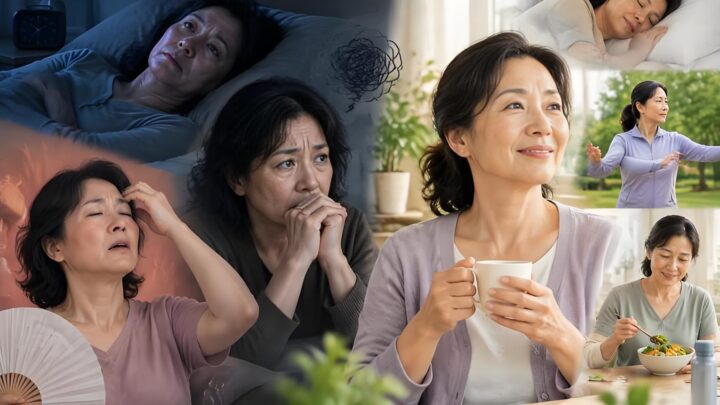
Health cultivation is often associated with food, exercise, sleep, breathing, and daily routine. Yet traditional Chinese wellness philosophy places equal importance on something less visible: the cultivation of the mind.
The Huangdi Neijing presents health as a state of harmony in which daily habits, emotions, desires, activity, rest, and one’s relationship with the world remain in balance. In this view, a healthy life is not created only by what we eat or how much we exercise. It also depends on how we respond to success and disappointment, how easily we become trapped in anger or worry, and whether we are able to return to calm after emotional disturbance.
This does not mean that emotions directly cause every disease, nor that a peaceful mind can replace medical care. Modern health is influenced by genetics, infections, environmental exposures, socioeconomic conditions, lifestyle, chance biological events, and many other factors. Still, emotional wellbeing matters because it can influence sleep, appetite, physical activity, relationships, decision-making, and the way people care for themselves.
Traditional Chinese thought often describes an ideal mental state through the concept of zhong he—balance and harmony. The classical idea is not to eliminate emotion. Joy, anger, grief, fear, disappointment, and excitement are natural. The goal is to experience them without being completely controlled by them.
A balanced mind can feel deeply while still choosing how to act.
This is an important distinction. Emotional cultivation is not suppression. Suppression pushes feelings away. Cultivation recognizes them, gives them space, and gradually develops the ability to respond with greater clarity.
In daily life, this means learning to notice the moment before an emotion becomes an automatic reaction.
When irritation begins to rise, notice it.
When worry begins to repeat itself, notice it.
When comparison turns into envy, notice it.
When disappointment starts becoming bitterness, notice it.
That small moment of awareness creates space between feeling and action. Within that space, choice becomes possible.
Traditional health philosophy also pays close attention to character. Long-standing habits such as resentment, arrogance, suspicion, hostility, dishonesty, jealousy, chronic comparison, or excessive self-criticism can make life emotionally exhausting. They can strain relationships and keep the mind in a constant state of tension.
The traditional answer is not to declare personality fixed forever. Instead, character is treated as something that can be refined.
A person who reacts too quickly can practice patience. Someone who hesitates excessively can practice decisiveness. A person who frequently criticizes others can practice restraint. Someone who carries old resentment can gradually learn to release it.
These changes are rarely immediate. Character is shaped over years, and changing habitual responses may also take years. But the possibility of change is itself an important part of health cultivation.
The question gradually shifts from “Why are other people making me feel this way?” to “What is happening inside me, and how do I want to respond?”
That shift does not deny external problems. It simply recognizes that our internal response remains one of the areas over which we may still have some influence.
Traditional Chinese medicine historically described emotional life through the “seven emotions”—joy, anger, worry, pensiveness, grief, fear, and fright. Classical texts connected excessive emotional states with disturbances in the body’s internal balance.
Modern readers do not need to accept every historical physiological explanation literally to appreciate the practical observation behind it. Persistent stress can interfere with sleep. Anger can increase tension and agitation. Grief can affect motivation and appetite. Chronic anxiety can influence concentration, physical activity, digestion, and social behavior.
The lesson is therefore not to become afraid of emotion. It is to become more skillful at moving through it.
One of the most interesting ideas in the original tradition is the cultivation of quiet joy.
This is different from excitement.
Quiet joy is a feeling of inner ease, warmth, gratitude, and gentle satisfaction. It does not require a dramatic event. It may arise while looking at a flower, sitting beside a window, walking among trees, listening to music, drinking tea, speaking with someone we love, or simply noticing that the mind has become less crowded.
A traditional exercise described in the source material uses a flower as a focus for relaxation and appreciation.
A modern interpretation can be very simple.
Sit somewhere comfortable. Choose something beautiful and calming—a flower, a tree, a landscape, a painting, or another object that naturally attracts your attention. Relax the forehead, eyes, jaw, shoulders, and hands. Let the breath remain easy. Look softly rather than staring intensely. Allow a slight sense of appreciation to arise without forcing it.
After a while, close the eyes and notice what remains.
Perhaps there is an impression of color.
Perhaps there is stillness.
Perhaps warmth.
Perhaps nothing in particular.
The goal is not to “absorb energy” from the flower. The value of the exercise lies in the way beauty can redirect attention, soften tension, and create a short interval of mental rest.
An old phrase could describe this beautifully: borrowing the flower to cultivate oneself.
Nature does not need to transfer a mysterious substance into the body for us to benefit from contemplating it. A living plant can remind us of growth, fragility, change, renewal, and the possibility of beginning again.
Traditional philosophy also connects health cultivation with kindness.
Laozi’s famous expression, shang shan ruo shui—“the highest goodness is like water”—offers a powerful image.
Water is soft but persistent.
It nourishes without demanding recognition.
It adapts to circumstances while remaining true to its nature.
Applied to everyday life, kindness can be understood as a way of reducing unnecessary hostility toward ourselves and others.
Kindness does not mean weakness.
It does not require agreeing with everyone.
It does not mean accepting abuse, abandoning boundaries, or remaining in harmful relationships.
A person can be compassionate and still say no.
A person can be calm and still be firm.
A person can forgive internally without returning to a situation that is unsafe.
The deeper principle is to avoid allowing hatred, resentment, or bitterness to become a permanent place of residence in the mind.
This matters because human beings are social. The emotional climate we create affects the relationships around us. A calm person may communicate more clearly. A chronically hostile person may generate conflict without intending to. A considerate person may make cooperation easier. A suspicious person may repeatedly interpret neutral situations as threatening.
In this practical sense, the inner world and outer world are connected.
Not through a mysterious force, but through attention, behavior, judgment, communication, and repeated choices.
The condition of the mind influences the way a person experiences family life, work, friendship, success, failure, aging, and change.
This is one reason traditional health philosophy often treats psychological cultivation as a form of practical life training rather than an abstract spiritual exercise.
Another enduring principle can be expressed in four Chinese characters: chang si yi er—often think of the one or two.
The idea comes from an old saying that eight or nine things out of ten in life may not unfold exactly as we wish.
Even so, there are still one or two things worth remembering.
The teaching does not ask us to deny hardship.
Loss is real.
Illness is real.
Disappointment is real.
Unfairness is real.
The practice is about where attention goes after we acknowledge them.
Some people repeatedly rehearse every painful event.
They replay old arguments.
They remember every slight.
They compare their lives with other people’s lives.
They notice what has disappeared but rarely what remains.
Over time, the mind can become trained to search primarily for evidence that life is disappointing.
“Think often of the one or two” offers another possibility.
Remember the person who supported you.
Notice the meal you were able to enjoy.
Notice that you woke up this morning.
Notice that you can still walk, speak, learn, read, listen, or experience something beautiful.
Notice a problem that did not occur.
Notice a small improvement.
Notice a peaceful hour.
Notice someone’s kindness.
Notice what remains rather than only what has been lost.
Gratitude does not erase difficulty. It prevents difficulty from becoming the entire landscape of consciousness.
This idea becomes especially meaningful with age.
Healthy aging is not only about cardiovascular health, muscle strength, mobility, bone density, or memory. Psychological flexibility also matters.
A person can grow older without becoming mentally closed.
Curiosity can remain.
Learning can continue.
New technology can be explored.
New friendships can be formed.
Old beliefs can be reconsidered.
Objects that no longer serve a purpose can be released.
Resentments can sometimes be released as well.
Traditional writers often associated vitality with the ability to renew.
That insight remains valuable.
The goal is not to remain young forever. It is to remain alive to life.
Mind cultivation therefore does not demand perfect calm, permanent happiness, or complete freedom from negative emotions.
No human being lives in such a state.
Its real purpose is to strengthen the ability to return.
Return from anger to clarity.
Return from worry to the present moment.
Return from comparison to gratitude.
Return from resentment to perspective.
Return from emotional exhaustion to rest.
Return from isolation to connection.
Return from rigidity to curiosity.
Return from constant mental noise to a few moments of silence.
In this sense, cultivation is a repeated process of restoration.
The body needs restoration through food, sleep, movement, and recovery.
The mind also needs restoration through quiet, beauty, humor, meaningful relationships, kindness, time in nature, and periods when nothing needs to be achieved.
Traditional Chinese wellness often refers to this broader practice as “nourishing life.”
To nourish life is not simply to maximize the number of years a person survives.
It is to create conditions in which those years contain greater clarity, dignity, vitality, connection, awareness, and peace.
Modern readers do not have to accept every ancient explanation to benefit from this philosophy.
Its most enduring principles remain surprisingly practical: live with moderation, protect sleep, move regularly, cultivate emotional awareness, reduce unnecessary hostility, maintain meaningful relationships, practice kindness without abandoning boundaries, stay curious as you age, make room for beauty, spend time in nature, and remember that even in a difficult life there may still be “one or two” things worth appreciating.
A calm mind cannot guarantee freedom from disease.
Positive thinking cannot replace medical diagnosis or treatment.
Kindness cannot control fate.
Meditation cannot make every difficult circumstance disappear.
But a more balanced inner life can still change something deeply important: how we experience our days, how we respond to adversity, how we treat other people, and how wisely we care for ourselves.
That is why the cultivation of the mind has remained one of the deepest themes in traditional Chinese health philosophy.
The body is part of health.
The mind is part of health.
And a life well cultivated gives thoughtful attention to both.
FAQ
What does cultivating the mind mean?
Cultivating the mind refers to developing greater awareness of thoughts, emotions and habitual reactions while practicing calmness, perspective, gratitude, kindness and psychological flexibility.
How does traditional Chinese wellness view emotional balance?
Traditional Chinese wellness philosophy considers emotional balance an important part of overall harmony. The goal is not to eliminate emotions but to prevent them from becoming excessively disruptive or controlling daily life.
What does zhong he mean?
Zhong he is a classical Chinese concept commonly associated with balance and harmony. It describes an ideal in which emotions arise naturally but remain appropriate and proportionate rather than becoming excessive.
What is the inner smile practice?
The traditional practice described in this article uses relaxation, gentle attention, natural breathing and appreciation of something beautiful to encourage a quieter and more positive state of mind. It is best understood as a contemplative wellness practice rather than a medical treatment.
What does “think often of the one or two” mean?
It refers to deliberately noticing the positive or meaningful parts of life even when many things are difficult. It is closely related to gratitude, perspective and directing attention toward what remains valuable.
Can positive thinking prevent disease?
No. Positive thinking cannot guarantee freedom from disease and should never replace appropriate medical care. Emotional wellbeing can, however, influence sleep, relationships, daily habits and overall quality of life.
Is emotional balance important for healthy aging?
Yes. Healthy aging involves more than physical strength and disease prevention. Psychological flexibility, meaningful relationships, curiosity, emotional regulation and the ability to adapt to change also contribute to quality of life.
Medical Disclaimer: This article is provided for educational and informational purposes only. Traditional wellness concepts discussed here should not be interpreted as medical diagnosis, treatment, or evidence that emotions directly cause or cure specific diseases. Persistent emotional distress, anxiety, depression, sleep problems, or other health concerns should be discussed with an appropriately qualified healthcare professional.
This article is for general education and does not replace individualized care from a qualified health professional. Seek appropriate advice for persistent, severe, or concerning symptoms.
Read the full medical disclaimer