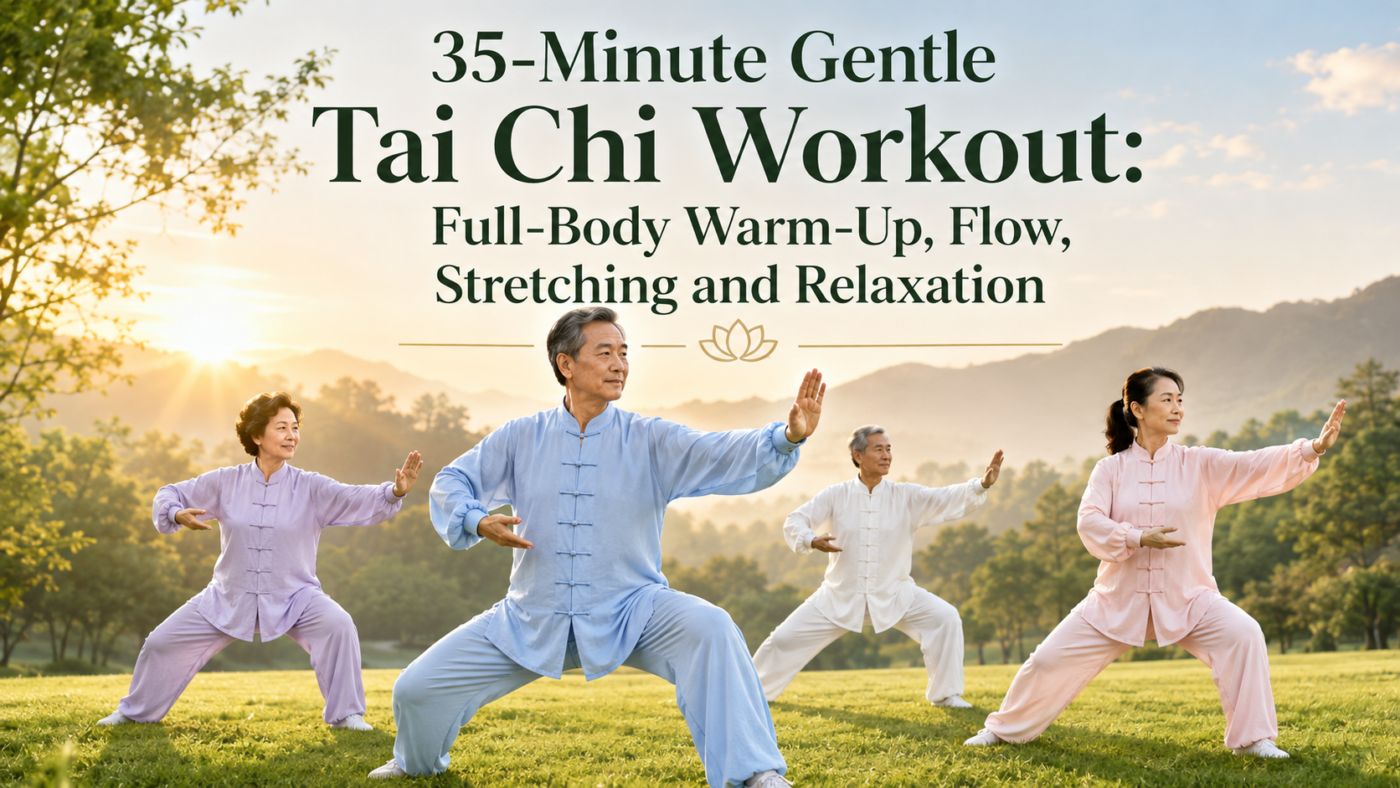
Tai Chi does not need to be fast, exhausting or complicated to become a meaningful part of your movement routine. One of its greatest strengths is the way it combines slow, controlled movement with balance, coordination, body awareness and relaxed breathing.
This approximately 35-minute practice follows a simple three-part structure: a gentle full-body warm-up, a longer Tai Chi-inspired movement session, and a final period of stretching and relaxation.
That structure makes the routine especially approachable for people who prefer low-impact exercise, are returning to regular movement after a period of inactivity, or simply want an alternative to high-intensity workouts.
Rather than rushing from one exercise to another, the session encourages continuous, controlled movement. The goal is not to perform every motion perfectly. Instead, focus on moving comfortably, maintaining steady breathing and gradually becoming more aware of how your body shifts, turns, reaches and balances.
Workout at a Glance
Total time: About 35 minutes
Part 1: Gentle Full-Body Warm-Up
Approximately 0:10 to 2:16
Part 2: Gentle Tai Chi Exercise
Approximately 2:16 to 31:32
Part 3: Gentle Stretching and Relaxation
Approximately 31:32 to 35:23
Equipment: No special equipment required
Location: Suitable for practicing at home when you have enough clear floor space
Intensity: Gentle to moderate depending on your range of motion and effort
Main focus: Mobility, balance, coordination, controlled movement, flexibility and relaxation
Part 1: Gentle Full-Body Warm-Up
The workout begins with a brief full-body warm-up.
Although this section lasts only a few minutes, it serves an important purpose. Moving gradually before the longer exercise period can help you transition from sitting or everyday activity into more intentional movement.
Use this portion of the workout to become aware of your posture and breathing.
Keep your knees relaxed rather than locked. Let your shoulders drop naturally away from your ears. Avoid forcing your range of motion, particularly during the first few minutes.
The warm-up is also an opportunity to check how your body feels that day.
Some days you may feel flexible and energetic. On other days you may feel stiff, tired or slightly less balanced. A gentle practice should be adjusted to your current ability rather than forcing your body to match yesterday’s performance.
During the warm-up, keep your movements comfortable, breathe naturally, avoid sudden jerking motions, reduce your range of motion if necessary, give yourself enough room to move safely, and use a stable chair or countertop nearby if you need additional balance support.
The goal is simply to prepare the body for the longer flowing section that follows.
Part 2: Gentle Tai Chi Exercise
At around the two-minute mark, the workout moves into its main Tai Chi section.
This is the longest portion of the routine and continues for approximately 29 minutes.
The transcript contains very little spoken instruction and does not identify the individual movements by traditional Tai Chi names. For that reason, it would be misleading to label the exercises as specific classical forms without seeing and identifying each posture individually.
Instead, the best way to approach this routine is as a guided movement practice. Watch the demonstration carefully and reproduce each movement within your own comfortable range.
Focus on Control Rather Than Speed
Tai Chi is characterized by controlled movement rather than explosive effort.
Try to avoid rushing ahead of the demonstration. Give each movement time to develop.
A slower pace provides an opportunity to notice how your weight moves from one side of the body to the other and how your upper and lower body coordinate.
This kind of attention is one reason Tai Chi can feel very different from conventional cardio exercise.
You are not simply completing repetitions. You are practicing how you move.
Keep Your Knees Comfortable
Many Tai Chi-style movements involve gentle bending of the knees and shifting body weight.
Your knees should remain comfortable throughout the session.
You do not need to squat deeply to benefit from the practice. Beginners can use a higher stance, decrease the depth of knee bending and make the movements smaller.
If a movement causes sharp pain, stop rather than trying to push through it.
Let the Arms Move Naturally
The upper-body movements can help encourage comfortable motion through the shoulders, elbows, wrists and upper back.
Avoid using unnecessary muscular tension.
Imagine that the arms are moving smoothly through space rather than being forced into position.
If raising your arms overhead or away from your body is uncomfortable, use a smaller range.
Consistency and control are more important than making the movement look dramatic.
Why Gentle Tai Chi Can Be Valuable
Tai Chi is unusual because one practice can involve several aspects of physical movement at the same time.
Depending on the routine, these may include balance, coordination, mobility, controlled weight shifting, lower-body engagement, posture and mindful breathing.
That makes it particularly interesting for people who want a form of movement that feels less aggressive than many conventional workouts.
It Encourages Balance Practice
Tai Chi frequently requires the body to shift weight gradually between the legs while the arms and torso continue moving.
This creates repeated opportunities to practice balance in a controlled environment.
For younger adults, balance may be something they rarely think about. As we get older, however, maintaining balance and confidence during everyday movement becomes increasingly important.
You do not need to stand on one leg for long periods to challenge balance. Even slow weight shifting can require coordination between the feet, ankles, knees, hips and trunk.
For anyone who already has significant balance problems, practicing beside a sturdy chair, railing or countertop may be safer.
It Promotes Everyday Mobility
Mobility involves more than being able to perform a deep stretch.
It includes the ability to comfortably turn, reach, transfer weight, bend and coordinate different parts of the body.
A gentle full-body Tai Chi routine exposes the body to a variety of movement patterns without requiring high-impact jumping or fast direction changes.
For people who spend many hours sitting, this type of regular movement can also provide a useful break from prolonged inactivity.
It Encourages Coordination
Moving the arms while simultaneously shifting the lower body requires coordination.
At first, this can feel surprisingly difficult.
You may discover that the right arm, left arm and legs do not automatically cooperate.
That is normal.
Instead of becoming frustrated, slow the movement down.
Coordination often improves through repetition.
You can also practice only the lower-body component of a movement first and gradually add the arms once the footwork feels comfortable.
It Can Be Adapted to Different Fitness Levels
One of the practical advantages of gentle Tai Chi is scalability.
A beginner might use smaller arm movements, shallower knee bends, a narrower stance, slower transitions and additional support for balance.
A more experienced participant may gradually increase movement range and control.
There is no need for everyone to perform the routine identically.
The appropriate version is the one you can perform safely and consistently.
Can Tai Chi Help With Weight Management?
Tai Chi is sometimes marketed online using phrases such as burn belly fat, melt fat or lose belly fat fast.
Those descriptions should be interpreted cautiously.
No Tai Chi movement can selectively remove fat from one specific part of your body.
Body-fat reduction depends on overall energy balance and is influenced by physical activity, nutrition, sleep, genetics, hormones and other individual factors.
However, Tai Chi can still contribute to an active lifestyle.
A 35-minute movement session adds physical activity to your day, and a form of exercise that you actually enjoy and repeat consistently can be more useful in the long term than an intense workout that you quickly abandon.
For weight management, think of Tai Chi as one component of a broader healthy lifestyle, not a shortcut for targeted fat loss.
Part 3: Gentle Stretching and Relaxation
At approximately 31 and a half minutes, the workout transitions into its final section: gentle stretching and relaxation.
After nearly half an hour of continuous movement, this slower ending gives you an opportunity to gradually reduce your effort rather than stopping suddenly.
Allow your breathing to become comfortable.
Keep the stretches gentle.
Stretching should usually create a mild sensation of tension, not sharp pain.
Avoid bouncing aggressively into a position or forcing yourself to reach farther simply because the person demonstrating the exercise has a greater range of motion.
Your body proportions, mobility and training experience may be different.
The final minutes can also serve as a mental transition.
Instead of immediately reaching for your phone or returning to work, spend a moment noticing your breathing and how your body feels after the session.
That sense of intentional slowing down is part of what makes gentle movement practices appealing to many people.
How Often Should You Practice?
There is no single schedule that works for everyone.
Beginners might start with two or three sessions per week and gradually increase frequency as the routine becomes familiar.
You can also divide the workout.
For example, if 35 minutes feels too long initially, you might begin with a shorter portion of the session and gradually build toward completing the entire routine.
The most important principle is consistency.
A sustainable exercise routine performed regularly is generally more practical than repeatedly starting overly ambitious programs and abandoning them.
Tai Chi can also complement other forms of physical activity rather than replacing them.
A balanced fitness routine may include aerobic exercise, muscle-strengthening work, mobility training and balance activities in addition to Tai Chi.
Who May Enjoy This Workout?
Beginners
The controlled pace makes it easier to follow than many fast workout formats.
Adults Over 40
Gentle mobility and balance practice can become increasingly valuable as maintaining movement quality becomes a greater priority.
Older Adults
Tai Chi is widely practiced by older adults because movements can often be adapted to different abilities.
People Who Prefer Low-Impact Exercise
There is no need for running or repeated jumping.
People Working Out at Home
The routine requires little space and no specialized gym equipment.
People Looking for Mindful Movement
The slower pace can encourage greater attention to posture, movement and breathing.
Beginner Tips for a Better Tai Chi Session
Wear Comfortable Clothing
Choose clothing that allows your shoulders, hips and knees to move without restriction.
Use Support When Needed
There is nothing wrong with keeping a chair or stable surface nearby.
Safety matters more than performing a movement without assistance.
Keep the Floor Clear
Remove rugs, cords, pets, furniture or other obstacles that could increase your risk of tripping.
Wear Appropriate Footwear
Depending on your floor surface and personal needs, choose stable footwear that allows you to move without slipping.
Do Not Chase Perfect Form
You are learning a movement pattern.
Allow yourself time to become familiar with it.
Reduce the Range Before Stopping Completely
If a particular movement feels too demanding, first try making it smaller and slower.
Stop for Concerning Symptoms
Stop exercising if you experience chest pain, severe shortness of breath, faintness, sudden weakness, severe dizziness or significant pain.
Seek appropriate medical attention when necessary.
A Simple Way to Build a Weekly Routine
Monday: 35-minute gentle Tai Chi
Tuesday: Walking and light strength exercises
Wednesday: Rest or gentle mobility
Thursday: 35-minute gentle Tai Chi
Friday: Walking and strength exercises
Saturday: Short Tai Chi or outdoor activity
Sunday: Recovery and gentle stretching
You do not need to follow this exact schedule.
The purpose is to show that Tai Chi can work alongside other forms of exercise rather than competing with them.
The Most Important Principle: Keep Moving Consistently
The value of a gentle Tai Chi workout is not determined by how dramatic it looks.
Simple movements practiced regularly can become a useful way to improve movement awareness, challenge coordination, work on balance and create a consistent exercise habit.
You do not need perfect flexibility.
You do not need expensive equipment.
And you do not need to transform the practice into a high-intensity workout.
Give yourself enough space, follow the demonstration at a comfortable pace and allow your movement quality to improve gradually.
A calm 35-minute session may be exactly the kind of exercise you can continue returning to, and consistency is one of the most important ingredients in any sustainable movement routine.
Frequently Asked Questions
Is this 35-minute Tai Chi workout suitable for beginners?
It can be suitable for many beginners because the workout uses a gentle pace and can be modified by reducing movement range, knee bending and speed. People with medical conditions, significant mobility limitations or a history of falls should consider discussing appropriate exercise with a qualified health professional.
Can I do Tai Chi every day?
Many people practice gentle Tai Chi regularly. Frequency should depend on your fitness level, recovery, health status and the intensity of the session. Beginners can start gradually rather than feeling obligated to complete a long workout every day.
Does Tai Chi burn belly fat?
Tai Chi cannot selectively burn abdominal fat. It can contribute to overall physical activity and energy expenditure, but changes in body fat depend on overall energy balance and multiple lifestyle and biological factors.
Is Tai Chi good for balance?
Tai Chi includes slow weight shifting and coordinated movement that can challenge balance. Research has found benefits for balance and fall-related outcomes particularly among older adults, although individual results vary.
Do I need Tai Chi experience?
No previous experience is required to begin a gentle routine. Start slowly, use a smaller range of motion and focus on following the movement rather than trying to perform every position perfectly.
Can older adults follow this workout?
Many Tai Chi exercises can be adapted for older adults, but individual ability varies considerably. Anyone with substantial balance problems, recent surgery, serious cardiovascular disease or other significant medical concerns should obtain individualized guidance before beginning a new exercise program.
Do I need equipment?
No specialized Tai Chi equipment is necessary. A clear, nonslip exercise area is the main requirement. People who need balance assistance should keep a stable chair or other secure support nearby.
Medical Disclaimer
This article is for general educational and informational purposes only and is not medical advice, diagnosis or treatment. Exercise suitability varies according to age, medical history, medications, injuries and individual physical ability. Consult an appropriate healthcare professional before beginning a new exercise program if you have a medical condition, significant balance difficulty, recent injury or surgery, or other health concerns. Stop exercising and seek appropriate medical care if you develop concerning symptoms.
This article is for general education and does not replace individualized care from a qualified health professional. Seek appropriate advice for persistent, severe, or concerning symptoms.
Read the full medical disclaimer