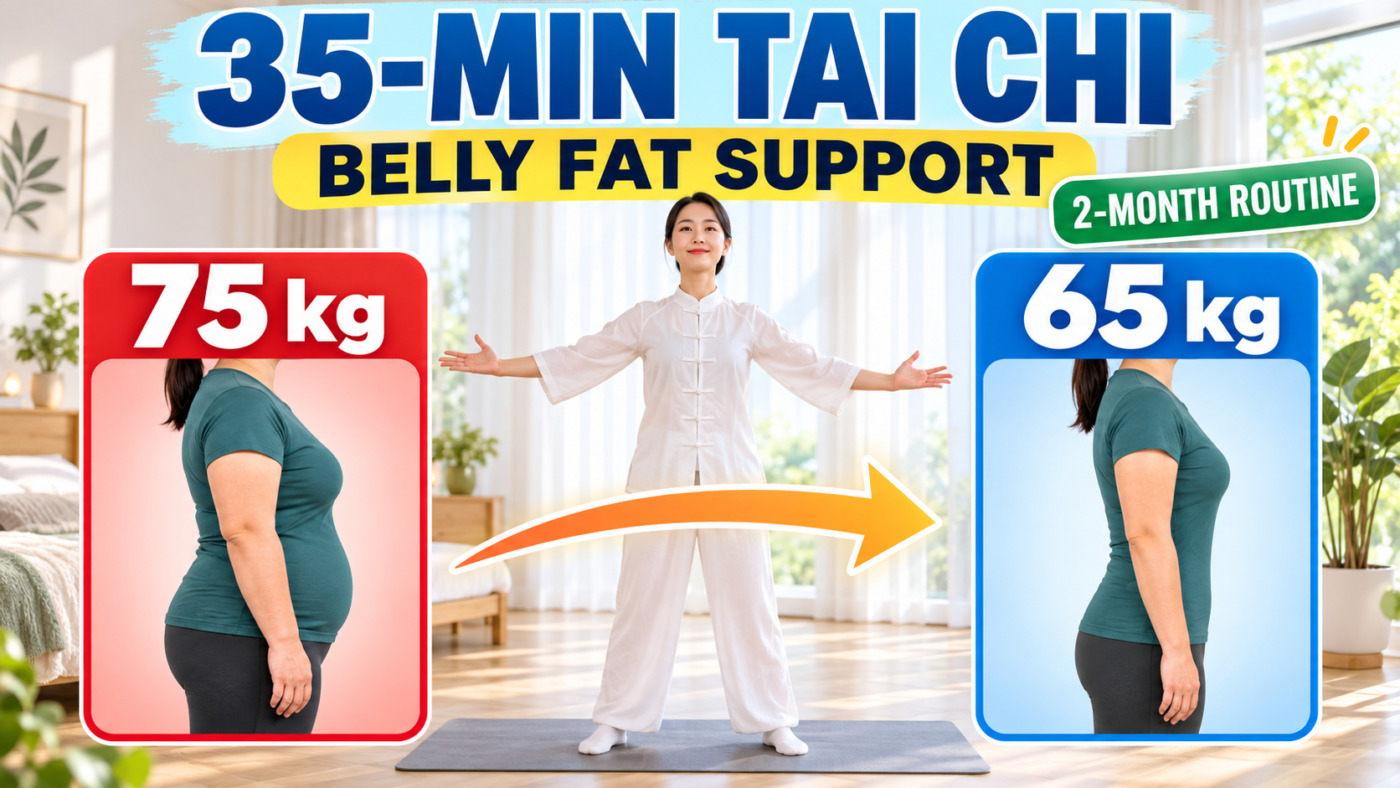
Tai chi workout after 50 can be a practical way to stay active without relying on jumping, running, or high-impact exercise. This 35-minute routine combines 39 standing movements for balance, mobility, lower-body strength, coordination, posture, and healthy weight-management support.
Rather than promising targeted belly-fat loss, the routine is best viewed as a full-body movement practice that keeps the legs, hips, core, shoulders, and ankles active while challenging movement patterns that become increasingly important with age.
Staying active after 50 does not require jumping, running, or pushing your joints through exhausting workouts.
A well-designed low-impact routine can still challenge your legs, hips, core, shoulders, balance, and coordination while helping you maintain the mobility needed for everyday life.
This approximately 35-minute Tai Chi-inspired workout combines 39 standing movements into one continuous full-body session.
The routine moves gradually from shoulder and hip mobility into squats, heel raises, weight shifts, knee lifts, lunges, cross-body reaches, balance work, and slower finishing movements.
The result is a workout designed around three priorities that become increasingly valuable with age:
Maintaining strength.
Preserving mobility.
Keeping your balance and coordination challenged.
Why Tai Chi-Inspired Exercise Can Be Useful After 50
As we get older, physical fitness becomes about much more than calorie burn.
Being able to turn comfortably, reach overhead, rise from a chair, step backward, change direction, stand on one leg, and recover your balance can affect how confidently you move throughout the day.
This routine repeatedly trains those abilities.
Squats and knee bends challenge the thighs and hips.
Heel raises activate the calves and ankles.
Side-to-side movements train lateral control.
Cross-body reaches challenge coordination.
Shoulder circles and arm openings restore upper-body mobility.
Knee lifts and backward steps challenge balance.
The workout also keeps large muscle groups active for an extended period, which increases total physical activity and energy expenditure.
That can support long-term weight management, but it should not be interpreted as targeted belly-fat loss. The source itself repeatedly combines large-muscle movements with increased energy use, such as the squat-and-hug sequence near the beginning.
The 39-Movement Tai Chi Workout After 50
- Elbow-Open Shoulder Rolls
Open the elbows outward and roll the shoulders smoothly backward, then reverse direction. Use slow circles to warm the shoulders and upper back before the more demanding movements begin. - Hip Circles
Place both hands on the hips and circle the pelvis slowly in one direction, then reverse. Keep the movement comfortable rather than forcing a large range. - Overhead Side Bend
Reach one arm overhead and gently lean to the side. Return to center and switch. The goal is a comfortable stretch through the side body. - Squat Chest Hug
Open the arms wide, bend the knees into a comfortable squat, and loosely wrap the arms in front of the chest. Stand again and repeat. This recruits the thighs, hips, and trunk while keeping the movement low impact. - Side Reach Heel Lift
Shift toward one side while moving the arms in the same direction and lifting the opposite heel. Return through the center and alternate. - Turning Arm Swing
Rotate gently through the torso while allowing both arms to swing in the same direction. Lift the opposite heel naturally as the body turns. This keeps the shoulders, waist, and hips moving together without jumping. - Squat Arm Open
Bend the knees gently with the palms together, then stand and open the arms wide. This combines lower-body strength with chest and shoulder mobility. - Elbow Lift Toe Raise
Keep the elbows close to the torso, lift them outward while rising onto the toes, then lower with control. The calves and ankles work while the upper body adds coordination. - Chest-to-Forward Press
Place both hands near the chest. Press one hand forward, return it, and alternate sides. Keep the shoulders relaxed. - Alternating Heel Curls
Bring the heels toward the back of the body one at a time at a steady pace. This keeps the legs moving while remaining relatively gentle on the joints. - Squat Back Reach
Begin with a shallow squat. As you stand, reach one arm behind while leaning slightly toward the same side. Alternate directions. - Overhead Reach and Open
Interlace the fingers, reach upward, then open both arms wide and lower slowly. This restores movement through the shoulders and upper torso. - Side Hip Push
Extend the arms outward and shift the hips gently from side to side. Keep the upper body tall. - Hip Sway Arm Flow
Hold one arm high and one low while swaying the hips from side to side and allowing the arms to move rhythmically.
These waist movements can strengthen coordination and trunk control, but they do not selectively remove abdominal fat.
- Squat Cross Arms
Begin with the hands overhead. Bend into a comfortable squat while crossing the arms in front of the torso, then stand again.
The original script describes this movement as supporting belly-fat reduction. A more accurate interpretation is that the legs, hips, and abdominal muscles work together and increase total muscular activity.
- Knee Lift Arm Swing
Reach the arms overhead, then swing them downward as one knee rises. Return and alternate. This is a useful combination of balance, coordination, and core stabilization. - Squat Back Swing
Reach upward, bend the knees, and sweep both arms backward. Stand and repeat in a smooth rhythm. - Toe Raise Back Swing
Extend the arms forward, sweep them behind while rising onto the toes, then lower. This combines chest opening with calf and ankle work. - Cross and Open Arms
Cross the arms low in front, raise them overhead, open them outward, and lower slowly. Use the movement to restore shoulder range without rushing. - Gentle Neck Tilt
With both hands on the hips, move the head through a very small, comfortable range.
Do not aggressively drop the head backward. People with neck pain, dizziness, cervical spine conditions, or balance concerns should keep the neck neutral or skip this exercise.
- Shoulder Press Open
Place the hands on the shoulders, bring the elbows forward, then open the chest and elbows outward. This can counter the rounded position associated with long periods of sitting. - Shoulder Roll Swing
Roll one shoulder backward while allowing the arm to follow naturally. Return and repeat on the other side. - Squat Body Turn
Perform a shallow squat, stand, and rotate gently from side to side. The legs provide strength work while the upper body adds rotational mobility. - Elbow Chest Open
Keep the elbows bent in front of the torso and open them outward, then return. Do not force the chest stretch. - Lunge Arm Circles
Step one foot forward into a comfortable split stance and circle the arms in a large but controlled pattern. The legs, trunk, and shoulders work together. - Side Lunge Weight Shift
Take a wide stance, bend one knee while the opposite leg remains longer, then shift gradually to the other side. Reduce the depth if the knees or hips feel uncomfortable. - Side Bend Leg Touch
Reach both arms upward, lengthen through the body, then gently lean toward one side and lower the hand toward the leg. Alternate sides. - Squat to Knee Lift
Perform a shallow squat, stand, and raise one knee while moving the hands toward that side. Repeat with the opposite knee.
This transition from two-leg support to single-leg balance makes the movement more demanding than a squat alone.
- Cross-Foot Reach
Stand with the feet wide, hinge forward comfortably, and reach one hand toward the opposite foot. Return and alternate.
Avoid rounding or reaching farther than your mobility allows.
- Squat Prayer Reach
Bring the palms together at the chest, perform a controlled knee bend, then stand and raise the hands overhead. This keeps the legs working while lengthening the body. - Back Step Reach
Step one foot backward while reaching the same-side arm overhead. Return and switch sides. Backward stepping adds an important balance challenge often missing from ordinary forward walking. - Chest Open Toe Raise
Bring the hands together, open the arms outward while rising onto the toes, and lower slowly. This links upper-body posture with ankle control. - Squat Arm Pull
Bend the knees while holding the arms high, then draw the elbows downward.
Keep the head neutral instead of deliberately forcing it backward if that position feels uncomfortable.
- Interlaced Heel Raises
Interlace the fingers and reach overhead while alternating heel lifts. This trains ankle strength, weight shifting, and balance. - Elbow Pull Toe Raise
Extend the arms forward, draw the elbows backward as you rise onto your toes, then lower. The shoulders, upper back, and calves work together. - Cross-Back Knee Bend
Step one foot diagonally behind the other and bend the knees slightly. Return and switch sides.
This movement challenges thighs, hips, coordination, and balance.
- Squat Reach Open
Take a wide stance with the palms together. Bend the knees, rise, reach overhead, and open the arms. - Squat Toe Raise
Begin with a shallow knee bend and the arms forward. Sweep the arms backward as you rise onto the toes, then return.
The combination challenges both lower-body strength and standing balance.
- Side Sway Arm Swing
Finish by swaying gently from side to side while one arm moves smoothly up and down. Switch arms and gradually reduce the effort.
This final movement is intentionally calmer, helping the body transition out of the more demanding part of the workout.
What This Workout Actually Trains
The strongest feature of this routine is not any one exercise.
It is the variety of movement patterns.
During a typical day, many people spend hours sitting and then move primarily forward when they walk.
This workout adds:
Rotation
Side bending
Backward stepping
Cross stepping
Heel raises
Squatting
Single-leg balance
Overhead reaching
Lateral weight shifting
Chest opening
These directions make the routine more complete than simply repeating one walking pattern.A tai chi workout after 50 can support weight management by increasing total physical activity and engaging multiple muscle groups, but no exercise can selectively remove fat from the abdomen.
Can This Workout Help With Belly Fat After 50?
It can support overall weight management, but it cannot specifically target abdominal fat.
Several movements in the original script are described as reducing belly fat because they move the waist or engage the abdominal muscles. For example, the hip-sway and squat-cross-arm sections make those claims explicitly.
That distinction matters.
A side bend can train the muscles around your torso.
A knee lift can recruit your core.
A squat can increase muscular work.
A continuous 35-minute session can contribute to total energy expenditure.
But none of those movements can instruct the body to remove fat specifically from the belly.
Reductions in abdominal fat occur as part of overall changes in body fat and are influenced by nutrition, exercise, age, genetics, sleep, medications, hormones, and other individual factors.A tai chi workout after 50 works best as part of a consistent routine that also includes regular walking, appropriate strength training, adequate recovery, and sustainable nutrition habits.
Why Strength Matters After 50
Weight loss should not be the only goal.
Maintaining enough lower-body strength to stand from a chair, climb stairs, change direction, and recover from a loss of balance becomes increasingly important with age.
This routine repeatedly loads the:
Quadriceps
Glutes
Calves
Ankles
Hip stabilizers
Core musculature
Many of those muscles are also important for everyday independence.
Why Balance Training Matters
The workout frequently shifts weight from one leg to the other.
Heel raises reduce the size of your base of support.
Knee lifts briefly place the body on one leg.
Backward and cross-back steps require more directional control than ordinary walking.
Side lunges move the center of mass laterally.
Those challenges make balance an important part of the session rather than an afterthought.
The source specifically links stronger legs and lower-body control with safer walking and direction changes during the side-lunge sequence.
How to Modify the Routine
You do not need to perform every movement at the original range.
For an easier version, keep squats shallow, reduce knee-lift height, make smaller steps, keep both heels closer to the floor, move the arms through a smaller range, and use a sturdy chair or countertop for balance.
For the cross-back steps and single-leg movements, stability matters more than range.
If you cannot control the position comfortably, make it smaller.
How Hard Should It Feel?
For a general low-impact wellness session, the effort should feel sustainable rather than exhausting.
You should still be able to control your breathing and movement quality.
A harder version does not have to mean faster.
You can increase the challenge by using:
Slightly deeper controlled squats
Longer steps
More deliberate weight shifts
Larger but comfortable arm movements
Less rest
Better single-leg control
The priority should remain smooth movement.
Who Should Be More Cautious?
People with significant balance problems, severe osteoporosis, recent surgery or injury, unstable cardiovascular symptoms, uncontrolled joint pain, or neurological conditions affecting movement should seek individualized guidance before attempting unfamiliar exercises.
Stop the workout if you experience chest pain, faintness, severe shortness of breath, sudden weakness, or sharp pain.
Neck movements deserve particular caution. Gentle mobility should never require forceful extension or aggressive head rolling.
How Often Should You Practice?
A routine like this can be incorporated several times per week depending on your fitness level, recovery, and other exercise.
You can also divide the session.
For example, perform the first 15–20 movements on a shorter day and complete the full routine when you have more time.
Consistency is more useful than forcing yourself through 35 minutes when your body is unusually tired or uncomfortable.
The Bottom Line
This 39-movement Tai Chi-inspired workout offers much more than a simple “fat-burning routine.”
It trains the shoulders.
It mobilizes the hips.
It strengthens the legs.
It challenges the ankles.
It engages the trunk.
It introduces backward and sideways movement.
It trains balance.
And it keeps the whole body active with relatively little impact.
The source closes by encouraging regular practice after 50 to support weight management, flexibility, and continued activity.
The most useful goal, however, is not to promise a younger body or targeted belly-fat loss.
It is to keep building the physical qualities that help you move confidently as you age: strength, balance, mobility, coordination, and consistent daily activity.
FAQ
Is Tai Chi good exercise after 50?
Tai Chi-inspired exercise can be a useful low-impact option after 50 because it combines controlled movement, balance, weight shifting, mobility, and muscular activity without requiring jumping.
Can a Tai Chi workout after 50 help with weight loss?
A Tai Chi workout can contribute to healthy weight management by increasing physical activity and energy expenditure. Weight loss, however, depends on overall energy balance, nutrition, activity level, recovery, and individual factors.
Can Tai Chi reduce belly fat after 50?
Tai Chi cannot selectively burn abdominal fat. However, regular full-body activity can contribute to overall fat loss over time, which may also reduce abdominal fat.
Is 35 minutes of Tai Chi enough?
A 35-minute session can provide meaningful physical activity, particularly when practiced consistently. Total weekly exercise, intensity, strength work, walking, and nutrition also influence long-term results.
Is this Tai Chi workout suitable for beginners?
Many movements can be modified for beginners by using shallower squats, smaller steps, lower knee lifts, slower transitions, and a chair or countertop for balance.
Can Tai Chi improve balance after 50?
Many Tai Chi-inspired movements challenge balance through heel raises, knee lifts, backward steps, cross-back steps, lateral weight shifts, and controlled single-leg support.
The source specifically uses side-lunge weight shifts to train lower-body control and relates stronger legs to safer walking and changes of direction. Pasted text.txtTXT
How often should people over 50 do Tai Chi?
Frequency depends on fitness level, recovery, health conditions, and other exercise. A gentle routine may be practiced several times per week, while beginners can start with shorter or less frequent sessions.
Is Tai Chi easier on the joints than jumping workouts?
Tai Chi-inspired exercise generally avoids repeated jumping and hard landings. However, squats, lunges, and deeper knee bends can still challenge the joints, so range of motion should be adjusted according to comfort.
Medical Disclaimer
This content is for general educational and informational purposes only and is not intended to diagnose, treat, cure, or prevent any disease or medical condition. Exercise tolerance varies between individuals. Modify or stop movements that cause pain, dizziness, loss of balance, or other concerning symptoms, and seek appropriate professional guidance when needed.
This article is for general education and does not replace individualized care from a qualified health professional. Seek appropriate advice for persistent, severe, or concerning symptoms.
Read the full medical disclaimer