Why Your Heels May Lift During a Deep Squat
Some people can comfortably sit into a deep squat with both heels on the floor.
Others immediately rise onto their toes, lean forward or lose their balance.
Neither situation tells you whether your body is young, old, healthy or unhealthy.
Deep squatting is a complex movement that requires several joints and body regions to work together.
Your ankles need sufficient movement.
Your knees and hips need to flex.
Your trunk has to remain controlled.
Your feet need to provide a stable base.
Your nervous system also needs enough familiarity with the position to maintain balance.
This is why simply trying harder does not always improve a squat.
If your heels immediately rise from the floor, limited ankle dorsiflexion may be one contributing factor.
Hip mobility, body proportions, balance, strength, previous injuries and individual anatomy can also influence how you squat.
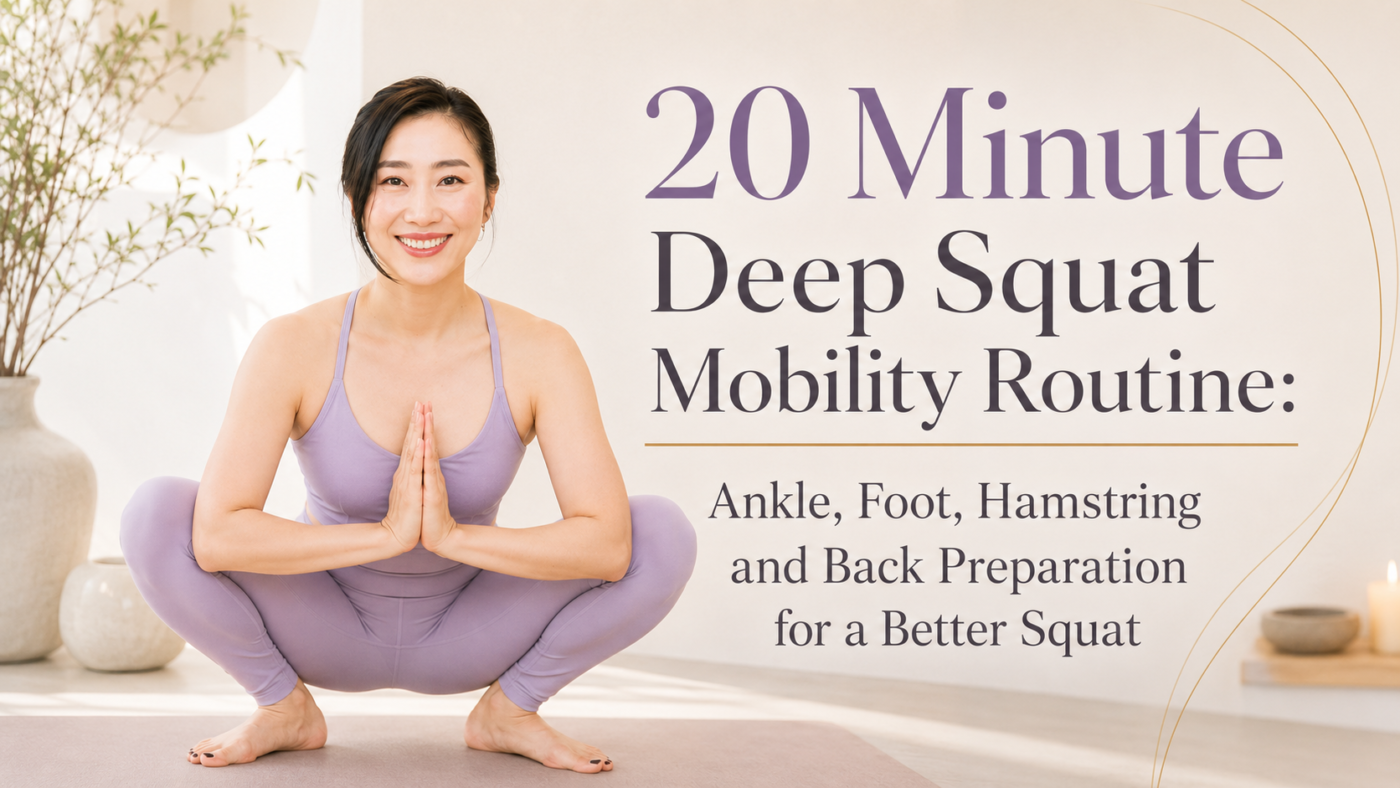
Instead of forcing yourself downward, this approximately 20 minute routine gradually prepares the feet, ankles, back and legs before practicing the squat itself.
What Is a Deep Squat?
A deep squat generally refers to lowering the hips substantially while bending the hips, knees and ankles.
The exact appearance varies considerably between individuals.
Some people naturally squat with their feet relatively straight.
Others are more comfortable with their toes turned slightly outward.
Some can keep their torso fairly upright.
Others need more forward trunk inclination because of their limb proportions.
There is no requirement that every person’s squat look identical.
A useful squat is one that fits your anatomy, allows you to remain controlled and does not cause significant pain.
Why Ankle Mobility Matters
The ankle plays an important role during squatting.
As you lower your body, your shin generally needs to move forward relative to the foot.
This movement is known as ankle dorsiflexion.
If available ankle dorsiflexion is limited, your body has to find another strategy.
You may raise your heels.
You may lean farther forward.
You may turn your feet outward.
You may reduce your squat depth.
Or you may combine several of these compensations.
That does not automatically mean something is wrong.
It simply provides useful information about how your body currently performs the movement.
Part One
Check Your Starting Squat
Before beginning the mobility work, perform a comfortable squat.
Stand with your feet at a natural width.
Allow your toes to point in a direction that feels comfortable.
Slowly bend your knees and hips.
Lower only as far as you can control.
Notice what happens.
Do your heels rise?
Do you feel stiffness around the ankles?
Do your knees feel comfortable?
Does your torso fall dramatically forward?
Do you feel balanced?
Can you breathe comfortably?
There is no need to judge the result.
This is simply your starting point.
You will repeat the movement later and compare how it feels.
Using a Chair Is Completely Fine
Beginners often assume that using a chair somehow makes an exercise less effective.
It does not.
A sturdy chair, countertop or railing can give you additional balance support while you explore a new movement.
This may allow you to concentrate on ankle and hip movement without worrying about falling backward.
Place the chair somewhere stable.
Do not use lightweight furniture that could slide.
Use as much assistance as necessary.
As your confidence improves, you may gradually rely on the support less.
Part Two
Chair Assisted Ankle Mobility
The first major focus of the routine is the ankle.
Place the front of one foot securely on or near a stable support as demonstrated.
Gradually allow the knee and lower leg to move forward while keeping the movement controlled.
The purpose is to explore ankle dorsiflexion.
Do not force the ankle into pain.
A gentle stretching or pressure sensation may occur.
Sharp pain should not.
Move slowly back and forth through a comfortable range.
Continue breathing.
Then repeat on the opposite side.
Ankle mobility often differs from one leg to the other, so do not assume both sides should move exactly the same distance.
Should You Bounce Into an Ankle Stretch?
Aggressive bouncing is unnecessary.
Small controlled movements can be useful when practicing mobility, but they should remain deliberate.
The objective is not to force the joint as far as possible.
Think instead about gradually becoming comfortable with the movement.
More range is not automatically better.
The amount you need depends partly on the activity you are trying to perform.
Part Three
Gentle Ankle Massage
The routine next includes self massage around the ankle.
Gentle massage may feel pleasant and can create a temporary sensation of warmth.
Use light to moderate pressure.
Avoid aggressively pressing directly onto an area that is swollen, bruised, recently injured or sharply painful.
The ankle contains multiple bones, tendons, ligaments, nerves and blood vessels packed into a relatively small area.
There is no reason to attack it with excessive pressure.
Massage should feel comfortable.
It should not leave you injured.
Move your hands around the ankle and simply notice areas that feel tense or sensitive.
Repeat on the opposite side.
Can Ankle Massage Permanently Unlock Your Squat?
Not by itself.
Massage can make tissues feel temporarily more comfortable, but deep squat ability depends on much more than one small area around the ankle.
Mobility, strength, balance, movement experience and individual anatomy all contribute.
Use massage as an optional preparation technique rather than treating it as a cure.
Part Four
Foot and Toe Mobility
Your feet form the foundation of your squat.
The video includes gentle manipulation of the toes and forefoot.
You can carefully move your toes, spread them and explore comfortable movement through the foot.
Some people rarely move their toes independently because they spend most of the day inside shoes.
Giving the feet a little movement can simply increase awareness of the contact between your feet and the ground.
Avoid forcefully twisting individual toes.
People with arthritis, recent foot injuries, diabetes related loss of sensation or other significant foot conditions should be particularly cautious with aggressive self manipulation.
After moving one foot, compare how it feels with the other.
Then repeat on the opposite side.
Think About the Whole Foot
When you eventually return to squatting, try to notice the entire foot contacting the floor.
You may hear coaches describe a tripod foot.
This generally means maintaining stable contact through the heel and the front of the foot rather than collapsing onto one edge.
You do not need to obsess over this.
The simple goal is a foot that feels stable beneath you.
Part Five
Hamstring Self Massage
The routine then moves toward the back of the thighs.
The hamstrings are large muscles running along the posterior thigh.
Gentle pressure or massage may feel relaxing for some people.
The original video encourages very deep pressure.
That is unnecessary.
More pressure does not automatically produce a better result.
Use enough pressure to create a tolerable massage sensation without sharp pain, numbness or significant bruising.
You can use your hands or another comfortable technique.
Move slowly.
Avoid repeatedly digging into one painful point.
The goal is not to destroy muscle knots.
It is simply to prepare the body for movement.
Do Tight Hamstrings Prevent Deep Squats?
They may influence movement in some people, but they are not the only factor.
A squat involves coordinated movement at the ankle, knee and hip.
Someone may have flexible hamstrings and still struggle to squat deeply because of ankle mobility, balance or anatomy.
Another person may have relatively stiff hamstrings yet squat comfortably.
Avoid trying to identify a single muscle as the explanation for every movement limitation.
Part Six
Upper Back and Lat Stretch
One particularly useful feature of this routine is that it does not focus only on the legs.
Place your elbows or hands on a stable chair or other support.
Allow your hips to move backward while your chest gently lowers.
You may feel stretching through the sides of the torso, shoulders, upper back or latissimus muscles.
Keep your neck comfortable.
Do not aggressively force your head between your arms.
Breathe slowly.
Move only into a range that feels controlled.
The upper body matters because squat posture is a whole body task.
However, you do not need an exceptionally flexible upper back to perform every type of squat.
The appropriate posture depends on the squat variation and your anatomy.
Do Not Try to Make Your Back Crack
The original video describes cracking sensations as satisfying.
A stretch does not need to produce a crack to be effective.
Joint sounds can occur for many reasons and are often harmless when they happen naturally without pain.
But deliberately forcing your spine until something cracks is unnecessary.
A successful mobility session should be measured by comfortable movement, not noise.
Part Seven
Wide Stance Leg Mobility
Next, open your stance comfortably.
Shift your weight toward one side while allowing the opposite leg to lengthen.
You may feel a stretch through the inner thigh or back of the leg.
Keep the movement controlled.
Do not drop suddenly into the position.
Your toes and knees should remain comfortable.
Move to one side.
Return toward the center.
Then explore the other side.
You may notice differences between your left and right legs.
Small asymmetries are common.
The goal is not necessarily to make both sides perfectly identical.
Focus on comfortable control.
Part Eight
Return to the Supported Deep Squat
Now return to the movement you tested at the beginning.
Use a sturdy chair if necessary.
Stand in a comfortable stance.
Slowly bend your knees and hips.
Allow your knees to move in the same general direction as your toes.
Lower your body gradually.
Keep breathing.
Stop before pain or loss of control.
Your heels may stay completely down.
They may not.
Either is useful information.
Do not force your heels to the floor by collapsing your posture somewhere else.
Instead, practice the best squat available to you today.
Should Your Spine Be Perfectly Straight?
Not literally.
The spine has natural curves, and some trunk inclination occurs during squatting.
The goal should not be to create a rigid, perfectly vertical back at all costs.
Aim for a controlled trunk position that feels stable.
Your torso angle will partly depend on your body proportions, mobility and squat stance.
Some people naturally lean farther forward than others.
Part Nine
Slow Squat Repetitions
If the supported squat feels comfortable, practice moving in and out of it.
Slowly lower.
Pause briefly.
Slowly stand.
The movement itself can help you practice coordination.
Instead of trying to achieve maximum depth immediately, aim for repeatable quality.
A shallower controlled squat is often more useful than a very deep position you cannot control.
As your movement becomes more familiar, depth may gradually improve.
Can Your Knees Travel Forward?
For many people, the knees naturally move forward during a deep squat.
Trying to prevent all forward knee movement can make deep squatting unnecessarily difficult.
The amount of movement depends on body proportions, ankle mobility and squat style.
The more important question is whether the movement is comfortable and controlled.
If you have a specific knee condition or are recovering from surgery, follow the recommendations of your clinician or physical therapist.
Part Ten
Resting Squat Hold
When you reach a comfortable squat depth, remain there briefly.
Use a chair if necessary.
Keep your feet stable.
Relax unnecessary tension in the shoulders.
Breathe normally.
You can place your hands together or keep them on your support.
Start with a short duration.
There is no need to hold the position for several minutes immediately.
Ten or twenty comfortable seconds can be enough for a beginner.
Gradually increase time only if the position continues to feel good.
A resting squat should not feel like a test of pain tolerance.
What If Your Heels Still Rise?
That is okay.
You have several options.
Continue practicing ankle mobility.
Use a support.
Reduce your squat depth.
Experiment with stance width.
Allow your toes to turn slightly outward if that feels natural.
Or temporarily place a small stable elevation beneath your heels.
Heel elevation changes squat mechanics and may make a deeper squat more accessible for some people.
This does not mean you have failed.
Exercise should be adapted to the individual rather than forcing every body into the same position.
Part Eleven
Advanced Squat Hold
The video progresses into a harder version in which the arms extend forward while the person maintains the squat.
This increases the challenge.
Only attempt this after you can comfortably control the supported version.
Lower slowly.
Extend your arms.
Maintain a stable foot position.
Continue breathing.
If your balance begins to fail, use the chair.
There is no advantage to falling simply because a movement has been labeled advanced.
Control matters more than difficulty.
What About Feeling Your Organs Lift?
The video describes the advanced squat as making the organs lift.
That should be treated as motivational language rather than anatomy.
A squat does not physically reposition sagging organs throughout the body in the way the phrase suggests.
Squatting does involve muscular activity and changes in pressure throughout the trunk and pelvis.
That is very different from claiming that it reverses internal organ sagging.
Part Twelve
Duck Walking Is Optional
The final advanced exercise is a low squat walk, sometimes called a duck walk.
This is substantially more demanding than simply holding a squat.
It requires greater mobility, strength, coordination and balance.
It is not necessary for improving basic squat ability.
Beginners can skip it completely.
People with knee, hip or ankle pain should be particularly cautious.
If you choose to try it, remain controlled and move slowly.
Stop if joint pain develops.
There is no health prize for completing the most difficult version.
Can Deep Squatting Reverse Sagging?
No.
A deep squat does not lift your face, tighten loose skin or reverse gravity throughout the body.
Those statements are exaggerated.
What squatting can do is train lower body muscles and movement patterns.
Regular resistance and functional exercise can contribute to maintaining muscle strength and physical capacity.
That is already a valuable benefit.
It does not need to be turned into an anti aging miracle claim.
Can Squatting Tighten the Pelvic Floor?
Not automatically.
The pelvic floor is a complex group of muscles that responds differently in different individuals.
Some people have weak pelvic floor muscles.
Others have excessive pelvic floor tension.
Some have coordination problems.
A general squat routine cannot diagnose these differences.
People experiencing urinary leakage, pelvic heaviness, vaginal bulging, pelvic pain or other persistent pelvic symptoms should seek appropriate medical or pelvic health assessment.
Can Squats Make Your Face Look Younger?
There is no established mechanism by which practicing a resting squat directly lifts facial tissues.
Regular exercise can contribute to general health, strength and physical function.
That is not the same as a facial lifting treatment.
Avoid connecting every exercise with claims about facial rejuvenation.
Why Squatting May Still Matter for Healthy Aging
The absence of anti aging magic does not make squatting unimportant.
Being able to lower and raise your body requires coordination between many joints and muscles.
Squat based movements also resemble everyday tasks such as sitting down, standing from a low seat and picking objects up.
Maintaining lower body strength and movement confidence becomes increasingly valuable with age.
However, everyone does not need to achieve an extremely deep resting squat.
A person’s useful range should reflect their goals, health status and anatomy.
A 70 year old who can confidently rise from a chair may have a more meaningful functional achievement than someone forcing themselves into a painful floor level squat simply for social media.
When You Should Stop
Stop the exercise if you experience sharp joint pain.
Stop if you feel sudden instability.
Stop for significant dizziness.
Stop if you experience numbness or unexpected weakness.
Do not aggressively massage an acutely injured or swollen area.
People recovering from hip, knee, ankle or spinal surgery should follow individualized rehabilitation guidance.
If you have significant arthritis, severe osteoporosis, neurological conditions, balance disorders or other conditions that affect exercise safety, professional guidance may be appropriate.
How Often Should You Practice?
You do not need to perform the entire routine every day.
A practical approach is to practice mobility several times per week and gradually include squat exercises as your body becomes accustomed to them.
You could also select only the sections you need.
For example, someone who sits at a desk all day might spend several minutes on ankle mobility followed by a few controlled squats.
Someone working specifically on squat technique might use the routine as a warm up before strength training.
Consistency is usually more useful than occasional extreme stretching.
Recheck Your Squat
At the end of the session, return to your original squat.
Use approximately the same stance.
Slowly lower yourself.
Notice the difference.
Does the ankle feel easier?
Do the heels stay closer to the floor?
Do you feel more stable?
Can you squat slightly deeper without forcing it?
Does your torso feel more comfortable?
Any immediate improvement may partly reflect warming up, repeated exposure to the movement and temporary changes in how comfortable the position feels.
That is perfectly fine.
You do not need a dramatic transformation from one session.
Mobility develops through repeated practice.
The Goal Is Not a Perfect Squat
Social media makes it easy to believe that everyone should be able to sit effortlessly in a deep squat with the heels flat, torso upright and feet perfectly parallel.
Human bodies are more complicated than that.
Hip structure varies.
Limb proportions vary.
Ankle mobility varies.
Training history varies.
Previous injury varies.
Age and strength vary.
Your best squat does not need to look exactly like someone else’s.
The goal is to develop a movement that is useful, comfortable and controlled for your body.
Frequently Asked Questions
Why can I squat only when standing on my toes?
Limited ankle dorsiflexion can be one reason, but it is not the only possibility. Hip mobility, strength, balance, body proportions and movement technique can all influence squat depth.
Should my heels always stay on the floor?
Not necessarily in every exercise variation. If your goal is to develop a comfortable flat foot deep squat, ankle mobility may be worth working on. Heel elevation is also deliberately used in some squat variations.
Can ankle stretching improve my squat?
Improving ankle dorsiflexion may help some people achieve greater squat depth, particularly when limited ankle movement is contributing to the problem.
Is a deep squat bad for the knees?
Deep squatting is not automatically harmful to healthy knees. A recent review found that most included evidence did not show a negative effect on knee joint health when deep squats were performed with appropriate technique. Individual injuries and medical conditions still matter.
Should I force myself deeper every day?
No. Progress should come from comfortable, controlled practice rather than forcing the joints into painful positions.
Can I use a chair?
Yes. A stable chair can make squat practice more accessible and safer for beginners or people who need balance assistance.
Can I place something under my heels?
Yes, when appropriate. Heel elevation changes squat mechanics and can make greater squat depth more accessible for some people. Research confirms that heel elevation changes ankle and knee range of motion during squatting.
Does squatting reverse body sagging?
No. Squatting can strengthen muscles and improve movement capacity, but it does not reverse loose skin, facial sagging or aging throughout the body.
Does a deep squat lift internal organs?
There is no good basis for describing ordinary squat practice as lifting internal organs. That phrase should be treated as motivational language rather than a physiological claim.
Is duck walking necessary?
No. Duck walking is an optional advanced movement and is not required to improve basic squat mobility.
Medical Disclaimer
This article is for general educational and informational purposes only and is not medical advice, diagnosis or treatment. Exercise suitability varies according to medical history, injuries, age, balance and individual physical ability. Stop any exercise that causes sharp or worsening pain, significant dizziness, numbness or unexpected weakness. Consult an appropriate healthcare professional or physical therapist if you have persistent joint pain, recent surgery, significant mobility limitations or other health concerns before starting a new exercise program.
This article is for general education and does not replace individualized care from a qualified health professional. Seek appropriate advice for persistent, severe, or concerning symptoms.
Read the full medical disclaimer