Why Traditional Chinese Medicine Still Interests Modern Wellness
Modern wellness can become surprisingly complicated. People track sleep, wear continuous glucose monitors, experiment with supplements, follow strict meal plans, use red-light devices and try increasingly sophisticated recovery routines. Yet fatigue, poor sleep, digestive discomfort, muscle tension and stress can still persist.
Traditional Chinese medicine, commonly called TCM, approaches health from a different direction. Instead of focusing only on individual symptoms, traditional practitioners look for broader patterns involving sleep, digestion, temperature, appetite, emotional state, activity and other aspects of daily life.
This systems-based perspective is one reason TCM continues to attract attention around the world.
However, it is important to distinguish traditional theory from modern biomedical science. Concepts such as Qi, Yin, Yang and organ patterns belong to a traditional medical framework. They should not be treated as scientifically established anatomical or physiological mechanisms.
TCM can therefore be explored as a complementary wellness tradition rather than a substitute for modern diagnosis or medical treatment.
What Is Traditional Chinese Medicine?
Traditional Chinese medicine is not simply acupuncture or herbal tea.
It is a broad historical medical system that includes herbal medicine, acupuncture, moxibustion, massage, dietary traditions, movement practices such as qigong and tai chi, and theories about how different patterns of health and illness develop.
One of its central principles is that health depends on balance.
Rather than asking only, “What disease does this symptom represent?” a traditional practitioner may also ask how different symptoms relate to one another.
For example, fatigue, poor appetite, bloating, poor sleep and emotional stress might be interpreted as connected parts of a larger pattern.
Modern medicine also increasingly recognizes that health systems interact. Sleep affects metabolism. Stress affects gastrointestinal function. Physical activity influences mood. Hormones influence sleep and appetite. The gut and brain communicate continuously.
The explanations are different, but both perspectives acknowledge that human health cannot always be understood by examining one symptom in isolation.
What Does Qi Actually Mean?
Qi is perhaps the most famous concept in Chinese medicine and one of the easiest to misunderstand.
It is often translated as “energy,” but that translation can create confusion.
Qi is not a scientifically measured energy field comparable with electricity, calories or electromagnetic radiation.
Within traditional Chinese medicine, Qi is better understood as a conceptual way of describing activity, movement and functional vitality within a living system.
Traditional practitioners use Qi terminology to describe processes such as movement, digestion, resilience and functional strength.
A modern reader can think of Qi as a traditional organizing concept rather than a measurable biological substance.
This distinction allows us to appreciate the historical theory without making scientific claims that have not been demonstrated.
Qi Deficiency
One common TCM pattern is called Qi deficiency.
Traditionally, it is associated with symptoms such as persistent tiredness, low motivation, weakness, reduced appetite and a tendency to feel easily depleted.
These symptoms are real, but they are also nonspecific.
Persistent fatigue can result from sleep deprivation, anemia, thyroid disease, nutrient deficiencies, depression, medication effects, infections, sleep apnea and many other medical conditions.
For that reason, feeling tired does not mean someone medically “has Qi deficiency.”
Instead, Qi deficiency can be understood as a traditional pattern used to organize a certain cluster of symptoms.
If fatigue persists despite adequate rest, medical evaluation remains important.
Qi Stagnation
Another well-known traditional pattern is Qi stagnation.
Where Qi deficiency traditionally describes insufficient functional vitality, Qi stagnation describes constrained or disrupted movement.
It is commonly associated with irritability, emotional tension, frequent sighing, chest tightness, muscle tension and digestive discomfort that becomes worse during stressful periods.
The analogy is useful because stress really can produce a sense of being physically “stuck.”
Jaw muscles tighten.
Shoulders rise.
Breathing becomes shallower.
Gastrointestinal motility may change.
Sleep becomes fragmented.
The modern explanation involves the nervous system, stress hormones, muscle activation and the gut-brain axis rather than literal blockage of Qi.
Still, the traditional language can provide some people with an intuitive way of noticing how stress appears in their bodies.
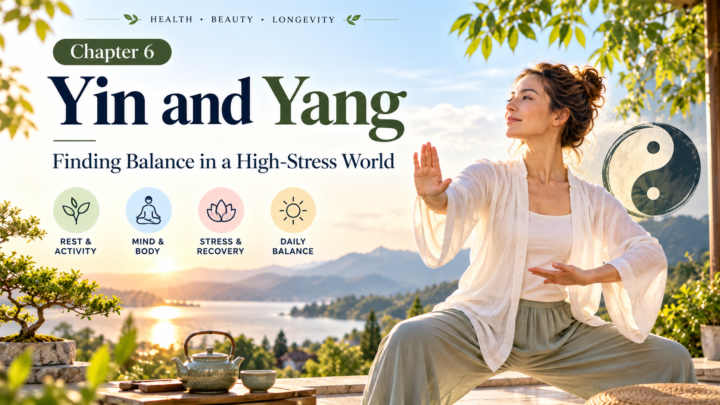
Yin and Yang: A Model of Dynamic Balance
Yin and Yang are broader philosophical concepts extending far beyond medicine.
Within TCM, they describe complementary qualities that must remain in dynamic relationship.
Yin is traditionally associated with cooling, nourishment, stillness, moisture and restoration.
Yang is traditionally associated with warmth, activity, movement and outward expression.
These ideas should not be interpreted as measurable biological substances.
Their value lies more in the principle they express: human health requires both activity and recovery.
A life consisting entirely of stimulation, exercise, work, caffeine, deadlines and poor sleep is unlikely to remain sustainable.
Likewise, complete inactivity is not healthy either.
The modern physiological parallel is straightforward. The body requires cycles of exertion and recovery, wakefulness and sleep, sympathetic activation and parasympathetic activity.
Balance does not mean remaining perfectly still in the middle. It means adapting appropriately as circumstances change.
What TCM Calls Yin Deficiency
Within traditional theory, Yin deficiency describes insufficient cooling or nourishing qualities.
Traditional signs may include night sweats, restlessness, dryness, difficulty settling at night and feeling hot in the evening.
Again, these symptoms have many possible medical explanations.
Night sweats, for example, can be associated with hormonal changes, medications, infections, sleep environment and other conditions.
Anyone experiencing persistent or unexplained night sweats should not assume that Yin deficiency is the cause.
The traditional framework may be interesting, but appropriate medical evaluation still matters.
What TCM Calls Yang Deficiency
Yang deficiency traditionally describes insufficient warming and activating qualities.
It may be associated with feeling unusually cold, low motivation, fatigue, sluggishness and reduced sexual drive.
These symptoms can also occur with thyroid disorders, anemia, inadequate calorie intake, depression, hormonal changes and other medical conditions.
TCM terminology should therefore not replace biomedical assessment.
Its most useful role is as a traditional conceptual framework rather than a diagnostic shortcut.
Stress Is Not Only Mental
One of the strongest bridges between ancient wellness traditions and modern science is the recognition that stress can affect the entire body.
The autonomic nervous system constantly adjusts heart rate, breathing, digestion and other functions.
During stress, muscles may become more tense, digestion may change and sleep may become lighter.
Some people experience diarrhea during periods of intense anxiety.
Others become constipated.
Some develop headaches, jaw tension or shoulder pain.
This is part of why the traditional idea that emotions influence physical health remains compelling, even though modern physiology explains the process differently.
The Traditional Organ Emotion Associations
TCM historically associates particular emotions with different functional systems.
Grief is traditionally connected with the Lung system. Fear is linked with the Kidney system. Anger and frustration are associated with the Liver system, while excessive worry is often connected with the Spleen system.
These associations should be understood as elements of traditional theory, not proven one-to-one biological relationships.
Anger does not literally damage the anatomical liver simply because TCM associates the emotion with the Liver system.
What modern science does support is the broader principle that chronic psychological stress can influence cardiovascular health, sleep, immune signaling, gastrointestinal function and behavior.
Digestion: Where Tradition and Modern Physiology Often Meet
TCM places extraordinary emphasis on digestion.
Traditional texts often describe digestion through metaphors involving warmth and transformation.
This has led to common recommendations such as eating more cooked foods, drinking warm beverages and avoiding excessive cold foods when digestion feels weak.
There is no strong evidence that healthy people universally need to avoid cold food or cold water.
The stomach is capable of regulating temperature effectively.
However, the broader advice to choose foods that are personally comfortable and easy to tolerate can be sensible.
People with certain gastrointestinal conditions may find enormous raw salads, very high-fiber meals or large quantities of specific foods difficult to digest.
Cooking vegetables can soften plant structure and may make some foods easier to tolerate.
That does not make cooked vegetables universally superior to raw vegetables. Both can be part of a healthy diet.
Individual tolerance matters.
Do You Need a Large Breakfast?
Traditional Chinese dietary teachings often favor eating more substantial meals earlier in the day and lighter meals later.
Modern research on circadian metabolism does suggest that meal timing can influence metabolic responses.
However, there is no single breakfast rule that works for everyone.
Some people feel better eating breakfast.
Others naturally prefer eating later.
The most important factors remain overall diet quality, adequate nutrition, sustainable eating patterns and individual medical needs.
A reasonable principle is to avoid automatically forcing either breakfast or fasting simply because a wellness trend says you should.
Pay attention to energy, appetite, digestion and overall nutritional intake.
Warm Food Versus Cold Food
TCM frequently categorizes foods as warming, cooling or neutral.
This does not necessarily refer to the physical temperature of the food.
Ginger, for example, is traditionally considered warming, while watermelon is traditionally considered cooling.
These classifications belong to the Chinese medical system rather than modern nutritional science.
They can be explored culturally, but they should not be confused with measurable changes in “internal heat.”
A practical modern approach is simpler: observe how particular foods affect your digestion, appetite and overall comfort without turning food temperature into a rigid rule.
Movement as a Way to Restore Flow
One of the strongest practical recommendations within traditional Chinese wellness is regular movement.
This is also strongly supported by modern medicine.
Walking, strength training, cycling, swimming, tai chi, qigong and other forms of physical activity can improve cardiovascular health, metabolic health, sleep and mood.
The appropriate intensity depends on the individual.
Someone recovering from illness or severe exhaustion may need gentler exercise.
Someone healthy and well-conditioned may benefit from higher-intensity training.
The mistake is assuming that harder exercise is automatically healthier.
Exercise should build capacity rather than repeatedly leaving the body unable to recover.
Why Qigong Is Worth Exploring
Qigong combines slow movement, posture, breathing and focused attention.
Although traditional explanations emphasize the circulation of Qi, modern researchers often study qigong through other mechanisms, including physical activity, relaxation, breathing, balance and stress regulation.
It is generally gentle and can be accessible to people who do not enjoy intense exercise.
For beginners, even several minutes of slow movement and breathing can provide a useful transition between periods of sitting, working and mental stress.
Emotional Release Does Not Require Mysticism
TCM frequently emphasizes the importance of allowing emotional states to move rather than remain chronically constrained.
A modern interpretation does not require believing that emotions physically block meridians.
It can simply mean recognizing feelings rather than continuously suppressing them.
Journaling, talking with trusted people, psychotherapy, spending time outdoors, breathing exercises and physical movement can all help people process emotional stress.
The goal is not to eliminate unpleasant emotions.
Fear, anger, sadness and grief are normal parts of life.
The goal is to respond to them without allowing chronic stress to dominate daily functioning.
Sleep Matters More Than the Organ Clock
Traditional Chinese medicine describes a 24-hour organ clock in which different functional systems are associated with different two-hour periods.
One commonly discussed period is approximately 11 p.m. to 3 a.m., traditionally associated with the Gallbladder and Liver systems.
There is no modern scientific evidence showing that the anatomical liver performs a unique detoxification cycle only during those specific hours.
The liver works continuously.
However, the broader recommendation to maintain regular sleep and avoid chronic late-night wakefulness is strongly supported by modern sleep science.
Circadian rhythms affect hormones, metabolism, alertness and numerous physiological processes.
For most adults, consistent sleep timing and sufficient sleep duration matter considerably more than following a traditional organ clock literally.
A Practical TCM-Inspired Wellness Routine
If you want to explore traditional Chinese wellness without turning it into another demanding optimization project, begin with simple habits:
- Eat mostly nutritious foods that you digest comfortably, using cooked foods when they feel easier on your stomach.
- Move every day through walking, strength training, tai chi, qigong or another form of activity you enjoy.
- Protect adequate sleep and maintain reasonably consistent sleep and wake times.
- Create deliberate recovery periods rather than treating rest as wasted time.
- Notice where you physically hold stress, especially the jaw, shoulders, neck and abdomen.
- Use slow breathing, journaling, social connection or professional support to manage chronic stress.
- Treat TCM concepts as traditional wellness frameworks rather than self-diagnoses.
You do not need to adopt every traditional practice.
The goal is not perfection.
The goal is developing a more sustainable relationship with your body.
When Symptoms Should Not Be Explained Away as “Imbalance”
Traditional wellness language can become harmful when it delays appropriate medical care.
Persistent fatigue deserves evaluation.
Ongoing abdominal pain, severe bloating, unexplained weight changes, chest pain, significant menstrual changes, persistent insomnia, severe anxiety or depression should not automatically be attributed to Qi deficiency or imbalance.
A normal initial blood test also does not mean symptoms are imaginary.
Medical diagnosis can require additional history, follow-up testing or evaluation by another specialist depending on the symptoms.
Traditional approaches can sometimes complement medical care, but they should not replace it when concerning symptoms are present.
Traditional Wisdom Without the False Choice
There is no need to decide that either traditional Chinese medicine or modern medicine must contain every answer.
They developed in different historical contexts and use very different models.
Modern medicine provides anatomy, physiology, laboratory testing, imaging, pharmaceutical treatment, surgery and evidence-based disease management.
Traditional Chinese medicine offers an influential historical framework centered on balance, patterns, daily habits and observation.
The safest approach is to appreciate what traditional practices may contribute while remaining clear about what modern evidence does and does not support.
That approach allows curiosity without exaggeration.
The Most Useful Lesson From TCM
Perhaps the most valuable lesson is not any single herb, acupuncture point or dietary rule.
It is the idea that health is dynamic.
Sleep affects mood.
Mood affects eating.
Stress affects digestion.
Movement affects sleep.
Relationships affect mental health.
Workload affects recovery.
No part of the body exists entirely in isolation.
Traditional Chinese medicine expresses this interconnectedness through Qi, Yin and Yang.
Modern medicine describes it through nervous, endocrine, metabolic, immune and behavioral systems.
The language is different, but both perspectives can encourage the same practical question:
What does my body need in order to function well over the long term?
That question is usually more useful than chasing the latest wellness trend.
FAQ
Is Qi scientifically proven?
Qi is a traditional Chinese medical and philosophical concept. Modern science has not identified Qi as a distinct measurable form of biological energy.
Is Yin and Yang scientifically measurable?
No. Yin and Yang are traditional conceptual categories rather than measurable physiological substances. Their principle of balancing activity and recovery can nevertheless be useful as a wellness metaphor.
Does cold water harm digestion?
There is no strong evidence that cold water harms digestion in healthy people. Some individuals simply find warm beverages more comfortable.
Are raw vegetables unhealthy?
No. Raw vegetables can be highly nutritious. Some people experience bloating from large amounts of raw fiber and may tolerate cooked vegetables better.
Is qigong good for health?
Qigong provides gentle movement, breathing and relaxation. Research has investigated potential benefits for balance, stress and quality of life, although evidence varies depending on the condition studied.
Does waking between 1 a.m. and 3 a.m. mean there is something wrong with the liver?
Not necessarily. The association between particular nighttime hours and organ systems comes from traditional Chinese medicine. Modern causes of nighttime waking include stress, alcohol, sleep apnea, environmental disturbance, menopause, medications and many other factors.
Can TCM replace modern medicine?
No. Traditional Chinese medicine may be used as complementary care in some situations, but it should not replace appropriate medical diagnosis or treatment, particularly for serious or persistent symptoms.
Medical Disclaimer
This article is for educational purposes only and is not medical advice. Concepts such as Qi, Yin, Yang, Qi deficiency, Qi stagnation and traditional organ systems belong to traditional Chinese medicine and are not equivalent to modern biomedical diagnoses. Persistent fatigue, sleep problems, digestive symptoms, pain, anxiety or other significant health concerns should be evaluated by a qualified healthcare professional. Consult an appropriate healthcare professional before using Chinese herbal medicine, acupuncture or other therapeutic interventions, particularly if you are pregnant, breastfeeding, taking prescription medication or living with a chronic medical condition.
This article is for general education and does not replace individualized care from a qualified health professional. Seek appropriate advice for persistent, severe, or concerning symptoms.
Read the full medical disclaimer