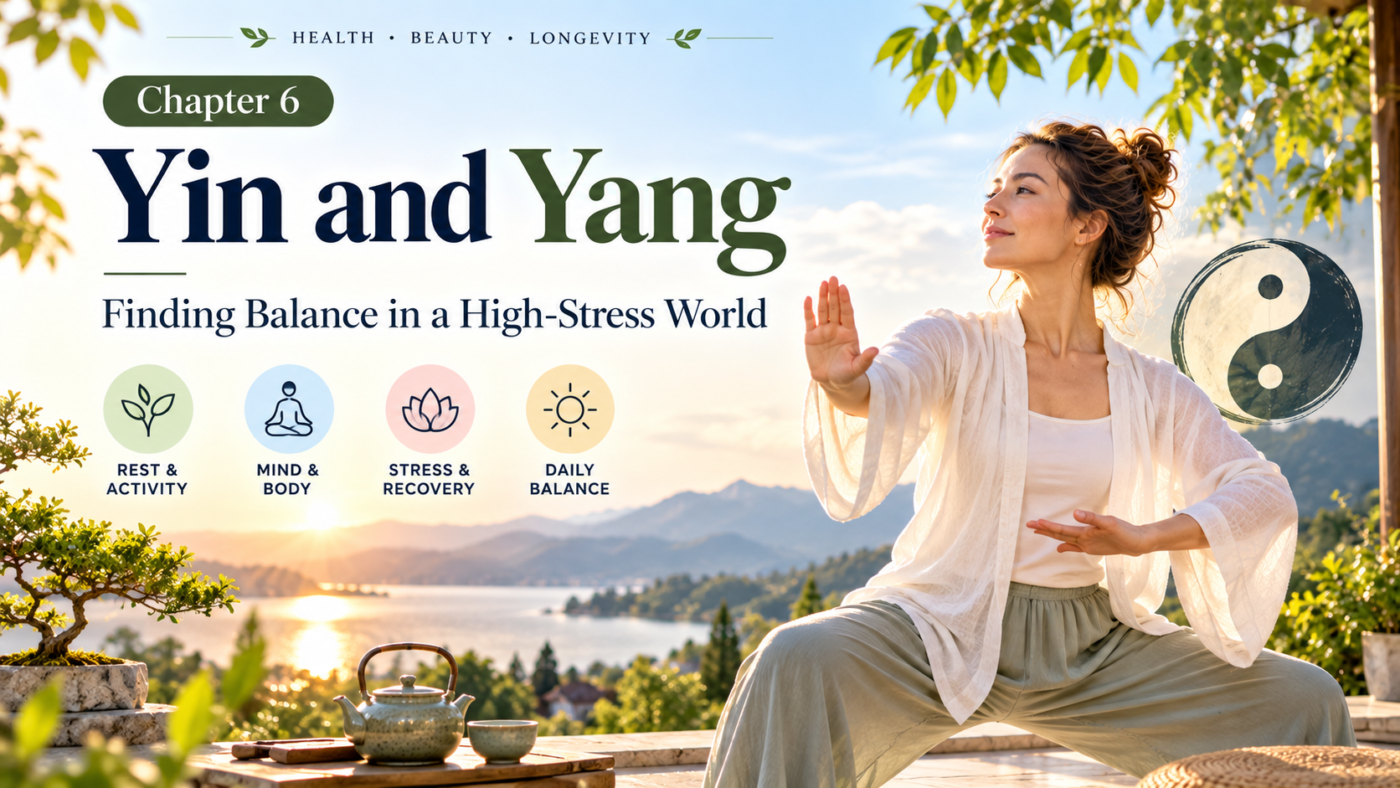
Yin and yang balance offers a traditional way to think about one of modern life’s biggest challenges: how to alternate effort with recovery. Stress is part of being alive, but when work, digital stimulation, poor sleep, emotional strain and constant responsibility leave too little time for restoration, both the body and mind can begin to feel depleted.
A completely stress-free life is neither realistic nor necessary. We need a certain amount of challenge to learn, adapt, solve problems, protect ourselves, and move toward meaningful goals.Stress is part of being alive.
What Is Yin and Yang Balance?
Yin and yang balance is a traditional Chinese philosophical concept describing the dynamic relationship between complementary qualities such as rest and activity, darkness and light, coolness and warmth, stillness and movement. In a modern wellness context, it can serve as a useful metaphor for recognizing when effort has dominated for too long and recovery has become insufficient.
A completely stress-free life is neither realistic nor necessary. We need a certain amount of challenge to learn, adapt, solve problems, protect ourselves, and move toward meaningful goals.
The problem begins when challenge becomes continuous and recovery becomes rare.
When pressure follows us from morning until night, when the mind remains alert long after work is finished, and when sleep, movement, relationships, and quiet time are repeatedly pushed aside, everyday stress can begin to feel like depletion.
You may still be functioning.
You may still be going to work, answering messages, caring for other people, and completing your responsibilities.
But inside, something feels out of balance.
This idea of balance has existed in many healing traditions. In traditional Chinese thought, one of its most enduring expressions is the relationship between yin and yang.
Yin and yang are not simply two opposing forces fighting against each other. They represent a traditional way of understanding how apparently opposite qualities can coexist, depend on one another, and continually change.
Rest and activity.
Night and day.
Cooling and warming.
Stillness and movement.
Inward attention and outward action.
From this perspective, health is not a permanent state of perfect stillness. It is the ability to adjust.
That idea remains surprisingly relevant in a world where many people are constantly doing but rarely recovering.
Stress Is Not Always the Enemy
Stress is often discussed as if it were automatically harmful.
It is not.
When we face a challenge, the body can temporarily increase alertness and prepare us to respond. Heart rate may rise, breathing may change, muscles may tense, and attention may sharpen.
For a short period, this response can be useful.
The difficulty comes when the stress response is repeatedly activated without enough time for recovery.
A demanding morning becomes a demanding afternoon.
Work follows you home.
A difficult conversation keeps replaying in your mind.
You go to bed physically tired but mentally alert.
Sleep is shortened.
The next day begins with less energy.
Then ordinary frustrations feel harder to tolerate.
This creates a cycle in which stress can interfere with recovery, poor recovery can reduce resilience, and reduced resilience can make the next stressor feel even larger.
The goal, therefore, is not to eliminate all stress.
It is to improve the relationship between effort and restoration.
Why Coping Matters
Two people can experience the same event and respond very differently.
A delayed train may be a temporary inconvenience for one person and a disaster for another.
A critical email may inspire useful reflection in one person and hours of rumination in someone else.
A busy week may feel challenging but manageable when sleep is good, support is available, and the schedule has clear limits. The same workload may feel unbearable when someone is already exhausted, worried, isolated, or physically unwell.
This does not mean that stress is imaginary.
It means that stress is shaped by both the event and the person experiencing it.
Our interpretation matters.
Our habits matter.
Our physical condition matters.
Our environment matters.
Our available support matters.
And our ability to recover matters.
A healthier response to stress is not simply “thinking positively.” It involves learning when to act, when to pause, when to accept uncertainty, when to ask for help, and when to stop demanding more from a body and mind that need recovery.
Yin and Yang: A Traditional Language of Balance
In traditional Chinese philosophy and medicine, yin and yang describe complementary qualities that exist in relationship to one another.
Yin is traditionally associated with qualities such as quiet, darkness, coolness, inwardness, and rest.
Yang is associated with activity, light, warmth, outward movement, and stimulation.
Neither is inherently good or bad.
A healthy life requires both.
Without activity, there is stagnation.
Without rest, there is exhaustion.
Without stimulation, there may be little growth.
Without quiet, there may be no recovery.
Without outward engagement, life can become isolated.
Without inward reflection, life can become directionless.
The important idea is not equality at every moment.
It is responsiveness.
Day naturally becomes night.
Periods of work should be followed by periods of rest.
Intense exercise should be followed by recovery.
Social engagement should be balanced by moments of solitude when needed.
The traditional yin-yang model describes health as dynamic rather than static.
Balance is something continually adjusted, not something achieved once and permanently maintained.
What Does Qi Mean?
Traditional Chinese medicine also uses the concept of qi, often translated as “vital energy,” “life energy,” or sometimes “functional vitality.”
Within traditional theory, qi is described as participating in the functioning and regulation of the body and moving through pathways traditionally called meridians.
It is important to understand what this means in a modern health context.
Qi is a traditional concept. It is not the same as calories, electrical energy, ATP, blood flow, oxygen, hormones, or another scientifically measured biological substance.
Modern science does not require the traditional concept of qi to explain how the human body functions.
However, the language of qi can still be understood as part of the historical framework through which Chinese medicine describes vitality, function, weakness, movement, and balance.
This distinction allows us to appreciate the cultural and philosophical value of traditional concepts without presenting them as established biomedical mechanisms.
When Life Becomes Too Yang
Modern life often favors qualities traditionally associated with yang:
speed,
activity,
competition,
noise,
brightness,
stimulation,
constant communication,
achievement,
and outward performance.
We wake to alarms.
We check messages.
We commute.
We work.
We respond.
We consume information.
We exercise.
We shop.
We plan.
We compare.
We continue until bedtime.
Even leisure can become highly stimulating.
Streaming.
Social media.
Gaming.
Online shopping.
News.
Notifications.
There is always something happening.
There is always something else to see.
From a traditional yin-yang perspective, the problem is not that activity is bad.
The problem is that activity without enough restoration becomes difficult to sustain.
Modern life often contains abundant yang and insufficient yin.
Not enough quiet.
Not enough darkness.
Not enough stillness.
Not enough unstructured time.
Not enough sleep.
Not enough opportunities for the mind to stop reacting.
Whether or not one uses traditional terminology, the practical lesson is easy to recognize.
Human beings need recovery.
Rest Is an Active Part of Health
Many people treat rest as the absence of productivity.
That view can make recovery feel guilty or wasteful.
But rest performs an important function.
Sleep supports memory, emotional regulation, immune function, metabolism, and physical repair.
Breaks can restore attention.
Quiet time can reduce constant cognitive demand.
Gentle movement can help someone transition away from prolonged sitting or mental tension.
Time with supportive people can reduce the feeling of carrying everything alone.
Rest should not always be interpreted as doing nothing.
Sometimes rest means changing the type of demand placed on the body and mind.
A walk may be restorative after hours of concentration.
Quiet reading may be restorative after a socially demanding day.
Gentle stretching may be restorative after prolonged sitting.
Sleep may be restorative after physical exertion.
Solitude may be restorative after constant conversation.
Connection may be restorative after isolation.
Balance depends on what you need.
The Mind and Body Are Constantly Communicating
It is difficult to separate physical and psychological health into completely independent categories.
A poor night of sleep can change mood the next day.
Pain can make concentration more difficult.
Anxiety can increase muscle tension and interfere with sleep.
Chronic stress can influence daily habits such as exercise, food choices, alcohol use, and bedtime routines.
Fatigue can make social interaction feel harder.
Loneliness can make stress more difficult to manage.
This does not mean every physical symptom is psychological.
Nor does it mean every emotional problem can be solved through lifestyle changes.
It means the mind and body exist in continuous interaction.
A useful approach to health therefore looks at the whole pattern rather than only one isolated symptom.
Why “Energy Loss” Is Better Understood as a Metaphor
People often say:
“My energy is gone.”
“That meeting drained me.”
“I have nothing left.”
Traditional language may describe this as depletion of qi.
Modern language may describe it as fatigue, exhaustion, mental overload, low motivation, sleep debt, or reduced physical capacity.
These expressions are not necessarily describing the same biological mechanism.
But they often point toward the same human experience: the feeling that available resources are no longer matching demands.
For health education, this is an important distinction.
We can use the language of vitality and balance without claiming that stress literally causes an invisible energy to leak from the body.
What matters is the lived reality.
A person who sleeps poorly, works excessively, worries continuously, eats irregularly, sits for most of the day, and rarely recovers is likely to feel different from someone whose life contains adequate sleep, meaningful movement, social support, nutrition, and periods of genuine rest.
The practical question is not:
“Where did my energy go?”
It is:
“What is preventing me from recovering?”
Traditional Practices and Modern Wellness
Traditional Chinese health practices often include acupuncture, herbal medicine, massage, dietary approaches, breathing practices, tai chi, qigong, and other methods.
These practices should not all be treated as if they have the same evidence, risks, or effects.
Research on specific approaches varies considerably.
Tai chi, for example, combines slow movements, posture, breathing, mental focus, and relaxation. Modern research has examined it for areas such as balance, mobility, pain, mood, and quality of life.
Qigong similarly combines movement or stillness with breathing and focused attention.
For many generally healthy adults, gentle mind-body practices can provide a structured way to slow down, move the body, and practice focused attention.
That does not mean they “rebalance qi” in a scientifically proven physiological sense.
It means the practices themselves may offer useful forms of movement, relaxation, body awareness, and routine.
Traditional herbal products require greater caution because ingredients, quality, interactions, contamination, and dosing can vary. They should not be assumed to be safe merely because they are described as natural.
Traditional approaches are best viewed as complementary tools rather than substitutes for appropriate medical diagnosis and treatment.
Balance Is Not the Same for Everyone
One reason balance can be difficult to define is that people need different things at different times.
A sedentary office worker may need more movement.
An endurance athlete may need more recovery.
A socially isolated person may benefit from more connection.
A caregiver surrounded by people all day may need quiet.
Someone sleeping six hours a night may need more rest.
Someone spending most of the weekend in bed because of unexplained exhaustion may need medical evaluation rather than simply more rest.
Balance is not a universal schedule.
It is the appropriate response to your current condition.
This is why self-awareness matters.
Instead of asking whether your life looks balanced compared with someone else’s, ask whether your current pattern allows you to function, recover, and remain well.
A Simple Yin-Yang Reflection for Modern Life
You do not need to practice traditional Chinese medicine to use yin and yang as a reflection tool.
At the end of a day, consider two sides of your life.
Ask how much of the day was spent in outward activity: work, communication, exercise, decision-making, travel, problem-solving, and stimulation.
Then consider how much time supported recovery: sleep, quiet, nourishing meals, gentle movement, nature, reflection, enjoyable relationships, and periods without digital interruption.
The goal is not to divide every day exactly in half.
Some seasons of life require more effort.
Some days will be intense.
Some responsibilities cannot be postponed.
The question is whether recovery eventually follows.
A short period of imbalance may be manageable.
A permanent state of imbalance is much harder to sustain.
When Stress Becomes a Cycle
Stress can create habits that make stress harder to tolerate.
You sleep poorly, so you drink more caffeine.
You feel tired, so you stop exercising.
You are short on time, so meals become less balanced.
You feel overwhelmed, so you spend late evenings scrolling for distraction.
You stay up later, sleep worse, and wake with even less energy.
The next day’s demands have not changed.
But your ability to meet them has.
This is how stress can become self-reinforcing.
The solution is rarely a dramatic escape from ordinary life.
More often, it begins by interrupting one part of the cycle.
Go to bed earlier.
Reduce late caffeine.
Take a short walk.
Put the phone away during dinner.
Eat before you become ravenously hungry.
Create one period of quiet each day.
Ask for help.
Remove one unnecessary obligation.
Small corrections can begin moving the system in a different direction.
Finding Your Own Point of Balance
Traditional yin-yang philosophy reminds us that opposites can depend on one another.
Effort gives meaning to rest.
Rest makes effort possible.
Engagement makes solitude valuable.
Solitude can deepen engagement.
Challenge encourages growth.
Recovery allows growth to continue.
The healthiest goal is therefore not maximum activity and not maximum rest.
It is adaptability.
Can you increase effort when life requires it?
Can you reduce effort when recovery is needed?
Can you recognize when your body is asking for attention?
Can you stop before exhaustion makes the decision for you?
Can you distinguish normal stress from symptoms that deserve professional evaluation?
These questions are more useful than pursuing a perfectly balanced lifestyle.
When Fatigue Needs More Than Balance
Persistent fatigue should never automatically be explained by stress, “low qi,” or an imbalance of yin and yang.
Fatigue can have many causes.
Sleep disorders, anemia, thyroid disease, diabetes, infections, medication effects, depression, anxiety, chronic pain, and other medical conditions may all contribute.
If fatigue lasts for several weeks without an obvious explanation, becomes progressively worse, substantially interferes with daily life, or occurs with other concerning symptoms, professional medical evaluation is appropriate.
Traditional concepts can provide meaningful ways to think about lifestyle and balance.
They should not be used to delay diagnosis or evidence-based medical care.
The Practical Wisdom of Yin and Yang
The lasting value of yin and yang may be less about explaining human biology and more about reminding us of something modern life easily forgets:
Opposites need each other.
We cannot stay awake forever.
We cannot work without recovery.
We cannot remain stimulated without eventually needing quiet.
We cannot continuously give without replenishing ourselves.
We cannot accelerate indefinitely.
A healthy life contains rhythm.
Activity and rest.
Connection and solitude.
Discipline and flexibility.
Effort and recovery.
Movement and stillness.
The goal is not perfect equilibrium.
Life is too dynamic for that.
The goal is to notice when one side has dominated for too long—and to make a thoughtful correction before exhaustion makes the correction for us.
In a culture that continually asks us to do more, the ancient language of yin and yang offers a simple reminder:
Sometimes better health begins not by adding another task, but by restoring what has been missing.
7 Practical Ways to Restore Yin and Yang Balance
- Protect Your Sleep
Sleep is one of the most important forms of recovery. A consistent sleep schedule, a dark and quiet bedroom, less late-night stimulation, and appropriate caffeine timing can help support healthier sleep. - Balance Activity With Recovery
Exercise, work, and mental effort all require recovery. Avoid treating every free hour as an opportunity to accomplish more. - Create Periods of Quiet
Reduce unnecessary notifications, screen exposure, and constant multitasking. Even short periods without demands can help the mind shift away from continuous stimulation. - Practice Gentle Movement
Walking, stretching, tai chi, and qigong can provide movement without turning every activity into high-intensity exercise. - Eat and Hydrate Regularly
Regular meals, adequate fluids, and a balanced eating pattern can support more stable daily functioning than relying heavily on caffeine or irregular eating. - Reduce Unnecessary Commitments
Every commitment uses time and attention. Creating healthier boundaries can protect recovery time and reduce avoidable overload. - Know When Fatigue Needs Medical Evaluation
Persistent or unexplained fatigue should not automatically be attributed to stress, low qi, or yin-yang imbalance. Medical conditions, medications, sleep disorders, and mental health conditions can also contribute.
FAQ
What does yin and yang balance mean?
Yin and yang are traditional Chinese concepts describing complementary and continually changing qualities, such as rest and activity, darkness and light, or stillness and movement. Balance does not mean both sides must always be equal; it refers to a dynamic relationship that changes with circumstances.
How does yin and yang relate to health?
Traditional Chinese medicine uses yin and yang as part of its historical framework for describing patterns of health and imbalance. These concepts should be understood as traditional theories rather than scientifically established biological mechanisms.
What is qi in traditional Chinese medicine?
Qi is a traditional concept often translated as vital energy or functional vitality. It plays an important role within traditional Chinese medicine theory, but it is not equivalent to a scientifically measured substance such as ATP, oxygen, hormones, or electrical energy.
Can tai chi help with stress and balance?
Tai chi combines slow movement, posture, breathing, attention and relaxation. It can provide a gentle form of physical activity and mind-body practice, although potential benefits depend on the individual and the specific health outcome being considered.
Is stress always harmful?
No. Short-term stress can be a normal adaptive response. Problems may arise when stress is persistent, recovery is inadequate, or stress begins to interfere with sleep, mood, health or everyday functioning.
Can yin and yang imbalance explain chronic fatigue?
Persistent fatigue should not be medically diagnosed as a yin-yang imbalance. Fatigue can have many causes, including sleep problems, anemia, thyroid disorders, medication effects, depression, anxiety and other medical conditions.
When should fatigue be medically evaluated?
Consider seeking professional medical advice when fatigue persists for several weeks without a clear explanation, worsens, significantly interferes with normal activities, or occurs with other concerning symptoms.
Medical Disclaimer: This article is for general educational and informational purposes only and is not intended as medical advice, diagnosis, or treatment. Traditional Chinese medicine concepts such as yin, yang, qi, and meridians are described here as traditional frameworks and should not be interpreted as scientifically established biological mechanisms. Persistent, severe, unexplained, or worsening fatigue should be evaluated by a qualified healthcare professional.
This article is for general education and does not replace individualized care from a qualified health professional. Seek appropriate advice for persistent, severe, or concerning symptoms.
Read the full medical disclaimer