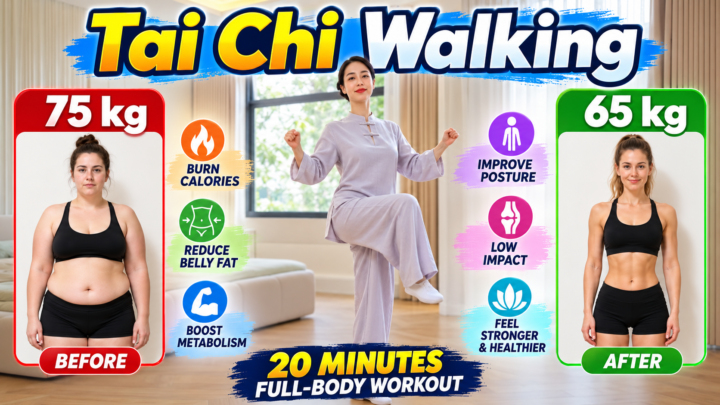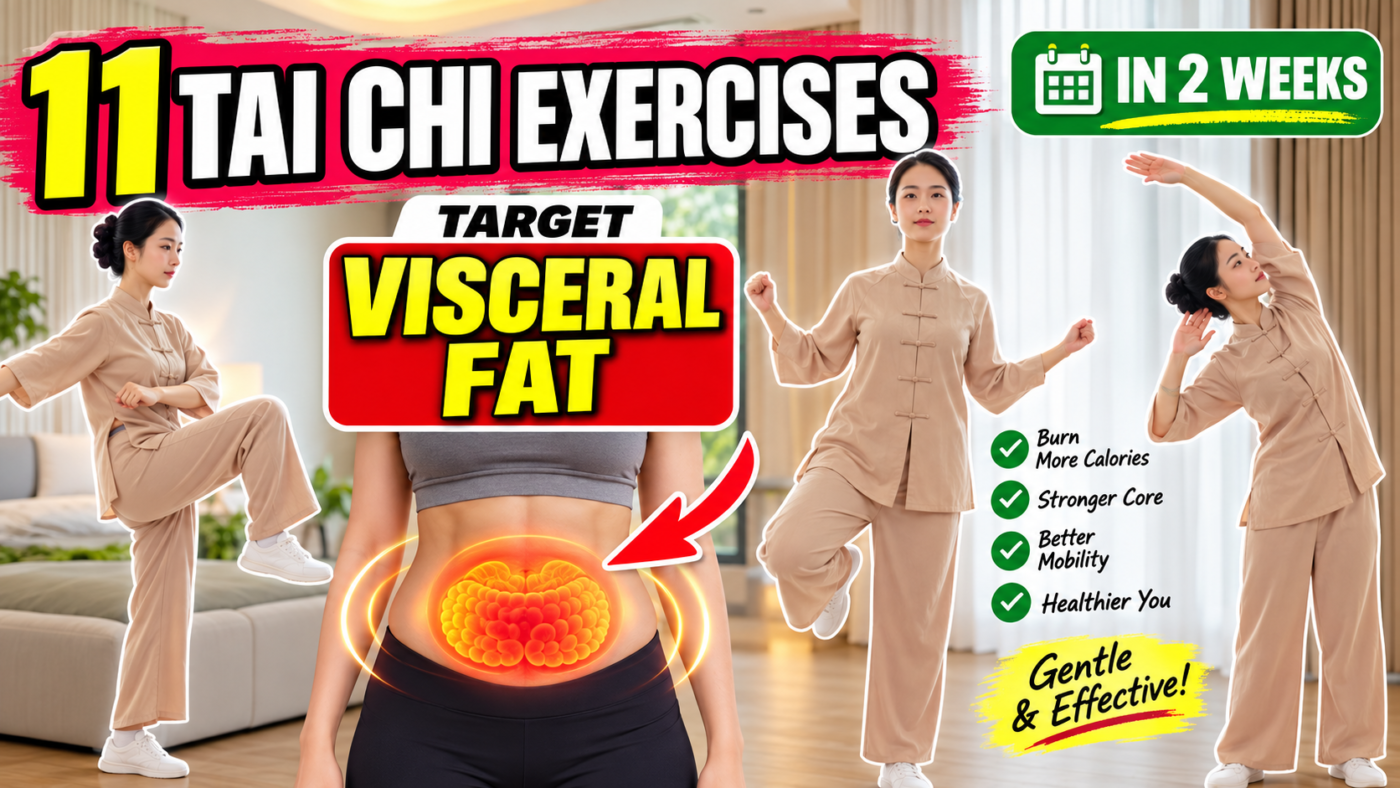
A short daily movement routine can do more than simply help you “burn calories.” When practiced consistently, gentle full-body exercise can improve mobility, balance, coordination, lower-body strength, core control, posture, and overall physical confidence.
The 11 movements below are inspired by flowing Tai Chi-style exercise but also include dynamic lunges, knee drives, kicks, balance work, and stretching. They are designed to keep the body moving through multiple planes while remaining accessible to many adults.
It is important to set realistic expectations. No individual exercise can selectively “melt belly fat,” eliminate love handles, or directly burn visceral fat from a specific area. Fat loss occurs systemically and depends largely on overall energy balance, nutrition, physical activity, sleep, and other lifestyle factors.
What these movements can do is help increase daily activity, challenge large muscle groups, improve trunk control, and support a more active lifestyle—which can contribute to long-term weight management and healthy aging.
Why This Daily Tai Chi-Inspired Routine Can Be Useful
Traditional Tai Chi is known for slow, controlled movement, balance, breathing, and body awareness. This routine is somewhat more dynamic, combining those qualities with functional fitness movements.
Together, the exercises emphasize several useful physical capacities:
Core stability and rotational control.
Hip and lower-body mobility.
Single-leg balance.
Coordination between the upper and lower body.
Gentle cardiovascular activity.
Postural awareness.
Flexibility.
Functional strength for everyday movement.
The goal is not to move as quickly or aggressively as possible. Smooth control matters more than speed.
Beginners should use a smaller range of motion and slow down whenever balance becomes difficult.
Exercise 1: Cross Knee-Elbow Touch
Stand upright with your feet comfortably apart.
Lift one knee toward your torso while bringing the opposite elbow downward toward it. Return to the starting position and repeat on the other side.
Continue alternating in a smooth rhythm.
The diagonal pattern creates rotation through the trunk while challenging balance and coordination.
Why It Helps
The movement engages the abdominal wall and oblique muscles while requiring the hips and shoulders to work together.
It can also gently raise your heart rate when repeated continuously.
Do not focus on forcefully crushing the elbow and knee together. Instead, keep the movement controlled and allow the torso to rotate naturally.
Exercise 2: Curtsy Lunge With Arm Swing
Begin standing tall with both arms raised.
Step one foot diagonally behind the opposite leg while lowering into a comfortable curtsy-style lunge.
At the same time, sweep the arms downward toward the side.
Return to standing and repeat in the opposite direction.
Why It Helps
This exercise combines lower-body loading with whole-body coordination.
The glutes, thighs, hips, and trunk all contribute to the movement, while the arm swing adds mobility through the shoulders and torso.
A deeper lunge is not automatically better. People with knee, hip, or balance concerns can make the step smaller.
Exercise 3: Straight-Leg Kick and Toe Reach
Stand upright.
Lift one leg straight in front of you while reaching toward the foot with the opposite hand.
Lower the leg and repeat on the other side.
Move rhythmically without forcing the kick excessively high.
Why It Helps
This movement challenges balance, hamstring mobility, hip flexion, and core control.
The crossing reach also introduces gentle trunk rotation.
If touching the toes causes you to round aggressively through the spine, simply reach toward the shin or knee instead.
Exercise 4: Same-Side Knee Drive
Stand tall and raise your arms.
Drive one knee upward as the arms travel downward toward the same side.
Return to the starting position and repeat on the other side.
Why It Helps
The exercise combines knee lifting with side-body shortening, giving the lateral trunk muscles a useful challenge.
It also develops coordination and provides a modest cardiovascular stimulus when performed continuously.
This movement may strengthen the abdominal area, but it does not selectively remove fat from the waist.
Exercise 5: Step-Back Knee Drive
Step one leg backward while raising the opposite arm overhead.
Then drive the back knee forward and upward as your arms change position.
Repeat several controlled repetitions before switching sides, or alternate sides continuously if comfortable.
Why It Helps
The step-back position works the hips and legs, while the knee drive challenges balance and core stabilization.
It can also help counter some of the stiffness many people feel after prolonged sitting by moving the hips repeatedly through extension and flexion.
Keep the standing knee soft rather than locked.
Exercise 6: High Circle Cross Lunge
Circle both arms overhead.
Step one leg diagonally behind you while sweeping the arms downward toward the side.
Return to standing, circle the arms overhead again, and repeat to the opposite side.
Why It Helps
This is one of the most whole-body movements in the routine.
The legs control the lunge, the trunk stabilizes the body, and the shoulders move through a broad arc.
Large arm movements do not literally increase lung capacity during a single session, but they can encourage fuller breathing and improve shoulder mobility when performed comfortably.
Exercise 7: High-Reach Knee Drive
Raise both arms overhead.
Drive one knee upward while bringing the arms downward.
Return the foot to the floor and reach overhead again.
Alternate sides.
Why It Helps
This rhythmic up-and-down motion engages the hips, thighs, shoulders, and trunk.
Repeated knee drives can increase exercise intensity without requiring jumping, making the movement useful for people who want a low-impact cardiovascular challenge.
Again, this cannot specifically burn visceral fat. Regular physical activity, however, is an important part of improving metabolic health and managing abdominal fat over time.
Exercise 8: Standing Forward Lunge
Step one foot forward.
Bend both knees within a comfortable range while keeping the torso upright.
Press through the front foot to return to standing, then repeat on the opposite side.
Why It Helps
Lunges train some of the largest muscles in the body, including the quadriceps and glutes.
They also challenge hip stability and balance.
Because larger muscle groups are involved, lunges can make the routine more physically demanding than the stretching movements.
If knee discomfort occurs, shorten the step and reduce the depth.
Exercise 9: Hamstring Toe-Reach Stretch
Step one foot slightly forward with the heel down and toes pointing upward.
Push the hips backward and hinge forward gently.
Allow your hands to reach toward the shin, ankle, or foot without forcing the stretch.
Return to standing and switch sides.
Why It Helps
This movement stretches the hamstrings and can improve awareness of the hip-hinge pattern.
Many people mistakenly round deeply through the lower back to reach farther.
Instead, think about folding from the hips while keeping the spine long.
Forward bending does not “detox” internal organs. The real benefits are primarily related to mobility, movement variability, and muscular relaxation.
Exercise 10: Standing Quadriceps Stretch
Stand beside a wall or chair if balance support is needed.
Bend one knee and bring the heel toward the buttocks.
Hold the ankle or foot gently.
Keep the knees relatively close together and avoid excessively arching your lower back.
Release and switch sides.
Why It Helps
The stretch targets the front of the thigh and can also involve the hip flexors depending on pelvic position.
Balancing on one leg adds a secondary stability challenge.
There is no need to pull the foot forcefully toward the body. A mild-to-moderate stretch is enough.
Exercise 11: Behind-the-Back Shoulder and Chest Stretch
Stand upright.
Clasp your hands behind your back if comfortable.
Lengthen the arms downward and slightly backward while gently opening the chest.
Keep your shoulders away from your ears and breathe slowly.
Why It Helps
This movement can provide a pleasant stretch across the chest and front of the shoulders after the more active exercises.
It may be particularly useful for people who spend long periods working at a desk.
Stretching can temporarily reduce feelings of stiffness, although it cannot guarantee that post-workout soreness will be prevented.
How Long Should You Practice?
You do not need an exhausting workout to benefit from regular movement.
A practical starting point is approximately 10 to 15 minutes, depending on your fitness level.
You might perform each movement for around 30 to 60 seconds with short pauses as needed.
Beginners can perform fewer repetitions and gradually build tolerance.
The routine can be practiced several times per week or even daily when the intensity remains comfortable and your body is recovering well.
However, soreness, persistent fatigue, worsening joint pain, or declining performance may indicate that you should reduce volume or take additional recovery time.
Can These Exercises Reduce Belly Fat?
This deserves a clear answer.
They can help support fat loss, but they cannot specifically force the body to burn fat from the abdomen.
The idea that exercising one body part directly burns fat from that location is known as spot reduction, and it is generally not how human fat loss works.
Abdominal and visceral fat are influenced by many factors, including overall body weight, calorie intake, physical activity, age, genetics, sleep, stress, alcohol intake, and metabolic health.
Exercise remains extremely valuable because regular activity can increase energy expenditure, preserve muscle, improve insulin sensitivity, and support overall health.
Think of these exercises as part of a broader strategy rather than a targeted “belly-fat cure.”
Why Consistency Matters More Than a Two-Week Promise
You may notice improvements in coordination, stiffness, confidence, or energy within a relatively short period.
Visible changes in body composition usually take longer.
No responsible exercise program can guarantee a dramatic transformation in exactly two weeks.
A better goal is to ask:
Do I move more comfortably?
Is my balance improving?
Can I perform the exercises with better control?
Do everyday activities feel easier?
Am I becoming more consistent?
These are meaningful forms of progress.
Body composition changes can follow when exercise is combined with an appropriate diet and sustainable lifestyle habits.
Make the Routine Easier
If balance is difficult, keep one hand near a wall or chair.
Reduce the depth of lunges.
Lift the knees only as high as comfortable.
Perform toe touches toward the shin instead of the foot.
Move more slowly.
Take additional rest between exercises.
The purpose is to make movement sustainable, not to force your body into positions it cannot yet control.
Make the Routine More Challenging
Once the routine becomes easy, increase the duration slightly.
Use a greater but still controlled range of motion.
Reduce rest periods.
Perform the sequence for a second round.
Focus on slower eccentric control during lunges.
The progression should remain gradual.
Adding speed without control usually reduces exercise quality.
Who Should Be More Careful?
Anyone with significant balance problems, recent surgery, uncontrolled cardiovascular disease, severe joint pain, neurological conditions, or other major medical concerns should seek appropriate professional guidance before starting a new exercise routine.
Pregnancy, osteoporosis, arthritis, and previous knee or hip injuries may also require exercise modifications.
Stop if you develop chest pain, fainting, severe dizziness, sudden weakness, or unusual shortness of breath.
Pain is not a requirement for progress.
A Better Way to Think About Tai Chi-Inspired Fitness
The value of this routine is not that one movement “melts love handles” while another “flushes toxins.”
Its value comes from combining multiple forms of movement into one simple practice.
You rotate.
You reach.
You balance.
You lunge.
You stretch.
You shift weight from side to side.
You coordinate the arms and legs.
You breathe and keep moving.
Those are fundamental physical skills worth maintaining throughout life.
The Bottom Line
These 11 Tai Chi-inspired exercises provide a practical full-body routine that combines mobility, balance, coordination, core engagement, lower-body strengthening, and gentle cardiovascular movement.
They can support weight management when combined with an appropriate diet and active lifestyle, but they should not be promoted as a way to selectively eliminate belly or visceral fat.
Practice them with control rather than speed.
Use a range of motion that suits your body.
And focus on consistency rather than chasing a dramatic two-week transformation.
A few minutes of meaningful movement practiced regularly can contribute far more to long-term health than an extreme routine that you cannot sustain.
FAQ
Can these Tai Chi exercises reduce belly fat?
They can contribute to overall physical activity and energy expenditure, but they cannot selectively burn belly fat. Fat loss occurs throughout the body and depends largely on overall energy balance and lifestyle.
Can I do this routine every day?
Many people can perform gentle versions daily, provided there is no persistent pain or excessive fatigue. Intensity and recovery requirements vary between individuals.
How long should the routine take?
Around 10 to 15 minutes is a practical starting point, although you can shorten or extend it based on fitness level and recovery.
Are these exercises suitable for beginners?
Yes, many can be modified by reducing range of motion, moving more slowly, and using a chair or wall for balance.
Is this traditional Tai Chi?
The sequence contains Tai Chi-inspired flowing movement but also incorporates conventional dynamic fitness exercises such as lunges, knee drives, kicks, and static stretches. It is therefore more accurate to describe it as a Tai Chi-inspired routine rather than a traditional Tai Chi form.
Can older adults practice these movements?
Many older adults may benefit from appropriately modified balance, mobility, and strengthening exercises. Those with significant medical or balance concerns should seek individualized professional guidance.
Medical Disclaimer
This article is for educational and informational purposes only and is not medical advice. Exercise needs vary according to age, health status, medications, injuries, balance ability, and fitness level. Stop exercising and seek appropriate medical care for chest pain, fainting, severe dizziness, unusual shortness of breath, sudden weakness, or significant pain. People with chronic medical conditions, recent injuries, or major physical limitations should consult a qualified healthcare professional before beginning a new exercise program.
This article is for general education and does not replace individualized care from a qualified health professional. Seek appropriate advice for persistent, severe, or concerning symptoms.
Read the full medical disclaimer