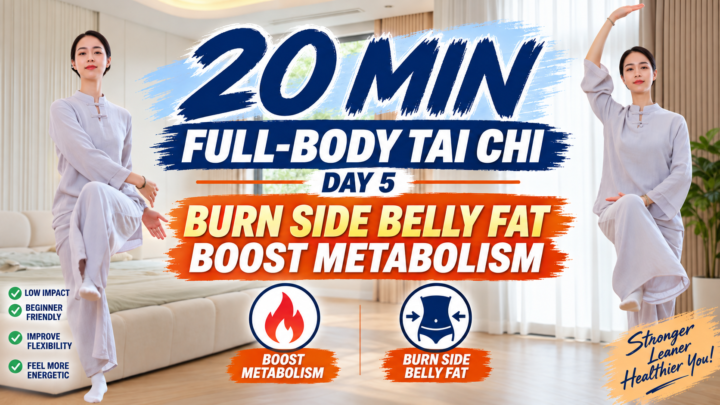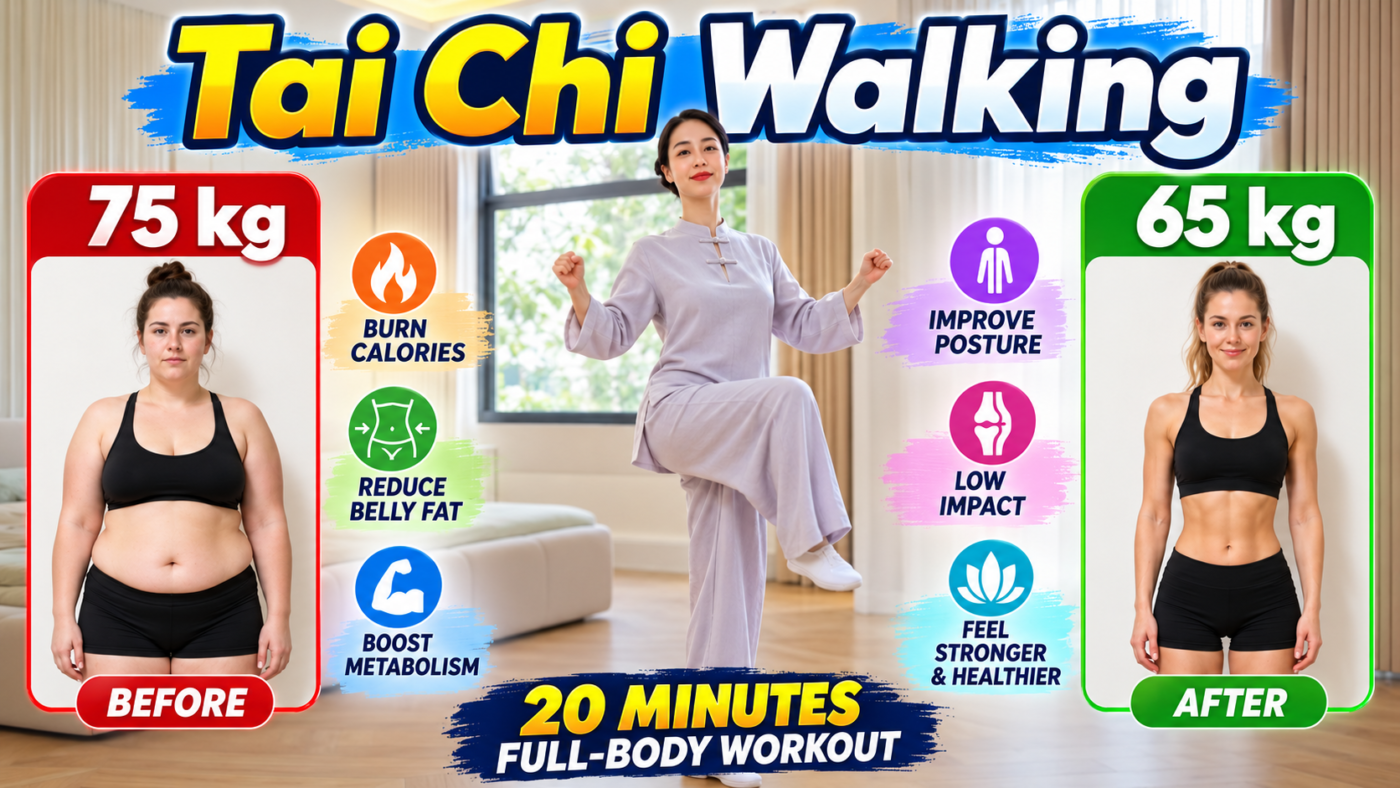
Can a person go from 75 kg to 65 kg in three months? For some people, a 10 kg reduction over that period may be possible, but it should never be treated as a guaranteed result. Weight-loss speed varies substantially according to starting weight, calorie intake, activity level, age, sleep, medical conditions, medications, and individual metabolism.
What matters more than chasing a specific number is building a routine that can actually be sustained.
For people who dislike jumping, running, or other high-impact cardio, a standing Tai Chi-inspired walking workout can be a practical alternative. This 20-minute routine keeps the body moving continuously through steps, reaches, knee lifts, squats, rotations, heel raises, and gentle balance work.
The movements are low impact, require no floor exercises, and can be adjusted for different fitness levels.
They will not selectively remove fat from the abdomen, waist, or inner thighs. However, regular full-body activity can increase energy expenditure, strengthen muscles, improve mobility, and support long-term weight management when combined with appropriate nutrition and other healthy habits.
Why a 20-Minute Tai Chi Walking Workout Can Be Useful
The term “Tai Chi walking” is used broadly here. This is not a traditional Tai Chi form. Instead, the routine combines Tai Chi-inspired flowing movement with standing fitness exercises.
Its main advantages are simplicity and continuity.
There is no need to get on the floor.
There is no jumping.
Most exercises can be slowed down.
The routine works multiple muscle groups.
Balance and coordination are challenged repeatedly.
Large arm movements increase whole-body involvement.
Lower-body exercises engage the hips, thighs, calves, and glutes.
For beginners, older adults, or people returning to exercise, that can make the workout easier to incorporate into daily life than more aggressive cardio sessions.
Exercise 1: Cross-Back Open Turn
Stand upright and extend both arms forward.
Step one foot diagonally behind the other.
Rotate your torso toward the side while opening one arm outward.
Return to center and repeat on the opposite side.
Why It Helps
The cross-back step challenges coordination, hip control, and balance.
The torso rotation engages the trunk and improves rotational mobility.
Because the legs and upper body move together, the exercise involves more muscle mass than a simple standing twist.
It may help strengthen and define the waist musculature, but it cannot selectively remove waist fat.
Exercise 2: Overhead Heel Press
Interlace your fingers and reach both arms overhead with the palms facing upward.
Alternate lifting one heel and then the other.
Maintain a steady rhythm.
Why It Helps
The overhead reach encourages upright posture and shoulder mobility.
Alternating heel raises activate the calves and provide a mild balance challenge.
Repeated calf contractions also support normal lower-leg circulation during movement.
Exercise 3: Forward Lunge Reach
Step one foot forward.
Bend the front knee while keeping the back leg comfortably extended.
Reach one arm overhead, then alternate arms.
Switch legs after several repetitions.
Why It Helps
This movement strengthens the quadriceps, glutes, and other lower-body muscles while opening the front of the hips and trunk.
The overhead reach adds a mobility and posture component.
Keep the lunge shallow if your knees or balance need additional support.
Exercise 4: Running Arm Swing
Stand upright with gentle fists beside the waist.
Swing the arms alternately forward and backward as though you were running while keeping the feet relatively still.
Why It Helps
Fast but controlled arm movement increases upper-body activity and can modestly raise heart rate.
Keeping the trunk stable also challenges postural control.
This can be useful for people who want a little more cardiovascular movement without impact on the knees.
Exercise 5: Side Leg Extension
Place both hands on your hips.
Extend one leg out to the side.
Bring it back toward the center and repeat before changing sides.
Why It Helps
Side leg movement activates the hip abductors, which contribute to pelvic stability, walking, and balance.
The exercise can strengthen the outer hips and thighs and support lower-body function.
Exercise 6: Front-and-Back Clap With Toe Raise
Clap the hands in front of your body.
Swing both arms behind you and bring the hands together again if comfortable.
At the same time, rise gently onto your toes.
Return and repeat.
Why It Helps
The arm swing encourages shoulder and chest mobility while the toe raise strengthens the calves.
Moving the upper and lower body simultaneously also increases coordination demands.
Do not force the hands to meet behind your body if shoulder mobility is limited.
Exercise 7: Back Reach Knee Pull
Extend both arms forward while reaching one leg behind.
Drive that knee forward while pulling both fists backward toward the hips.
Repeat before switching sides.
Why It Helps
This is one of the more dynamic movements in the routine.
The rear-leg reach engages the glutes and balance system.
The knee drive challenges the hips, abdominal stabilizers, and standing leg.
Large muscle involvement can also increase the exercise’s energy demand.
Exercise 8: Knee Lift With Under-Thigh Clap
Open both arms wide at shoulder height.
Lift one knee and bring both hands downward to clap beneath the thigh.
Return to standing and alternate sides.
Why It Helps
The movement combines balance, hip flexion, shoulder movement, and core stabilization.
It can also gently elevate heart rate when performed continuously.
If the under-thigh clap is difficult, simply reach toward the knee.
Exercise 9: Cross-Hand Knee Touch
Cross both hands over the chest.
Lift one knee and bring the hands downward toward it.
Return to standing and switch sides.
Why It Helps
Alternating knee lifts increase lower-body activity while challenging coordination and trunk control.
Keeping the torso upright throughout the exercise also reinforces postural awareness.
Exercise 10: Side Open Twist
Hold both hands in front of the chest and keep the knees softly bent.
Rotate toward one side while opening both arms.
Return to center and switch sides.
Why It Helps
This combines trunk rotation with chest opening.
The movement can improve upper-back mobility and engage the oblique muscles.
It supports a more mobile and upright body, but it should not be viewed as a way to burn fat specifically from the waist.
Exercise 11: Knee Lift Front Kick
Place both hands on your hips.
Lift one knee, then extend the lower leg forward into a controlled kick.
Bring the leg back, repeat if desired, and switch sides.
Why It Helps
The exercise strengthens the hip flexors and quadriceps while challenging balance.
The abdominal muscles help stabilize the pelvis during the kick.
Keep the kick low if your balance is limited.
Exercise 12: Low Press
Stand with your feet wide apart.
Keep both hands near the waist with the palms facing downward.
Bend the knees slightly as one hand presses down in front of the body and the other presses downward behind.
Alternate sides.
Why It Helps
The wide stance keeps the thighs and hips active while the alternating arm movement adds coordination.
The slow, grounded pattern also reinforces body control and alignment.
Exercise 13: Side-Slide Squat
Stand with the feet wide and place the hands along the sides of your waist or thighs.
Bend the knees gently while sliding the hands downward along the sides of the body.
Return to standing and repeat.
Why It Helps
The squat strengthens the thighs and glutes.
Keeping the movement controlled can also help reinforce proper lower-body alignment.
You do not need to squat deeply to benefit.
Exercise 14: Squat High Press
Stand with your feet wide and both fists beside the waist.
Bend into a shallow squat while pressing one arm overhead.
Return and switch sides.
Why It Helps
This combines a lower-body squat with upper-body reaching.
Because the arms and legs work simultaneously, more of the body is involved than during a simple squat.
It is one of the more demanding exercises in the routine and can modestly increase cardiovascular effort.
Exercise 15: Overhead Open Squat
Bring both hands together overhead.
Open the arms outward as you bend the knees into a comfortable squat.
Return to standing and repeat.
Why It Helps
The squat trains the hips and thighs, while the arm opening encourages chest and shoulder mobility.
Keeping the chest lifted can also promote better postural awareness.
Exercise 16: Side Lunge Leg Extension
Stand with the feet wide and cross the arms in front of the chest.
Bend one knee while keeping the opposite leg straight.
If comfortable, lift the toes of the straight leg.
Shift back to center and repeat on the other side.
Why It Helps
Side lunges strengthen the hips, thighs, and glutes while stretching the inner thigh.
Moving from side to side also challenges balance and lateral control.
This is particularly useful because many people spend most of their movement time traveling forward rather than sideways.
Exercise 17: Elbow Close and Open
Place both hands behind the head.
Bring the elbows gently forward while slightly lowering the head.
Then lift the head and open the elbows wide.
Repeat slowly.
Why It Helps
This exercise encourages movement through the shoulders and upper back.
Opening the elbows can counter the rounded posture that often develops after prolonged sitting or screen use.
Avoid pulling aggressively on the head or neck.
Exercise 18: Gentle Body Twist
Keep your knees relaxed and allow a slight comfortable bounce.
Rotate the torso from side to side while letting the arms swing naturally.
One hand may move toward the shoulder as the other travels behind the back.
Why It Helps
This relaxed rotation can reduce feelings of stiffness through the trunk, shoulders, and hips.
The goal is fluidity rather than intensity.
Do not force the lower back into a large twisting range.
Exercise 19: Hip Swing Reach
Shift the hips gently toward one side while reaching the opposite arm overhead.
Move smoothly to the other side.
Why It Helps
The movement improves lateral mobility through the trunk and hips.
The overhead reach lengthens the side of the body while the shifting pattern develops coordination.
Exercise 20: Upper-Body Twist
Bend both elbows and hold the forearms comfortably in front of the chest.
Rotate gently from side to side.
Keep the hips relatively stable and finish with relaxed breathing.
Why It Helps
This final movement can serve as a gentle cooldown.
It encourages mobility through the waist, upper back, and shoulders and helps bring the intensity of the workout down gradually.
Can Tai Chi Walking Help With Weight Loss?
It can help, but the mechanism needs to be understood correctly.
Weight loss occurs when average energy expenditure exceeds energy intake over time.
This workout contributes by adding physical activity.
The more consistently you move, the more energy you generally expend across the week.
Exercise can also help preserve muscle during weight loss, improve fitness, support insulin sensitivity, and make daily activity easier.
But no 20-minute workout can guarantee a particular amount of weight loss by itself.
Nutrition and total lifestyle remain central.
Can You Lose 10 kg in Three Months?
For some people, losing 10 kg in three months may be achievable.
For others, it would be too aggressive.
Ten kilograms over roughly 12 to 13 weeks averages around 0.75 to 0.85 kg per week.
Whether that rate is appropriate depends on starting body weight, body composition, medical history, nutritional intake, and other individual factors.
A person starting at 75 kg should not automatically assume that reaching 65 kg in exactly three months is healthy or necessary.
A slower rate may be more sustainable.
The best target is one that preserves strength, nutrition, energy, and long-term adherence.
Why Low-Impact Exercise Can Be Valuable
High-intensity cardio can be effective for improving fitness and increasing energy expenditure, but it is not the only option.
Running, jumping, and high-impact intervals can also be difficult for people with knee pain, low fitness, poor balance, or significant excess body weight.
Low-impact exercise provides another pathway.
You can still:
Move continuously.
Raise your heart rate.
Train the legs.
Challenge balance.
Use the arms.
Improve mobility.
Increase weekly activity.
The workout does not need to hurt your joints to be useful.
Can You Lose Fat From the Belly, Waist, and Inner Thighs?
Not selectively.
These are common fat-storage areas, but performing exercises for those areas does not force the body to use fat from those exact locations.
This is the difference between strengthening a muscle and reducing the fat covering it.
A side lunge can strengthen the thighs.
A twist can train the obliques.
A knee lift can engage the abdominal muscles.
But fat reduction occurs according to overall energy balance and individual biology.
Over time, total body-fat reduction may make those areas smaller.
Why Standing Workouts Are Practical
A standing routine has several advantages.
You do not need a yoga mat.
You do not repeatedly transition between the floor and standing.
The movements are easier to perform in a small space.
People who have difficulty getting down to or up from the floor may find them more accessible.
That makes a standing workout particularly useful for home exercise.
How Hard Should the Workout Feel?
Aim for light to moderate intensity.
You should feel warmer and more active, but still able to maintain control.
You should generally be able to speak in short sentences without extreme breathlessness.
If the workout becomes too difficult:
Slow down.
Take smaller steps.
Reduce the depth of lunges and squats.
Lower your kicks.
Use a chair for balance.
Take longer rests.
The routine can still be effective when modified.
How Often Can You Practice It?
Many people can perform a low-impact routine like this several times per week.
Some may enjoy doing a lighter version daily.
The appropriate frequency depends on your fitness level and how your body responds.
Persistent fatigue, worsening joint pain, declining performance, or excessive soreness are signs that more recovery may be needed.
Combine Tai Chi Walking With Regular Walking
A 20-minute workout is valuable, but it should not be the only movement in your day.
Try to maintain general activity outside formal exercise.
Walk during phone calls.
Take short movement breaks.
Walk after meals when practical.
Use stairs when appropriate.
Stand up regularly if your work requires long periods of sitting.
This extra movement can make a substantial difference to total weekly activity.
Add Strength Training for Better Long-Term Results
Tai Chi-inspired walking can improve movement, balance, and general activity, but resistance training adds another important component.
Strength training helps preserve or increase muscle.
That becomes especially important during weight loss and with aging.
A balanced weekly program might therefore include:
Tai Chi walking.
Regular walking.
Resistance training.
Mobility work.
Adequate recovery.
The exact combination depends on your goals and ability.
Nutrition Still Determines Much of the Outcome
Exercise should not be used to compensate for an unsustainable diet.
For weight management, focus on an eating pattern you can maintain.
Prioritize adequate protein.
Eat vegetables and fruit regularly.
Choose minimally processed foods often.
Include appropriate portions of carbohydrates and healthy fats.
Control calorie intake without extreme restriction.
Stay hydrated.
The more extreme the diet becomes, the harder it often becomes to maintain training quality and consistency.
Do Not Chase the Scale Alone
Body weight is only one measure of progress.
Also look for:
Improved walking endurance.
Better balance.
Greater flexibility.
More comfortable stairs.
Stronger legs.
Improved posture.
A smaller waist measurement over time.
Better energy.
More consistent exercise habits.
These changes can occur even when scale weight moves slowly.
The Bottom Line
This 20-minute Tai Chi walking workout provides 20 standing exercises that combine stepping, balance, knee lifts, squats, rotations, heel raises, reaching, and mobility work.
It is a practical low-impact routine for people who want to move the whole body without jumping or floor exercise.
It can contribute to weight management and improved body composition, but it cannot guarantee that someone will lose 10 kg in three months or selectively burn fat from the belly, waist, or thighs.
The most effective approach remains straightforward:
Move consistently.
Eat appropriately for your goal.
Build and preserve muscle.
Sleep well.
Stay active throughout the day.
Track progress over months rather than days.
A sustainable routine repeated regularly will usually take you farther than an extreme program that is impossible to maintain.
FAQ
Can a 20-minute Tai Chi walking workout help with weight loss?
Yes. It adds physical activity and energy expenditure and can support weight management when combined with appropriate nutrition and other healthy habits.
Can I lose 10 kg in three months with this routine?
No single workout can guarantee that result. Some people may lose around 10 kg over three months, but a safe and realistic rate varies according to starting weight, diet, health status, activity level, and individual physiology.
Does Tai Chi walking burn belly fat?
It can contribute to overall fat loss, but it cannot selectively burn abdominal fat. The waist may become smaller as total body fat decreases.
Is this workout easier on the knees than running?
It is generally lower impact because it does not involve repeated running or jumping. However, lunges and squats can still stress the knees if performed too deeply or with poor control, so modifications may be needed.
Is this traditional Tai Chi?
No. It is better described as a Tai Chi-inspired standing fitness or walking workout because it combines flowing movements with conventional exercises such as squats, knee lifts, kicks, and lunges.
Can beginners do it?
Yes. Beginners can move more slowly, shorten steps, perform shallower squats, keep kicks low, and use a chair or wall for balance.
Can older adults practice Tai Chi walking?
Many older adults can benefit from appropriately modified standing exercise, especially for balance and mobility. Those with significant health or balance issues should seek individualized professional guidance.
How often should I do the workout?
Several sessions per week can be a reasonable starting point. A lighter version may be suitable more frequently if recovery is good and there is no persistent pain or excessive fatigue.
Medical Disclaimer
This article is for educational and informational purposes only and is not medical advice. Weight-loss goals and exercise needs vary according to age, health status, medications, injuries, balance ability, body composition, and fitness level. Rapid or substantial weight loss may not be appropriate for everyone. Stop exercising and seek appropriate medical attention for chest pain, fainting, severe dizziness, unusual shortness of breath, sudden weakness, or significant pain. People with chronic medical conditions, recent injuries, major physical limitations, or concerns about an appropriate rate of weight loss should consult a qualified healthcare professional before making substantial changes to exercise or diet.
This article is for general education and does not replace individualized care from a qualified health professional. Seek appropriate advice for persistent, severe, or concerning symptoms.
Read the full medical disclaimer