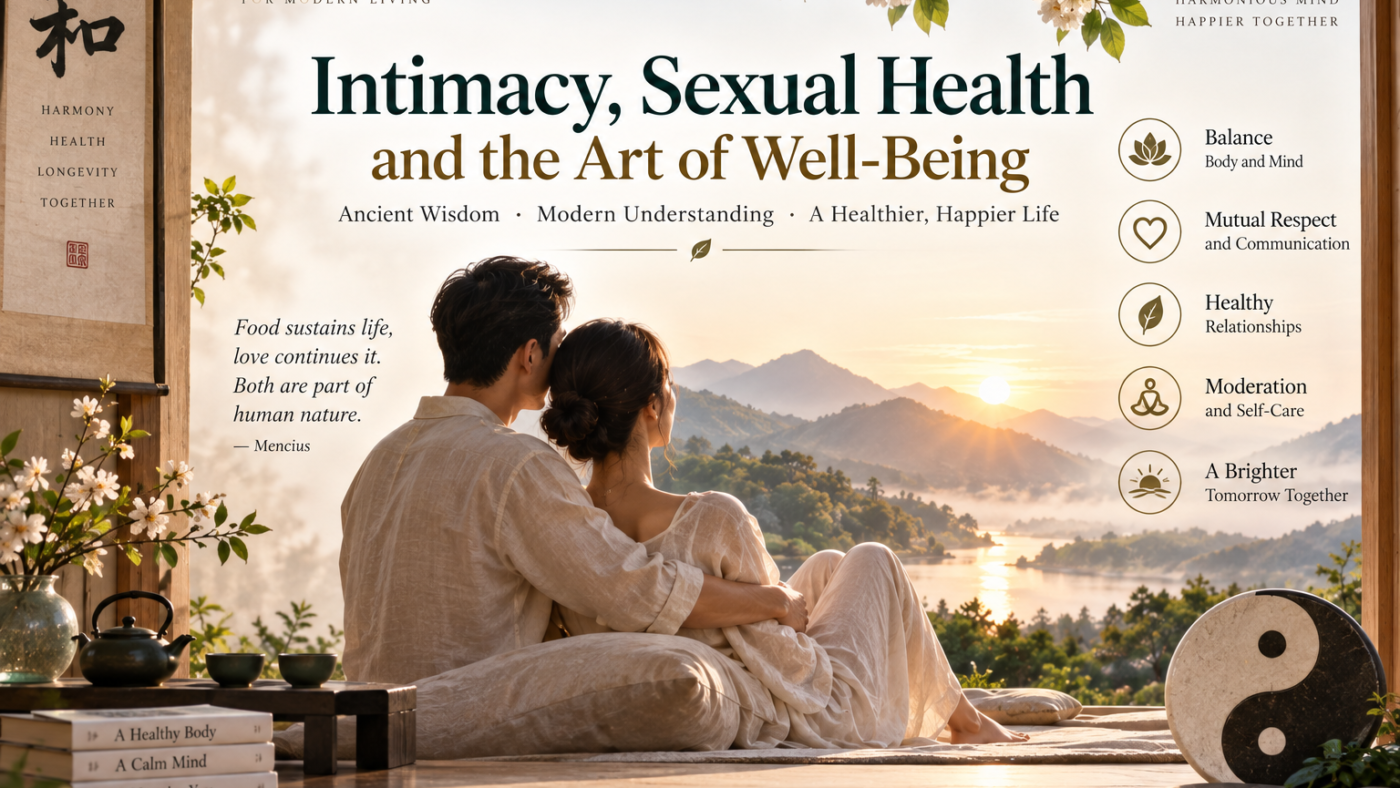
Sexual health and Chinese Yangsheng come together in a traditional approach to intimacy that emphasizes balance, moderation, mutual respect, physical readiness, and overall well-being. Classical Chinese wellness traditions viewed sexuality as one part of yangsheng—the art of nourishing life—while modern sexual health adds essential principles such as consent, communication, preventive care, and individual medical needs.Sexuality has always been part of the human experience, yet throughout history it has often been discussed far less openly than food, exercise, sleep, or other aspects of health.
An ancient passage recorded in the Mencius expresses this directly: “Food and sexual desire are part of human nature.”
Food sustains life, while sexuality is connected with intimacy, reproduction, pleasure, partnership, and emotional connection. From the perspective of traditional Chinese health culture, both deserve thoughtful attention rather than embarrassment or excess.
Classical Chinese wellness traditions therefore treated sexual life as one part of yangsheng—the art of nourishing life.
These traditions developed concepts such as preserving Jing, balancing Yin and Yang, avoiding intimacy during severe exhaustion, and paying attention to mutual readiness between partners. Some of these ideas remain valuable as historical approaches to moderation and self-awareness.
Others reflect the medical beliefs of ancient China and should not be interpreted as established facts of modern physiology.
A useful modern approach is therefore neither to dismiss the traditional literature nor to accept every classical claim literally. Instead, we can explore the underlying themes—moderation, mutual respect, communication, physical readiness, emotional harmony, and recovery—and understand them alongside contemporary sexual health knowledge.
Sexuality as Part of a Balanced Life
Traditional Chinese medicine did not necessarily view sexuality as something opposed to health.
Instead, classical health-preservation literature frequently asked a different question:
How can sexual life remain in harmony with the overall condition of the body?
This approach reflects one of the central principles of Chinese wellness philosophy: neither excessive indulgence nor rigid deprivation represents true balance.
Sleep can be beneficial, but endless sleep is not health.
Exercise is beneficial, but excessive training without recovery can become harmful.
Food sustains the body, but overeating can disturb health.
Traditional thinkers applied the same principle to sexuality.
The central idea was moderation according to the individual.
Modern sexual health reaches a similar practical conclusion in a different way. There is no universal frequency of sexual activity that is considered ideal for every adult. Desire and frequency differ greatly according to age, relationships, stress, health, medications, hormones, sleep, emotional state, and individual preference.
A healthy sexual life therefore cannot be defined simply by counting how often intercourse occurs.
More important questions include whether both partners want the experience, whether it is comfortable, whether communication is open, whether safer-sex needs are addressed, and whether sexual activity supports rather than disrupts physical and emotional well-being.
Preserving Jing: Understanding an Ancient Idea
One of the most important concepts in classical Chinese sexual-health literature is Jing, usually translated as “essence.”
Traditional Chinese Medicine describes Jing as a fundamental substance associated with growth, development, reproduction, aging, and constitutional vitality.
It is important to understand that this is a traditional functional concept.
Jing is not identical to semen, sperm, eggs, hormones, DNA, or any single substance recognized by modern biology.
Some historical texts placed particular emphasis on conserving male sexual essence and warned that excessive ejaculation could weaken vitality. This gave rise to the traditional idea often described as “preserving essence to nourish the spirit.”
Classical Chinese thought expressed the relationship poetically:
Jing transforms into Qi, and Qi supports Shen.
Within this framework, sufficient essence was believed to support physical strength, mental clarity, and emotional stability.
Modern medicine does not regard normal ejaculation as a depletion of a finite life-energy reserve. Sexual activity and ejaculation are normal physiological processes, and there is no scientifically established rule that a particular number of ejaculations causes weakness, premature aging, or loss of longevity.
The traditional concept can nevertheless be understood more broadly.
When sexual activity becomes so frequent, compulsive, physically demanding, or sleep-disrupting that a person feels persistently exhausted or unable to meet daily responsibilities, reducing its frequency may be reasonable.
The useful principle is therefore not fear of losing essence.
It is awareness of the body’s overall condition.
Mutual Readiness Matters
Ancient Chinese sexual literature frequently emphasized that intimacy should not begin abruptly when one partner is physically or emotionally unprepared.
This theme appears in texts traditionally associated with the dialogue between the Yellow Emperor and the mysterious female teachers sometimes known as Su Nü or Xuan Nü.
The terminology used in these texts belongs to another historical period, but the underlying observation is surprisingly recognizable:
Mutual arousal matters.
One classical discussion describes signs that both partners should become physically and emotionally receptive before intercourse proceeds.
Ancient authors interpreted these responses through concepts such as Qi, Blood, the organs, and Yin-Yang harmony.
Modern physiology uses different language.
Sexual arousal can involve changes in blood flow, genital sensitivity, erection, lubrication, breathing, heart rate, muscle tension, emotional attention, and neurological activity.
The terminology has changed, but one practical lesson remains valuable: satisfying intimacy should not be rushed.
Communication, affection, touch, emotional connection, and sufficient time for arousal can improve comfort and reduce unnecessary friction or pain.
There is no single correct sequence that applies to every couple. People differ greatly in how quickly they become aroused, what kinds of touch they enjoy, and what makes them feel emotionally secure.
The goal is not to reproduce an ancient checklist.
The goal is mutual responsiveness.
Consent Comes Before Technique
Traditional sexual-health literature was primarily concerned with harmony between partners. Modern sexual health adds an essential principle that should always be explicit:
Consent.
Both partners should freely want the sexual activity taking place.
Consent should be voluntary, informed, and ongoing. A person can change their mind at any point.
An erection, lubrication, physical excitement, marriage, previous sexual activity, or a partner’s expectation does not replace consent.
Likewise, lack of immediate physiological arousal does not necessarily mean lack of affection. Stress, fatigue, hormonal changes, medications, illness, relationship concerns, anxiety, aging, and many other factors can influence sexual response.
Healthy intimacy depends on communication rather than assumptions.
Do Not Force Sexual Performance
Some traditional health texts warned against attempting intercourse when the body was exhausted or when sexual function was not naturally responding.
This can be translated into an important modern principle:
Do not treat sexual performance as something that must be forced.
Temporary changes in sexual desire, erections, lubrication, or orgasm are common.
A single episode of erectile difficulty, reduced desire, or difficulty reaching orgasm does not necessarily indicate disease.
Persistent problems, however, may deserve attention.
Sexual difficulties can sometimes be associated with stress, relationship problems, medications, hormonal changes, cardiovascular conditions, diabetes, neurological disorders, menopause, pelvic-floor issues, or other medical factors.
Rather than using unproven “strengthening” remedies simply to increase sexual frequency, it is safer to understand the underlying cause when symptoms persist.
Sexual wellness should not become a competition in endurance or frequency.
Comfort and health matter more than performance.
Fatigue and Intimacy
Ancient Chinese health-preservation texts repeatedly advised against sexual activity during profound exhaustion.
The explanation was traditionally expressed in terms of protecting Qi and Jing.
A modern interpretation is simpler.
When the body is severely fatigued, it needs recovery.
Physical exhaustion can reduce desire and sexual performance, while chronic sleep deprivation and stress can affect mood, concentration, relationships, and sexual interest.
There is no need to prohibit intimacy merely because someone has had a long day.
The practical principle is to listen to the body.
If both partners feel comfortable and interested, intimacy may itself be relaxing.
If someone is exhausted, unwell, dizzy, in pain, or simply wants to sleep, rest may be the better choice.
Sexual Activity During Illness
Traditional writings sometimes make sweeping statements that people with liver disease, kidney disease, cancer, or other illnesses should avoid sexual intercourse entirely.
That is too broad for modern health guidance.
Whether sexual activity is appropriate depends on the specific condition, its severity, symptoms, treatment, medications, and the individual’s overall health.
Many people living with chronic illnesses can continue to have satisfying sexual relationships.
Others may need temporary adjustments.
A person recovering from surgery, experiencing severe pain, significant shortness of breath, uncontrolled cardiovascular symptoms, serious infection, or treatment-related complications may need medical guidance before resuming strenuous sexual activity.
There is no single rule based simply on the name of a disease.
Individual assessment matters.
Rest and Recovery After Sex
Classical literature often describes a period of quietness after intercourse.
This observation is understandable. Many people naturally feel relaxed or sleepy after sexual activity or orgasm.
Resting together, sleeping, talking, cuddling, or simply allowing the body to settle can all be part of healthy intimacy.
However, there is no medical requirement to fall asleep immediately after ejaculation, nor is there a need to avoid normal hygiene because of fear that “cold” or “dampness” will enter the body.
Gentle personal hygiene is reasonable.
People prone to irritation should avoid harsh soaps, aggressive internal washing, or heavily fragranced products around sensitive genital tissue.
Sex should not normally cause persistent pain, burning, unusual bleeding, sores, or other significant symptoms. When these occur, medical evaluation may be appropriate.
Sexual Health Is Also Preventive Health
Classical Chinese writings focused heavily on conserving vitality, but modern sexual wellness must also include prevention.
Sexually transmitted infections may spread through vaginal, oral, anal, or genital skin-to-skin sexual contact, depending on the infection.
Some infections produce obvious symptoms.
Others may produce none.
Safer sexual practices may therefore include appropriate condom or barrier use, STI testing when relevant, vaccination against preventable infections such as HPV and hepatitis B where recommended, and honest communication between partners about sexual health.
Pregnancy prevention should also be considered whenever pregnancy is possible and not desired.
A fulfilling sexual relationship and responsible sexual health are not competing goals.
They belong together.
Were There Traditionally Forbidden Days for Sex?
Some ancient Chinese texts describe specific days or circumstances during which sexual intercourse was discouraged.
Historical examples include certain lunar dates, solar terms, eclipses, storms, periods of extreme weather, and other unusual events.
These ideas developed within a worldview known as Tian Ren Xiang Ying—the correspondence between Heaven and humanity.
Ancient Chinese philosophy regarded the human body as part of the larger natural world. Changes in seasons, climate, sunlight, lunar cycles, and cosmic patterns were therefore believed to influence human life.
This philosophy played a major role in the development of Chinese medicine.
It should, however, be distinguished from modern scientific evidence.
There is no established medical requirement to avoid sexual intercourse on the first or last day of the lunar month, during a full moon, on a particular solar term, or simply because a storm is occurring.
Claims that lunar gravity creates specific medically dangerous days for intercourse are not supported by established clinical evidence.
The traditional calendar is better understood as part of the historical philosophy of aligning human life with the rhythms of nature.
Nature Still Matters—Just Differently
Rejecting literal “forbidden days” does not mean the environment is irrelevant to health.
Light and darkness influence circadian rhythms.
Extreme heat can increase physiological strain.
Sleep patterns can affect hormones and mood.
Seasonal conditions can influence physical activity, respiratory illness, mental well-being, and daily behavior.
Human beings unquestionably interact with their environment.
But demonstrating that the environment affects health is different from proving that a particular lunar date makes sexual activity harmful.
The distinction is important.
Traditional wisdom becomes more useful when symbolism and cultural philosophy are not confused with established biomedical mechanisms.
What Ancient Sexual Wellness Was Really Trying to Protect
When the old texts are read as a whole, their deeper message is broader than semen retention or lists of prohibited dates.
They repeatedly return to several themes:
Do not exhaust the body unnecessarily.
Do not force sexual activity.
Pay attention to mutual readiness.
Respect natural changes in desire.
Allow time for emotional and physical connection.
Recover when tired.
Avoid turning pleasure into excess.
Maintain harmony between intimacy and the rest of life.
These principles can still be meaningful today.
They simply need to be interpreted through a modern understanding of anatomy, physiology, consent, relationships, and sexual health.
This modern approach to sexual health and Chinese Yangsheng focuses less on rigid rules and more on sustainable physical and emotional well-being.
Intimacy and Emotional Well-Being
Sexual health is not limited to genital function.
Intimacy can include affection, trust, communication, companionship, touch, emotional safety, and mutual understanding.
Desire naturally changes over a lifetime.
Work pressures, parenting, aging, stress, menopause, illness, medication, grief, sleep problems, body-image concerns, and relationship changes can all influence sexuality.
Differences in desire between partners are also common.
The solution is rarely to judge one partner as deficient or to force both people toward an imaginary ideal frequency.
Open conversation is usually more constructive.
Partners can discuss what feels comfortable, what has changed, what they enjoy, what they do not want, and what forms of intimacy remain meaningful to them.
Sometimes the most important form of sexual wellness is simply learning to talk.
Viewed this way, sexual health and Chinese Yangsheng can coexist within a balanced framework of traditional wisdom, modern health knowledge, consent, communication, and mutual respect.
Moderation Without Fear
Traditional Chinese health preservation often emphasizes jie—restraint or moderation.
This idea can still be valuable when interpreted carefully.
Moderation does not mean that sexuality is harmful.
It means avoiding extremes that undermine well-being.
For one person, a satisfying sexual life may be frequent.
For another, it may be occasional.
For another, there may be periods with little or no sexual activity.
None of these patterns automatically indicates poor health.
Instead of asking:
“How many times should a healthy person have sex?”
A more useful question is:
“Does this pattern feel comfortable, consensual, sustainable, and compatible with the health and daily life of both partners?”
That question is far closer to the true spirit of health preservation.
A Modern Interpretation of Sexual Yangsheng
The ancient Chinese art of nourishing life developed in a world very different from ours.
Its language of Jing, Qi, Shen, Yin, Yang, and seasonal correspondence cannot simply be translated into hormones, neurotransmitters, sperm counts, or other modern biological measurements.
Yet its holistic perspective can still encourage reflection.
Sexual well-being is connected with sleep.
It is connected with stress.
It is connected with relationships.
It is connected with physical health.
It is connected with emotional well-being.
And above all, it is connected with how two people treat one another.
The most useful modern interpretation of sexual yangsheng is therefore not rigid abstinence, fear of ejaculation, or obedience to a calendar.
It is balanced intimacy.
Respect the body.
Respect your partner.
Communicate openly.
Allow arousal to develop naturally.
Do not force performance.
Practice safer sex when appropriate.
Rest when the body needs rest.
Seek medical advice when persistent symptoms or sexual difficulties arise.
In this way, an ancient conversation about preserving essence can become a much broader contemporary lesson:
Healthy intimacy is not about consuming vitality.
It is about creating a form of closeness that can coexist with physical health, emotional balance, mutual respect, and a sustainable life.
FAQ
What is Yangsheng?
Yangsheng is a traditional Chinese concept commonly translated as “nourishing life” or “cultivating health.” It includes practices related to sleep, diet, movement, emotional balance, seasonal living, rest, and other aspects of daily well-being.
What is Jing in Traditional Chinese Medicine?
Jing is traditionally translated as “essence.” In Traditional Chinese Medicine, it is associated with growth, development, reproduction, aging, and constitutional vitality. Jing is a traditional functional concept and should not be considered identical to semen, sperm, hormones, DNA, or any single substance recognized by modern medicine.
Does sexual activity deplete Jing?
Some classical Chinese texts associated excessive sexual activity, particularly frequent ejaculation, with loss of Jing. Modern medicine does not recognize normal sexual activity or ejaculation as depletion of a fixed life-energy reserve. The traditional idea is better understood today as an emphasis on moderation and avoiding excessive physical exhaustion.
How often should a healthy person have sex?
There is no universal ideal frequency. Sexual desire and activity vary according to age, health, relationships, hormones, medications, stress, sleep, and individual preference. A healthy pattern is one that is consensual, comfortable, sustainable, and appropriate for both partners.
What does Yin and Yang mean in relationships?
Within traditional Chinese philosophy, Yin and Yang describe complementary forces that depend on balance rather than opposition. In discussions of intimacy, they have historically been used as a framework for describing reciprocity, harmony, responsiveness, and balance between partners.
Is sexual activity safe when someone has a chronic illness?
Many people with chronic health conditions can maintain satisfying sexual relationships. Whether adjustments are necessary depends on the specific condition, symptoms, treatment, stamina, and individual circumstances. People with significant symptoms or concerns should seek appropriate medical guidance.
Are there traditional Chinese forbidden days for sex?
Some historical Chinese texts discouraged sexual activity on particular lunar dates, seasonal transitions, eclipses, or during unusual weather. These ideas reflect traditional philosophies about harmony between humans and nature. Modern medical evidence does not establish specific lunar or calendar dates as inherently unsafe for sexual activity.
Is rest important after sex?
Many people naturally feel relaxed or sleepy after sexual activity or orgasm. Rest can be comfortable and beneficial, but there is no universal medical requirement to sleep immediately afterward. Normal gentle hygiene is also appropriate.
What are the foundations of healthy intimacy?
Healthy intimacy generally includes mutual consent, communication, comfort, respect, emotional safety, appropriate sexual-health precautions, and attention to each partner’s physical and emotional needs.
Medical Disclaimer: This article is for educational and informational purposes only. Historical discussions of Jing, Qi, Yin and Yang, sexual timing, and other concepts reflect traditional Chinese health theories and should not be interpreted as established modern medical mechanisms. Sexual-health needs vary substantially among individuals. Persistent pain, erectile difficulties, abnormal bleeding or discharge, concerning genital symptoms, or other significant health problems should be discussed with an appropriate healthcare professional.
This article is for general education and does not replace individualized care from a qualified health professional. Seek appropriate advice for persistent, severe, or concerning symptoms.
Read the full medical disclaimer