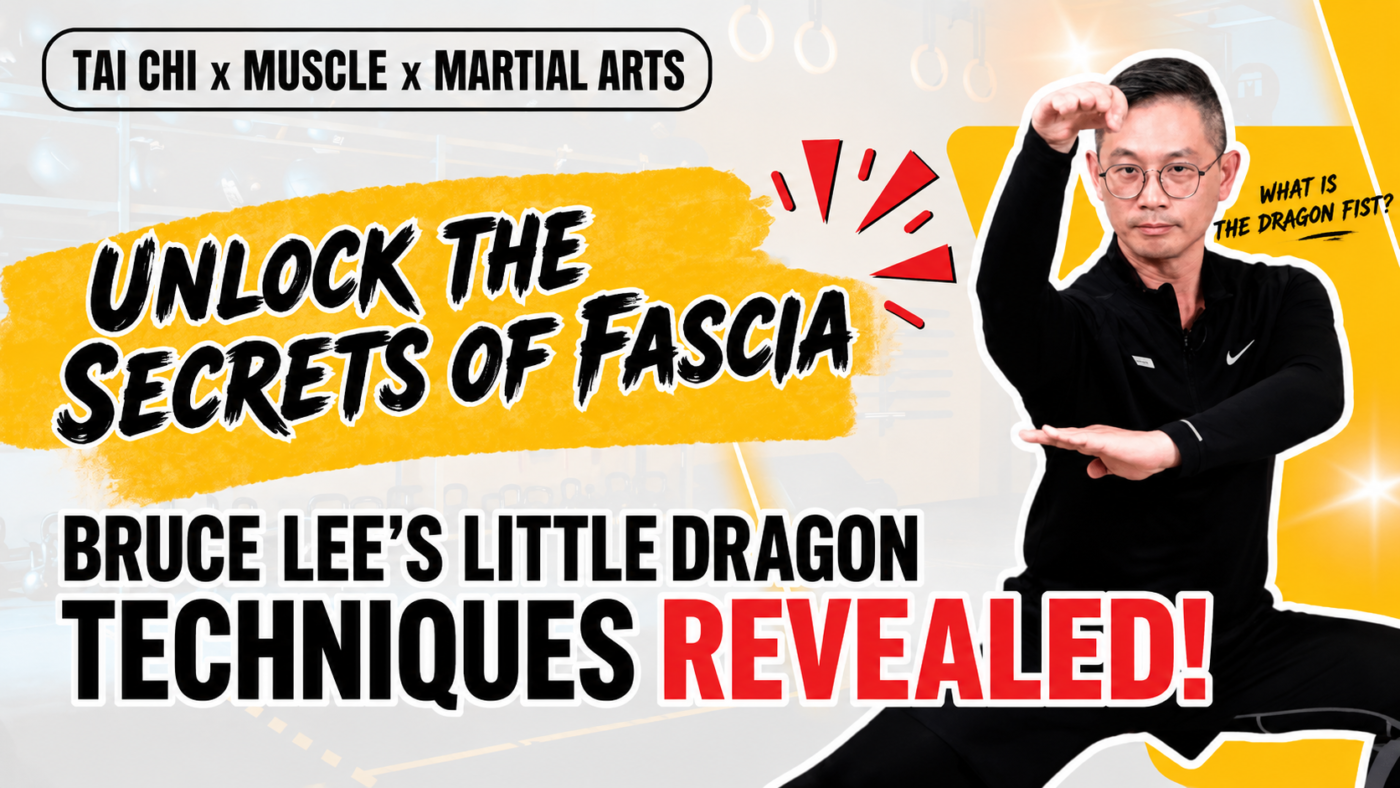
Fascia has become one of the most fascinating topics in modern movement science. It is often described as a body-wide network that connects muscles, surrounds organs, transmits force and helps us sense where our body is in space. Traditional practices such as Tai Chi have also emphasized whole-body coordination, relaxation, elasticity and awareness for centuries.
That overlap is genuinely interesting. But it does not mean every traditional explanation can simply be translated into modern fascia terminology.
Claims that fascia stores emotions, that intention directly moves fascia, that fascia alone produces martial-arts power, or that a particular posture can completely determine mood go considerably beyond current scientific evidence.
A better way to understand the subject is to preserve what is valuable in traditional movement practice while separating metaphor, personal experience and emerging hypotheses from established physiology.
That gives us a far more useful question: what can fascia science, Tai Chi and modern exercise research actually teach us about moving better as we age?
What Is Fascia?
Fascia is connective tissue that forms a continuous three-dimensional network throughout the body.
Depending on the anatomical definition being used, fascial tissues surround and connect muscles, nerves, blood vessels, organs and other structures. They contain collagen, elastin, cells such as fibroblasts, water and other components of the extracellular matrix.
It is therefore reasonable to think of fascia as part of a body-wide connective system.
It is less accurate to say that the entire body contains only one literal piece of fascia.
Different fascial layers and connective tissues have distinct structures and functions even though they are mechanically continuous with neighboring tissues.
This distinction matters because popular fascia discussions sometimes turn a useful anatomical concept into the idea of a mysterious single sheet controlling every part of the body.
The reality is more complex and more interesting.
Fascia Is Richly Innervated, but It Is Not Proven to Be an Emotional Organ
Fascial tissues contain sensory nerve endings.
These sensory systems contribute to mechanosensation, pain perception, proprioception and awareness of internal bodily states.
Proprioception is the ability to sense body position and movement without constantly looking at your limbs.
Close your eyes and touch your nose. Your nervous system can usually guide your finger remarkably well because information is continuously coming from muscles, tendons, joints, skin and connective tissues.
Fascia participates in this sensory environment.
However, saying that fascia contains sensory receptors is very different from saying that fascia itself is an emotional organ.
Human emotion emerges from interactions among the brain, autonomic nervous system, endocrine system, sensory information, memories and social context.
Fascial tissue may contribute sensory information to this broader system, but there is currently no good evidence that fascia independently stores emotions such as loneliness, fear or sadness.
Descriptions such as emotional fascia or emotional memory in fascia are therefore better understood as metaphors rather than established biological mechanisms.
Can Posture Influence How You Feel?
There is a more scientifically interesting idea underneath the emotional-fascia claim.
Body position and psychological state can influence each other.
Someone who feels exhausted or discouraged may naturally become less animated, move more slowly or adopt a more closed posture.
Conversely, changing how we move, breathe and interact with the environment may influence aspects of subjective experience.
But this relationship is not deterministic.
Slouching does not automatically make someone depressed.
Standing tall does not cure anxiety.
And adopting a so-called power pose is not a scientifically established method for dramatically changing hormones, confidence or life outcomes.
The strongest lesson is simpler.
Posture, movement, breathing, attention and mood interact. Comfortable upright movement may help some people feel more alert and capable, but posture should not be treated as a psychological diagnosis or cure.
The Traditional Tai Chi Idea of Length Without Excessive Tension
One of the most useful concepts in the original material is the distinction between stiffness and relaxed structural support.
Tai Chi practitioners often describe a feeling of being lifted gently through the top of the head while remaining grounded through the feet.
This should not require aggressive muscular contraction.
Imagine standing tall without trying to become rigid.
Allow the back of the neck to remain comfortable.
Let the rib cage move freely.
Keep the knees relaxed rather than locked.
Feel the feet contacting the ground.
The body becomes organized without becoming stiff.
Traditional language may describe this as using intention rather than brute force.
Modern movement science might describe aspects of the same experience in terms of motor control, postural coordination, sensory feedback and efficient distribution of muscular effort.
These are not identical explanations, but they can describe overlapping experiences.
Does Intention Really Change the Body?
Yes, but not because thoughts magically pull on fascia.
Movement begins with the nervous system.
Before voluntarily raising your arm, neural signals organize muscle activation.
Before changing your stance, your nervous system adjusts muscle tone, balance and joint position.
Attention can also change movement quality.
A person instructed to reach toward the ceiling may organize movement differently from someone simply told to straighten the spine.
Motor imagery is even used in rehabilitation and athletic training.
In that sense, traditional instructions based on imagery and intention can have legitimate value.
The scientific mechanism, however, involves the nervous system coordinating muscles and the rest of the musculoskeletal system.
It is more accurate to say:
intention influences motor control, and motor control changes tissue loading and movement.
That is very different from claiming that thought directly commands fascia.
Fascia and Whole-Body Force Transmission
Muscles do not function in complete isolation.
When you walk, run, throw, climb stairs or punch, forces are distributed across muscles, tendons, connective tissues, joints and the ground.
Fascial connections may participate in transmitting mechanical forces between neighboring structures.
This helps explain why modern biomechanics increasingly studies movement as coordinated kinetic chains rather than as isolated muscles acting independently.
But this does not mean muscular force is unimportant.
The statement that martial arts power does not come from muscles is physiologically incorrect.
Muscle contraction remains a major source of active human force.
What skilled movement can change is how effectively that force is coordinated and transmitted.
A powerful movement may involve the feet interacting with the ground, the legs generating force, the trunk transferring and rotating that force, and the shoulder, arm and hand delivering it.
Good coordination makes the whole movement appear effortless.
That is not the absence of muscle.
It is efficient use of muscle.
What Martial Arts Can Teach Us About Kinetic Chains
Traditional martial arts frequently describe power as beginning in the feet, traveling through the legs and waist, and finally reaching the hands.
This idea has a useful biomechanical parallel.
Throwing, striking and many athletic movements depend on sequential coordination across multiple body segments.
The legs, pelvis, trunk, shoulder and arm contribute at different moments.
If one part of the chain is poorly timed, some force is lost.
This helps explain why an experienced martial artist can sometimes produce impressive force without looking as though every muscle is contracting maximally.
Skill involves timing, acceleration, coordination and positioning.
Passive elastic structures may also temporarily store and return mechanical energy.
The body therefore operates as an integrated system.
It is unnecessary to claim that fascia alone explains martial-arts power.
What About Bruce Lee’s One-Inch Punch?
Bruce Lee’s famous short-distance striking demonstrations are often used today as examples of fascia-based power.
That interpretation is speculative.
Short-range striking can involve rapid lower-body force production, trunk rotation, joint sequencing, acceleration, body mass transfer and exceptional motor coordination.
Connective tissues inevitably participate because they are part of the musculoskeletal system.
But there is no scientific basis for saying Bruce Lee’s technique was primarily generated by a particular fascia chain.
His performance is better understood as an example of highly refined whole-body coordination.
The Spring-Like Body
The original video is much stronger when discussing elasticity.
Walking and running really do depend partly on elastic energy storage and return.
Tendons are particularly important.
When the foot contacts the ground during running, some mechanical energy can be temporarily stored in elastic tissues and then released during the next phase of movement.
The Achilles tendon is a classic example.
This can improve movement efficiency.
The fascial system and other connective tissues also have viscoelastic properties and participate in mechanical loading.
Traditional martial-arts descriptions of the body behaving like a spring can therefore be a useful analogy.
But it should remain an analogy.
The body is not literally a giant rubber band.
Movement Becomes Less Elastic With Aging
Aging is associated with changes in muscles, connective tissues, the nervous system and joints.
Research suggests that fascial tissues can become stiffer and show altered mechanical properties with advancing age.
Muscle mass and strength can decline.
Tendons and connective tissues may change.
Balance and proprioception can also deteriorate.
Physical inactivity can amplify many of these changes.
This is one reason remaining physically active is so important later in life.
However, the popular explanation that inactivity causes elastin to disappear and simply be replaced by collagen is an oversimplification.
Extracellular tissues undergo complex remodeling in response to aging, loading, injury and disuse.
Collagen turnover, cross-linking, extracellular matrix organization, hydration and cellular signaling all matter.
Exercise can influence connective-tissue remodeling, but it should not be described as simply turning collagen back into elastin.
Can Fascia Be Trained?
Connective tissues respond to mechanical loading.
The extracellular matrix is biologically active rather than being inert wrapping material.
Fibroblasts respond to mechanical forces, and physical activity can influence tissue remodeling.
Different forms of movement place different demands on connective tissues.
A sensible movement program can include strength training, mobility work, balance training, walking, controlled dynamic movement and, where appropriate, modest elastic or spring-like exercises.
For older adults, progression matters.
The goal is not to make every movement extremely flexible.
Healthy aging requires strength as well as mobility.
Being very flexible but weak is not automatically advantageous, just as being strong but unable to move comfortably through useful ranges may create limitations.
A resilient body needs both capacity and control.
Strength Training Does Not Automatically Make the Body Stiff
The transcript contrasts flexible martial artists with heavily muscled gym users.
This needs an important correction.
Resistance training does not inevitably make people stiff.
Well-designed strength training performed through appropriate ranges of motion can maintain or even improve flexibility while increasing strength, muscle mass and bone-loading capacity.
For adults over 40 and especially over 60, resistance training is one of the most important components of healthy aging.
Tai Chi, mobility exercises and strength training should not be presented as competitors.
They can complement each other extremely well.
Why Tai Chi Is Particularly Interesting for Healthy Aging
Tai Chi has much stronger scientific support than many of the speculative fascia claims surrounding it.
Modern systematic reviews and randomized trials have found that Tai Chi can improve balance and physical function in older adults.
It may also reduce fall risk.
Research has also reported improvements in aspects of lower-limb proprioception.
These effects make sense.
Tai Chi repeatedly challenges weight shifting, controlled stepping, coordination, balance, attention and awareness of body position.
Its slow pace allows practitioners to pay close attention to movement quality.
For many older adults, these are valuable skills.
Recent systematic reviews continue to support improvements in static and dynamic balance among older adults practicing Tai Chi.
So Tai Chi does not need extraordinary claims about invisible energy to be impressive.
Its measurable effects are already valuable.
Tai Chi and Proprioception
Traditional Tai Chi training pays close attention to subtle changes in pressure, balance and contact.
Push-hands practice adds interaction with another person’s movement and resistance.
From a scientific perspective, this can be discussed in terms of sensory feedback, anticipatory control, proprioception and motor learning.
A skilled practitioner may become very good at detecting changes in another person’s direction and pressure.
That does not require supernatural perception.
Athletes in many disciplines develop specialized sensory-motor skills through repeated practice.
Research has found evidence that Tai Chi can improve lower-limb joint proprioception in older adults, although the field still has limitations.
Can Balance Training Improve Body Awareness?
Yes.
Exercises performed on appropriately challenging surfaces, single-leg tasks and other sensorimotor activities can challenge balance and proprioceptive control.
A systematic review found potential improvements in balance among older adults following proprioceptive and sensorimotor exercise, although the overall certainty of evidence ranged from very low to low.
That is important because it reminds us not to oversell the science.
The evidence is encouraging, but not every exercise marketed as fascia activation has been scientifically validated.
Standing Meditation and Zhan Zhuang
Standing practices such as Zhan Zhuang are interesting because apparently little is happening externally while substantial attention is being directed internally.
A practitioner maintains a position while monitoring balance, breathing, unnecessary tension and body alignment.
This could reasonably be viewed as a form of low-intensity postural and attentional training.
However, claims that standing meditation specifically remodels fascia, changes collagen-to-elastin ratios or directly trains special fascial sensory pathways have not been established through high-quality clinical research.
The practice may still be useful.
We simply need to describe what is known and what remains hypothetical.
The Problem With the Idea of Fascia Memory
People often use the phrase muscle memory even though memories are not literally stored inside muscle fibers.
Much of what we call muscle memory reflects adaptations within the nervous system and changes produced through repeated training.
Fascia memory should be treated with similar caution.
Long-term habits can influence tissues.
Repeated loading can contribute to structural adaptation.
Inactivity can influence connective tissue.
Movement patterns can become habitual through motor learning.
But that is not evidence that fascia contains autobiographical memories or remembers being hugged as a child.
A sad memory triggered by a particular posture can certainly feel real.
The neurological explanation involves learned associations, sensory cues and memory systems in the brain.
There is no need to claim that the memory itself lives inside the fascia.
Can Your Body Store Stress?
Chronic psychological stress can influence the body.
Stress can alter muscle tension, sleep, pain sensitivity, breathing, heart rate and autonomic nervous-system activity.
People experiencing chronic anxiety may report persistent physical tension.
These experiences are real.
But saying that stress becomes physically trapped inside fascia is not currently an established biological explanation.
The more scientifically grounded interpretation is that psychological stress and physical symptoms interact through neural, endocrine, behavioral and autonomic pathways.
Movement, exercise, breathing practices, relaxation and Tai Chi can sometimes help because they influence several of these systems.
What Is Biotensegrity?
Biotensegrity attempts to apply the architectural concept of tensegrity to biological structures.
In a classic tensegrity structure, compression elements are stabilized within a continuous system of tension.
This provides an appealing way to think about how forces can be distributed throughout complex biological systems.
Researchers and clinicians have used the concept to discuss cells, connective tissues and whole-body mechanics.
However, whole-body biotensegrity remains primarily a theoretical model rather than a universally established explanation of human biomechanics.
Scientific reviews have specifically pointed out limitations of applying simplified tensegrity models to living humans, where fluids, muscles, neural control, organ movement and changing forces greatly increase complexity.
So biotensegrity can be a useful conceptual lens.
It should not be presented as proven proof that bones literally float independently inside a fascial web.
Why Whole-Body Thinking Still Matters
Rejecting exaggerated biotensegrity claims does not mean returning to a simplistic view in which every painful body part should be treated independently.
Human movement is clearly integrated.
Hip strength can influence walking.
Ankle mobility can change movement strategies.
Trunk control affects lifting.
Pain can alter movement elsewhere in the body.
The nervous system continuously coordinates these components.
Connective tissues also form anatomical continuities.
Research recognizes fascia as an interconnected connective-tissue system and continues to investigate its contribution to mechanics, injury and adaptation.
The key is to avoid converting interconnectedness into the claim that every painful location must be caused by a remote fascial restriction.
Low-back pain, for example, has many possible causes and often cannot be reduced to a single tight fascial chain.
Does Fascia Explain Back Pain?
Fascial tissues can contain nociceptive nerve endings and may contribute to some musculoskeletal pain.
But chronic back pain is usually multifactorial.
Potential contributors can include tissue injury, muscular capacity, sleep, stress, physical activity, nervous-system sensitization and other medical conditions.
For that reason, treating only the area that hurts is sometimes insufficient.
But treating every back problem as a global fascia imbalance is equally simplistic.
A good clinical approach starts with appropriate evaluation rather than a predetermined fascia theory.
Four Useful Training Qualities
Some contemporary fascia-oriented training systems emphasize elasticity, stretching, sensory awareness and tissue stimulation.
These ideas can be translated into a practical healthy-aging program without claiming that each exercise uniquely isolates fascia.
Elastic movement can include gentle bouncing, rhythmic stepping and progressive spring-like movement when appropriate.
Mobility work can help maintain comfortable range of motion.
Sensorimotor exercises can challenge balance and coordination.
Strength training can increase muscular capacity and improve the body’s ability to tolerate load.
Walking and aerobic activity support cardiovascular and metabolic health.
Tai Chi can provide a combination of balance, attention, controlled movement and weight shifting.
A complete program usually works better than chasing a single tissue.
Healthy Aging Is Not About Training Fascia Alone
The extracellular matrix changes with physical activity, inactivity and aging.
Mechanical loading influences cell signaling and connective-tissue remodeling.
That does not mean fascia should replace muscles, bones, tendons, joints or the nervous system in our understanding of movement.
Healthy aging depends on maintaining many capacities simultaneously.
Strength matters.
Balance matters.
Aerobic fitness matters.
Bone health matters.
Mobility matters.
Coordination matters.
Sleep and nutrition matter.
Cognitive and emotional health matter.
Fascia belongs inside this larger picture.
A Practical Tai Chi-Inspired Posture Exercise
Stand with your feet approximately hip-width apart.
Allow your knees to remain relaxed.
Imagine the crown of your head gently moving upward while your feet remain comfortably connected to the ground.
Avoid pulling your shoulders aggressively backward.
Let the neck remain comfortable.
Breathe naturally.
Now slowly shift your weight from one foot toward the other without rushing.
Pay attention to where you feel pressure under each foot.
Notice how the pelvis and trunk respond.
Return to the center.
This simple exercise combines postural awareness, balance, breathing and sensory attention without requiring mystical explanations.
For someone with significant balance problems, practice beside a stable support.
A Practical Elasticity Exercise
If you are medically able to perform standing exercise, begin with relaxed marching or gentle heel raises.
Allow movement to remain rhythmic rather than rigid.
Progress gradually rather than immediately attempting jumping or explosive bouncing.
Older adults with osteoporosis, joint disease, recent surgery or significant balance problems should choose exercise intensity carefully.
Elastic movement can be useful, but safety comes first.
The Most Important Principle: Do Not Confuse Relaxation With Collapse
Traditional Tai Chi makes an important distinction between being relaxed and becoming structurally collapsed.
Complete stiffness is inefficient.
Complete collapse is also inefficient.
Good movement continually adjusts muscular activity according to what the task requires.
When standing quietly, only modest activity is necessary.
When someone pushes against you, more muscular activity is required.
When the force disappears, unnecessary contraction should decrease.
This ability to adjust is one of the real meanings behind relaxed strength.
It is motor control, not magic.
What Science Supports and What Remains Speculative
Modern research supports the idea that fascia is a biologically active, innervated connective-tissue system that participates in mechanical force transmission and adapts to loading.
Research also supports Tai Chi as a useful exercise for balance and physical function, particularly in older adults.
There is reasonable evidence that sensory-motor and proprioceptive training can improve aspects of balance.
There is also strong biological evidence that connective tissues remodel in response to mechanical loading and aging.
However, several popular claims remain unsupported or substantially overstated.
Fascia has not been proven to independently store emotions.
The often-repeated claim that fascia contains exactly 250 million sensory receptors should not be presented as an established anatomical fact without qualification.
Thought does not directly move fascia independently of the nervous and muscular systems.
Martial-arts power does not come from fascia instead of muscles.
Bruce Lee’s one-inch punch has not been scientifically demonstrated to depend on specific fascial chains.
Biotensegrity remains a theoretical model.
Inactivity does not simply replace elastin with collagen, and exercise does not simply reverse that process.
Traditional concepts can be valuable without pretending that modern science has already proven every traditional explanation.
The Bottom Line
Fascia science and Tai Chi do have meaningful areas of overlap.
Both encourage us to think beyond isolated muscles and pay attention to coordination, sensory awareness, elasticity, movement quality and the body as an integrated system.
But the strongest bridge between tradition and modern science is not created by relabeling Qi as fascia or claiming that ancient masters secretly discovered connective-tissue biology centuries ago.
The stronger bridge is built by asking what traditional practices actually train.
Tai Chi trains controlled movement.
It trains balance.
It trains weight shifting.
It encourages attention to body position.
It combines breathing with movement.
It teaches practitioners to generate force without unnecessary muscular tension.
And research increasingly supports several of these qualities as valuable for healthy aging.
Your body is adaptable throughout life.
Movement can change strength, coordination, balance and connective-tissue loading.
The nervous system can continue learning.
Older adults can improve physical function.
That message is already powerful enough without exaggeration.
Frequently Asked Questions
Is fascia really one continuous network throughout the body?
Fascial connective tissues form anatomical continuities throughout the body, but describing all fascia as one literal sheet oversimplifies the anatomy. Different fascial tissues have different structures and functions.
Does fascia store emotions?
There is currently no convincing evidence that emotional memories are literally stored in fascia. Fascial tissues contain sensory nerves and participate in body sensation, while emotional memory is primarily associated with nervous-system processes.
Can posture change your mood?
Posture and emotional state can interact, but the effects are much more modest and complex than popular power-pose claims suggest. Standing tall is not a treatment for depression or anxiety.
Does Tai Chi train fascia?
Tai Chi inevitably loads muscles, tendons, connective tissues and joints. It may influence connective-tissue adaptation as part of normal physical training, but its proven health benefits should not be attributed exclusively to fascia.
Is Tai Chi good for older adults?
Research suggests Tai Chi can improve balance and physical function and may reduce fall risk in older adults.
Can Tai Chi improve proprioception?
Some evidence suggests Tai Chi can improve aspects of lower-limb proprioception, although more research is needed.
Does fascia generate strength without muscles?
No. Skeletal muscles are a major source of active force. Tendons, fascia and other connective tissues can transmit force and store or release elastic energy, but they work as parts of an integrated musculoskeletal system.
Is biotensegrity scientifically proven?
Biotensegrity is an influential theoretical model that may help conceptualize aspects of biological mechanics, but applying it as a complete explanation of whole-body biomechanics remains debated and requires further validation.
Does aging make fascia stiffer?
Research suggests aging is associated with structural and functional changes in connective tissues, including increased fascial stiffness and reduced elasticity. Physical activity may help maintain function, although aging cannot simply be reversed by a single type of fascia exercise. PubMed
Is strength training bad for fascia or flexibility?
No. Properly designed resistance training is an important part of healthy aging and does not automatically make the body stiff. Strength, mobility, balance and aerobic exercise can all be combined.
References
Schleip R and colleagues. Fascial Tissue Research in Sports Medicine: From Molecules to Tissue Adaptation, Injury and Diagnostics.
Bordoni B and Myers T. A Review of the Theoretical Fascial Models: Biotensegrity, Fascintegrity, and Myofascial Chains.
Bordoni B and colleagues. Biotensegrity or Fascintegrity?
Wilke J and colleagues. Structural and Functional Changes in the Coupling of Fascial Tissue, Skeletal Muscle and Nerves During Aging.
Bertolini R and colleagues. Effects of Tai Chi Chuan on Older Adults’ Balance: A Systematic Review With Meta-Analysis.
Cui and colleagues. Tai Chi Improves Balance Performance in Healthy Older Adults: A Systematic Review and Meta-Analysis.
Effects of Tai Chi on Lower Limb Proprioception in Adults Aged Over 55: A Systematic Review and Meta-Analysis.
Exercise Builds the Scaffold of Life: Muscle Extracellular Matrix Biomarker Responses to Physical Activity, Inactivity and Aging.
Medical Disclaimer
This article is intended for general educational purposes and is not a substitute for individualized medical advice, diagnosis or treatment. People with significant pain, neurological symptoms, dizziness, recent injury, osteoporosis, balance problems or other medical conditions should consult an appropriate healthcare professional before beginning a new exercise program.
This article is for general education and does not replace individualized care from a qualified health professional. Seek appropriate advice for persistent, severe, or concerning symptoms.
Read the full medical disclaimer