Alzheimer’s Disease and Dementia: Understanding Memory Loss and Cognitive Health
Alzheimer’s disease and dementia are major brain health concerns that affect memory, thinking, communication, independence, and quality of life. As populations age, more individuals and families are navigating the challenges of cognitive decline and the growing need for supportive care.
Understanding Alzheimer’s disease and dementia requires recognizing the difference between normal age-related forgetfulness, mild cognitive impairment, and progressive neurological conditions that interfere with everyday activities.
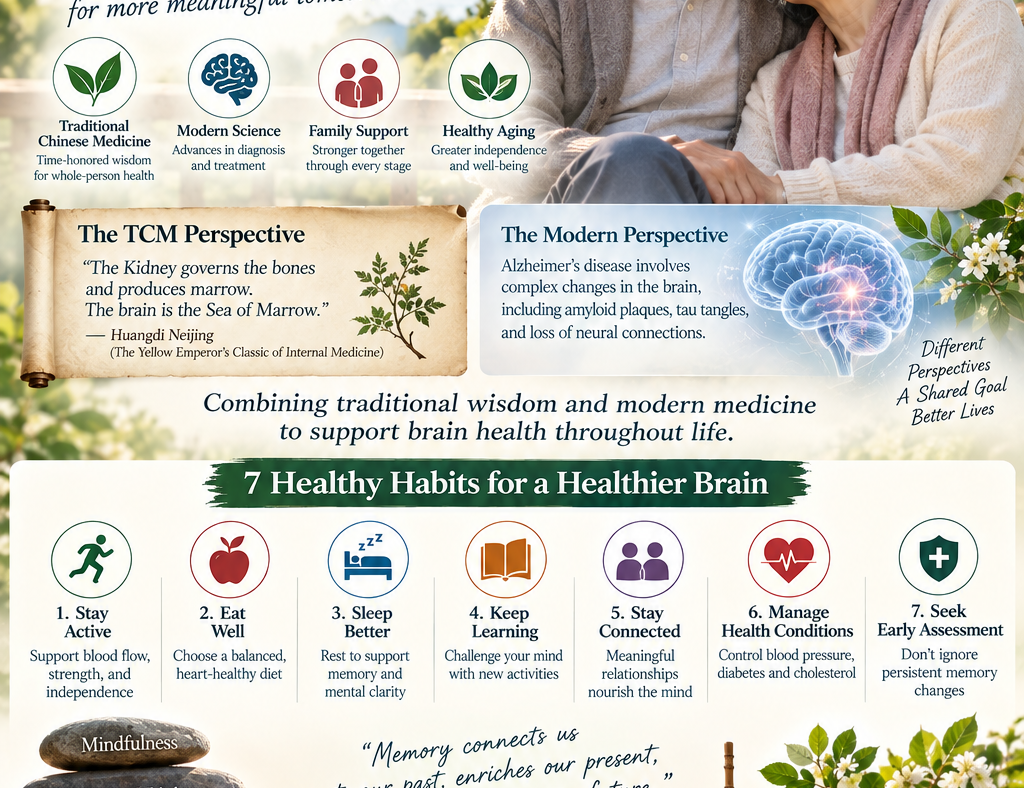
Traditional Chinese Medicine offers a historical perspective through Kidney Essence, the Sea of Marrow, Qi and blood, and the preservation of foundational vitality. Modern neuroscience provides an evidence-based understanding of brain aging, amyloid plaques, tau tangles, neuronal damage, and the complex biological processes associated with cognitive disorders.
A comprehensive approach to brain health combines appropriate medical assessment, preventive healthcare, balanced nutrition, regular physical activity, restorative sleep, mental engagement, and social connection.
The goal is to support cognitive well-being, recognize meaningful changes early, and help individuals and families maintain dignity, independence, and quality of life throughout the aging process.Alzheimer’s disease and dementia are important public health concerns in an aging world. As life expectancy increases, more families are navigating changes in memory, thinking, communication, and everyday independence among older relatives.
For some individuals, the first noticeable change is a gradual decline in short-term memory. A person may repeatedly forget recent conversations, misplace familiar objects, or struggle to remember appointments.
Others experience difficulty organizing daily activities, finding the right words, making decisions, or navigating familiar surroundings.
As cognitive difficulties become more pronounced, family members may need to provide increasing support with medication management, household responsibilities, financial decisions, and personal care.
Traditional Chinese Medicine (TCM) approaches memory and cognitive vitality through the historical concepts of Kidney Essence, the Sea of Marrow, Qi and blood, and the nourishment of the brain.
Modern neuroscience provides a different explanation based on brain cells, neural connections, protein accumulation, vascular health, genetics, and the complex biological processes associated with neurodegenerative disease.
A comprehensive approach to cognitive wellness can acknowledge both perspectives while distinguishing classical health philosophy from established medical knowledge.
The goal of brain health preservation is not to promise that every form of cognitive decline can be reversed.
It is to recognize meaningful changes early, support appropriate diagnosis and treatment, maintain everyday functioning, and preserve dignity and quality of life throughout the aging process.
What Is Dementia?
Dementia is a general term used to describe a decline in cognitive abilities that becomes significant enough to interfere with everyday activities and independence.
It is not a single disease.
Rather, dementia can result from several different conditions affecting the brain.
These conditions may interfere with memory, language, attention, judgment, reasoning, spatial awareness, and behavior.
Some people develop progressive difficulty remembering new information.
Others initially experience changes in personality, communication, movement, or executive functioning.
The symptoms depend partly on the underlying disease and the brain regions affected.
Dementia should not be confused with ordinary age-related forgetfulness.
Although certain changes in memory and thinking can occur during healthy aging, dementia involves more substantial impairment.
According to the World Health Organization’s July 2026 fact sheet, approximately 57 million people worldwide were living with dementia in 2021.
Nearly 10 million new cases occur globally each year, making dementia an important concern for healthcare systems, families, and communities.
Alzheimer’s disease is the most common cause, accounting for approximately 60%–70% of dementia cases.
世界卫生组织
+1
Alzheimer’s Disease: Understanding the Most Common Form of Dementia
Alzheimer’s disease is a progressive neurodegenerative condition that affects memory, thinking, and other cognitive functions.
The disease involves complex biological changes in the brain.
Two important features are the accumulation of beta-amyloid plaques and abnormal tau protein tangles.
Beta-amyloid plaques form between nerve cells, while abnormal tau accumulates within neurons.
These changes are associated with impaired cellular communication, loss of neural connections, and progressive damage to brain tissue.
However, Alzheimer’s disease is not caused by one simple mechanism.
Genetic susceptibility, age-related biological changes, inflammation, vascular health, and other factors may contribute.
As the disease progresses, individuals may experience increasing difficulty with memory, communication, judgment, and everyday activities.
Eventually, some people require substantial assistance with personal care and daily living.
The rate of progression varies considerably.
Alzheimer’s disease cannot currently be cured, but available treatments can help manage symptoms, and selected disease-modifying therapies may slow progression in eligible people with early Alzheimer’s disease.
The Traditional Chinese Medicine Concept of Kidney Governing the Brain
One of the classical principles of Traditional Chinese Medicine is that the Kidney stores Essence and governs the bones.
Within this historical framework, Kidney Essence is associated with growth, development, reproduction, aging, and the nourishment of the body.
The classical relationship between the Kidney, bone marrow, and brain occupies an important place in traditional discussions of cognitive vitality.
A traditional expression describes the brain as the Sea of Marrow.
The brain is understood as requiring sufficient nourishment from foundational Essence and other vital substances to maintain its traditional functional balance.
Classical Chinese medicine also describes the Kidney as governing storage and preservation.
Within this framework, memory is sometimes discussed through the concept of retaining and storing information.
Some traditional practitioners interpret reduced memory, fatigue, or other age-related complaints through patterns involving Kidney Essence deficiency.
These descriptions reflect a historical system of health interpretation.
They are not equivalent to modern measurements of neurological function, cerebrospinal fluid, kidney filtration, or brain tissue volume.
The traditional relationship between Kidney Essence and brain health can be appreciated as part of Chinese medical philosophy without interpreting it as proof that anatomical kidney disease causes Alzheimer’s disease.
Kidney Essence and the Traditional Philosophy of Healthy Aging
Traditional Chinese Medicine places considerable emphasis on preserving foundational vitality throughout life.
Kidney Essence is understood within the classical framework as an important resource associated with development and aging.
As people grow older, traditional practitioners may interpret certain changes in strength, hearing, memory, or physical vitality through the concept of declining Essence.
This perspective encourages attention to long-term nourishment, appropriate rest, and sustainable daily habits.
However, there is no established scientific basis for concluding that all memory problems result from Kidney Essence deficiency.
Likewise, replenishing traditional Kidney Essence has not been demonstrated to reverse the brain pathology of Alzheimer’s disease.
Modern medicine recognizes that the anatomical kidneys and brain interact through several physiological processes.
For example, advanced kidney disease can affect cognitive functioning through metabolic, vascular, and other mechanisms.
However, this does not establish an equivalence between classical Kidney Essence and modern kidney function.
The traditional principle is most useful as a cultural perspective encouraging people to protect their health throughout life.
The Sea of Marrow: A Classical Understanding of Brain Nourishment
The brain occupies a distinctive position in Traditional Chinese Medicine.
Although classical theory emphasizes the five Zang systems, it also recognizes the brain as an important structure associated with consciousness, sensory function, and mental activity.
The expression Nao Wei Sui Zhi Hai (脑为髓之海) describes the brain as the Sea of Marrow.
Within this historical framework, adequate nourishment of the Sea of Marrow is considered important for cognitive and physical vitality.
Traditional practitioners may discuss symptoms such as dizziness, forgetfulness, reduced concentration, or other complaints through patterns involving insufficient nourishment of the brain.
However, the classical concept of Marrow is not identical to anatomical bone marrow.
Modern bone marrow produces blood cells and performs important immune functions.
The brain is composed of specialized nervous tissue, including neurons, supporting cells, blood vessels, and other structures.
Memory depends on coordinated neural activity rather than the physical storage of reproductive Essence within the brain.
The traditional concept of nourishing the Sea of Marrow should therefore not be interpreted as evidence that herbal tonification can regenerate damaged neurons or reverse established dementia.
How Memory Works in the Modern Brain
Memory is not a single function located within one organ or isolated brain region.
It depends on coordinated activity across several neural networks.
Different types of memory involve different biological processes.
Short-term and working memory allow people to retain information temporarily while completing tasks.
Long-term memory involves the formation, consolidation, storage, and retrieval of information over longer periods.
The hippocampus plays an important role in forming certain new memories.
Other brain regions, including parts of the cerebral cortex, contribute to long-term information processing and retrieval.
Attention, sleep, emotional state, and general health can influence how effectively information is learned and remembered.
This helps explain why a person who is exhausted, distracted, or under significant stress may struggle to remember new information.
However, temporary difficulty concentrating is not equivalent to Alzheimer’s disease.
Understanding the distinction between ordinary cognitive fluctuations and progressive impairment is essential for responsible brain health education.
Normal Age-Related Forgetfulness Versus Dementia
Many older adults notice that recalling names or retrieving certain information takes longer than it once did.
These experiences can occur during normal aging.
However, more substantial changes in memory and everyday functioning deserve attention.
The following comparison illustrates some common differences.
| Normal Age-Related Forgetfulness | Possible Signs of Dementia |
|---|---|
| Occasionally forgetting a name | Frequently forgetting familiar people or important information |
| Misplacing an object occasionally | Repeatedly losing items and being unable to retrace steps |
| Forgetting an appointment but remembering later | Repeatedly forgetting important appointments or recent events |
| Occasionally searching for a word | Increasing difficulty maintaining conversations |
| Making an occasional mistake | Repeated problems managing familiar responsibilities |
| Needing more time to learn a new skill | Significant difficulty completing previously familiar tasks |
These examples are not sufficient to establish a diagnosis.
They indicate when further assessment may be appropriate.
A person experiencing persistent or progressive memory difficulties should not assume that the changes are an inevitable consequence of aging.
Mild Cognitive Impairment: An Important Stage to Understand
Mild cognitive impairment, commonly abbreviated as MCI, describes cognitive changes that are more pronounced than expected for an individual’s age but do not substantially interfere with everyday independence.
A person with MCI may notice increasing forgetfulness or difficulty concentrating.
Family members may also observe changes.
However, the individual can generally continue performing ordinary daily activities.
MCI is important because some people with the condition later develop Alzheimer’s disease or another form of dementia.
Nevertheless, not everyone with MCI progresses to dementia.
Some individuals remain relatively stable over time.
Others improve, particularly when a contributing medical or psychological condition is identified and treated.
MCI therefore should not be interpreted as a guaranteed early stage of Alzheimer’s disease.
Appropriate evaluation can help clarify the nature of the symptoms and guide follow-up care.
Early Warning Signs of Alzheimer’s Disease
Recognizing cognitive changes early can provide opportunities for appropriate assessment and planning.
Some of the changes that deserve attention include persistent difficulty remembering recently learned information.
A person may ask the same question repeatedly despite receiving an answer only a short time earlier.
They may struggle with familiar responsibilities, such as paying bills, preparing meals, or managing medication schedules.
Other possible changes include increasing difficulty finding words, following conversations, or understanding the sequence of familiar activities.
Some individuals experience confusion about dates, places, or the purpose of an activity.
Others begin having difficulty navigating familiar routes.
Personality or behavioral changes can also occur.
However, these symptoms are not unique to Alzheimer’s disease.
Depression, medication effects, sleep disorders, delirium, metabolic disturbances, and other conditions may produce similar complaints.
Early medical assessment is therefore more appropriate than attempting to determine the diagnosis through traditional constitutional signs alone.
Why Alzheimer’s Disease Is Not Simply Kidney Deficiency
Traditional Chinese Medicine sometimes attributes age-related memory problems to Kidney deficiency or insufficient nourishment of the Sea of Marrow.
However, Alzheimer’s disease has identifiable neurological and biological characteristics that cannot be reduced to one traditional pattern.
The condition involves complex changes affecting neurons, protein processing, brain networks, and other biological systems.
Traditional pattern differentiation does not establish the presence or absence of amyloid plaques or tau pathology.
Similarly, symptoms such as cold hands, fatigue, lower back discomfort, or reduced sexual vitality do not diagnose Alzheimer’s disease.
There is no established evidence that taking a Kidney-tonifying formula for 30 or 100 days reliably reverses Alzheimer’s pathology or restores lost cognitive function.
The historical concept of supporting vitality may contribute to discussions of general wellness.
However, it should not replace neurological assessment, appropriate treatment, or ongoing cognitive care.
The Relationship Between Sexual Activity and Memory
Traditional Chinese health literature sometimes associates excessive sexual activity with the depletion of Kidney Essence.
Within this historical framework, reproductive Essence is considered part of the body’s foundational resources.
Some classical explanations connect the loss of Essence with reduced vitality or difficulty concentrating.
However, modern medicine does not establish ordinary sexual activity or masturbation as causes of Alzheimer’s disease or permanent cognitive decline.
There is no scientifically validated monthly limit on masturbation required to preserve memory.
Similarly, a decline in academic performance does not establish that a young person has depleted reproductive Essence.
Changes in concentration or learning may involve inadequate sleep, stress, depression, attention difficulties, medical conditions, or other factors.
Sexual activity can be part of normal human health when it is consensual, comfortable, and does not interfere with important responsibilities.
The appropriate concern is whether a behavior causes distress, injury, sleep deprivation, or significant disruption to daily life.
Ordinary sexual behavior should not be presented as a cause of dementia or intellectual impairment.
The Relationship Between Cardiovascular Health and Brain Health
Modern brain health research emphasizes the importance of cardiovascular and metabolic health.
The brain requires an adequate supply of oxygen and nutrients delivered through blood circulation.
Conditions affecting blood vessels may influence cognitive functioning over time.
Hypertension, diabetes, high cholesterol, smoking, and other cardiovascular risk factors can contribute to vascular disease.
Some individuals develop vascular cognitive impairment after strokes or through the cumulative effects of damage to small blood vessels.
Alzheimer’s disease and vascular disease can also coexist.
This is one reason modern preventive health strategies frequently address heart and brain health together.
Managing blood pressure, blood glucose, and cholesterol according to medical guidance can support overall health and may contribute to reducing dementia risk.
However, an individual who maintains healthy cardiovascular habits can still develop Alzheimer’s disease.
Risk reduction is not the same as guaranteed prevention.
Sleep and Memory: Why Rest Matters
Sleep contributes to several important aspects of cognitive health.
During sleep, the brain participates in processes associated with memory consolidation and the regulation of neural activity.
Inadequate sleep can interfere with attention, learning, and the ability to remember new information.
Persistent sleep problems may also affect daytime functioning and emotional well-being.
Older adults may experience insomnia, sleep apnea, fragmented sleep, or other sleep-related concerns.
Some individuals with dementia develop changes in sleep timing, nighttime restlessness, or difficulty maintaining a consistent daily rhythm.
Sleep health therefore deserves attention both before and after the development of cognitive impairment.
Maintaining a consistent routine, obtaining appropriate daytime light exposure, and addressing sleep disorders may support overall well-being.
However, sleeping for a particular number of hours or following a traditional meridian schedule does not guarantee prevention of Alzheimer’s disease.
Sleep problems that persist or substantially interfere with daily life deserve individualized assessment.
The Importance of Hearing and Vision for Cognitive Health
Sensory health is often overlooked in discussions of memory and healthy aging.
Hearing loss may make conversations increasingly difficult.
A person who cannot clearly hear information may appear forgetful even when the primary problem involves hearing.
Vision difficulties can also interfere with reading, navigation, social participation, and everyday activities.
Appropriate hearing and vision care may help older adults remain connected with their surroundings.
The World Health Organization includes addressing sensory impairments, including the use of hearing aids where needed, among important approaches to dementia risk reduction.
These interventions should be understood as part of comprehensive health preservation rather than guaranteed methods of preventing cognitive decline.
7 Healthy Habits for a Healthier Brain
Supporting cognitive health requires attention to several aspects of daily life.
The following habits can contribute to broader physical and mental well-being.
1. Maintain Regular Physical Activity
Appropriate physical activity supports cardiovascular health, mobility, and general well-being.
Walking, swimming, cycling, strength training, and suitable low-impact activities may be incorporated into a healthy routine.
For older adults, balance and strength exercises can also support independence and reduce fall risk.
2. Follow a Balanced, Heart-Healthy Diet
A varied diet can support general health and cardiovascular function.
Vegetables, fruits, whole grains, appropriate protein sources, nuts, and healthy fats may form part of a balanced eating pattern.
Dietary approaches such as the Mediterranean and DASH eating patterns have been studied in relation to cardiovascular and cognitive health.
No single food or supplement has been established as a cure for Alzheimer’s disease.
3. Protect Sleep Quality
Maintain reasonably consistent sleeping and waking times.
Address persistent insomnia, excessive daytime sleepiness, or symptoms suggesting sleep apnea.
Avoid assuming that poor sleep is an unavoidable consequence of aging.
4. Stay Mentally Engaged
Continue participating in meaningful learning and enjoyable intellectual activities.
Reading, music, language learning, crafts, art, and other interests may support engagement.
Choose activities that are satisfying rather than treating memory exercises as a compulsory test of intelligence.
5. Maintain Social Connections
Regular interaction with family members, friends, neighbors, and community groups can support emotional well-being.
Conversation, shared activities, and meaningful relationships may help reduce social isolation.
Older adults with mobility or communication difficulties may need practical assistance to maintain social participation.
6. Manage Chronic Health Conditions
Follow appropriate care for hypertension, diabetes, high cholesterol, depression, and other relevant conditions.
Review medications when side effects or interactions are suspected.
Hearing and vision assessments are also important parts of comprehensive preventive healthcare.
7. Seek Assessment for Persistent Cognitive Changes
Do not dismiss progressive memory difficulties as normal aging.
Early evaluation may identify treatable conditions or clarify whether Alzheimer’s disease or another cognitive disorder is present.
Medical assessment can also help individuals and families prepare for future care needs.
These principles are consistent with the World Health Organization’s updated 2026 guidance on reducing cognitive decline and dementia risk across the lifespan.
Tai Chi, Qigong, and Traditional Brain Health Cultivation
Tai Chi and Qigong are traditional Chinese mind-body practices combining gentle movement, postural control, breathing awareness, and focused attention.
Within the classical framework, these practices are sometimes described as supporting the movement of Qi and the harmonious relationship between Yin and Yang.
Modern research evaluates these practices through measurable outcomes such as physical function, balance, cognitive performance, and quality of life.
Tai Chi may provide a suitable form of low-impact activity for some older adults.
The combination of movement, attention, coordination, and social participation can make it an appealing component of a broader wellness routine.
However, Tai Chi and Qigong have not been established as cures for Alzheimer’s disease.
They should not be presented as methods for removing amyloid plaques or regenerating damaged brain tissue.
For people already living with dementia, movement activities should be adapted to mobility, balance, medical conditions, and individual preferences.
The aim is to support comfort, physical function, and meaningful participation rather than achieve a specific cognitive score.
How Alzheimer’s Disease Is Diagnosed
An accurate diagnosis begins with understanding the person’s symptoms and medical history.
A healthcare professional may ask about changes in memory, language, behavior, everyday functioning, and medication use.
Information from a family member or another trusted person may be useful when the individual agrees.
Cognitive assessments can help identify patterns of impairment.
Blood tests and other investigations may be used to examine possible contributing conditions.
Brain imaging, including MRI or CT, can help evaluate structural changes or identify other possible explanations.
In selected circumstances, specialists may use tests involving cerebrospinal fluid, blood biomarkers, or amyloid PET imaging.
These techniques can provide information about biological changes associated with Alzheimer’s disease.
However, no single test should be interpreted in isolation.
Diagnosis requires consideration of symptoms, cognitive functioning, clinical history, and appropriate investigations.
Early assessment may be particularly important when treatment eligibility depends on confirming the underlying disease.
Modern Treatment Options for Alzheimer’s Disease
Although Alzheimer’s disease cannot currently be cured, modern treatment offers several approaches to managing symptoms and supporting quality of life.
Some medications are used to help maintain cognitive functioning or reduce certain symptoms.
Cholinesterase inhibitors, including donepezil and rivastigmine, may be prescribed for selected individuals.
Memantine may be considered for some people with moderate or severe Alzheimer’s disease.
The appropriate treatment depends on the stage of illness, medical history, and individual circumstances.
More recently, anti-amyloid treatments have become available for selected people with early Alzheimer’s disease.
These include lecanemab and donanemab.
They target abnormal amyloid accumulation and may slow clinical decline in eligible patients.
However, these therapies are not suitable for everyone and do not cure Alzheimer’s disease.
They can cause serious adverse effects, including brain swelling and bleeding, and require specialist assessment and appropriate MRI monitoring.
In August 2025, the U.S. Food and Drug Administration recommended additional earlier MRI monitoring for patients receiving lecanemab because of safety concerns involving amyloid-related imaging abnormalities.
FDA
+2
Treatment decisions should be made through individualized discussion with an appropriately qualified healthcare professional.
Can Traditional Chinese Medicine Treat Alzheimer’s Disease?
Traditional Chinese Medicine has a long history of addressing age-related changes in memory and vitality.
Traditional practitioners may consider patterns involving Kidney Essence, the Sea of Marrow, Qi deficiency, blood stasis, or other classical concepts.
However, these patterns are not established explanations for the biological processes underlying Alzheimer’s disease.
The effectiveness of a particular herbal formula cannot be determined from traditional theory alone.
There is insufficient reliable evidence that Kidney-tonifying preparations can consistently reverse Alzheimer’s disease or restore lost neurological function.
Traditional herbal products may also cause adverse effects or interact with prescription medications.
Some preparations may contain contaminants or undeclared ingredients.
Anyone considering complementary treatment should discuss the specific product and its ingredients with an appropriate healthcare professional.
Traditional wellness practices may support comfort and general well-being, but they should not replace necessary neurological care or established medical treatment.
Supporting a Family Member Living With Dementia
Dementia affects more than memory.
It can change how a person communicates, manages everyday activities, and interacts with familiar surroundings.
Family support can therefore become increasingly important.
However, providing care should not mean taking away every opportunity for independence.
A person living with early dementia may still be able to participate in daily decisions, maintain hobbies, enjoy relationships, and perform familiar activities.
Support should be adapted to the individual’s actual abilities.
A predictable daily routine may reduce confusion.
Clear communication, familiar objects, and a comfortable environment can also be helpful.
When memory difficulties make complex instructions challenging, short and respectful explanations may be more effective.
Families may need to consider medication management, home safety, transportation, and future care arrangements.
The person living with dementia should remain involved in decisions as much as possible.
Preserving dignity is an essential part of good dementia care.
Caregiver Health and Emotional Well-Being
Family members who provide dementia care may experience substantial physical and emotional demands.
Some caregivers manage employment, household responsibilities, and care for children while supporting an older relative.
Others experience interrupted sleep, social isolation, or uncertainty about the future.
Caregiving responsibilities may increase as the disease progresses.
A sustainable care plan should include support for caregivers as well as the person living with dementia.
Sharing responsibilities among family members, arranging respite care, and accessing community services may help reduce excessive strain.
Caregivers also need opportunities to maintain their own medical care, sleep, relationships, and personal activities.
Seeking practical support is an important part of maintaining safe and compassionate care.
When Memory Problems Require Urgent Medical Attention
Gradual changes in memory and thinking deserve medical evaluation, but sudden confusion requires particular attention.
A person who becomes acutely disoriented over hours or days may be experiencing delirium, medication-related effects, infection, metabolic disturbance, or another medical problem.
This pattern differs from the usual gradual progression of Alzheimer’s disease.
Sudden difficulty speaking, facial drooping, weakness on one side of the body, or an abrupt change in neurological function may indicate stroke.
These symptoms require emergency medical assessment.
Rapidly worsening confusion, unexplained loss of consciousness, or serious changes in alertness should also be assessed urgently.
Families should not assume that every new episode of confusion is simply part of existing dementia.
Treatable medical conditions can occur alongside Alzheimer’s disease and may require prompt intervention.
Alzheimer’s Disease and Dementia: Supporting Brain Health and Healthy Aging
Traditional Chinese Medicine offers a historical philosophy in which cognitive vitality is associated with Kidney Essence, the Sea of Marrow, Qi and blood, and the preservation of foundational resources throughout life.
The classical principle of supporting vitality reflects a longstanding interest in maintaining health before serious problems become established.
Modern neuroscience provides a scientific understanding of Alzheimer’s disease, brain aging, neurodegeneration, vascular health, and the complex mechanisms involved in memory and cognition.
These perspectives can coexist when their different purposes and limitations are clearly understood.
Memory loss should not automatically be attributed to Kidney deficiency, sexual activity, or the natural passage of time.
Some cognitive complaints arise from treatable conditions.
Others reflect mild cognitive impairment or an established neurological disease.
Early assessment can help identify the underlying problem and clarify appropriate care.
For individuals without dementia, sustainable habits may support broader brain health and help reduce certain risks.
For people living with Alzheimer’s disease, appropriate treatment, meaningful daily activities, emotional support, and practical assistance can help preserve quality of life.
For families and caregivers, access to reliable information and community support is equally important.
The purpose of healthy aging is not to promise that every person can remain free from cognitive disease.
It is to support the brain and body throughout life while preserving independence, dignity, human connection, and compassionate care.
The deeper lesson of traditional health cultivation is that longevity should be accompanied by thoughtful attention to the quality of life.
By combining preventive wellness with modern medical knowledge, individuals and families can approach cognitive aging with greater understanding, preparation, and confidence.
FAQ
What is the difference between Alzheimer’s disease and dementia?
Dementia is a general term describing cognitive decline that significantly interferes with everyday functioning. Alzheimer’s disease is a specific neurodegenerative condition and the most common cause of dementia.
What are the early warning signs of Alzheimer’s disease?
Early signs may include persistent difficulty remembering recent information, repeating questions, misplacing objects, struggling with familiar tasks, and becoming confused about time or place. Changes in language, judgment, and behavior may also occur.
Is memory loss a normal part of aging?
Mild forgetfulness can occur during normal aging. However, persistent memory problems that interfere with daily activities deserve medical assessment. Dementia is not an inevitable consequence of growing older.
What is mild cognitive impairment?
Mild cognitive impairment, or MCI, involves measurable changes in memory or other cognitive functions that are more pronounced than expected for age but do not substantially interfere with everyday independence. Not everyone with MCI develops dementia.
Can Traditional Chinese Medicine cure Alzheimer’s disease?
Traditional Chinese Medicine offers historical concepts involving Kidney Essence, Qi and blood, and the Sea of Marrow. However, traditional Kidney-tonifying therapies have not been established as cures for Alzheimer’s disease or methods for reversing its underlying brain pathology.
Can Tai Chi help support brain health?
Tai Chi may support physical activity, balance, coordination, and general well-being. It can be incorporated into a broader healthy-aging routine when appropriate. However, Tai Chi has not been established as a cure for Alzheimer’s disease.
What daily habits may help reduce dementia risk?
Regular physical activity, balanced nutrition, appropriate blood pressure and diabetes management, avoiding smoking, addressing hearing and vision problems, maintaining social connections, and supporting sleep health may contribute to reducing dementia risk. No lifestyle routine can guarantee prevention.
Can Alzheimer’s disease be treated?
There is currently no cure for Alzheimer’s disease. However, certain medications may help manage symptoms, while selected disease-modifying treatments, including lecanemab and donanemab, may slow clinical decline in eligible individuals with early Alzheimer’s disease. These treatments require specialist assessment and have potentially serious adverse effects.
How can family members support someone living with dementia?
Family members can provide a predictable daily routine, respectful communication, practical assistance, social engagement, and appropriate healthcare support. Care should be adapted to the individual’s abilities while preserving dignity and participation in decisions.
When should someone seek medical attention for memory loss?
Persistent or progressive memory changes deserve medical assessment. Sudden confusion, difficulty speaking, facial drooping, or new weakness may indicate an acute medical condition such as stroke and require emergency care.
Medical Disclaimer
This article is intended for educational and informational purposes only and does not constitute medical advice, diagnosis, or treatment. Traditional Chinese Medicine concepts are presented for historical and educational understanding and should not be considered equivalent to established medical diagnoses. Alzheimer’s disease, dementia, mild cognitive impairment, and other causes of memory loss require individualized medical assessment. Do not discontinue prescribed medication or replace necessary neurological care with herbal remedies, supplements, or complementary practices. Anti-amyloid therapies have specific eligibility requirements and potentially serious adverse effects and should be considered only under specialist supervision. Sudden confusion, loss of consciousness, facial drooping, difficulty speaking, or new weakness may indicate a medical emergency and requires immediate assessment.
This article is for general education and does not replace individualized care from a qualified health professional. Seek appropriate advice for persistent, severe, or concerning symptoms.
Read the full medical disclaimer