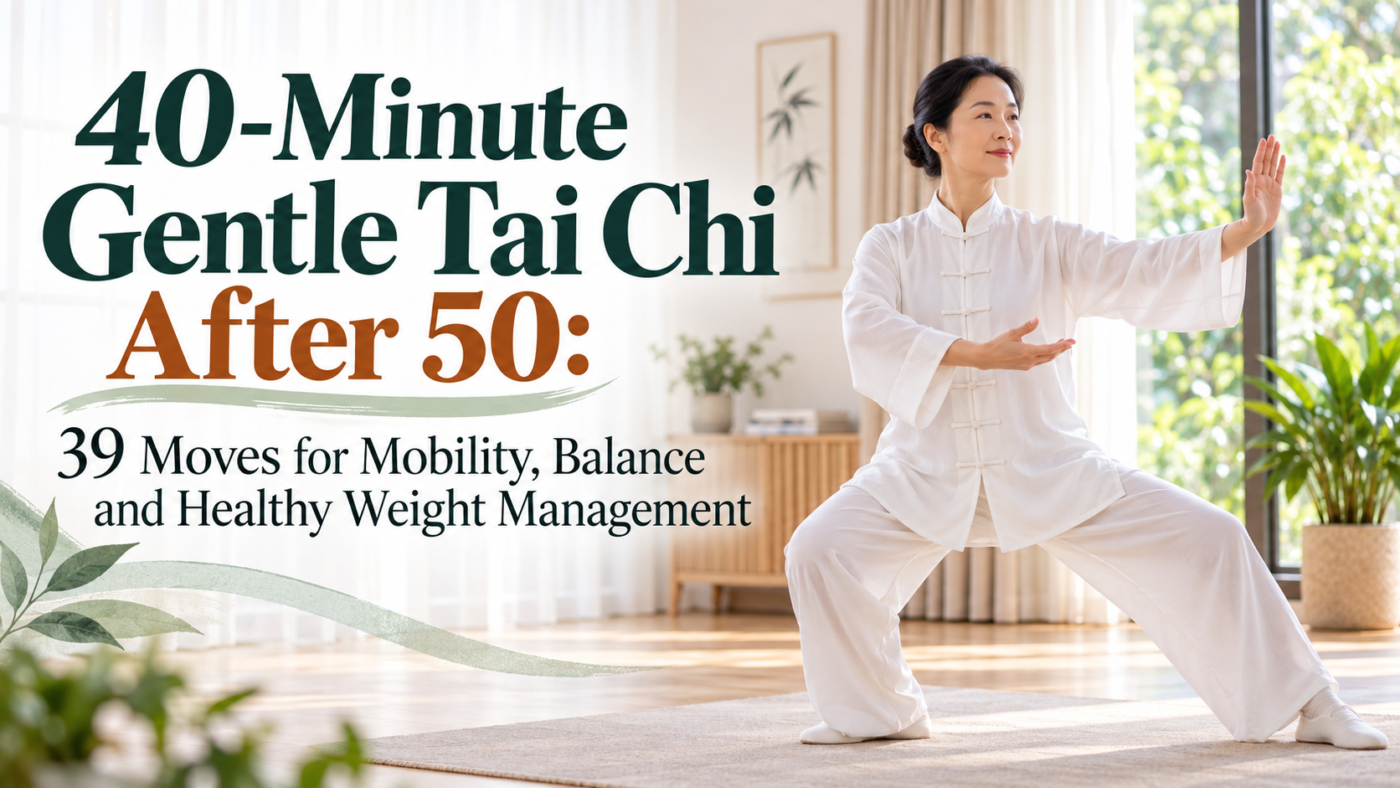
A 40-minute gentle Tai Chi routine can be a useful way to combine mobility, balance, lower-body strength, coordination, and sustained full-body movement in one low-impact session.
This workout is especially relevant for adults over 50 because many of the movements target physical qualities that become increasingly important with age: ankle strength, hip mobility, trunk control, posture, balance, and the ability to move comfortably through everyday tasks.
The original routine repeatedly suggests that specific movements can reduce belly fat. That claim needs to be corrected. No individual movement can selectively burn abdominal fat. Tai Chi can contribute to daily activity and energy expenditure, but reductions in belly fat or overall body fat depend on total energy balance, nutrition, sleep, physical activity, genetics, and long-term consistency.
The real value of this routine is that it keeps the body moving for an extended period while remaining relatively joint-friendly and adaptable.
Why Tai Chi After 50 Can Be Valuable
After 50, many people begin noticing changes in flexibility, balance, leg strength, recovery, and posture.
That does not mean decline is inevitable.
These abilities can still be trained.
A well-designed Tai Chi session can help challenge:
Balance
Joint mobility
Lower-body strength
Trunk control
Coordination
Postural awareness
Movement confidence
Muscular endurance
The combination makes Tai Chi especially suitable for people who want a gentler alternative to high-impact workouts.
Can Tai Chi Help With Weight Management After 50?
Yes, but not because it targets fat from one specific area.
Tai Chi contributes to overall physical activity and energy expenditure.
A 40-minute session can involve repeated squats, heel raises, lunges, weight shifts, arm movements, knee lifts, and trunk rotations. These movements keep several major muscle groups active and may increase total daily calorie expenditure.
For meaningful changes in body composition, Tai Chi works best as part of a broader plan that includes:
Regular walking or other aerobic exercise
Progressive resistance training
Adequate protein
Balanced nutrition
Sufficient sleep
Long-term consistency
Can Tai Chi Reduce Belly Fat?
Tai Chi cannot selectively remove belly fat.
Movements that involve the waist, hips, or abdominal muscles may strengthen and coordinate the trunk, but they do not force the body to burn fat from the abdomen.
Fat loss occurs throughout the body.
That means exercises such as hip sways, side bends, cross-body reaches, and squats can still be valuable, but their benefit comes from overall movement, muscle activation, and energy expenditure rather than local fat burning.
The 39-Move 40-Minute Gentle Tai Chi Routine
Move slowly and maintain comfortable breathing throughout the session.
If balance is uncertain, practice near a wall, chair, or countertop.
Reduce the range of motion whenever needed.
Exercise 1: Elbow Open Shoulder Rolls
Open both elbows outward.
Roll the shoulders smoothly backward.
Then reverse direction.
This movement helps loosen the shoulders and upper back before the more active part of the session.
Avoid forcing the range.
Exercise 2: Hip Circles
Place both hands on the hips.
Circle the hips slowly in one direction.
Then reverse.
Keep the movement smooth and controlled.
This can help improve comfortable mobility through the hips, waist, and lower back.
Exercise 3: Overhead Side Bend
Place one hand on the hip.
Reach the opposite arm overhead.
Lean gently to the side.
Return to the center and switch.
This movement stretches the side body and encourages trunk mobility.
Exercise 4: Squat Chest Hug
Stand tall and open both arms.
Bend the knees into a gentle squat while bringing the arms around the chest.
Stand and open again.
This movement activates the thighs, hips, and trunk.
The squat does not need to be deep.
Exercise 5: Side Reach Heel Lift
Reach the upper body toward one side.
Move both arms in the same direction, with one high and one low.
Lift the opposite heel.
Return and switch sides.
This combines balance, coordination, and side-body mobility.
Exercise 6: Turning Arm Swing
Rotate the torso toward one side.
Lift the opposite heel.
Allow both arms to swing in the direction of the turn.
Switch sides.
This helps coordinate the shoulders, hips, and trunk.
Exercise 7: Squat Arm Open
Bend the knees and bring the palms together in front of the chest.
Stand tall and open both arms outward.
Repeat.
This combines lower-body strength with upper-body mobility.
Exercise 8: Elbow Lift Toe Raise
Keep the elbows close to the body.
Lift the elbows outward as you rise onto the toes.
Lower and repeat.
This movement challenges the calves, ankles, shoulders, and balance.
Exercise 9: Chest-to-Forward Press
Place both hands on the chest.
Press one hand forward.
Return and alternate sides.
This movement encourages shoulder mobility and arm coordination.
Exercise 10: Alternating Heel Curls
Hold the hands comfortably behind the body.
Curl one heel toward the back.
Lower it and switch sides.
Continue at a steady pace.
This keeps the legs active and encourages knee flexion.
Exercise 11: Squat Back Reach
Bend the knees into a shallow squat.
Stand and rotate slightly while reaching one arm backward.
Return and switch sides.
This combines lower-body strength with trunk rotation and shoulder mobility.
Exercise 12: Overhead Reach and Open
Interlace the fingers.
Reach overhead.
Open the arms wide and lower them slowly.
This lengthens the upper body and encourages shoulder range of motion.
Exercise 13: Side Hip Push
Extend both arms outward.
Shift the hips gently from side to side.
Keep the torso tall.
This trains weight shifting and lateral control.
Exercise 14: Hip Sway Arm Flow
Hold one arm high and the other low.
Sway the hips side to side as the arms move rhythmically.
This keeps the waist, shoulders, and hips moving together.
It does not directly burn belly fat.
Exercise 15: Squat Cross Arms
Stand with the feet wide.
Bring the hands together overhead.
Bend the knees while crossing the arms in front of the abdomen.
Stand and repeat.
This movement activates the legs, hips, and trunk.
Exercise 16: Knee Lift Arm Swing
Raise both arms overhead.
Swing the arms downward as one knee lifts.
Lower and switch sides.
This movement challenges balance and whole-body coordination.
Exercise 17: Squat Back Swing
Raise both arms overhead.
Bend the knees while swinging the arms backward.
Stand and repeat.
This creates a larger full-body movement pattern.
Exercise 18: Toe Raise Back Swing
Extend both arms forward.
Rise onto the toes while swinging both arms backward.
Return and repeat.
This combines calf activation with shoulder movement.
Exercise 19: Cross and Open Arms
Cross the arms low in front of the body.
Raise them overhead.
Open the arms outward and lower them.
This encourages chest and shoulder mobility.
Exercise 20: Neck Tilt
Place the hands on the hips.
Move the head gently backward within a comfortable range.
Return to neutral.
Avoid forcing the neck into extension.
For many people, smaller movements are safer and more comfortable.
Exercise 21: Shoulder Press Open
Place both hands on the shoulders.
Lift the elbows outward.
Move the shoulders gently forward, then open the chest.
Return.
This can help restore movement after prolonged sitting.
Exercise 22: Shoulder Roll Swing
Roll one shoulder backward and allow the arm to follow naturally.
Return to the center.
Repeat on the opposite side.
This helps release tension through the upper back and shoulders.
Exercise 23: Squat Body Turn
Bend the elbows in front of the chest.
Lower into a gentle squat.
Stand and rotate the torso from side to side.
Return and repeat.
This combines lower-body strength with trunk mobility.
Exercise 24: Elbow Chest Open
Hold both elbows bent in front of the chest.
Open them outward.
Return and repeat.
This helps mobilize the chest and shoulders.
Exercise 25: Lunge Arm Circles
Step one foot forward.
Bend the front knee slightly.
Circle both arms in a broad windmill pattern.
This combines lower-body work with shoulder mobility and coordination.
Exercise 26: Side Lunge Hold
Cross both arms over the chest.
Bend one knee while extending the opposite leg.
Shift from side to side.
This challenges the thighs, hips, and balance.
Use a smaller range if needed.
Exercise 27: Side Bend Leg Touch
Reach both arms overhead.
Lean to one side and lower the same-side hand toward the leg.
Return and switch.
This encourages side-body flexibility.
Exercise 28: Squat to Knee Lift
Bend the knees into a shallow squat.
Stand and lift one knee.
Move both hands toward that side.
Return and alternate.
This combines leg strength, core control, and balance.
Exercise 29: Cross-Foot Touch
Stand with the feet wide.
Bend forward gently.
Reach one hand toward the opposite foot or lower leg.
Return and switch sides.
This combines trunk rotation with hip and hamstring mobility.
Avoid forcing the reach.
Exercise 30: Squat Prayer Reach
Bring the palms together in front of the chest.
Bend the knees.
Stand and reach the hands overhead.
Return and repeat.
This combines lower-body activity with a full-body reach.
Exercise 31: Back Step Reach
Step one foot backward.
Reach the same-side arm overhead.
Return and switch sides.
This challenges balance while keeping the hips and shoulders mobile.
Exercise 32: Chest Open Toe Raise
Bring both hands together in front of the body.
Open the arms as you rise onto the toes.
Return and repeat.
This combines posture, calf activation, and upper-body mobility.
Exercise 33: Squat Arm Pull
Bend the knees.
Hold both fists overhead.
Pull the arms downward beside the body.
Return and repeat.
This engages the legs, shoulders, and upper back together.
Avoid tilting the head back excessively.
Exercise 34: Interlaced Heel Raises
Interlace the fingers and reach overhead.
Alternate lifting one heel at a time.
Continue slowly.
This challenges ankle control and balance.
Exercise 35: Elbow Pull Toe Raise
Extend both arms forward.
Pull the elbows backward while rising onto the toes.
Lower the heels as the hands move downward.
Repeat.
This combines upper- and lower-body movement in a steady rhythm.
Exercise 36: Cross-Back Knee Bend
Bring the palms together in front of the chest.
Step one foot diagonally backward.
Bend both knees slightly.
Return and switch sides.
This movement challenges the hips, thighs, and balance.
Exercise 37: Squat Reach Open
Stand with the feet wide.
Bring the palms together at the chest.
Bend the knees.
Rise, reach overhead, and open the arms.
Repeat.
This creates a flowing full-body sequence.
Exercise 38: Squat Toe Raise
Lean slightly forward.
Bend the knees and extend the arms in front.
Swing the arms backward as you rise onto the toes.
Return and repeat.
This challenges balance, calf strength, and whole-body coordination.
Exercise 39: Side Sway Arm Swing
Shift the body gently from side to side.
Swing one arm smoothly up and down.
Keep the opposite hand on the abdomen.
Switch arms.
This is a useful way to reduce intensity and finish the session with a more relaxed rhythm.
Why Balance Training Matters More After 50
Balance depends on more than leg strength.
It also involves:
Vision
Inner-ear function
Sensory feedback from the feet
Joint awareness
Reaction time
Muscle strength
Nervous-system coordination
Tai Chi repeatedly challenges these systems through weight shifting, heel raises, knee lifts, lunges, and controlled directional changes.
That makes balance training one of the strongest practical reasons to include Tai Chi in a healthy-aging routine.
Why Ankle and Calf Strength Matter
The calves and ankles play an important role in walking, standing, and recovering balance.
This routine includes multiple heel-raise variations, which can help train those areas.
Stronger ankles and calves may improve confidence during everyday movement, particularly when stepping, climbing stairs, or changing direction.
Why Hip Mobility Matters After 50
Hip stiffness can make many daily tasks harder.
These include:
Walking
Climbing stairs
Bending
Turning
Getting out of a chair
Stepping over obstacles
This routine repeatedly uses hip circles, lunges, squats, side shifts, and rotational movements to keep the hips moving through varied ranges.
Why Squats Are Useful
Squats train one of the most important patterns in daily life.
You use a squat-like pattern when:
Sitting down
Standing up
Getting into a car
Getting off the toilet
Picking something up
A shallow squat performed with good control can help strengthen the thighs and hips.
Depth is not the goal.
Control is more important.
Can 40 Minutes of Tai Chi Improve Fitness?
Yes, especially for people who are currently inactive or returning to exercise.
A 40-minute session can provide a substantial amount of low-impact movement.
However, Tai Chi should not necessarily replace all other types of exercise.
For broader health and fitness benefits, combine it with:
Aerobic exercise
Resistance training
Walking
Mobility work
Adequate recovery
How Much Energy Does 40 Minutes of Tai Chi Use?
There is no universal number.
Energy expenditure depends on:
Body weight
Movement intensity
Range of motion
Fitness level
Muscle mass
Age
Rest periods
A 40-minute Tai Chi session generally uses less energy than vigorous running but more than remaining sedentary.
The value comes from sustained movement and the fact that many people can repeat it consistently.
Healthy Weight Management After 50
Weight management often becomes more challenging with age because of changes in activity, muscle mass, sleep, hormones, and lifestyle.
A good strategy includes:
Maintaining muscle mass
Staying physically active
Prioritizing protein
Eating mostly minimally processed foods
Managing total calorie intake
Sleeping well
Strength training regularly
Using Tai Chi as part of this routine can help increase activity without adding high joint impact.
What This Routine Can Realistically Improve
With regular practice, you may notice improvements in:
Balance confidence
Hip mobility
Shoulder movement
Ankle strength
Leg endurance
Coordination
Postural awareness
Movement confidence
Daily activity levels
These are realistic and meaningful outcomes.
What This Routine Cannot Promise
It cannot guarantee:
Targeted belly-fat loss
Rapid weight loss
Reversal of aging
Permanent pain relief
Disease prevention
A specific number of calories burned
Avoiding exaggerated promises makes the routine more credible and safer.
Is This Routine Suitable for Adults Over 60?
For many people, yes, with modifications.
Useful adjustments include:
Use a chair for balance
Perform shallower squats
Take smaller steps
Reduce lunge depth
Avoid deep side bends
Keep heel raises small
Rest whenever needed
The routine should be adapted to the person, not the other way around.
When to Stop
Stop immediately if you experience:
Chest pain
Severe shortness of breath
Dizziness
Loss of balance
Sudden weakness
Sharp joint pain
Unusual neurological symptoms
People with recent surgery or significant heart, neurological, or joint conditions should seek individualized guidance before beginning a new exercise routine.
Final Thoughts
This 40-minute gentle Tai Chi routine includes 39 movements designed to keep the body active while emphasizing mobility, balance, coordination, lower-body strength, and whole-body control.
For adults over 50, those qualities matter because they directly support everyday function.
The routine will not selectively burn belly fat or stop aging.
What it can do is help you move more, challenge the legs and core, maintain mobility, and develop a consistent exercise habit.
That is a much stronger foundation for healthy aging and long-term weight management than any promise of rapid fat loss.
Frequently Asked Questions
Is 40 minutes of Tai Chi good for people over 50?
Yes. A 40-minute Tai Chi session can provide meaningful low-impact movement for balance, mobility, coordination, and muscular endurance, provided the exercises are adjusted to individual ability.
Can Tai Chi help with belly fat after 50?
Tai Chi cannot target belly fat specifically. It can contribute to total physical activity and energy expenditure, which may support overall fat loss when combined with appropriate nutrition and other exercise.
Does Tai Chi help with balance?
Yes. Tai Chi frequently uses weight shifts, heel raises, single-leg movements, and controlled stepping, all of which can help train balance.
Can Tai Chi help improve flexibility?
Regular practice may help maintain or improve comfortable mobility through the hips, shoulders, trunk, ankles, and spine.
Is this routine suitable for beginners?
Yes, but beginners should use smaller ranges, slower movements, and support when needed.
Can people over 60 do this workout?
Many can, but modifications may be necessary depending on balance, joint health, fitness, and medical conditions.
How often should I do Tai Chi after 50?
Several sessions per week can be a useful starting point. Daily gentle practice may also be reasonable if the movements remain comfortable.
Medical Disclaimer
This article is for educational purposes only and is not medical advice. Exercise should be modified according to your health, fitness level, joint condition, balance, and mobility. Stop if you experience pain, dizziness, chest discomfort, unusual shortness of breath, or loss of balance, and consult a qualified healthcare professional when appropriate.
This article is for general education and does not replace individualized care from a qualified health professional. Seek appropriate advice for persistent, severe, or concerning symptoms.
Read the full medical disclaimer