Modern wellness culture often encourages people to push harder.
Exercise before breakfast. Add another supplement. Track more metrics. Restrict more foods. Wake up earlier. Optimize every hour.
Yet becoming healthier does not always require doing more.
Traditional Chinese medicine, or TCM, developed around a different idea: health depends partly on maintaining balance and adapting daily habits to the individual, the environment and the season.
TCM uses concepts such as Qi, Yin, Yang, Cold, Heat, Blood and organ systems in ways that do not correspond directly to modern anatomy or physiology. They are traditional theoretical frameworks rather than scientifically measurable substances or diagnoses.
Still, many practices inspired by this tradition overlap with modern ideas about physical activity, sleep, stress management, mindful eating and sustainable lifestyle habits.
Here are 15 TCM-inspired practices worth understanding, along with a modern perspective on what they may realistically offer.
1. Begin the Day With Hydration
Warm water is one of the simplest habits associated with Chinese wellness culture.
Traditional Chinese medicine often describes digestion through the metaphor of warmth and transformation. From this perspective, warm or room-temperature drinks are commonly preferred, particularly in the morning.
Modern science does not show that cold water extinguishes a digestive fire or damages healthy digestion.
What matters much more is hydration itself.
After several hours of sleep, drinking water can simply be a comfortable way to begin replacing fluids.
Some people find warm water soothing, especially if they experience sensitivity to very cold drinks.
There is no need to force yourself to drink extremely hot water. In fact, beverages hot enough to burn the mouth or throat should be avoided.
Choose a temperature that feels comfortable and encourages you to stay adequately hydrated.
2. Keep Your Feet Comfortable in Cold Weather
TCM places unusual importance on the feet because several traditional meridian pathways are described as beginning or ending there.
This has contributed to practices such as warm foot baths, massage and wearing slippers indoors.
From a modern perspective, warm feet are primarily about thermal comfort.
Cold temperatures naturally cause blood vessels in the skin and extremities to constrict. Keeping the feet comfortably warm may therefore make cold environments much more pleasant.
However, cold feet do not directly cause viral infections, and wearing socks should not be considered a treatment for menstrual disorders or other medical conditions.
If your feet are persistently cold even in comfortable temperatures, particularly when accompanied by fatigue, color changes, numbness or pain, consider discussing it with a healthcare professional.
3. Dry Wet Hair Before Going Into Very Cold Conditions
Many people grow up hearing that going outdoors with wet hair will make them sick.
That is not how respiratory infections occur.
Colds are caused by viruses, not by wet hair.
Still, walking outside with soaking-wet hair in very cold weather can make the body feel uncomfortable and increase heat loss from the head.
Drying your hair before sleep can also be more comfortable and may reduce prolonged moisture on the scalp and pillow.
So the practical advice can remain simple:
Dry your hair when doing so makes you more comfortable, but do not confuse wet hair with the cause of infection.
4. Dress Appropriately for Cold and Windy Weather
In TCM, the concept of Wind is traditionally used to explain certain rapidly changing symptoms, including those associated with respiratory illness.
This should not be interpreted literally as wind carrying illness into the body through an exposed neck.
Viruses, bacteria and allergens are responsible for respiratory infections and allergic reactions.
Nevertheless, scarves and appropriate layers are sensible in cold weather.
They help maintain thermal comfort and may protect sensitive airways from very cold, dry air.
The useful modern takeaway is therefore not that covering the neck blocks pathogens, but that appropriate clothing helps the body remain comfortable under environmental stress.
5. Experiment With Cooked Vegetables if Raw Foods Cause Bloating
Vegetables are important whether they are raw or cooked.
But preparation changes their texture and digestibility.
Cooking softens plant tissues and can make certain vegetables easier for some people to tolerate.
A very large raw salad containing substantial amounts of kale, cabbage, broccoli or other fibrous vegetables may cause bloating in people who are sensitive to certain fibers or fermentable carbohydrates.
That does not mean the vegetables are unhealthy.
It simply means that individual tolerance matters.
Steaming, roasting, simmering or lightly sautéing vegetables may make them more comfortable to eat while preserving valuable nutrients.
If persistent bloating occurs regardless of preparation, consider possible causes such as irritable bowel syndrome, food intolerance, constipation or other gastrointestinal conditions.
6. You Do Not Need to Fear Cold Foods
Traditional Chinese dietetics classifies foods according to properties such as warming, cooling and neutral.
These classifications refer to traditional energetic qualities rather than the physical temperature of the food.
Modern nutritional science does not show that an iced smoothie freezes digestion or prevents the stomach from functioning.
The gastrointestinal system tightly regulates its own internal environment.
Still, individual experience matters.
If a cold smoothie leaves you uncomfortable while a warm breakfast feels better, there is no reason to ignore that preference.
The healthiest diet is not simply the diet with the most scientifically fashionable ingredients.
It also needs to be tolerable, nutritionally balanced and sustainable.
7. Slow Down While Eating
This is one of the strongest habits in the entire list.
Eating while typing emails, driving, scrolling or rushing through a meeting can make it difficult to pay attention to hunger, fullness and enjoyment.
Slower eating encourages more chewing and gives the brain more time to register satiety.
It may also help some people feel less rushed around meals.
You do not need to turn every lunch into a meditation session.
Try something simpler.
Put the phone away.
Sit down.
Chew normally.
Notice the food.
Allow yourself enough time to recognize when you are comfortably full.
Traditional language might describe this as supporting digestion.
Modern language might call it mindful eating.
The practical behavior is remarkably similar.
8. Take a Short Walk After Meals
A short post-meal walk is one of the easiest lifestyle habits with a reasonable modern evidence base.
Gentle walking after eating activates skeletal muscles, which can help the body handle post-meal glucose.
It also interrupts prolonged sitting.
The walk does not need to be long or intense.
Even several minutes of comfortable movement can be useful.
A ten-minute walk after lunch or dinner may also provide sunlight, fresh air and a mental break from work.
In traditional Chinese terminology, movement is often described as helping Qi circulate.
Modern physiology uses very different mechanisms to explain the benefits, but both frameworks arrive at a similar practical recommendation:
Do not spend the entire day completely sedentary.
9. Use Heat for Comfort, Not as a Cure-All
Heating pads, warm baths and foot baths are common across many cultures.
Heat can temporarily relax muscles and provide comfort for some types of pain, including menstrual cramps.
However, the explanation does not need to involve clearing blocked energy or increasing circulation to internal organs.
A heating pad also should not be used continuously as a preventive treatment when there is no discomfort.
Use heat safely.
Avoid temperatures hot enough to burn the skin.
Do not fall asleep with heating devices unless they are specifically designed for safe overnight use.
Persistent, severe or worsening pelvic pain should be medically evaluated rather than repeatedly managed only with heat.
10. Enjoy Jujube and Goji Berry Tea as Food, Not Medicine
Jujube dates and goji berries have long histories in Chinese food and herbal traditions.
They can make a pleasant naturally sweet tea and provide plant compounds and nutrients as part of a varied diet.
Traditional Chinese medicine sometimes describes these foods as nourishing Blood.
Blood in this context is a TCM theoretical concept and should not be equated directly with hemoglobin, iron status or circulating blood volume.
Jujube and goji tea should therefore not be advertised as a treatment for anemia, menstrual disorders or chronic fatigue.
If someone experiences heavy periods, persistent fatigue, shortness of breath or suspected iron deficiency, appropriate laboratory testing is much more important than relying on a traditional tea.
Goji berries can also interact with certain medications, including some anticoagulants, so concentrated or frequent medicinal use deserves caution.
11. Try Qigong
Qigong combines gentle movement, posture, breathing and focused attention.
Unlike intense exercise, it is generally slow and accessible.
A short practice can involve standing movements, coordinated breathing and controlled shifts of body weight.
Some research suggests that qigong may support quality of life, balance, stress reduction and certain aspects of physical function, although evidence quality varies depending on the condition being studied.
You do not need to accept Qi as a scientifically measurable form of energy to benefit from gentle coordinated movement.
Qigong can simply be viewed as a traditional mind-body exercise.
Five or ten minutes can be enough to begin.
For older adults or people who dislike high-intensity workouts, qigong and tai chi may provide particularly approachable forms of movement.
12. Pay Attention to How Your Environment Affects You
Traditional Chinese philosophy often places the individual within a larger environmental context rather than treating the body as an isolated machine.
Modern behavioral science also recognizes that environments influence behavior.
A chaotic workspace may make concentration harder.
A dark room may affect alertness.
A noisy bedroom may interfere with sleep.
An environment that constantly triggers stress can make relaxation difficult.
You cannot control every environment.
But you can improve some of them.
Open the curtains during the day.
Reduce unnecessary clutter.
Make your sleep environment darker and quieter at night.
Take breaks outdoors.
Spend time with people around whom you feel comfortable.
The language of Qi is optional.
The relationship between environment and behavior is very real.
13. Understand What Acupuncture Can and Cannot Do
Acupuncture is one of the most internationally recognized components of traditional Chinese medicine.
It involves inserting very thin needles into specific points on the body.
Modern research has studied acupuncture most extensively for pain and several other conditions.
Evidence varies substantially depending on what condition is being treated.
For some chronic pain conditions, acupuncture may provide modest benefit for some patients. For many other wellness claims, evidence remains limited or uncertain.
Acupuncture should therefore not be presented as something everyone needs regularly simply to maintain health.
If you want to try it, choose a properly trained and licensed practitioner where licensing applies.
Needles should be sterile and single-use.
Acupuncture can be part of complementary care, but it should not replace appropriate diagnosis or proven treatment for serious medical conditions.
14. Think Beyond Calories, but Keep Nutrition Science
One interesting aspect of traditional Chinese dietetics is its emphasis on individual context.
Instead of asking only whether a food is universally good or bad, it asks how the person feels after eating it, what season they are in and what other foods surround it.
Modern nutrition also increasingly rejects simplistic good-food versus bad-food thinking.
Calories, protein, carbohydrates, fats and fiber remain biologically important.
So do vitamins, minerals and overall dietary quality.
But individual tolerance matters too.
One person may feel excellent after yogurt.
Another may have lactose intolerance.
One person tolerates large salads easily.
Another becomes extremely bloated.
One person enjoys spicy food.
Another experiences reflux.
There is no contradiction in using modern nutrition science while also paying attention to individual experience.
The safest approach is to let traditional concepts add context rather than replace nutritional evidence.
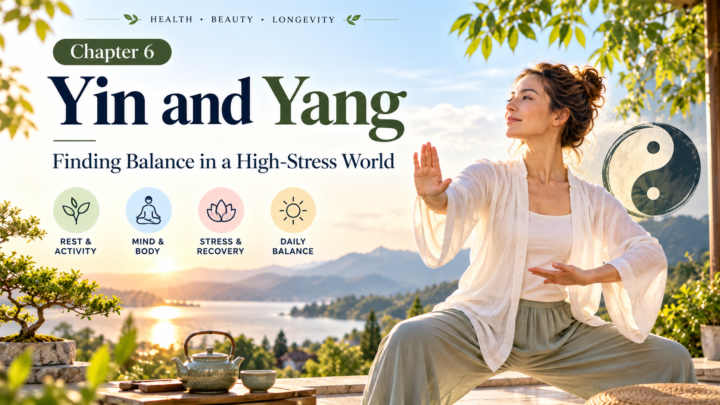
15. Use Yin and Yang as a Metaphor for Sustainable Balance
Yin and Yang are among the best-known concepts in Chinese philosophy.
In simplified traditional terms, Yang is associated with activity, warmth and outward movement, while Yin is associated with rest, cooling, restoration and inwardness.
These are philosophical categories, not measurable physiological variables.
But as a metaphor, they can be surprisingly useful.
Consider a person who works long hours, trains intensely, travels constantly, sleeps six hours and fills every free evening with social commitments.
Their problem may not be lack of discipline.
They may need recovery.
Now consider someone who is almost completely sedentary, socially isolated and spending most of the day indoors.
More restoration may not be the answer.
They may benefit from more movement, sunlight, challenge and social contact.
This is where Yin and Yang can become a practical lifestyle metaphor.
Activity needs recovery.
Challenge needs rest.
Social stimulation needs quiet.
Training needs sleep.
Effort needs nourishment.
Neither side is inherently better.
Sustainable health usually requires both.
The Bigger Lesson: Wellness Should Support You, Not Exhaust You
There is a useful message hidden beneath many traditional Chinese medicine practices.
Your health routine should not become another source of chronic stress.
More exercise is not always better.
More restriction is not always healthier.
More supplements do not automatically produce better health.
A wellness routine that makes you exhausted, anxious or afraid of ordinary foods may no longer be serving its purpose.
Instead, pay attention to the fundamentals.
Move regularly.
Sleep adequately.
Eat a varied diet.
Stay hydrated.
Spend time with people who matter to you.
Manage stress.
Take breaks.
Enjoy food.
Spend time outdoors.
Seek medical care when symptoms deserve investigation.
Traditional frameworks can sometimes offer an additional way of thinking about these behaviors, but they should complement rather than replace modern medical evidence.
Start Small
You do not need to adopt all 15 practices.
Pick one.
Maybe you begin walking for ten minutes after dinner.
Maybe you replace one rushed desk lunch with a slower meal.
Maybe you try five minutes of qigong.
Maybe you finally protect an additional half hour for sleep.
Maybe you cook vegetables differently because your current meals leave you bloated.
Observe what happens.
Keep what helps.
Discard what does not.
Health is rarely created by one dramatic intervention.
More often, it grows from ordinary habits repeated for years.
That principle may be one of the most enduring connections between traditional Chinese wellness and modern preventive health.
FAQ
Is warm water healthier than cold water?
For most healthy people, both warm and cold water can provide hydration. Warm water may feel more comfortable for some people, but there is no good evidence that cold water damages normal digestion.
Can going outside with wet hair make you sick?
Wet hair does not cause viral respiratory infections. However, wet hair can make you feel colder in low temperatures, so drying it may improve comfort.
Are raw vegetables harder to digest?
Some raw vegetables contain substantial amounts of fiber and may cause bloating in sensitive individuals. Cooking softens plant tissues and may make certain vegetables easier to tolerate.
Is walking after meals healthy?
Yes. Gentle post-meal walking can help reduce prolonged sitting and may improve post-meal blood glucose control.
Does qigong really work?
Research suggests qigong may provide benefits for some aspects of physical and psychological well-being, but study quality varies. It is best viewed as a gentle mind-body movement practice rather than a cure for disease.
Does acupuncture unblock Qi?
Unblocking Qi is the traditional Chinese explanation. Modern science has not established Qi as a measurable biological substance. Research instead studies acupuncture through neurological, pain-processing and other physiological mechanisms.
Can goji berries and jujube dates treat anemia?
No food tea should be relied upon to treat diagnosed anemia. Iron-deficiency anemia and other forms of anemia require appropriate evaluation and treatment.
Does TCM food temperature mean the actual temperature of food?
Not necessarily. Traditional Chinese dietetics also classifies foods as warming or cooling according to traditional energetic theory. These classifications are different from modern nutritional or biochemical categories.
What is the healthiest way to use traditional Chinese medicine?
Use low-risk lifestyle practices as complementary wellness tools, distinguish traditional theory from established biomedical facts and consult qualified healthcare professionals for persistent symptoms or medicinal herbal treatments.
Medical Disclaimer
This article is for educational purposes only and does not provide medical diagnosis or treatment. Traditional Chinese medicine concepts including Qi, Yin, Yang, Blood, Cold, Heat and meridians are traditional theoretical frameworks and should not be interpreted as equivalent to modern biomedical diagnoses or measurable physiological substances. Acupuncture, herbal medicines and other TCM therapies can have risks and may interact with conventional treatment. Consult an appropriately qualified healthcare professional for persistent symptoms, medical conditions or before beginning medicinal herbal therapy.
This article is for general education and does not replace individualized care from a qualified health professional. Seek appropriate advice for persistent, severe, or concerning symptoms.
Read the full medical disclaimer