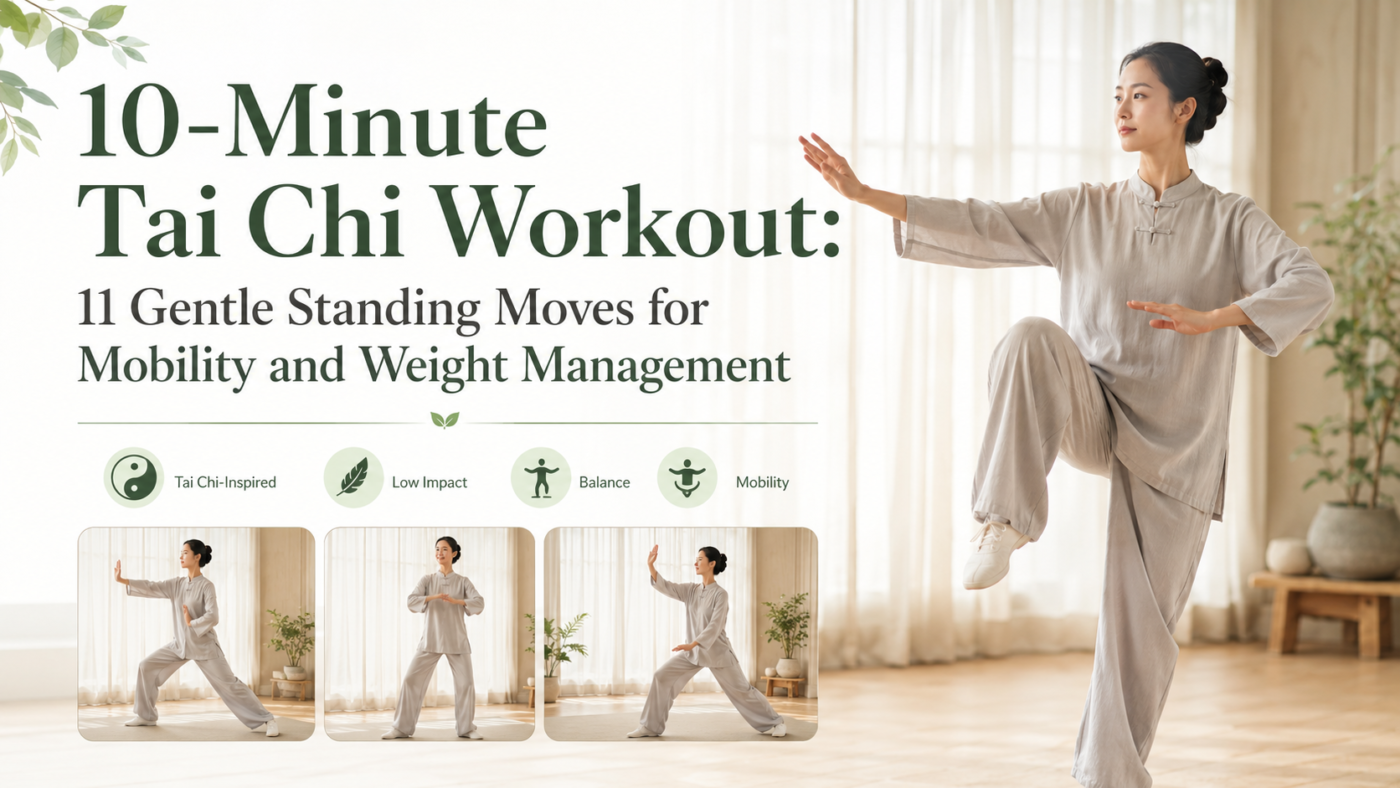
A 10-minute Tai Chi workout can be a simple way to add more movement, balance practice, mobility work, and gentle whole-body activity to your day. While a short routine cannot selectively burn belly fat or guarantee a reduction in visceral fat within two weeks, practicing consistently may help you become more active and support a broader healthy-weight and healthy-aging routine.
Tai chi traditionally combines slow, controlled movements with breathing, mental focus, and relaxation. Research summarized by the U.S. National Center for Complementary and Integrative Health suggests that tai chi may improve balance and stability, particularly in older adults, and may reduce fall risk in some populations.
The sequence below is best described as a Tai Chi-inspired standing workout rather than a classical tai chi form. It combines flowing arm movements with knee lifts, cross-steps, balance work, and gentle stretching.
That makes it especially useful for people who want a low-impact way to move more without getting down on the floor.
Can a 10-Minute Tai Chi Workout Reduce Belly Fat?
Regular physical activity can contribute to weight management and may help reduce abdominal fat over time. But no single tai chi movement—or abdominal exercise—can specifically remove fat from one part of the body.
Visceral fat is the deeper abdominal fat surrounding internal organs. It responds to the same overall lifestyle strategies used to reduce excess body fat, including regular physical activity and appropriate nutrition. Mayo Clinic specifically notes that exercises targeting the abdomen alone do not eliminate belly fat.
The U.S. Physical Activity Guidelines also state that regular activity can help reduce abdominal fat and preserve muscle during weight loss.
So instead of thinking:
“This move burns belly fat.”
A more accurate way to think about this routine is:
“This movement increases my daily physical activity and may contribute to long-term energy expenditure, fitness, and weight management.”
That distinction matters.
What Can 10 Minutes a Day Realistically Do?
Ten minutes per day adds up to about 70 minutes of activity per week.
For someone who has been mostly sedentary, that can be a meaningful starting point. Current U.S. guidelines emphasize that moving more and sitting less benefits nearly everyone, and even modest increases in physical activity can provide health benefits. Adults are generally encouraged to work toward 150 to 300 minutes of moderate-intensity aerobic activity each week, along with muscle-strengthening activity on at least two days.
A short routine therefore does not have to be “enough” by itself to be worthwhile.
It can be the beginning of a more active day.
Exercise 1: Cross Knee Tap
Stand tall with your feet comfortably apart.
Lift one knee while bringing the opposite elbow downward toward it.
Return to the starting position.
Repeat on the other side.
Continue alternating in a smooth rhythm.
Try to keep your torso controlled rather than collapsing toward the knee.
What It Works
This movement combines hip flexion, trunk rotation, balance, and coordination.
Because both the upper and lower body are moving, it may raise your heart rate slightly more than standing still while also challenging the abdominal muscles to stabilize your trunk.
It does not directly burn abdominal fat, but it can contribute to overall activity and energy expenditure.
Exercise 2: Cross-Step Pull-Down
Raise both arms overhead.
Step one foot slightly backward and across your body.
At the same time, draw both arms downward.
Return to the center and repeat on the other side.
Move slowly enough that you remain balanced.
Potential Benefits
The cross-step challenges:
- Hip mobility
- Balance
- Lower-body coordination
- Shoulder movement
- Trunk control
If crossing the foot behind you feels unstable, simply step backward instead.
There is no need to sacrifice balance for a larger range of motion.
Exercise 3: Side-Arm Toe Kick
Open both arms outward as you inhale comfortably.
Lift one leg forward and, if comfortable, reach the opposite or same-side hand toward the foot.
Lower the leg slowly.
Alternate sides.
You do not need to touch your toes.
What It Works
Controlled leg lifting can challenge the hip flexors and quadriceps while requiring the standing leg and trunk to maintain balance.
It can also provide a dynamic stretch to the hamstrings.
Keep the movement comfortable rather than kicking forcefully.
Exercise 4: Back-Step Knee Swing
Reach both arms forward while stepping one foot backward.
Shift your weight forward again and lift that knee.
Allow your arms to sweep toward the same side in a controlled motion.
Repeat several times before changing sides.
Why This Movement Is Useful
Moving backward and then forward challenges weight shifting—a fundamental skill involved in everyday walking and balance.
The movement also requires coordination between the hips, legs, trunk, and arms.
For beginners, keep the back step small.
Exercise 5: Knee Lift and Reach
Stand upright.
Lift one knee while reaching the same-side arm overhead.
Lower both smoothly.
Repeat several times, then switch sides.
Try to create a sense of length through your torso without aggressively arching your lower back.
Benefits
This movement combines:
- Hip flexion
- Single-leg balance
- Shoulder mobility
- Core stabilization
- Coordination
It can also gently increase whole-body movement when performed repeatedly.
Exercise 6: Arm Circle With Cross-Step
Begin with both arms overhead.
Circle the arms outward and downward while stepping one foot lightly behind the other.
Return to center.
Repeat on the opposite side.
Keep the arm circles relaxed and flowing.
Tai Chi-Inspired Element
The continuous relationship between arm movement, stepping, breathing, and weight transfer gives this movement a tai chi-inspired quality.
Traditional tai chi is much more structured than this exercise, but the emphasis on controlled weight shifting and continuous motion is compatible with tai chi principles.
Exercise 7: Knee Lift With Arm Swing
Raise both arms overhead as you inhale comfortably.
As you exhale, lower the arms while lifting one knee.
Lower the leg and repeat on the opposite side.
Maintain a steady rhythm rather than rushing.
Breathing and Movement
Tai chi traditionally incorporates controlled breathing alongside gentle movement and mental focus. NCCIH describes tai chi as combining physical postures, gentle movement, breathing, relaxation, and attention.
Do not force yourself to match a rigid breathing pattern if it makes you dizzy or uncomfortable.
Natural breathing is perfectly acceptable.
Exercise 8: Side Knee Press
Step your feet wider than hip-width apart.
Shift your weight toward one side and gently bend that knee.
Place your hands lightly on the thigh rather than pressing directly into the kneecap.
Return to the center.
Repeat to the other side.
What It Works
This movement can gently challenge:
- Inner-thigh mobility
- Hip movement
- Quadriceps
- Side-to-side weight shifting
- Balance
Your knee should generally track in the same direction as your toes.
Use a shallower bend if you have limited mobility.
Exercise 9: Toe-Up Forward Fold
Place one foot slightly ahead of you.
Keep the heel down and lift the toes.
Push your hips gently backward.
Lean forward from the hips until you feel a mild stretch behind the thigh and calf.
Return upright and switch legs.
Important Adjustment
The goal is not to bend as low as possible.
A small hip hinge may be enough to stretch the hamstrings.
Keep your spine comfortable and avoid bouncing.
People with significant back problems should use extra caution with forward bending.
Exercise 10: Supported Standing Quadriceps Stretch
Stand beside a sturdy chair, countertop, or wall.
Shift your weight onto one leg.
Bend the other knee behind you.
If comfortable, hold the ankle or pant leg.
Gently bring the heel toward the buttocks until you feel a mild stretch along the front of the thigh.
Hold briefly while breathing normally.
Switch sides.
Balance Comes First
There is no benefit to performing this stretch unsupported if you are struggling to balance.
Holding a stable object makes the movement safer and allows you to concentrate on the stretch.
Exercise 11: Cross-Arm Shoulder Stretch
Bring one arm across the front of your chest.
Use the opposite arm to hold it gently closer to your body.
Keep your shoulder relaxed.
Breathe normally.
Hold briefly and switch sides.
This is an easy way to finish the routine with relaxed upper-body mobility.
Why Balance Training Matters More With Age
One reason tai chi has attracted so much scientific interest is its potential effect on balance.
NCCIH reports evidence that tai chi may improve balance and stability in older people. A large review cited by NCCIH found that tai chi may reduce the rate of falls and the number of older adults experiencing falls, although evidence strength varies by outcome.
That makes movements involving controlled stepping and weight transfer particularly relevant for healthy aging.
The goal is not simply burning calories.
Maintaining the ability to shift your weight, coordinate your limbs, and recover your balance can become increasingly valuable over time.
Is This Routine Really Tai Chi?
Not in the strict traditional sense.
Classical tai chi consists of established movement forms and principles developed from Chinese martial arts traditions.
Movements such as cross-knee taps, toe kicks, and fitness-style knee raises are better described as tai chi-inspired low-impact exercises.
That does not make them ineffective.
It simply makes the description more accurate.
For a health website, accuracy matters more than forcing every gentle Chinese-inspired movement under the “tai chi” label.
What Tai Chi Has Actually Been Shown to Help
Tai chi research is much stronger for some outcomes than others.
Among the more promising areas are:
Balance and Fall Prevention
Research suggests tai chi can improve balance and may reduce fall risk among older adults.
Knee Osteoarthritis
NCCIH reports that clinical guidelines strongly recommend tai chi as one non-drug approach for managing knee osteoarthritis, with studies suggesting potential benefits for pain, stiffness, physical function, and balance.
Psychological Well-Being
Some research suggests tai chi may support quality of life and psychological well-being in certain populations, although evidence quality varies.
These evidence-supported areas are more appropriate reasons to practice tai chi than promises of dramatic fat loss in 14 days.
Can Tai Chi Help With Visceral Fat?
Possibly as part of a broader active lifestyle—but the claim needs context.
Physical activity can help reduce total and abdominal fat over time, especially when combined with nutrition that supports an appropriate energy balance.
However, there is no reason to believe that performing a particular tai chi movement sends a direct fat-burning signal specifically to visceral fat.
Fat loss is systemic.
Where your body loses fat first or fastest varies substantially between individuals.
Do You Need to Practice Every Day?
No.
Daily practice can be convenient because a 10-minute routine is easy to fit into a schedule, but there is no requirement to practice seven days a week.
For beginners, three to five sessions per week may already represent a substantial increase in activity.
You can also alternate tai chi-inspired routines with:
- Walking
- Strength training
- Cycling
- Swimming
- Mobility exercises
- Traditional tai chi practice
- Qigong
Variety helps develop different aspects of physical fitness.
How to Make the Routine Easier
If you are new to exercise:
Use a chair or countertop whenever balance feels uncertain.
Keep knee lifts low.
Use smaller steps.
Do not force toe touches.
Skip cross-steps if they make you unstable.
Take additional rest breaks.
Perform fewer repetitions.
You can gradually increase your range of motion as your confidence improves.
How to Make It More Challenging
Once the movements feel easy, you can gradually:
Increase the duration from 10 to 15 minutes.
Perform another round of the routine.
Increase the range of comfortable knee lifts.
Slow the movements to challenge balance.
Add a brisk walk afterward.
Combine the routine with resistance training on other days.
Increasing activity gradually is generally preferable to jumping immediately into a much harder workout.
Who Should Be Careful?
Tai chi is generally considered a relatively safe form of physical activity, but that does not mean every exercise is appropriate for everyone. NCCIH notes that musculoskeletal discomfort can occur when people begin tai chi practice.
Use extra caution if you have:
- Significant balance problems
- Recent surgery
- Severe osteoporosis
- Uncontrolled cardiovascular disease
- Significant hip or knee pain
- Vertigo
- Neurological conditions affecting balance
- Recent falls
A healthcare or rehabilitation professional can help modify exercises when needed.
A Better Two-Week Goal
Instead of promising:
“Lose belly fat in two weeks.”
Set a goal you can actually measure:
Practice approximately 10 minutes a day for two weeks and notice whether movement feels easier.
You might track:
- How consistently you practice
- Whether your balance feels steadier
- Whether your range of motion improves
- Whether movements become smoother
- Whether you feel less stiff
- Whether you are accumulating more daily activity
Changes in body fat usually require more time and depend on far more than one short exercise routine.
But building a movement habit can start immediately.
The Bottom Line
A 10-minute Tai Chi workout can be an accessible way to add gentle movement, balance practice, coordination, stretching, and whole-body activity to your day.
This particular sequence is more accurately described as tai chi-inspired fitness than traditional tai chi, but many of its movements still emphasize controlled stepping, weight transfer, coordination, and flowing motion.
Regular practice may support mobility and contribute to overall physical activity. Tai chi itself has particularly encouraging evidence for improving balance and helping reduce fall risk in older adults.
What this routine cannot do is selectively melt belly fat or guarantee a reduction in visceral fat after two weeks.
Use it as one piece of a larger healthy lifestyle.
Move consistently.
Build gradually.
And let the long-term benefits of staying active matter more than a short-term promise on the scale.
FAQ
Can a 10-minute Tai Chi workout help with weight loss?
It can contribute to your total daily physical activity and energy expenditure, but weight loss depends on overall activity, nutrition, energy balance, and individual factors. Ten minutes should be viewed as a useful starting point rather than a complete weight-loss program.
Can Tai Chi reduce belly fat?
Tai chi cannot selectively burn abdominal fat. Regular physical activity can contribute to reductions in overall and abdominal fat, but belly fat responds to broader diet and exercise strategies rather than one specific movement.
Can Tai Chi reduce visceral fat?
Physical activity can help improve body composition and reduce abdominal fat over time, but a specific tai chi exercise cannot directly target visceral fat.
Is Tai Chi good for people over 50?
Tai chi can be particularly useful for middle-aged and older adults because it combines gentle movement with balance and coordination. Research suggests that tai chi may improve balance and help reduce fall risk in older adults.
Is 10 minutes of Tai Chi every day enough?
Ten minutes is a useful way to begin moving more, especially if you are currently inactive. However, adults are generally encouraged to work toward at least 150 minutes of moderate-intensity aerobic activity each week along with muscle-strengthening exercise on at least two days.
Is this routine traditional Tai Chi?
Not exactly. It contains flowing movements, controlled weight shifts, breathing, and balance exercises inspired by tai chi, but several movements are fitness exercises rather than traditional tai chi forms.
Do I need good balance to start?
No. Beginners can practice beside a wall, countertop, or sturdy chair and reduce the size of each movement.
Medical Disclaimer
This article is for educational and informational purposes only and is not medical advice. Exercise ability and balance vary between individuals. If you have cardiovascular disease, severe osteoporosis, significant joint or back problems, neurological conditions, recurrent falls, vertigo, recent surgery, or another medical condition that may affect safe exercise, consult an appropriate healthcare professional before beginning a new exercise program. Use stable support when necessary and stop exercising if you experience chest pain, severe shortness of breath, dizziness, faintness, sharp pain, or sudden weakness.
This article is for general education and does not replace individualized care from a qualified health professional. Seek appropriate advice for persistent, severe, or concerning symptoms.
Read the full medical disclaimer