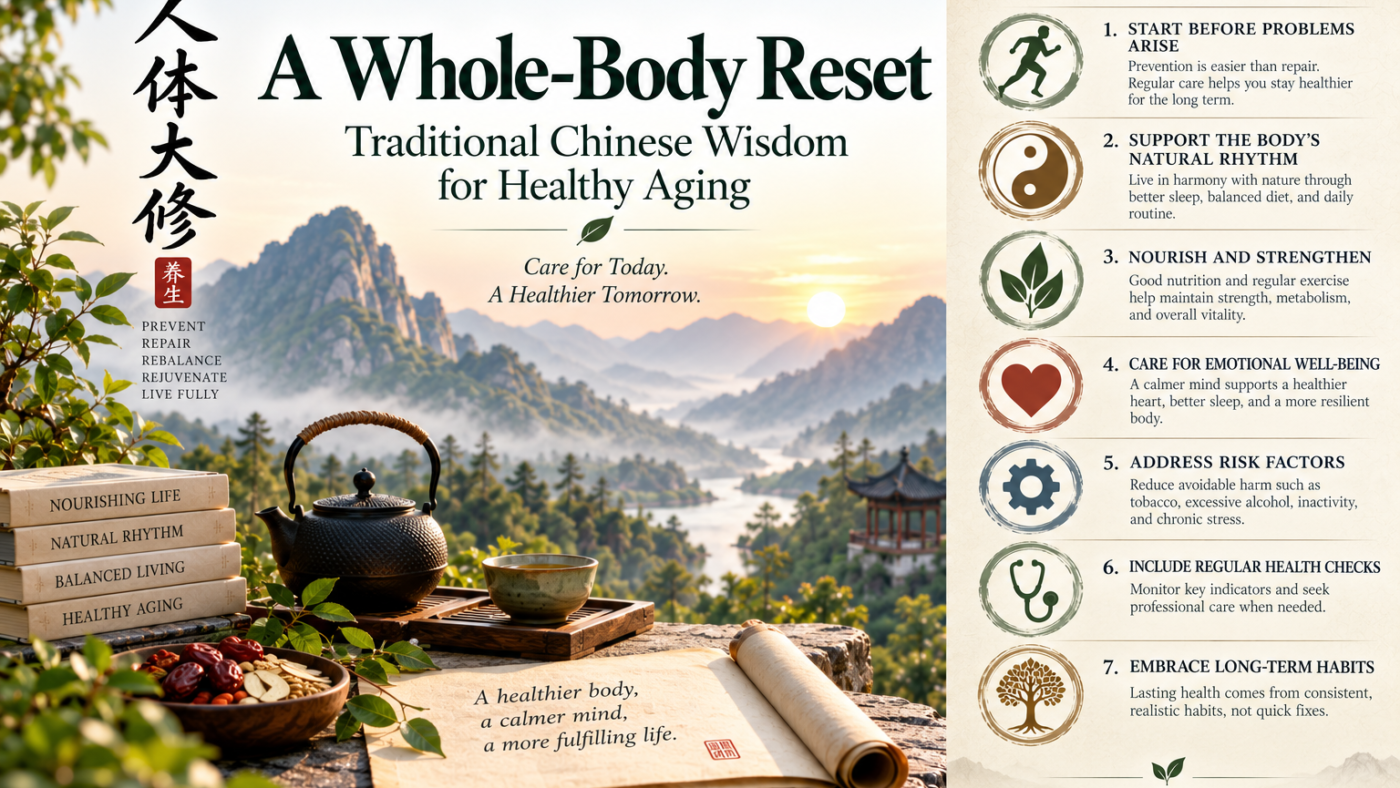
A whole-body reset is a structured approach to healthy aging that focuses on sleep, nutrition, movement, strength, emotional well-being, risk reduction, and preventive care. Inspired by the traditional Chinese principle of protecting health before disease develops, it offers a practical way to reassess daily habits and build a healthier foundation for the years ahead.Modern life teaches us to maintain almost everything we depend on.
Cars receive regular servicing. Machines are inspected before they fail. Homes are repaired before small problems become major ones.
Yet people often wait until their own health has clearly deteriorated before giving serious attention to sleep, movement, nutrition, stress, preventive care, and recovery.
Traditional Chinese health culture approached this differently.
The classical idea of zhi wei bing—often translated as “treating before disease”—encouraged people to protect health before illness became established.
From this perspective, a “whole-body reset” does not mean rebuilding the body as if it were a machine. Nor does it mean that every organ can be restored to youth through a fixed formula.
A more useful modern interpretation is a structured period of health reassessment and renewal:
Review your habits.
Protect sleep.
Improve nutrition.
Rebuild strength.
Reduce harmful exposures.
Address neglected symptoms.
Restore emotional balance.
And make preventive care part of everyday life.
Why Regular Health Maintenance Matters
A well-maintained car may last longer and function more reliably than one that is neglected.
The human body is far more complex, but the analogy contains one useful lesson:
Prevention is often easier than repair.
Many major health risks develop gradually.
High blood pressure may cause no symptoms for years.
Blood glucose can worsen before diabetes is diagnosed.
Muscle strength can decline slowly.
Sleep problems can become chronic.
Physical inactivity can gradually reduce endurance and mobility.
Stress may accumulate until it begins affecting mood, appetite, relationships, or cardiovascular health.
Regular attention gives people a chance to identify these changes earlier.
A whole-body reset is therefore less about “fixing” the body and more about checking whether daily life is still supporting long-term health.
When Does Aging Begin?
Traditional Chinese texts describe human development in stages.
The Huangdi Neijing famously presents age-related cycles for women and men, linking maturity, reproduction, strength, hair, bones, and constitutional vitality with different periods of life.
These descriptions are culturally important, but aging does not begin suddenly on one birthday.
Modern biology shows that aging is gradual, highly individual, and different across tissues.
Some physiological changes begin relatively early in adulthood.
Others may not become noticeable until decades later.
Muscle mass and strength may gradually decline with age, particularly when physical activity is low.
Bone remodeling changes over time.
Vision, hearing, cardiovascular function, metabolism, hormone patterns, and recovery capacity may also change at different rates.
But chronological age alone does not determine functional age.
A physically active 60-year-old may have better strength and cardiovascular fitness than a sedentary 40-year-old.
This is why healthy aging is not simply about preventing birthdays.
It is about preserving function.
Aging Is Not the Same as Decline
Growing older is inevitable.
Rapid loss of strength, mobility, independence, and health is not always inevitable.
Many age-related changes are strongly influenced by lifestyle.
Resistance training can help preserve muscle and strength.
Regular aerobic activity supports cardiovascular fitness.
Adequate protein supports muscle maintenance.
Good sleep supports recovery.
Balanced nutrition supports metabolic and bone health.
Social connection and mental engagement support emotional and cognitive well-being.
Avoiding tobacco and limiting harmful alcohol exposure can substantially reduce long-term health risks.
Modern healthy aging therefore focuses on healthspan—the years of life spent with good function and independence—not simply lifespan.
The Traditional Idea of Renewal
Traditional wellness literature often describes the body as continually renewing itself.
That general idea is true.
Human tissues are dynamic.
Cells are constantly being created, repaired, replaced, and removed.
But the entire body does not replace itself every 100 days.
Different tissues have different turnover rates.
Some intestinal cells renew rapidly.
Red blood cells typically circulate for several months.
Skin renews on another timescale.
Bone remodels slowly.
Some cells, including many neurons, may persist for decades or even most of a lifetime.
The traditional “hundred-day” idea is therefore better understood symbolically:
Meaningful physical change requires time and consistency.
A whole-body reset works best when it replaces short-term anti-aging promises with sustainable habits that protect strength, sleep, cardiovascular health, and independence.
Why a 100-Day Health Reset Can Still Be Useful
Although there is no universal 100-day cellular replacement cycle, approximately three months can be a practical period for changing habits.
One hundred days is long enough to establish routines, improve fitness, observe changes in sleep, build strength, adjust diet, and measure progress.
It also prevents the unrealistic expectation that health should transform in a week.
A 100-day reset can therefore be used as a behavioral framework rather than a biological law.
The goal is not to replace every cell.
The goal is to replace inconsistent habits with sustainable ones.
Part One: Restore the Daily Rhythm
The first element of a whole-body reset is regularity.
Traditional Chinese health preservation placed great importance on living according to natural rhythms.
Modern circadian science also shows that regular patterns of light exposure, sleep, activity, and eating help organize many physiological processes.
A practical reset may begin with:
Going to bed and waking at reasonably consistent times.
Getting daylight exposure during the morning or daytime.
Reducing excessive late-night screen exposure.
Avoiding very heavy meals close to bedtime.
Allowing enough time for sleep.
Keeping physical activity primarily during waking hours.
The point is not to follow the sun with mathematical precision.
It is to give the body predictable signals.
Part Two: Rebuild Strength
One of the most important protections against age-related decline is maintaining muscle.
Muscle supports much more than appearance.
It contributes to mobility.
Balance.
Glucose regulation.
Bone loading.
Metabolic health.
Physical independence.
And resilience during illness.
A healthy-aging reset should therefore include resistance exercise when appropriate.
This might involve:
Bodyweight exercises.
Resistance bands.
Free weights.
Machines.
Functional movements such as squatting, carrying, pushing, pulling, and stepping.
The appropriate program depends on age, health, experience, and physical limitations.
The goal is gradual progression rather than exhaustion.
Part Three: Protect Cardiovascular Fitness
Walking remains one of the simplest forms of health maintenance.
Brisk walking, cycling, swimming, Tai Chi, dancing, hiking, and other forms of aerobic movement can support cardiovascular and metabolic health.
For people who have been sedentary, starting modestly is often better than attempting an extreme program.
Consistency matters more than dramatic effort.
The body adapts when it is challenged regularly and allowed to recover.
Part Four: Nourish Rather Than Overeat
Traditional Chinese wellness repeatedly warns against chronic excess.
That principle remains useful.
Healthy aging nutrition should provide adequate nourishment without requiring constant restriction.
Important priorities include:
Adequate protein.
Vegetables and fruits.
Whole grains or other minimally processed carbohydrate sources according to individual needs.
Legumes.
Healthy fats.
Appropriate hydration.
Sufficient vitamins and minerals.
Food should also support muscle, bone, digestion, and metabolic health.
The goal is not to eat as little as possible.
It is to eat well enough to support function.
Appetite Is Not a Measure of Vitality
Some traditional writings treat strong appetite and sexual desire as signs of powerful life energy.
These experiences can certainly reflect well-being, but they are not reliable medical measures of health.
A very strong appetite can also occur with stress, poor sleep, medication effects, metabolic conditions, or other factors.
Reduced appetite can have many causes.
Sexual desire also changes naturally with age, relationships, medications, hormonal changes, stress, illness, sleep, and emotional state.
Healthy aging should not be judged by appetite or libido alone.
Part Five: Protect Recovery
Traditional Chinese medicine places great emphasis on “storing” and conserving vitality.
A modern interpretation is recovery.
Exercise requires recovery.
Mental work requires recovery.
Stress requires recovery.
Sleep is one of the most important recovery processes available to the body.
Chronic sleep deprivation can affect mood, blood pressure, appetite, glucose metabolism, immune function, attention, and physical performance.
A whole-body reset therefore cannot succeed if sleep remains neglected.
Part Six: Reduce Avoidable Damage
Health maintenance is not only about adding beneficial habits.
It also means removing harmful ones.
A high-quality reset should examine:
Smoking.
Excessive alcohol use.
Chronic sleep deprivation.
Prolonged sitting.
Repeated overeating.
Extreme dieting.
Poor medication adherence.
Unmanaged blood pressure.
Untreated sleep apnea.
Chronic stress.
Unsafe sun exposure.
Lack of preventive care.
Often, removing one major risk matters more than adding ten supplements.
Part Seven: Protect Emotional Health
Traditional Chinese health culture has long linked emotional life with physical health.
Classical texts describe anger, grief, fear, worry, and excessive excitement through the language of Qi and organ systems.
Modern psychology and physiology use different explanations, but the relationship between emotional health and physical health is undeniable.
Chronic stress may affect sleep, cardiovascular function, eating behavior, relationships, and quality of life.
A whole-body reset should therefore include mental recovery.
This may involve:
Time outdoors.
Meditation.
Breathing practices.
Tai Chi or Qigong.
Social connection.
Reducing unnecessary commitments.
Counseling or psychotherapy when appropriate.
Meaningful hobbies.
Adequate rest.
Emotional health is not an optional extra.
It is part of health.
Do You Need Special “Anti-Aging Formulas”?
Traditional Chinese culture contains a long history of herbal tonics and longevity formulas.
Some people may choose to use traditional herbal preparations under appropriate professional guidance.
But no formula should be assumed to reverse aging.
Claims that a product can reliably turn gray hair black, stabilize loose teeth, restore sexual function, remove wrinkles, prevent nearly all disease, or guarantee extreme longevity should be treated cautiously.
Herbal products can also interact with medications and may affect the liver, kidneys, blood pressure, blood glucose, or bleeding risk.
For healthy aging, the foundation remains much less glamorous:
Sleep.
Exercise.
Nutrition.
Preventive care.
Risk-factor control.
Social connection.
And consistency.
Supplements Should Support, Not Replace, the Foundation
Many people become interested in supplements during middle age because they want faster results.
But supplementation should answer a specific need.
Vitamin D may be appropriate when intake or blood levels are inadequate.
Vitamin B12 may be important in certain dietary patterns or absorption problems.
Calcium needs depend on diet and individual circumstances.
Iron should not be taken casually when deficiency has not been established.
Protein supplementation may help some people meet nutritional needs.
The principle is targeted support, not indiscriminate consumption.
More supplements do not automatically mean better health.
Slow Improvement Is Often Better Than Dramatic Claims
Traditional health literature sometimes praises gradual nourishment over aggressive intervention.
This idea has genuine value.
Many important improvements happen slowly:
Strength builds gradually.
Blood pressure responds over time.
Body composition changes over months.
Sleep routines stabilize through repetition.
Metabolic health improves with consistent habits.
Bone responds to long-term loading.
Healthy aging is usually quiet.
There may be no dramatic moment when the body suddenly feels “renewed.”
The benefits accumulate.
Prevention Should Be Measurable
Traditional Chinese medicine emphasizes preventing disease before it develops.
Modern preventive health adds tools that allow risk to be measured.
Depending on age, sex, health history, and individual risk, preventive care may include:
Blood-pressure checks.
Blood glucose screening.
Cholesterol testing.
Cancer screening.
Dental examinations.
Vision care.
Vaccination.
Bone-health assessment.
Medication review.
Hearing evaluation.
Mental-health screening.
A whole-body reset should therefore include appropriate health checks rather than relying only on how someone feels.
Feeling healthy is valuable.
Knowing your risk factors is better.
There Is No Guaranteed Natural Lifespan of 120 Years
Some longevity traditions suggest that humans should naturally live to 120 years if health is perfectly maintained.
That should not be presented as a biological guarantee.
Human lifespan varies according to genetics, environment, healthcare, lifestyle, social conditions, chance, and many other factors.
Healthy living can reduce risk and improve the probability of longer, healthier life.
It cannot guarantee a particular age.
The better goal is not:
“How can I make sure I live to 120?”
It is:
“How can I preserve function, independence, and quality of life for as long as possible?”
The Three Foundations of a Whole-Body Reset
A practical health reset can be organized around three foundations.
Lifestyle
Sleep well.
Eat well.
Move regularly.
Build strength.
Avoid tobacco.
Manage alcohol wisely.
Maintain healthy routines.
Mind
Protect emotional balance.
Manage chronic stress.
Stay socially connected.
Create periods of calm.
Maintain curiosity and purpose.
Preventive Care
Know your blood pressure.
Understand your metabolic risks.
Attend appropriate screenings.
Review medications.
Seek evaluation when persistent symptoms develop.
These three foundations are more important than any single anti-aging product.
A Practical 100-Day Framework
A modern 100-day whole-body reset can be divided into phases.
Days 1–21: Stabilize
Establish consistent sleep and wake times.
Begin daily walking.
Reduce tobacco and excessive alcohol exposure.
Improve meal quality.
Schedule overdue health checks.
Days 22–50: Build
Introduce progressive resistance training.
Increase daily movement.
Improve protein and vegetable intake.
Create a regular stress-management practice.
Address persistent sleep problems.
Days 51–75: Strengthen
Gradually increase exercise challenge.
Review blood pressure, weight, waist circumference, fitness, or other appropriate markers.
Identify which habits are becoming automatic.
Correct what is not working.
Days 76–100: Sustain
Shift attention from short-term improvement to long-term maintenance.
Decide which habits can realistically continue for years.
A successful reset should not end on Day 100.
It should create a healthier default lifestyle.
You Do Not Need to Feel “Old” Before Starting
One of the limitations of traditional “major repair” thinking is the idea that people should wait until aging begins.
There is no reason to wait.
Healthy aging begins while people are still healthy.
Strength developed in midlife provides reserve later.
Good sleep established earlier helps prevent chronic patterns.
Blood-pressure control protects organs over decades.
Stopping smoking earlier produces greater long-term benefit.
Prevention is strongest when it begins before decline becomes obvious.
The Modern Meaning of Human Renewal
The body is not an engine.
It cannot simply be disassembled, cleaned, and returned to factory condition.
But it is extraordinarily adaptive.
Muscles respond to training.
Cardiovascular fitness responds to movement.
Sleep responds to routine.
Metabolism responds to diet and activity.
Skills can be learned.
Habits can change.
Stress can be managed.
Risk factors can be treated.
This ability to adapt is the real foundation of renewal.
A Traditional Idea With a Modern Purpose
The original idea behind “human major maintenance” contains a valuable message:
Do not wait for breakdown.
Traditional Chinese health culture expressed this through yangsheng, prevention, rhythm, balance, and conservation of vitality.
Modern health science expresses it through exercise, nutrition, sleep, preventive screening, risk reduction, rehabilitation, and behavior change.
The language is different.
The purpose is similar.
Protect health while it is still present.
The Deeper Lesson
A whole-body reset is not a miracle treatment.
It is a deliberate period of attention.
It asks whether your current life is helping your future self.
Are you still strong?
Are you sleeping enough?
Are you moving?
Are you eating in a way that supports your health?
Are preventable risks being ignored?
Are stress and exhaustion becoming normal?
Have you postponed medical or dental care?
Are your habits sustainable for the next decade?
These questions matter far more than any promise to “reverse aging.”
The most meaningful form of renewal is not becoming 20 again.
It is entering the next stage of life with more strength, better function, healthier habits, and fewer preventable risks.
That is a form of maintenance worth doing at every age.
The real purpose of a whole-body reset is not to become young again, but to enter the next stage of life with better function, stronger habits, and fewer preventable health risks.
FAQ
What is a whole-body reset?
A whole-body reset is a structured period of reviewing and improving lifestyle habits such as sleep, nutrition, physical activity, strength, stress management, preventive care, and harmful exposures. It is not a medical detox or a method for replacing all the body’s cells.
Can a whole-body reset reverse aging?
No lifestyle program can literally reverse biological aging. However, exercise, nutrition, adequate sleep, smoking cessation, risk-factor management, and preventive care can help preserve function and reduce some age-related health risks.
Does the body completely renew itself every 100 days?
No. Different cell types have very different lifespans. Some renew quickly, others over months or years, and some may remain for decades. A 100-day reset is better understood as a behavioral framework for building consistent habits.
Why use 100 days for a health reset?
One hundred days is long enough to establish routines, improve fitness, strengthen sleep habits, adjust nutrition, and observe meaningful progress without treating the period as a biological rule.
What is the most important exercise for healthy aging?
No single exercise is sufficient. A healthy-aging program generally benefits from a combination of resistance training, aerobic activity, balance, mobility, and regular everyday movement adapted to individual ability.
Is strength training important as people age?
Yes. Maintaining muscle strength supports mobility, balance, metabolic health, bone loading, physical independence, and resilience as people grow older.
Do anti-aging supplements work?
Some supplements are useful when there is a specific nutritional need or deficiency, but no supplement can replace sleep, exercise, nutrition, preventive care, and appropriate medical treatment. More supplements do not automatically mean better health.
Is healthy aging mainly about living longer?
Healthy aging focuses not only on lifespan but also on healthspan—the years lived with good function, mobility, independence, and quality of life.
When should someone begin healthy-aging habits?
There is no need to wait until old age. Healthy-aging habits are most useful when established before major decline occurs.
Medical Disclaimer: This article is for educational and informational purposes only. Traditional Chinese concepts discussed here reflect historical health-preservation philosophies and should not be interpreted as established biomedical mechanisms. A whole-body reset is not a substitute for medical diagnosis, treatment, preventive screening, or management of chronic disease. Exercise, supplements, herbal products, and major lifestyle changes should be adapted to individual health circumstances.
This article is for general education and does not replace individualized care from a qualified health professional. Seek appropriate advice for persistent, severe, or concerning symptoms.
Read the full medical disclaimer