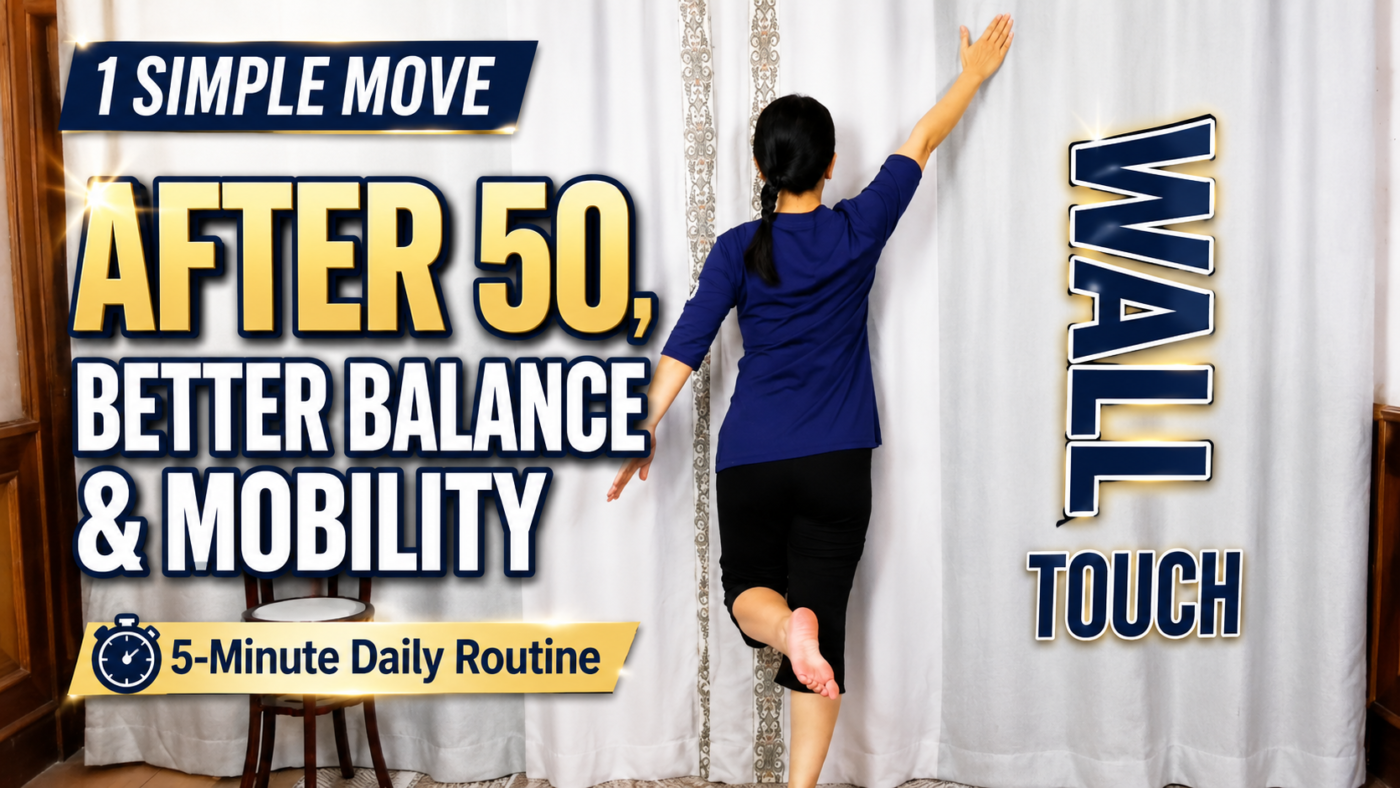
The wall touch exercise after 50 is a simple movement that combines overhead reaching, controlled heel raises, balance, and whole-body coordination.As we get older, maintaining strength is important, but strength alone is not enough. Balance, ankle stability, shoulder mobility, posture, and the ability to coordinate the upper and lower body all play important roles in how confidently we move through everyday life.
One simple exercise brings several of these elements together: standing in front of a wall, alternately reaching upward to touch it while rising onto the balls of the feet.
The movement looks almost too simple to matter. Try it continuously for a minute, however, and you may quickly notice your calves working, your shoulders moving, your balance being challenged, and your arms and legs learning to cooperate.
This is sometimes called a “wall-touch” exercise. It requires no special equipment and can be practiced at home in only a few minutes.
It should not be considered a treatment for blood clots, stroke, vascular disease, or chronic pain. What it can be is a practical movement exercise for people who want to maintain mobility, coordination, lower-leg strength, and balance as they age.
Why This Simple Movement Becomes More Useful After 50
Many people notice gradual physical changes after middle age.
The ankles may feel less stable. The calves fatigue more quickly. Shoulder movement may become restricted. Balance may not feel as automatic as it once did. Movements that require the arms and legs to work together can also become less fluid.
These changes are not always dramatic. They may first appear in ordinary activities such as climbing stairs, reaching for something on a high shelf, walking on uneven ground, or recovering balance after a small misstep.
This is why exercises that combine several basic movement skills can be useful.
The wall-touch exercise combines:
Calf activation and ankle movement.
Repeated heel raises.
Overhead arm movement.
Postural awareness.
Left-right coordination.
Dynamic balance.
Rhythmic breathing.
Because the wall provides a visual and physical reference point, it can also help beginners keep their movement more controlled.
How to Do the Wall-Touch Exercise
Stand facing a clear wall.
Position yourself close enough that your fingertips can comfortably reach the wall when your arm extends upward. For many people, having the toes roughly 10 to 15 centimeters from the wall is a reasonable starting point, although the exact distance should be adjusted for your body proportions and mobility.
Stand upright with your feet comfortably positioned and your weight evenly distributed.
Bring both hands up around shoulder level with the palms facing the wall.
Now begin the movement.
Step 1: Reach Up With One Arm
Slowly straighten one arm upward.
Rather than slapping or striking the wall, lightly touch it with your fingertips or palm.
The wall is not there to provide resistance. It acts mainly as a movement guide.
Step 2: Rise Onto Your Toes
As the arm reaches upward, gently lift your heels from the floor.
Rise onto the balls of your feet only as high as you can comfortably control.
There is no need to force the heels excessively high.
Step 3: Lower the Arm and Heels Together
Bring the arm back down while slowly lowering the heels to the floor.
Avoid dropping the heels suddenly.
Step 4: Repeat With the Other Arm
Reach upward with the opposite arm and again rise onto the balls of the feet.
Continue alternating from side to side:
Reach and rise.
Lower.
Change arms.
Reach and rise again.
The goal is to gradually develop a smooth rhythm between the upper and lower body.
Start Slowly Before Trying to Go Faster
One of the most common mistakes is trying to perform the exercise quickly before the movement pattern has become comfortable.
During the first few sessions, coordination matters more than speed.
Move slowly enough that you can maintain your balance and remain aware of what your arms, legs, and trunk are doing.
Once the movement becomes natural, the rhythm can gradually become slightly quicker if that feels comfortable.
Faster is not necessarily better.
Controlled repetitions are more useful than rushed repetitions performed with poor balance or posture.
What If Your Arms and Legs Do Not Coordinate?
This is extremely common.
Someone trying this exercise for the first time may discover that the arms and feet seem to have completely different plans.
You may raise the wrong arm, forget to lift your heels, lift one heel before the other, or lose the rhythm entirely.
That is part of the exercise.
Instead of forcing the full movement immediately, break it into smaller pieces.
First practice simple heel raises while keeping the hands down.
Rise onto the balls of the feet.
Pause briefly.
Lower the heels slowly.
Repeat until the movement feels stable.
Then practice raising both arms without the heel movement.
Once both patterns are comfortable, combine them.
Finally, progress to alternating one arm at a time.
This gradual progression is particularly useful for anyone who feels uncertain about balance or coordination.
Why Your Calves May Become Tired Quickly
A person who is not accustomed to heel raises may feel the calf muscles working within the first minute.
That does not necessarily mean something is wrong.
The calf muscles are repeatedly lifting part of your body weight every time the heels leave the floor.
Regularly training these muscles can help improve lower-leg strength and ankle control.
Strong and responsive lower legs are particularly valuable as we age because they contribute to walking, stair climbing, balance recovery, and many other everyday movements.
However, normal muscular effort is different from sharp pain.
If you experience sudden pain, severe cramping, chest discomfort, unusual shortness of breath, dizziness, or loss of balance, stop exercising.
The Wall Is More Than Something to Touch
The wall serves an important purpose.
Without it, many people gradually allow their reaching arm to drift forward, sideways, or backward.
The trunk may begin leaning.
The lower back may arch excessively.
The entire movement can slowly lose its original pattern.
The wall creates a consistent target.
Each time you reach upward, the fingers return to approximately the same plane. This can improve awareness of where your body is moving in space.
Once the movement becomes very familiar, it can sometimes be practiced without a wall.
For beginners and anyone with reduced balance, however, practicing near a stable support is usually the better choice.
Keep the Lower Back Relaxed
The movement should come primarily from the shoulders, arms, ankles, and calves.
A common mistake occurs when someone tries to reach higher by excessively arching the lower back.
This is unnecessary.
Imagine growing taller through the top of your head while keeping the ribs and pelvis relatively controlled.
Raise the arm only as high as your comfortable shoulder range allows.
If shoulder mobility is limited, simply make the reach smaller.
There is no requirement to touch a particular height on the wall.
The purpose is controlled movement, not maximum reach.
Do Not Hold Your Breath
Breathing should remain relaxed throughout the exercise.
One simple pattern is:
Breathe in gently as the arm rises.
Breathe out as the arm and heels lower.
You do not have to follow this pattern perfectly. The most important point is to avoid straining and holding your breath.
Smooth breathing often makes the movement feel easier and more rhythmic.
How Long Should You Practice?
Beginners do not need to start with five minutes.
Thirty seconds to one minute may be enough initially.
If that feels comfortable, rest and repeat.
Over time, you might gradually work toward two, three, or eventually five minutes according to your ability.
There is no special health benefit that suddenly appears at exactly five minutes.
Consistency and appropriate effort matter more than reaching a particular number.
A useful progression might be:
Start with about 30 to 60 seconds.
Practice slowly until coordination improves.
Increase the duration gradually.
Rest whenever technique begins to deteriorate.
Stop before fatigue causes you to lose control.
Someone who already exercises regularly may find the movement very easy, while someone who has been sedentary may find one minute surprisingly demanding.
Both responses are normal.
What You May Feel Afterward
After several minutes of repeated arm movement and heel raises, you may notice warmth in the calves, feet, shoulders, or upper back.
You may also feel temporarily less stiff because the body has been moving through repeated ranges of motion.
Some people describe this sensation as feeling “opened up” or more relaxed.
Traditional Chinese exercise systems often describe a similar experience using concepts such as promoting the smooth movement of qi and blood.
Those traditional descriptions can be understood as part of an older wellness framework.
From a modern physiological perspective, muscular activity increases energy demand, movement generates heat, joints move repeatedly, and circulation to working tissues changes in response to exercise.
The two explanations come from different medical traditions and should not be treated as identical.
The Traditional Meridian Perspective
Traditional Chinese wellness practices often interpret movements according to meridians and acupoints.
Within that framework, raising the arms is sometimes described as stretching pathways along the inner arms associated with the Heart and Pericardium meridians.
Heel raising and pressure through the forefoot may also draw attention to the sole of the foot, where Yongquan, or Kidney 1, is traditionally located.
Practitioners of traditional Chinese exercise may therefore describe the combined movement as helping the body feel more connected from the hands to the feet.
These ideas are meaningful within traditional Chinese medicine, but meridians should not be described as equivalent to arteries, veins, or other anatomical blood vessels.
Stimulating a meridian or acupoint has not been shown to mechanically clear arterial plaque or dissolve a blood clot.
That distinction is important.
Can This Exercise Prevent Blood Clots or Stroke?
This is where some popular explanations of the exercise go too far.
No single movement can guarantee protection from stroke.
The wall-touch exercise cannot dissolve an existing blood clot, remove plaque from an artery, or reduce someone’s risk of cerebral infarction to “the lowest possible level.”
Stroke prevention is much broader.
Regular physical activity is one important part of cardiovascular health, but so are managing blood pressure, avoiding smoking, controlling diabetes when present, addressing abnormal cholesterol, maintaining an appropriate body weight, following prescribed medical treatment, and obtaining appropriate medical care.
The benefit of this exercise is therefore better understood as part of an active lifestyle rather than as a vascular treatment.
That does not make the movement less useful.
It simply places it in the correct context.
Balance May Be One of Its Most Practical Benefits
One of the most valuable features of this exercise is the repeated transition between standing flat-footed and rising onto the balls of the feet.
The body must continually adjust its center of mass.
At the same time, the arms are moving above shoulder level.
This combination requires the nervous system and muscles to coordinate posture and balance.
Balance training becomes increasingly important with age because a fall can have serious consequences, especially in older adulthood.
Exercises that challenge balance safely, strengthen the legs, and improve coordination can therefore be a useful component of an overall exercise program.
The key word is safely.
If rising onto your toes makes you unstable, keep both hands close to the wall or another sturdy support.
A Safer Beginner Version
If the full exercise feels difficult, simplify it.
Stand facing the wall.
Keep both hands lightly touching the wall.
Practice slow heel raises.
Rise only slightly at first.
Lower slowly.
Once you can perform the heel raises comfortably, begin adding small arm movements.
Eventually, try alternating your arms.
Progression is more important than perfection.
There is no reason to rush.
Important Safety Considerations
People with balance difficulties should practice beside a sturdy wall, counter, or chair.
If you have a history of falls, significant dizziness, neurological problems, major joint disease, recent surgery, or serious cardiovascular disease, consider discussing new exercise routines with an appropriate healthcare professional.
If you have shoulder or lower-back problems, reduce the height of the arm reach.
Do not force the shoulders overhead.
Do not lean backward simply to touch a higher point on the wall.
People who become dizzy when standing or changing position should be particularly cautious.
Anyone with poorly controlled blood pressure or significant cardiovascular disease should avoid turning the movement into a fast, strenuous exercise without medical guidance.
And remember that new weakness, facial drooping, difficulty speaking, sudden loss of coordination, severe unexplained headache, or other possible signs of stroke require emergency medical attention—not exercise.
Do You Need to Practice Every Day?
Not necessarily.
Daily light practice may be comfortable for some people, but recovery requirements vary.
If your calves become unusually sore after the first few sessions, reduce the duration or allow additional recovery time.
Exercise does not need to become a test of willpower.
Some mild muscular fatigue after an unfamiliar activity can occur, but repeatedly pushing through significant pain is not a sign of better training.
Build gradually.
This Exercise Should Complement, Not Replace, Other Activity
The wall-touch exercise is useful, but it should not become your entire fitness program.
Healthy aging is better supported by combining different forms of movement.
Walking or other aerobic activity supports cardiovascular fitness.
Strength exercises help preserve muscle.
Balance exercises help maintain stability.
Mobility work helps maintain comfortable movement.
Activities such as tai chi may combine balance, coordination, controlled weight shifting, breathing, and movement awareness.
For that reason, it is misleading to claim that practicing this one wall exercise for a month is “better than ten years of tai chi.”
They are different forms of movement with different purposes.
The better approach is not to choose one and reject the other.
Use simple exercises like this as one piece of a broader movement routine.
A Simple 5-Minute Practice
Once you are familiar with the technique, a short routine can be very straightforward.
Spend the first minute practicing slow heel raises.
During the second minute, add gentle two-arm reaches.
During minutes three and four, begin alternating the arms.
During the final minute, slow the movement again and focus on posture and relaxed breathing.
If five minutes is too much, shorten the routine.
If it is easy, there is still no need to turn it into an exhausting workout.
Quality comes first.
The Takeaway
One month of wall touching will not make anyone immune to stroke, erase arterial disease, or replace years of tai chi practice.
But behind the exaggerated claims is a genuinely useful movement idea.
Alternating an overhead reach with controlled heel raises creates a simple exercise that challenges several abilities at once: calf strength, ankle control, shoulder movement, posture, balance, and coordination.
That makes it particularly interesting for adults who want to maintain confident movement as they grow older.
Start slowly.
Use the wall for support and alignment.
Do not force your range of motion.
Keep breathing.
Allow your coordination to improve naturally.
And rather than searching for one miraculous exercise, build a collection of simple movements that you can continue practicing for years.
That is a far more realistic path toward staying strong, mobile, and independent.
The wall touch exercise after 50 can be a useful addition to a broader strength, balance, and mobility routine.
Frequently Asked Questions
Is the wall-touch exercise suitable for people over 50?
Many generally healthy adults can perform a modified version of the movement. The difficulty should be adjusted according to balance, strength, shoulder mobility, and current health status.
How long should beginners practice?
Thirty seconds to one minute is a reasonable starting point for someone unfamiliar with repeated heel raises. Duration can gradually increase as strength and coordination improve.
Does the exercise prevent stroke?
No single exercise can guarantee stroke prevention. Regular physical activity can contribute to cardiovascular health, but stroke risk is influenced by many factors, including blood pressure, smoking, diabetes, cholesterol, heart conditions, medications, and overall lifestyle.
Does standing on the toes improve balance?
Repeated controlled heel raises challenge ankle and lower-leg muscles and require postural control. They can therefore be incorporated into a broader balance and strengthening program.
Should I slap the wall with my hands?
No. A gentle fingertip or palm touch is enough. The wall serves primarily as a reference point and, when necessary, as nearby support.
What if I cannot raise both heels very high?
That is fine. Begin with a small heel lift and use support if necessary. Range and endurance may improve gradually with practice.
Can I practice without a wall?
Once you have good balance and coordination, you may be able to perform the movement without touching a wall. Beginners and people with reduced balance should remain near a stable support.
Medical Disclaimer
This article is for educational and general wellness purposes only and is not medical advice. The exercise described here is not a treatment for stroke, thrombosis, cardiovascular disease, chronic pain, or any other medical condition. Individual exercise needs and risks vary. People with significant medical conditions, balance problems, recent injuries, or concerns about exercise safety should seek individualized guidance from a qualified healthcare professional.
This article is for general education and does not replace individualized care from a qualified health professional. Seek appropriate advice for persistent, severe, or concerning symptoms.
Read the full medical disclaimer