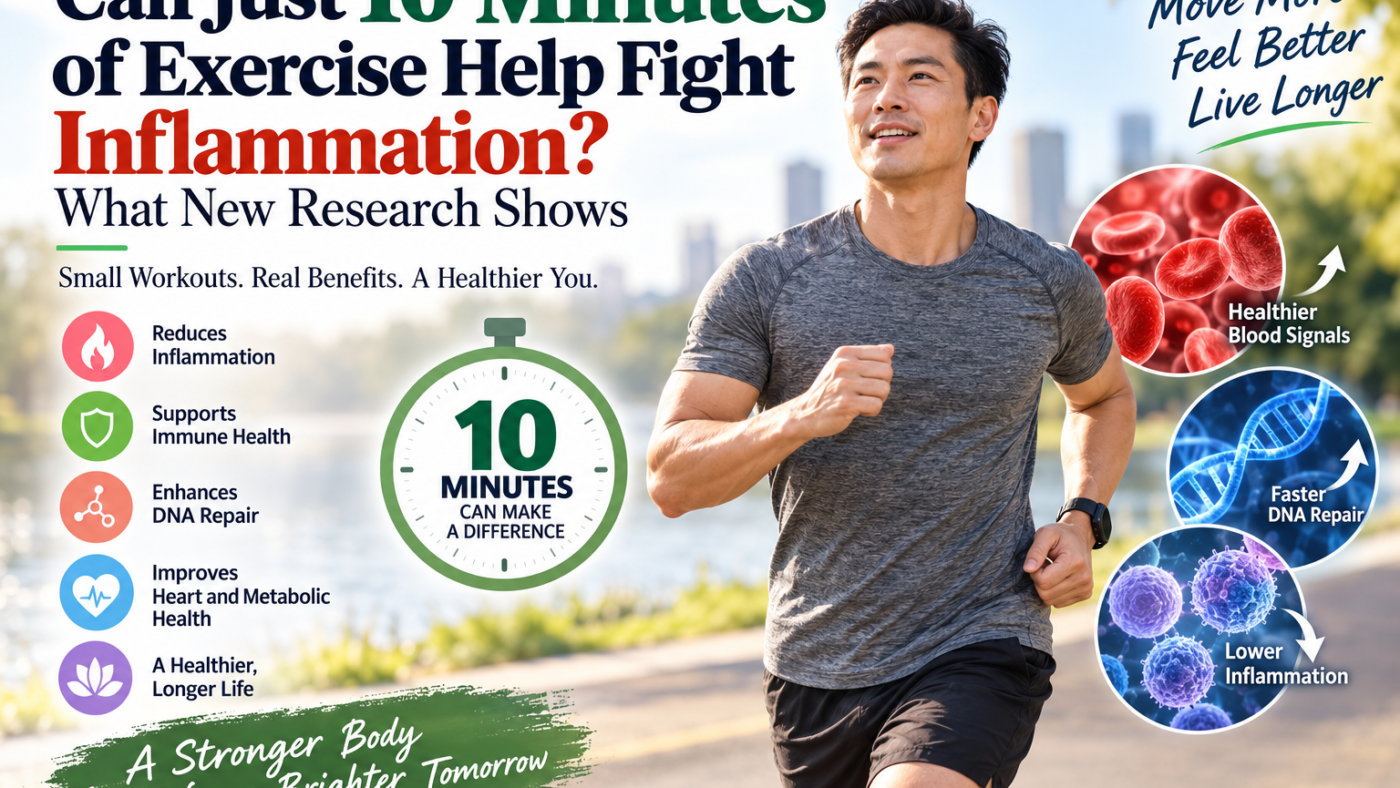
10 minute exercise benefits can begin sooner than many people realize. Even a short workout may rapidly change blood flow, metabolism and inflammatory signaling, making brief exercise sessions a practical option for busy adults.Sticking to an exercise routine is often harder than starting one. Busy schedules, long workdays, cold weather and low motivation can all interrupt even the best intentions.

But emerging research suggests that exercise does not always have to be long to produce measurable biological effects.
A study from Newcastle University found that a single bout of intense cycling lasting around 10 to 12 minutes changed the composition of participants’ blood. When researchers exposed colon cancer cells in the laboratory to serum collected after exercise, the cells showed faster DNA damage repair and changes in gene activity linked to energy metabolism and cell proliferation.
The findings do not mean that 10 minutes of exercise can “prevent cancer” by itself. But they do add to a growing body of evidence suggesting that even short bouts of exercise can rapidly alter inflammatory, metabolic and cellular signals in ways that may support long-term health.
What the 10-Minute Exercise Study Found
The Newcastle University research involved 30 adults with overweight or obesity.
Participants completed a maximal cycling test lasting approximately 10 to 12 minutes. Blood samples were collected before and immediately after exercise.
Researchers then examined how post-exercise serum affected colon cancer cells in laboratory conditions.
Several notable changes were observed.
Blood Chemistry Changed Quickly
After exercise, the concentration of multiple circulating proteins changed.
Several were involved in:
- inflammatory signaling
- vascular function
- immune activity
- metabolism
This shows how rapidly physical activity can influence the biochemical environment of the bloodstream.
DNA Damage Repair Became Faster in Cancer Cells
Colon cancer cells exposed to post-exercise serum showed faster resolution of markers associated with DNA damage.
The researchers also observed increased expression of PNKP, a gene involved in DNA repair.
This does not mean exercise serum “repairs cancer.”
Rather, it suggests that acute exercise may create circulating signals that influence how stressed cancer cells respond at the molecular level.
More Than 1,300 Genes Were Affected
Newcastle University reported that post-exercise blood altered activity across more than 1,300 genes in colon cancer cells.
Gene pathways related to mitochondrial energy metabolism were increased, while pathways involved in cell-cycle progression and proteasome activity were reduced.
This pattern is scientifically interesting because cancer cells depend heavily on controlled energy production and rapid proliferation.
However, these experiments were conducted in cells in the laboratory, not as a direct cancer-treatment trial in humans.
Why Exercise Is Often Described as Anti-Inflammatory
Inflammation is part of the body’s normal immune response.
Short-term inflammation helps the body respond to injury and infection.
The problem is persistent, low-grade inflammation.
Chronic inflammation is associated with:
- obesity
- insulin resistance
- cardiovascular disease
- type 2 diabetes
- some cancers
- age-related disease
Regular physical activity can help reduce this chronic inflammatory burden.
Interestingly, intense exercise can temporarily increase some inflammatory signaling molecules during and immediately after the workout.
This is not necessarily harmful.
Acute exercise creates a short-lived physiological stress response that can trigger beneficial adaptations afterward.
Over time, regular exercise is associated with improved metabolic health and lower chronic inflammatory activity.
One Workout Can Change the Bloodstream
The Newcastle findings are not isolated.
Research from Edith Cowan University has also shown that a single bout of resistance training or high-intensity interval training can increase circulating myokines.
Myokines are signaling molecules released by contracting muscles.
In a 2025 study involving breast cancer survivors, one session of resistance exercise or HIIT increased several myokines and reduced the growth of breast cancer cells by approximately 19% to 29% in laboratory testing using participants’ blood samples.
Again, these are laboratory findings.
They should not be interpreted to mean that one workout shrinks a tumor inside the human body.
What they do show is that skeletal muscle acts as an active endocrine organ.
When you exercise, muscles release molecules that communicate with other tissues throughout the body.
You Do Not Need a One-Hour Workout Every Time
One of the biggest barriers to exercise is the belief that it only “counts” if you complete a long workout.
That is not true.
Longer structured exercise sessions can certainly provide major benefits, but shorter bouts also contribute.
For people who struggle with consistency, one practical strategy is sometimes called:
Exercise Snacking
Exercise snacks are short periods of physical activity spread throughout the day.
They can last anywhere from less than one minute to approximately 10 minutes.
Instead of trying to find a continuous 45-minute block, someone might perform several short sessions at different times.
This approach can be particularly useful for:
- office workers
- people with busy schedules
- beginners
- adults returning to exercise
- people trying to reduce prolonged sitting
Three Ways to Use Exercise Snacks
Different people require different levels of intensity.
A useful approach is to match the exercise style to your fitness level and health status.
1. Sprint-Style Exercise Snacks
These are short, vigorous bursts.
Examples include:
- fast cycling
- uphill walking
- stair climbing
- high-knee running
- brief running intervals
- bodyweight squat intervals
A session might last only 20 to 60 seconds.
After adequate recovery, another short bout can be performed later in the day.
This format is most appropriate for generally healthy adults who already tolerate vigorous exercise.
It is not necessary to perform every interval at maximum effort.
In fact, true all-out exercise is inappropriate for many beginners.
2. Sitting-Break Exercise Snacks
For sedentary workers, the most important goal may simply be to stop sitting continuously.
Every 30 to 60 minutes, stand up and move for 2 to 5 minutes.
Examples include:
- walking around the office
- climbing a flight of stairs
- chair squats
- calf raises
- gentle shoulder movements
- hip mobility exercises
These short interruptions may support blood-glucose control, circulation and musculoskeletal comfort.
The key is frequency rather than intensity.
3. Ten-Minute Moderate Exercise Sessions
This is often the most practical option.
Try 5 to 10 minutes of activity several times during the day.
Examples include:
- brisk walking
- cycling
- stair climbing
- bodyweight strength exercises
- resistance-band exercises
Three 10-minute sessions across the day can accumulate to 30 minutes of movement without requiring a large uninterrupted block.
A Practical 10-Minute Workout
For a generally healthy adult, one simple routine could look like this.
Minute 1–2: Warm-Up
Walk briskly in place.
Add gentle arm swings and shoulder circles.
Minute 3–4: Squats or Sit-to-Stands
Perform controlled repetitions.
Use a chair for support if needed.
Minute 5–6: Brisk Walking or Stair Climbing
Increase your breathing rate while remaining in control.
Minute 7–8: Wall Push-Ups or Incline Push-Ups
Choose an angle appropriate for your strength.
Minute 9: Calf Raises
Rise slowly onto your toes and lower with control.
Minute 10: Easy Walking
Gradually reduce your breathing rate.
This is not a substitute for a complete weekly exercise program, but it is far better than doing nothing because you feel you do not have enough time.
How Hard Should You Exercise?
Intensity matters, but harder is not always better.
One easy way to estimate intensity is the talk test.
Light Intensity
You can speak and sing comfortably.
Moderate Intensity
You can speak in full sentences, but singing becomes difficult.
Vigorous Intensity
You can say only a few words before needing another breath.
For most people, moderate exercise can provide substantial benefits with lower injury risk than repeated all-out efforts.
What About Heart-Rate Targets?
Some people use estimated maximum heart rate to guide exercise.
A widely used rough estimate is:
220 minus your age
But this formula is only an approximation.
Individual maximum heart rate can differ significantly.
For general fitness, perceived exertion and the talk test are often simpler and more practical.
People taking medications that affect heart rate should not rely on generic heart-rate formulas without professional guidance.
Short Workouts Do Not Replace Weekly Exercise Goals
The fact that 10 minutes can produce biological changes does not mean 10 minutes per week is enough.
Adults should still aim to accumulate regular aerobic activity along with strength training.
Short sessions are useful because they make the total target easier to reach.
Think of them as building blocks.
Five minutes here and 10 minutes there can accumulate into a meaningful weekly amount.
Resistance Training Is Especially Valuable
Aerobic exercise receives a lot of attention, but strength training deserves equal emphasis.
Resistance exercise can help:
- preserve muscle mass
- improve insulin sensitivity
- support bone health
- maintain physical function
- reduce age-related weakness
- improve body composition
You do not necessarily need a gym.
Useful exercises include:
- sit-to-stands
- wall push-ups
- lunges
- step-ups
- resistance-band rows
- calf raises
- carrying moderately heavy objects
Consistency matters more than complexity.
Exercise and Cancer: What We Know and What We Do Not
The phrase “exercise fights cancer” can easily be exaggerated.
The evidence is more nuanced.
Regular physical activity is associated with a lower risk of several cancers and can improve physical function and quality of life in many cancer survivors.
Exercise is also increasingly incorporated into cancer rehabilitation and supportive care.
But exercise should not be described as a standalone cancer treatment.
Laboratory studies showing that exercise-conditioned blood affects cancer cells help scientists understand possible mechanisms.
They do not prove that a 10-minute workout directly kills cancer inside the human body.
That distinction is important.
If You Are Undergoing Cancer Treatment
Exercise can often be beneficial during or after cancer treatment, but the appropriate program depends on:
- cancer type
- treatment stage
- fatigue
- blood counts
- bone health
- cardiovascular status
- neuropathy
- surgical recovery
People receiving cancer treatment should discuss exercise intensity with their oncology team or an appropriately trained exercise professional.
Winter Exercise Requires Extra Care
Cold weather can increase cardiovascular strain and make muscles and connective tissues feel stiffer.
For some people, especially those with cardiovascular disease, exercising in very cold conditions deserves additional caution.
1. Avoid Sudden Intense Exercise in Extreme Cold
You do not need to force yourself into a maximal outdoor workout on the coldest morning of the year.
Indoor exercise is a perfectly reasonable alternative.
2. Warm Up Longer
In colder weather, extend your warm-up gradually.
Start with easy movement before progressing to faster walking, running or higher-intensity exercise.
3. Dress in Layers
Choose clothing that allows sweat to evaporate while protecting you from wind and cold.
Remove or add layers as needed.
4. Progress Gradually
Do not suddenly double your speed, duration or intensity.
Exercise adaptations occur over time.
A gradual increase is safer and more sustainable.
Who Should Be Cautious With High-Intensity Exercise?
High-intensity exercise is not appropriate for everyone.
Talk to a healthcare professional before starting vigorous training if you have:
- known heart disease
- uncontrolled hypertension
- significant arrhythmias
- severe lung disease
- uncontrolled diabetes
- major mobility limitations
- recent surgery
- unexplained chest discomfort
- a long period of physical inactivity combined with multiple cardiovascular risk factors
Stop exercise and seek medical evaluation if you develop:
- chest pain
- severe shortness of breath
- fainting
- unusual dizziness
- new palpitations
- sudden weakness
Older Adults Can Use Exercise Snacks Too
Older adults do not need to copy sprint workouts designed for younger athletes.
A safer version might include:
- 5 minutes of walking
- chair sit-to-stands
- supported calf raises
- gentle stair climbing
- light resistance-band exercises
- balance exercises near a stable support
Even relatively small increases in activity can be valuable for someone who has previously been sedentary.
The safest starting point is often:
Move more frequently before trying to move much harder.
Why Short Exercise Sessions Work
A short bout of physical activity can create multiple immediate effects.
Heart rate increases.
Muscles contract.
Blood flow changes.
Glucose uptake increases.
Myokines and other signaling molecules are released.
Blood vessels respond.
Energy metabolism accelerates.
These acute responses happen repeatedly every time you exercise.
Over weeks and months, repeated exposure helps create long-term adaptations.
This is why consistency matters more than the occasional heroic workout.
The Best Workout Is the One You Will Repeat
The biggest lesson from short-duration exercise research is not that everyone needs to perform a maximal 10-minute cycling test.
It is that meaningful biological responses can begin surprisingly quickly.
If your biggest obstacle is time, stop waiting for the perfect one-hour workout.
Start with:
5 minutes.
10 minutes.
A walk after lunch.
Two minutes away from your desk.
A few squats while waiting for dinner.
A short bike ride.
These small sessions can become the foundation of a much more active lifestyle.
The Bottom Line
Research from Newcastle University found that approximately 10 minutes of intense cycling altered circulating molecules and produced measurable effects when post-exercise serum was applied to colon cancer cells in laboratory experiments.
These changes included faster DNA damage repair and shifts in gene expression associated with mitochondrial metabolism and reduced cell proliferation.
The message is promising, but it should not be exaggerated.
Ten minutes of exercise is not a cancer cure.
What the study adds to a much larger body of evidence is something more practical:
Even a short workout can matter.
If long workouts feel impossible, use exercise snacks throughout your day.
Move frequently.
Build strength.
Reduce prolonged sitting.
Gradually accumulate more activity.
Because when it comes to health, ten minutes you actually do is far more valuable than an hour-long workout you keep postponing.
FAQ
Is 10 minutes of exercise really enough to help?
Ten minutes can produce immediate physiological changes and contribute to your daily activity total. For broader health benefits, however, regular activity accumulated throughout the week remains important.
Does exercise reduce inflammation?
Regular exercise is associated with lower chronic systemic inflammation. A single workout temporarily changes inflammatory and immune signaling, while repeated exercise produces longer-term adaptations.
Can 10 minutes of exercise prevent cancer?
No. The recent study showed molecular and cellular effects in laboratory experiments. It does not prove that one 10-minute workout prevents or treats cancer.
What are exercise snacks?
Exercise snacks are short bouts of movement distributed throughout the day, ranging from less than one minute to around 10 minutes.
Can walking count as an exercise snack?
Yes. Brisk walking for several minutes is one of the simplest and safest ways to accumulate activity.
How often should sedentary people stand up?
A practical approach is to break up prolonged sitting every 30 to 60 minutes with several minutes of standing or movement.
Are high-intensity exercise snacks safe for older adults?
Not necessarily. Older adults and people with chronic medical conditions should generally start with lower-intensity movement and increase gradually.
Medical Disclaimer
This article is for educational purposes only and is not medical advice. Exercise recommendations should be individualized according to age, fitness level, medical conditions and medications. People with cardiovascular disease, cancer, uncontrolled chronic disease or concerning symptoms should consult an appropriate healthcare professional before beginning vigorous exercise.
This article is for general education and does not replace individualized care from a qualified health professional. Seek appropriate advice for persistent, severe, or concerning symptoms.
Read the full medical disclaimer