Constipation becomes increasingly common as we get older, but the solution is not always as simple as eating more fiber or drinking more water.
You may already be eating vegetables, adding fiber to your meals, drinking plenty of fluids, and trying to maintain a healthy diet. Yet when you sit on the toilet, bowel movements still take too long. You may strain repeatedly, feel that something is “stuck,” or leave the bathroom with the uncomfortable sensation that you have not completely emptied your bowels.
For some people, the problem is not only what they eat.
How the digestive system moves, how the abdominal wall and diaphragm generate pressure, how the pelvic floor relaxes, how much you move during the day, and even the position you use on the toilet can all influence how easily stool passes.
This becomes particularly relevant after 45, when physical activity may decrease, sitting time may increase, mobility can gradually decline, and changes in medications, hydration, diet, sleep, hormones, and health conditions can all affect bowel habits.
The goal is not to “push harder.”
A healthier approach is to help the body coordinate several systems at the right time.
Why Constipation Is Not Always Just a Fiber Problem
Constipation can have many causes.
Inadequate fiber, insufficient fluid intake, physical inactivity, certain medications, changes in routine, hormonal or metabolic disorders, neurological conditions, irritable bowel syndrome, and pelvic floor dysfunction can all contribute.
Many people with chronic constipation do not have an obvious structural blockage. Instead, bowel function may be affected by slower movement through the colon, difficulty coordinating the muscles required for evacuation, or a combination of factors.
This is why two people with similar diets may have completely different bowel habits.
One person may eat relatively little fiber and remain regular, while another may carefully manage fiber and hydration and still struggle.
The digestive tract does not work in isolation. It interacts with the nervous system, diaphragm, abdominal muscles, pelvic floor, movement patterns, daily routine, stress levels, sleep, and physical activity.
For some people, improving these factors can make bowel movements more comfortable.
A Common Pattern: The Harder You Push, the More Difficult It Feels
Many people recognize this experience.
You feel the urge to have a bowel movement.
You sit down.
Nothing happens.
You begin pushing harder.
But instead of becoming easier, everything seems tighter.
This can happen when the muscles around the pelvic floor and anal outlet are not relaxing efficiently while abdominal pressure is increasing.
Defecation requires coordination.
The abdominal wall and diaphragm help generate pressure while the pelvic floor and anal outlet need to relax appropriately. If the outlet remains excessively tense while you keep increasing pressure, straining may become uncomfortable and ineffective.
This is one reason why “try harder” is not always useful advice for constipation.
The body needs both pressure and relaxation.
Why Your Toilet Position Matters
Human beings did not evolve sitting upright on modern toilets.
Historically, squatting was a common defecation posture. The difference matters because the position of the hips and pelvis affects the anorectal region.
A muscle known as the puborectalis wraps around the rectum and contributes to the anorectal angle. This mechanism helps maintain continence when we are not trying to have a bowel movement.
When the hips move into a deeper flexed position, similar to a squat, the anorectal angle may become more favorable for evacuation in some people.
That does not mean everyone should replace a sitting toilet with a squat toilet.
Modern sitting toilets have important advantages, particularly for older adults and people with limited hip, knee, ankle, or balance capacity.
The practical solution is often to modify the sitting position.
How to Improve Your Position on a Sitting Toilet
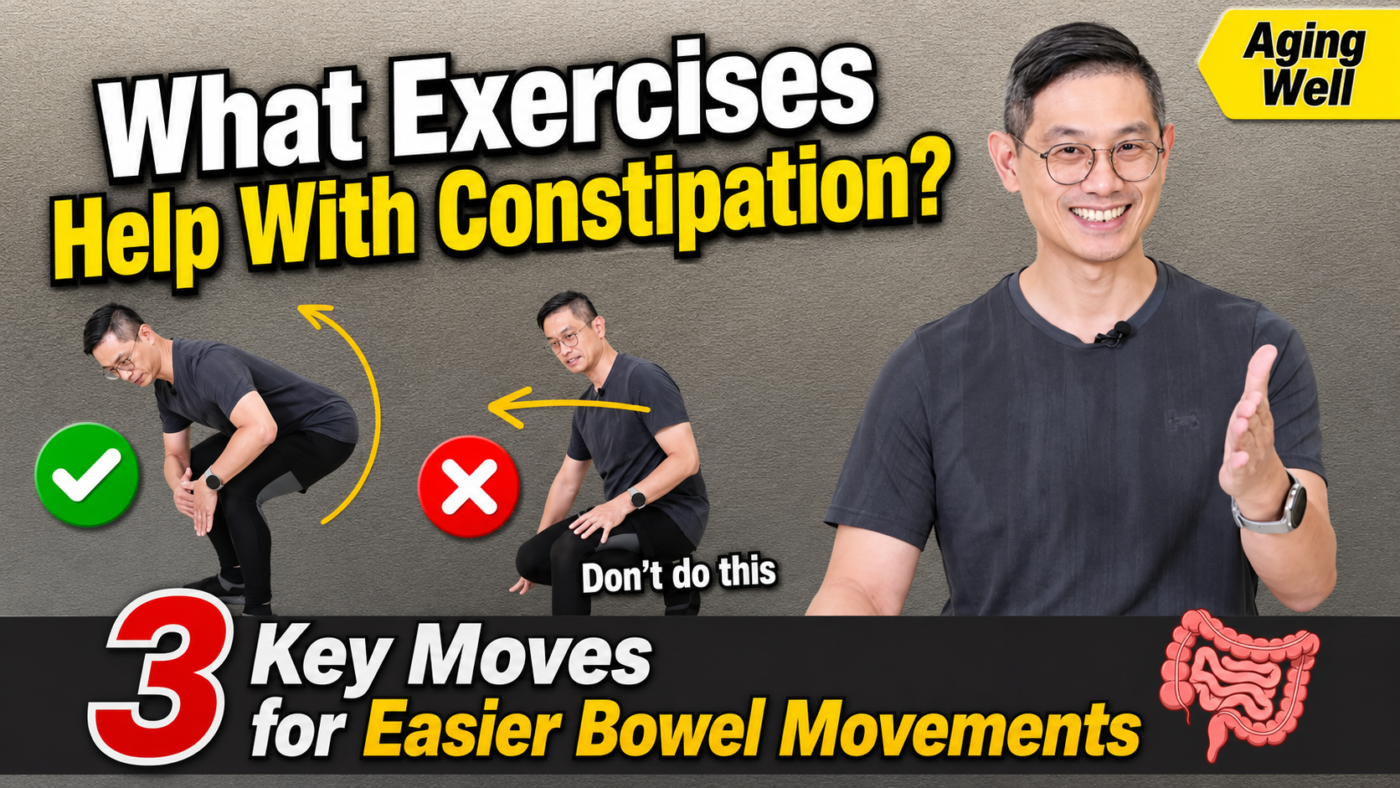
If you use a conventional toilet, try three simple adjustments.
1. Raise Your Feet
Place your feet on a small, stable footstool.
The goal is to bring the knees somewhat higher than the hips, creating a position closer to a supported squat.
Some people find that this makes evacuation easier, although it is important to understand that a footstool does not improve constipation for everyone.
Comfort matters more than forcing yourself into an extreme position.
2. Lean Slightly Forward
Instead of sitting completely upright or leaning backward, allow your torso to tilt gently forward from the hips.
Keep your feet supported.
Rest your forearms lightly on your thighs if that feels comfortable.
Avoid collapsing your chest completely toward your knees.
3. Keep Breathing
Do not immediately hold your breath and strain as hard as possible.
Allow the abdomen and lower ribs to move naturally with your breathing.
A calm exhalation can help reduce unnecessary whole-body tension.
The objective is coordinated pressure, not maximum effort.
Stop Turning the Toilet Into a Phone Chair
A comfortable sitting toilet creates another problem: it is easy to stay there far longer than necessary.
Scrolling through your phone can turn a short bathroom visit into 15 or 20 minutes of sitting and intermittent straining.
If nothing is happening, repeatedly forcing a bowel movement is generally not a productive strategy.
Respond to the natural urge when possible, give yourself enough time without rushing, but avoid making prolonged toilet sitting part of your daily routine.
Your bathroom should not become another desk.
What About a Squat Toilet?
A squat toilet may feel natural and effective for people who already have adequate hip, knee, ankle, and balance capacity.
But deep squatting is not appropriate for everyone.
People with significant knee pain, arthritis, poor balance, severe hip restriction, dizziness, neurological problems, recent joint surgery, or difficulty getting up from the floor should prioritize safety.
For many adults over 45, a sitting toilet combined with a stable footstool may be a more practical option.
If you do use a squat toilet, the ability to lower and rise safely matters just as much as the squat itself.
A Safer Way to Lower Into a Squat
Begin with your feet approximately hip-width apart or slightly wider.
Allow the toes to turn outward slightly if that is more comfortable for your hips.
Keep your knees generally moving in the same direction as your toes rather than allowing them to collapse inward.
Instead of driving the knees forward immediately, begin by sending the hips slightly backward.
Gradually bend the knees and hips together.
If balance is uncertain, use a stable hand support.
Never force yourself into a depth that causes knee or hip pain.
How to Stand Up More Easily
Getting out of a deep squat can be more difficult than lowering into one.
Instead of trying to lift your torso straight upward from the deepest position, shift your body slightly forward so your center of mass comes over your feet.
Allow the hips to rise.
Then straighten the knees and hips gradually.
Use a secure support if necessary.
For older adults with significant mobility limitations, a squat toilet may simply not be worth the fall risk.
The Three Systems Behind Easier Bowel Movements
A bowel movement may look like one simple action, but several systems have to cooperate.
Three are particularly relevant.
System 1: Intestinal Movement
The colon must move stool toward the rectum.
Regular physical activity supports overall gastrointestinal function, and a sedentary lifestyle is associated with constipation in some people.
System 2: Breathing and Abdominal Pressure
The diaphragm, abdominal wall, rib cage, and pelvic floor work together to manage pressure inside the abdomen.
Efficient bowel movements require pressure to be generated without excessive whole-body bracing.
System 3: Pelvic Floor Coordination
The pelvic floor does not simply need to be “strong.”
It needs to contract when appropriate and relax when appropriate.
This distinction is extremely important.
Someone who has difficulty relaxing the pelvic floor during defecation may not benefit from simply performing more and more strengthening contractions.
Coordination matters.
Movement Strategy 1: Get the Body Moving
The first goal is simple: reduce prolonged inactivity and introduce gentle rhythmic movement.
Walking is one of the easiest options.
A comfortable walk after meals can be an excellent daily habit. You do not need an intense workout. Regular light-to-moderate physical activity is more important than trying to exhaust yourself.
Walking, easy cycling, mobility work, and other forms of gentle aerobic movement can all form part of a constipation-friendly lifestyle.
You can also experiment with the following home movements.
Exercise 1: Gentle Abdominal Circles and Trunk Rotation
Stand or sit comfortably.
Place your hands lightly over your abdomen.
Make slow, gentle circular movements without pressing deeply.
The purpose is relaxation and body awareness rather than forcefully manipulating the intestines.
Perform approximately 12 relaxed circles.
Rest briefly and repeat for two or three rounds if comfortable.
Next, add gentle trunk rotation.
Turn the torso toward the right and then toward the left.
Allow the feet and hips to move naturally rather than twisting aggressively through the spine.
Your hands can remain lightly over the abdomen.
Perform the movement slowly and rhythmically.
This type of movement should feel comfortable.
It should never produce abdominal pain.
Avoid aggressive abdominal pressure, particularly if you have unexplained abdominal symptoms, a recent abdominal operation, a hernia, or another condition for which abdominal pressure has been restricted.
Exercise 2: Relaxed Arm Swings With Rotation
Stand with your feet comfortably apart.
Soften your knees slightly.
Allow your arms to hang loosely.
Rotate your torso gently from side to side and let the arms swing naturally around the body.
Do not force the range of motion.
The arms may lightly contact the sides of the body as they swing.
Think of this as whole-body rhythmic movement rather than an abdominal treatment.
Try approximately 12 repetitions in each direction or continue for 30 to 60 seconds.
Repeat two or three times if it feels good.
This is especially useful after long periods of sitting because it encourages movement through the hips, trunk, spine, and rib cage.
Exercise 3: Marching With an Overhead Reach
Stand tall near a wall or stable chair if balance is a concern.
Raise one knee comfortably while reaching one or both arms upward.
Lower the leg and repeat on the opposite side.
The movement can resemble a slow exaggerated march.
Pause briefly at the top if you are stable.
Perform approximately 8 to 12 repetitions per side.
Rest and repeat for two or three rounds if appropriate.
Afterward, you can use a gentle split-stance hip-flexor stretch.
Step one foot forward and the other backward.
Keep the torso tall and gently shift the pelvis forward until you feel a mild stretch near the front of the hip on the back-leg side.
Do not force the stretch.
These movements are not a cure for constipation. Their value comes from adding mobility and rhythmic activity to a lifestyle that may otherwise contain many hours of sitting.
Movement Strategy 2: Restore Rib-Cage Movement and Breathing
Many people spend their day collapsed over computers, phones, steering wheels, or desks.
The issue is not that slouching literally “closes the intestines.”
The more useful concern is that sustained collapsed posture can limit comfortable rib-cage movement and encourage shallow breathing patterns.
Improving trunk mobility and breathing can help you become more aware of abdominal pressure and relaxation.
Exercise 4: Seated Chest Opening
Sit upright on a stable chair.
Place your hands gently behind your ears.
Bring the elbows slightly forward as you allow the upper back to round comfortably.
Exhale.
Then slowly open the elbows outward and gently extend through the upper chest.
Inhale without forcing the neck backward.
Return to the starting position while exhaling.
Perform approximately 6 to 8 slow repetitions.
The movement should occur primarily through the upper back and rib cage rather than by aggressively arching the lower back.
Exercise 5: “Embrace the World”
Sit toward the front half of a stable chair with both feet supported.
Reach your arms forward as though hugging a large ball.
Allow the shoulder blades to spread and the upper back to broaden.
Exhale slowly.
Then open the arms outward.
Lift through the chest gently without throwing the head backward.
Inhale as the chest and rib cage expand.
Return to the embracing position and exhale.
Continue slowly for 6 to 12 repetitions.
The purpose is to alternate expansion and relaxation through the rib cage and upper trunk.
Exercise 6: 360-Degree Diaphragmatic Breathing
Place your hands around the lower ribs.
Your thumbs can point toward the back while the fingers rest along the sides and front of your lower rib cage.
Exhale comfortably.
Then inhale slowly through the nose.
Instead of trying to push only the belly forward, imagine the lower rib cage expanding gently in several directions: forward, sideways, and toward the back.
The abdomen should also be allowed to expand naturally.
Do not force an exaggerated breath.
Then exhale slowly and allow the rib cage and abdomen to return.
You can begin with approximately three seconds of inhalation followed by a longer, relaxed exhalation.
For example:
Inhale for about three seconds.
Exhale for about five or six seconds.
If comfortable, gradually make the breathing slower.
There is no need to chase an exact breathing ratio.
The most important goal is smooth, comfortable breathing without dizziness or excessive effort.
Practice for one to three minutes.
This type of breathing can be particularly helpful for learning the difference between abdominal expansion, abdominal bracing, and pelvic floor relaxation.
Movement Strategy 3: Train Pelvic Floor Coordination, Not Just Strength
One of the most important misconceptions about the pelvic floor is that stronger is always better.
It is not.
The pelvic floor has to perform several jobs.
It contributes to continence.
It helps manage pressure.
It supports pelvic organs.
And during defecation, certain muscles need to relax appropriately so stool can pass.
For someone who already holds excessive pelvic floor tension, repeatedly performing strong Kegel contractions without learning relaxation may be counterproductive.
The goal is control in both directions.
Contract when needed.
Relax when needed.
Exercise 7: Supine Frog-Leg Coordination
Lie on your back with your knees bent.
Bring the legs up only if doing so is comfortable for your back and hips.
Allow the knees to open outward gently while the feet come closer together, creating a relaxed frog-leg position.
Take a slow breath in.
Imagine the lower abdomen, rib cage, and pelvic floor softening and expanding.
As you exhale, gently engage the abdominal wall and pelvic floor.
The contraction should be mild.
Do not squeeze as hard as possible.
Then inhale again and deliberately release the contraction.
The relaxation phase is just as important as the contraction phase.
Perform approximately 6 to 10 controlled repetitions.
If you cannot tell whether you are contracting or relaxing the pelvic floor correctly, a pelvic floor physical therapist can provide much more precise guidance than repeatedly guessing on your own.
Exercise 8: Frog-Leg Relaxation
Remain lying on your back.
Bring the soles of the feet toward each other and allow the knees to fall outward only as far as comfortable.
Support the knees with cushions if necessary.
Rather than exercising aggressively, use this position to practice relaxation.
Breathe slowly.
Allow the lower abdomen, inner thighs, hips, and pelvic floor to soften.
Do not force the knees toward the floor.
Spend 30 to 60 seconds breathing comfortably.
For people who habitually brace or clench the pelvic floor, learning to release tension can be an important skill.
Exercise 9: Supported Yoga Squat
Stand with the feet somewhat wider than hip width.
Turn the toes slightly outward.
Hold a stable support if necessary.
Slowly send the hips backward and lower toward a comfortable squat.
You do not have to reach the floor.
If you can comfortably reach a deep squat, bring the hands together and allow the elbows to rest gently inside the knees.
Do not aggressively push the knees apart.
Breathe into the lower rib cage and abdomen.
As you inhale, practice allowing the pelvic floor to soften.
As you exhale, you may practice a very gentle pelvic floor contraction before releasing it again.
The key is the ability to move between activation and relaxation.
Perform several slow breathing cycles rather than turning the position into an endurance challenge.
If the knees, hips, ankles, or lower back hurt, use a higher supported squat or skip this exercise.
When Should You Practice?
You do not need an hour-long workout.
A short routine of approximately 10 minutes can be enough to introduce movement and breathing into your day.
Useful times include:
After waking in the morning.
After prolonged sitting.
At a separate time when you are relaxed.
Before your normal bowel routine if gentle movement helps you feel more comfortable.
Light walking after meals can also be useful, although vigorous exercise or deep abdominal manipulation immediately after a large meal may feel uncomfortable.
Consistency matters more than intensity.
A Better Bowel Routine
Movement cannot compensate for every cause of constipation.
The foundation still matters.
Eat enough fiber from vegetables, fruits, legumes, whole grains, nuts, seeds, and other minimally processed foods.
Increase fiber gradually rather than suddenly adding very large amounts.
Drink enough fluid, particularly when increasing dietary fiber.
Stay physically active.
Respond to the urge to have a bowel movement rather than repeatedly postponing it.
Maintain a regular sleep and meal schedule where possible.
Review medications and supplements with a healthcare professional if constipation began after starting a new product.
And avoid relying on repeated forceful straining.
For some people, trying to have a bowel movement at a consistent time, particularly after breakfast when the colon naturally becomes more active, can also help establish a regular routine.
Constipation After 45 Deserves Attention
Constipation becomes more common with age, but it should not automatically be dismissed as “just getting older.”
A new or persistent change in bowel habits deserves attention.
Some cases are related to lifestyle or functional changes.
Others can be associated with medications, thyroid disorders, diabetes, neurological conditions, pelvic floor disorders, gastrointestinal disease, or structural problems.
Seek medical evaluation if constipation persists despite reasonable self-care or represents a significant change from your normal bowel pattern.
Medical assessment is especially important if constipation occurs with rectal bleeding, blood in the stool, unexplained weight loss, persistent abdominal pain, vomiting, fever, inability to pass gas, anemia, or other significant symptoms.
Exercise is health promotion.
It is not a substitute for diagnosing disease.
The Simple Principle: Move, Manage Pressure, and Relax the Outlet
Instead of thinking about bowel movements as a matter of pushing harder, think about three things working together.
First, keep the body moving.
Second, learn to manage breathing and abdominal pressure.
Third, allow the pelvic floor and outlet to relax when they need to relax.
That is the central principle.
For many adults over 45, better bowel habits are not built from one miracle food, supplement, exercise, or toilet accessory.
They are built from a combination of nutrition, hydration, movement, breathing, positioning, pelvic floor coordination, daily routine, and appropriate medical care when needed.
Your body does not always need more force.
Sometimes it needs better coordination.
Frequently Asked Questions
Is constipation normal after age 45?
Constipation becomes more common with age, but persistent constipation should not simply be considered a normal part of aging. Diet, hydration, activity level, medications, pelvic floor function, medical conditions, and changes in daily routine can all contribute.
Is a squat toilet better for constipation?
A squat-like position may make evacuation easier for some people by changing hip position and the anorectal angle. However, squat toilets are not appropriate for everyone, particularly people with knee, hip, balance, or mobility problems.
Does a toilet footstool really help?
It can help some people achieve a more comfortable position with the knees above the hips. However, research suggests it is not universally effective for all types of constipation.
Should I push hard when I am constipated?
Repeated forceful straining is not a good long-term strategy. Bowel movements require coordination between abdominal pressure and relaxation of the pelvic floor and anal outlet.
Can walking help constipation?
Regular physical activity, including walking, may help improve constipation symptoms in some people and is an important part of overall digestive health.
Can pelvic floor problems cause constipation?
Yes. Some people have difficulty coordinating or relaxing the pelvic floor muscles during defecation. This may cause straining, incomplete evacuation, or a feeling of blockage.
Are Kegel exercises good for constipation?
Not automatically. Kegels focus on pelvic floor contraction. People who already have excessive pelvic floor tension or poor relaxation may need coordination and relaxation training rather than simply more strengthening.
When should constipation be checked by a doctor?
Seek medical advice when constipation is persistent, represents a significant new change in bowel habits, does not improve with reasonable self-care, or occurs with warning signs such as blood in the stool, rectal bleeding, unexplained weight loss, persistent abdominal pain, vomiting, fever, inability to pass gas, or other concerning symptoms.
Medical Disclaimer
This article is for educational and general wellness purposes only and is not medical advice, diagnosis, or treatment. Constipation can have many causes, including medical conditions and medication effects. Anyone with persistent, severe, new, or unexplained bowel changes should consult a qualified healthcare professional. Stop any exercise that causes pain, dizziness, unusual abdominal symptoms, or loss of balance.
This article is for general education and does not replace individualized care from a qualified health professional. Seek appropriate advice for persistent, severe, or concerning symptoms.
Read the full medical disclaimer