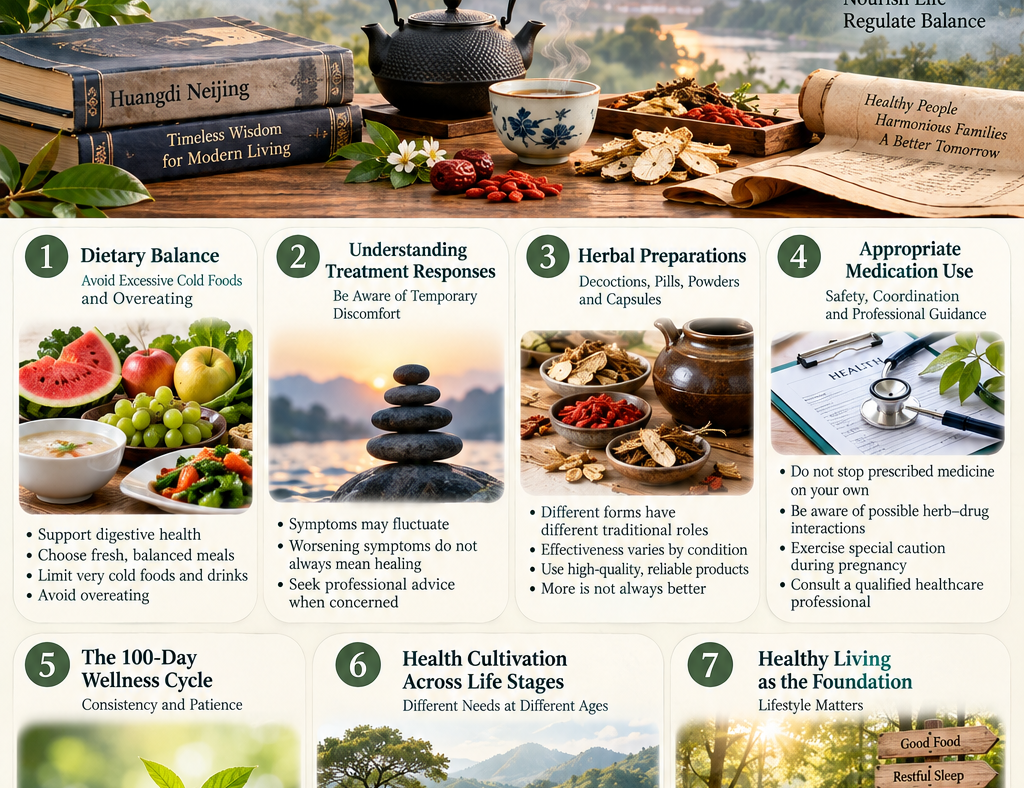
Traditional Chinese Medicine wellness emphasizes the importance of maintaining balance, supporting physiological function, and adapting to the changing needs of the body. Rather than viewing health cultivation as a temporary intervention, classical Chinese medicine encourages daily nourishment, moderation, emotional stability, appropriate activity, and harmony with the natural environment.Understanding dietary balance, herbal preparations, treatment responses, medication safety, the traditional 100-day wellness cycle, and healthy aging through the wisdom of Chinese medicine.
Traditional Chinese Medicine (TCM) approaches health cultivation as an ongoing process of maintaining balance, supporting physiological function, and adapting to the changing needs of the body.
Rather than viewing wellness as a temporary intervention, classical Chinese health philosophy emphasizes the importance of daily nourishment, moderation, emotional stability, appropriate activity, and harmony with the natural environment.
In this tradition, the term Tiaoyang (调养) refers to a process of regulation and nourishment.
Tiao describes the restoration or maintenance of balance, while Yang refers to nourishment and the cultivation of vitality.
Together, these concepts reflect the traditional belief that health depends on supporting the body’s functional systems while maintaining harmonious relationships among Qi, Blood, Yin, Yang, and the internal organs.
Modern medicine approaches these processes through the study of nutrition, metabolism, immune function, medication effects, physical activity, sleep, and the biological mechanisms of aging.
Although traditional and modern medical frameworks are not interchangeable, understanding their different perspectives can encourage a more thoughtful approach to health and longevity.
This guide explores seven important principles of traditional Chinese health cultivation and explains how they can be understood responsibly in contemporary life.
1. Dietary Balance: Understanding Cold Foods, Digestion, and Overeating
Traditional Chinese Medicine places considerable importance on the relationship between diet and digestive health.
Classical theory describes the Spleen and Stomach as the foundation of acquired vitality, responsible for transforming food and fluids into substances that nourish the body.
The traditional Spleen system is broader than the anatomical spleen recognized in modern medicine. It represents a functional concept associated with nourishment, transformation, and the distribution of essential resources.
Within this framework, excessive consumption of cold foods, irregular eating patterns, and overeating are traditionally regarded as possible disturbances of digestive harmony.
The Traditional Concept of Protecting Spleen Yang
TCM describes Spleen Yang as an important aspect of the body’s warming and transforming functions.
When this function is considered insufficient, practitioners may identify traditional patterns involving abdominal discomfort, reduced appetite, loose stools, or fatigue.
Warm, freshly prepared meals have therefore played an important role in Chinese dietary health cultivation.
Rice porridge, cooked vegetables, soups, and gently prepared foods are frequently associated with digestive comfort and nourishment.
However, the traditional classification of foods as warming or cooling should not be confused with the physical temperature of food or with established modern nutritional properties.
Watermelon, cucumber, tomatoes, and other foods traditionally classified as cooling are not inherently harmful to the digestive system.
For most healthy people, these foods can provide valuable nutrients and form part of a balanced diet.
Individual tolerance remains important.
Someone with a sensitive digestive system may prefer cooked vegetables or room-temperature beverages, while another person may tolerate raw vegetables and chilled foods comfortably.
The goal is to recognize personal needs without creating unnecessary dietary restrictions.
Why Overeating Can Affect Digestive Comfort
Eating excessively may cause abdominal fullness, bloating, reflux, or temporary discomfort.
In traditional Chinese medicine, overeating is often interpreted as placing an unnecessary burden on the Spleen and Stomach.
Modern physiology explains these symptoms through factors such as stomach distension, gastric emptying, food composition, and individual gastrointestinal sensitivity.
Practical dietary habits include eating at a comfortable pace, maintaining regular mealtimes, choosing nutritionally balanced foods, and avoiding repeated consumption of excessively large meals.
People experiencing persistent digestive symptoms should seek appropriate medical assessment rather than relying exclusively on traditional food classifications.
Raw Foods and Food Safety
Raw fruits and vegetables can contribute important vitamins, minerals, water, and dietary fiber.
They do not need to be universally avoided during traditional wellness practices.
However, safe washing, preparation, and storage are essential.
Raw or undercooked seafood carries additional risks because it may contain harmful microorganisms or parasites.
Pregnant individuals, older adults, young children, and people with weakened immune systems require particular attention to food safety.
Traditional dietary moderation and modern food safety can work together to support healthier eating.
2. Understanding Temporary Discomfort and Treatment Responses
An important concept in some traditional Chinese wellness literature is Qi Chong Bing Zao (气冲病灶), sometimes described as Qi reaching or confronting an affected area.
Within this historical framework, practitioners may interpret certain changes in bodily sensations as part of an evolving traditional treatment pattern.
Some accounts describe temporary discomfort in areas affected by longstanding health problems.
However, the interpretation of new or worsening symptoms requires considerable caution.
Why Symptoms May Change During Treatment
Symptoms associated with chronic conditions may fluctuate naturally.
Pain, stiffness, fatigue, and other sensations can change because of physical activity, inflammation, disease progression, medication effects, or other factors.
For example, someone with chronic cervical spine problems may experience varying levels of neck or arm discomfort.
An increase in pain does not necessarily indicate that a previously restricted pathway has reopened or that the underlying condition is resolving.
Similarly, reduced pain does not always mean that the original structural problem has disappeared.
Modern clinical assessment considers changes in pain alongside neurological function, mobility, physical examination, and other relevant findings.
When Discomfort Should Not Be Interpreted as Healing
A new or worsening symptom after taking an herbal preparation should not automatically be regarded as evidence of improved Qi circulation or the elimination of hidden disease.
Herbal products can cause adverse effects, interact with medications, or contain undeclared ingredients and contaminants.
If a new symptom appears after starting a supplement or herbal product, its use should be stopped and appropriate medical advice sought.
Severe allergic symptoms, difficulty breathing, chest pain, fainting, or new neurological symptoms require urgent medical attention.
The broader lesson is that health cultivation should be guided by careful observation, not by the assumption that feeling worse necessarily means becoming healthier.
Smoking, Alcohol, and the Difference Between Adaptation and Recovery
Traditional wellness literature sometimes describes harmful habits as creating an unhealthy state of adaptation.
Modern medicine recognizes that dependence and withdrawal can occur with substances such as nicotine and alcohol.
Quitting smoking provides health benefits at any age, including for older adults and people who have smoked for many years.
Alcohol requires additional consideration.
People who have been drinking heavily for a prolonged period may develop potentially dangerous withdrawal symptoms if they stop suddenly.
Such individuals should seek medical guidance before attempting withdrawal.
These distinctions illustrate why traditional concepts of balance must be interpreted alongside the specific biological risks involved.
3. Herbal Decoctions, Pills, Powders, and Capsules
Traditional Chinese Medicine uses several methods to prepare herbal medicines.
Different preparations developed historically to meet practical needs involving storage, administration, dosage, and the intended traditional therapeutic approach.
Two familiar categories are decoctions and pills.
Herbal Decoctions: The Traditional Role of Tang
A decoction, or Tang (汤), is generally prepared by simmering selected herbal ingredients in water.
Classical Chinese medicine often associates decoctions with more immediate traditional treatment strategies.
The expression “Tang means sweeping or clearing away” reflects a historical interpretation of the preparation’s intended action.
However, it should not be understood as proof that every decoction acts rapidly or that all conditions should improve after a fixed number of doses.
The response to an herbal preparation depends on its ingredients, dose, the individual, the underlying condition, and the available clinical evidence.
Some herbal compounds may also have significant pharmacological activity.
For this reason, decoctions require the same attention to safety, quality, and potential interactions as other medicinal products.
Herbal Pills and Powders: The Traditional Role of Wan and San
Herbal pills, known as Wan (丸), and powders, known as San (散), are additional forms of traditional medicine.
Historically, pills were sometimes associated with prolonged or gradual approaches to health cultivation.
Powders offered another method of preparing and administering herbs.
Modern products may also be supplied as tablets, granules, or capsules.
However, the dosage form alone does not determine whether a preparation works quickly or slowly.
A pill is not necessarily weaker than a decoction, and a decoction is not necessarily more effective than a capsule.
Safety and effectiveness depend on the specific product and its ingredients.
Choosing an Appropriate Herbal Preparation
People considering traditional herbal medicine should pay attention to product quality, ingredient identification, dosage, and possible interactions.
Products should come from reliable sources with appropriate quality controls.
Traditional preparations should not be assumed safe simply because they are derived from plants.
Herbs contain biologically active substances, and some may be unsuitable for people with liver disease, kidney disease, pregnancy, or other medical conditions.
A qualified healthcare professional should be consulted before combining herbal preparations with prescription medications.
4. Appropriate Medication Use and the Importance of Coordinated Care
One of the most important principles of responsible health cultivation is recognizing that more treatment does not necessarily mean better treatment.
Taking multiple herbal formulas, supplements, and conventional medications without appropriate guidance may increase the risk of adverse effects.
A sustainable approach requires attention to the individual’s medical history, existing treatment, and overall health needs.
Should Prescription Medicines Be Stopped During Traditional Wellness Care?
People should not independently stop, reduce, or replace prescribed medication because they have started traditional Chinese wellness practices.
Some medications control chronic conditions that may not produce obvious symptoms.
For example, blood pressure medication may be effective precisely because it maintains blood pressure within an appropriate range.
Feeling better does not necessarily mean that the underlying condition has resolved.
Any medication adjustment should be made with the prescribing healthcare professional.
Traditional wellness practices may complement appropriate treatment, but they should not be used as a reason to discontinue necessary medical care.
Herbal Medicine and Drug Interactions
Herbal preparations may affect how other medications work.
Potential interactions are particularly important for people using anticoagulants, diabetes medications, cardiovascular drugs, immunosuppressants, or other medicines requiring careful dosing.
Different herbal products may also interact with one another.
Maintaining an accurate list of all medications, supplements, and herbal preparations can help healthcare professionals identify potential risks.
This is especially important for older adults and people managing several chronic conditions.
Special Considerations During Pregnancy
Pregnancy requires additional attention to medication and herbal safety.
The developing fetus may be affected by substances taken during pregnancy, including some herbal preparations.
Certain herbs have pharmacological effects, while the safety of many others has not been adequately studied in pregnant individuals.
Traditional classifications such as promoting Blood circulation do not provide a sufficient basis for determining pregnancy safety.
People who are pregnant, breastfeeding, or planning pregnancy should discuss herbal products and supplements with an appropriately qualified healthcare professional.
Conventional prenatal care and prescribed treatment should continue as advised.
5. The Traditional 100-Day Wellness Cycle
The idea of a 100-day period has a longstanding place in certain forms of Chinese health cultivation.
Traditionally, a defined period of practice encourages consistency, patience, and the gradual development of healthier routines.
Some wellness traditions use 100 days as a symbolic period for cultivating discipline and observing changes in physical and emotional well-being.
This approach can be meaningful when understood as a practical framework rather than a guaranteed medical treatment cycle.
Does the Human Body Renew Every 100 Days?
The human body continuously repairs and replaces many of its cells.
However, different cell types have different life spans and renewal patterns.
Some cells are replaced relatively quickly, while others remain for years or even decades.
It is therefore inaccurate to suggest that every cell in the body is replaced approximately once every 100 days.
A 100-day wellness period cannot guarantee the elimination of chronic disease, complete cellular renewal, or reversal of biological aging.
Nevertheless, a structured period can provide an opportunity to establish sustainable habits.
A Practical Approach to 100 Days of Health Cultivation
A personal wellness period may focus on several interconnected areas of health.
Days 1–30
Establishing the Foundation
Develop consistent sleeping and waking times, improve dietary balance, introduce appropriate physical activity, and identify habits that interfere with well-being.
Days 31–60
Strengthening Daily Habits
Maintain regular movement, improve stress-management strategies, monitor dietary consistency, and adjust routines according to individual needs.
Days 61–100
Supporting Long-Term Consistency
Review progress, identify sustainable habits, address continuing difficulties, and establish realistic goals for the months ahead.
This structure should be understood as a habit-building approach rather than a medical protocol.
A person managing chronic disease may require treatment and follow-up over a much longer period.
Other concerns may improve more quickly.
The appropriate duration of care depends on the individual and the condition being addressed.
6. Health Cultivation Across Different Stages of Life
Traditional Chinese Medicine recognizes that the body’s needs change throughout life.
The Huangdi Neijing, or Yellow Emperor’s Inner Canon, describes human development through age-related patterns involving Essence, Qi, reproductive maturation, and aging.
Classical theory often uses seven-year cycles for women and eight-year cycles for men to illustrate these transitions.
These cycles offer a traditional cultural framework rather than precise biological deadlines.
Modern medicine recognizes considerable individual variation in puberty, reproductive development, menopause, and the aging process.
Early Adulthood: Building a Healthy Foundation
Early adulthood provides an opportunity to establish habits that may influence health for many years.
Adequate nutrition, regular physical activity, restorative sleep, and appropriate stress management support physical and emotional well-being.
Traditional Chinese health cultivation emphasizes moderation and avoiding unnecessary depletion of the body’s resources.
In contemporary terms, this can be understood as maintaining a sustainable balance between activity and recovery.
Middle Age: Preserving Strength and Functional Health
During middle age, some individuals experience gradual changes in muscle mass, body composition, sleep, hormonal activity, or metabolic health.
Traditional Chinese Medicine may interpret certain changes through concepts involving Kidney Essence, Yin, Yang, or Blood.
Modern health management focuses on identifying individual risks and preserving function.
Resistance training, cardiovascular exercise, balanced nutrition, and appropriate preventive care can support healthy aging.
Changes in hair, skin, or physical vitality should not automatically be attributed to traditional deficiency patterns.
When symptoms are persistent or unusual, appropriate medical evaluation may identify treatable causes.
Menopause and Reproductive Aging
The Huangdi Neijing associates female reproductive changes with traditional cycles of Kidney Essence and the gradual transformation of the body’s reproductive functions.
Modern medicine explains menopause through changes in ovarian function and reproductive hormones.
The timing of menopause varies among individuals.
Some women experience substantial symptoms, while others have relatively mild changes.
Appropriate care may include lifestyle adjustments, symptom management, and individualized medical treatment.
Importantly, vaginal bleeding after menopause should not be interpreted as evidence that a wellness treatment has restored youth or reproductive function.
Any bleeding after 12 months without a menstrual period requires medical assessment.
Later Life: Maintaining Independence and Quality of Life
Traditional health cultivation places considerable emphasis on preserving vitality during later life.
Modern healthy-aging research similarly focuses on maintaining mobility, cognitive function, physical strength, independence, and quality of life.
Older adults may benefit from regular physical activity appropriate to their abilities, including strength and balance training.
Social engagement, adequate nutrition, restorative sleep, and appropriate medical management also remain important.
Traditional practices such as Tai Chi may provide an accessible way to support balance, coordination, and gentle movement.
The goal is not to promise that aging can be stopped.
It is to support healthier, more active living throughout the later stages of life.
7. Healthy Living as the Foundation of Traditional Health Cultivation
The final principle of Chinese health cultivation concerns the relationship between treatment and everyday life.
Classical physicians recognized that daily habits influence the condition of the body.
Diet, sleep, physical activity, emotional state, and environmental exposure all form part of the wider context in which health is maintained.
Modern medicine similarly recognizes the importance of lifestyle factors in prevention and chronic disease management.
The Importance of Consistency
Healthy living is rarely the result of one dramatic intervention.
More often, it develops through the repeated practice of manageable habits.
A balanced diet provides essential nutrients.
Regular physical activity supports cardiovascular and musculoskeletal function.
Sleep allows important physiological recovery processes to occur.
Emotional well-being and supportive relationships contribute to quality of life.
Appropriate medical care helps identify and manage conditions that cannot be addressed through lifestyle alone.
Traditional Chinese Medicine expresses this broader philosophy through the cultivation of harmony among the body, mind, and environment.
Why Lifestyle Changes Should Be Individualized
A wellness routine appropriate for one person may not be suitable for another.
Age, medical history, physical ability, nutritional status, medications, and individual preferences all influence the choices that support health.
An older adult with limited mobility may require a different movement routine from a healthy teenager.
Someone with diabetes may have different nutritional considerations from a person without metabolic disease.
A pregnant individual may require additional precautions regarding herbs, food safety, and exercise.
The most useful approach is therefore not a rigid collection of universal rules, but a flexible framework that adapts to individual circumstances.
Traditional Chinese Medicine Wellness: Seven Principles for Everyday Life
Traditional Chinese Medicine describes the human body as an interconnected system influenced by internal function, daily behavior, emotional life, and the surrounding environment.
The concept of Tiaoyang emphasizes that nourishment and balance should be cultivated continuously rather than pursued only after illness appears.
Modern medical knowledge adds an important distinction: maintaining health, managing symptoms, treating disease, and reversing biological damage are different objectives.
A healthy lifestyle can contribute to prevention and well-being, but it cannot guarantee immunity from disease or replace necessary treatment.
Likewise, traditional preparations should not be expected to produce universal results within seven days, thirty days, or one hundred days.
The enduring value of Chinese health cultivation lies in its attention to moderation, consistency, and the relationship between everyday habits and long-term vitality.
The Huangdi Neijing encourages harmony with natural rhythms and the preservation of physical and mental balance.
These principles continue to offer meaningful inspiration when combined with modern scientific understanding and responsible healthcare.
True health cultivation is not about forcing the body to recover according to a fixed timetable. It is about creating sustainable conditions for nourishment, resilience, recovery, and lifelong well-being.
Medical Disclaimer
This article is intended for educational and informational purposes only and does not constitute medical advice, diagnosis, or treatment.
Traditional Chinese Medicine concepts such as Qi, Blood, Yin, Yang, Kidney Essence, Spleen Yang, and the 100-day cultivation cycle are presented as historical and cultural health frameworks and should not be interpreted as established biomedical diagnoses.
Herbal medicines and supplements may cause adverse effects or interact with prescription medications. Do not independently discontinue or change prescribed treatment. Consult a qualified healthcare professional before using herbal products, particularly during pregnancy, breastfeeding, childhood, older age, or when managing chronic medical conditions.
New or worsening symptoms should not automatically be interpreted as evidence of healing. Seek appropriate medical assessment when necessary.
Frequently Asked Questions
1. What is Traditional Chinese Medicine wellness?
Traditional Chinese Medicine wellness refers to traditional approaches to health cultivation that emphasize nourishment, moderation, balance, and harmony with the natural environment. These practices may include dietary guidance, movement, breathing exercises, and individualized traditional health assessments.
2. What are the seven essential principles of TCM health cultivation?
The seven principles discussed in this guide are dietary balance, understanding treatment responses, herbal preparation methods, appropriate medication use, the traditional 100-day wellness cycle, health cultivation across life stages, and sustainable daily habits.
3. Should people avoid cold foods during Chinese herbal treatment?
Traditional Chinese dietary theory classifies certain foods as warming or cooling. However, cold foods are not inherently harmful to everyone. Dietary choices should consider individual tolerance, nutritional needs, the specific herbal preparation, and any advice provided by a qualified healthcare professional.
4. Does feeling worse during traditional treatment mean the body is healing?
No. New or worsening symptoms should not automatically be interpreted as signs of recovery or improved Qi circulation. Symptoms may reflect adverse effects, medication interactions, or changes in an underlying medical condition. Appropriate assessment is important when symptoms worsen.
5. What is the difference between Chinese herbal decoctions and pills?
Herbal decoctions are generally prepared by simmering selected ingredients in water, while pills contain herbs processed into a solid dosage form. The preparation method may affect administration and exposure to certain compounds, but it does not independently establish treatment effectiveness or safety.
6. Can Chinese herbal medicine be taken with prescription medication?
Some herbal products may interact with prescription or over-the-counter medicines. Certain interactions can increase adverse effects or reduce medication effectiveness. People should inform their healthcare professionals about all medicines and supplements they use and should not independently discontinue prescribed treatment.
7. What is the traditional 100-day wellness cycle?
The 100-day wellness cycle is a traditional framework emphasizing consistency, patience, and gradual health cultivation. It can also be used as a practical period for developing healthier routines. However, it does not represent a universal biological renewal cycle or guarantee recovery from disease.
8. Can Traditional Chinese Medicine reverse aging?
Traditional Chinese Medicine includes historical approaches intended to preserve vitality and support healthy aging. However, no herbal formula or traditional wellness program has been established as a universal method for reversing biological aging. Healthy aging depends on many factors, including genetics, physical activity, nutrition, sleep, environmental conditions, and appropriate medical care.
9. Is Chinese herbal medicine safe during pregnancy?
Not all herbal preparations are safe during pregnancy. Some herbs may have pharmacological effects, while others have insufficient safety data. Pregnant or breastfeeding individuals should consult an appropriately qualified healthcare professional before using herbal products.
10. How can traditional Chinese health cultivation fit into modern life?
Traditional health cultivation can inspire consistent daily habits, including balanced nutrition, regular movement, restorative sleep, emotional well-being, and moderation. These practices can complement evidence-based healthcare when adapted to individual needs and applied safely.
Medical Disclaimer
This article is intended for educational and informational purposes only and does not constitute medical advice, diagnosis, or treatment.
Traditional Chinese Medicine concepts such as Qi, Blood, Yin, Yang, Kidney Essence, Spleen Yang, and the 100-day health cultivation cycle are presented as historical and cultural health frameworks and should not be interpreted as established biomedical diagnoses.
Herbal medicines and dietary supplements may cause adverse effects or interact with prescription medications. Do not independently discontinue or modify prescribed treatment.
Consult a qualified healthcare professional before using herbal products, particularly during pregnancy, breastfeeding, childhood, older age, or when managing chronic medical conditions.
New or worsening symptoms should not automatically be interpreted as signs of healing. Seek appropriate medical assessment when necessary.
This article is for general education and does not replace individualized care from a qualified health professional. Seek appropriate advice for persistent, severe, or concerning symptoms.
Read the full medical disclaimer