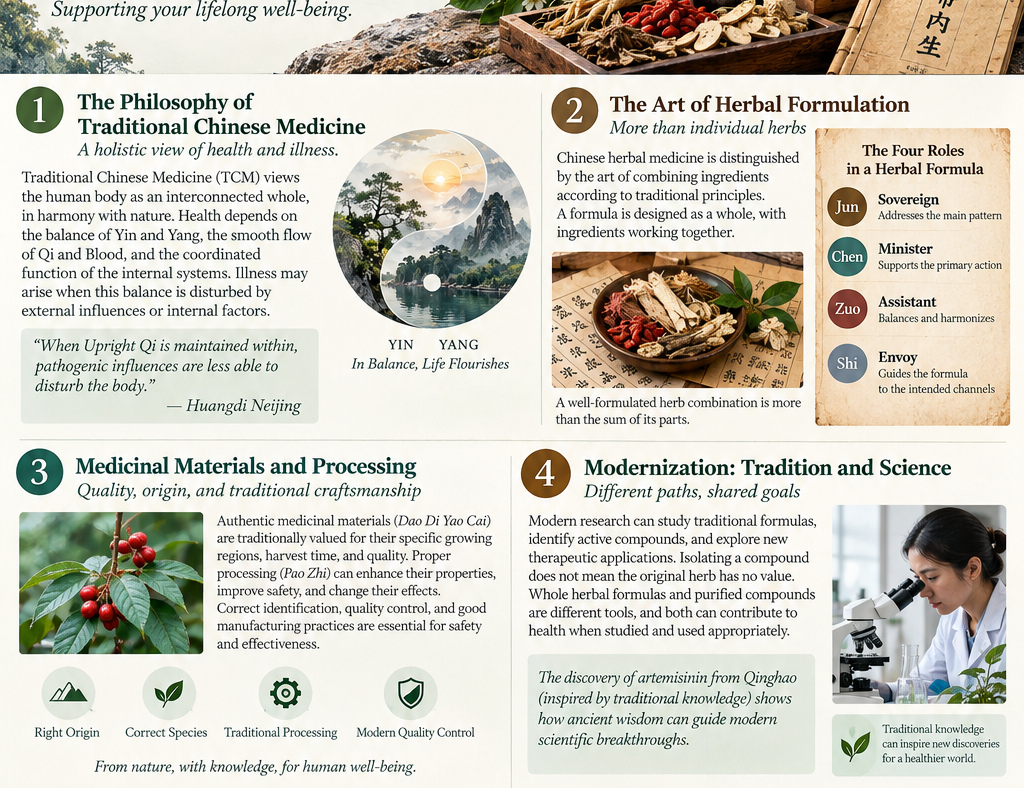
Traditional Chinese Medicine represents one of the world’s longstanding systems of medical knowledge and health cultivation. Developed through centuries of observation, clinical practice, philosophical reflection, and the study of natural substances, it offers a distinctive perspective on the relationships among the human body, illness, environmental influences, and everyday living.Exploring the philosophy of Chinese medicine, the art of herbal formulation, medicinal plant quality, modern pharmaceutical research, and the preservation of traditional medical knowledge.
Traditional Chinese Medicine (TCM) represents one of the world’s longstanding systems of medical knowledge and health cultivation. Developed through centuries of observation, clinical practice, philosophical reflection, and the study of natural substances, it offers a distinctive perspective on the relationships among the human body, illness, environmental influences, and everyday living.
Its historical foundations are closely associated with classical works such as the Huangdi Neijing (Yellow Emperor’s Inner Canon), the Shanghan Lun (Treatise on Cold Damage), and the Jingui Yaolue (Essential Prescriptions of the Golden Cabinet).
These texts helped establish a medical framework in which health is understood through the relationships among Yin, Yang, Qi, Blood, the functional organ systems, and the surrounding environment.
Traditional Chinese herbal medicine developed alongside this philosophy, gradually establishing sophisticated approaches to selecting medicinal materials, combining herbs, preparing formulas, and adapting treatment to individual patterns.
Today, the increasing global interest in traditional medicine raises an important question: How can ancient medical knowledge be understood, preserved, and evaluated responsibly in the modern world?
Answering this question requires respect for historical traditions, a clear understanding of traditional medical concepts, and a commitment to scientific evidence, pharmaceutical quality, and patient safety.
1. Traditional Chinese Medicine and the Future of Integrative Health
The historical development of Chinese medicine reflects a longstanding interest in understanding the human body as an interconnected system.
Classical practitioners observed that symptoms rarely appeared entirely independently of the body’s wider condition.
Changes in appetite, sleep, temperature sensitivity, emotional state, physical strength, digestion, and other bodily functions were traditionally considered alongside the primary complaint.
This approach contributed to the development of a framework in which illness was understood through patterns involving the relationships among different functional systems.
The Traditional Concept of Zheng Qi
One of the important concepts in Chinese medicine is Zheng Qi (正气), commonly translated as Upright Qi or the body’s healthy functional resources.
The Huangdi Neijing contains the well-known principle:
“When Upright Qi is maintained within, pathogenic influences are less able to disturb the body.”
This traditional statement reflects the importance placed on maintaining health and supporting the body’s capacity to respond to environmental challenges.
In classical theory, illness may arise when external influences and internal imbalances interact in a way that disturbs physiological harmony.
The traditional concept of Zheng Qi is sometimes compared with immune resilience or the body’s ability to maintain homeostasis.
However, these comparisons should be treated as explanatory analogies rather than direct scientific equivalences.
Zheng Qi is not a measurable immune substance, and a traditional diagnosis of Qi deficiency does not establish an identifiable immunological disorder.
Health, Microorganisms, and the Human Internal Environment
Modern biology recognizes that the human body exists in continuous interaction with microorganisms.
The skin, gastrointestinal tract, respiratory system, and other bodily surfaces contain diverse microbial communities.
Many microorganisms are harmless or beneficial under ordinary circumstances.
Others can cause disease when they enter vulnerable tissues, evade immune defenses, or multiply under favorable conditions.
The human immune system, physical barriers, microbial communities, genetics, and environmental exposures all influence susceptibility to infection.
This understanding provides a useful modern perspective on the broader relationship between the body and its environment.
However, maintaining a healthy lifestyle does not guarantee protection against infection.
Serious infectious diseases can occur in otherwise healthy individuals, and appropriate vaccination, antimicrobial treatment, and other evidence-based preventive measures remain important.
Pattern Differentiation: A Distinctive Feature of Chinese Medicine
Traditional Chinese Medicine emphasizes Bian Zheng Lun Zhi (辨证论治), commonly translated as pattern differentiation and treatment.
Rather than choosing an intervention solely according to the name of a disease, a traditional practitioner may evaluate the individual’s overall presentation.
Two people with a similar symptom may receive different traditional assessments, while individuals with different symptoms may sometimes be understood through related traditional patterns.
Classical patterns may involve concepts such as:
- Yin deficiency or Yang deficiency.
- Qi deficiency or Blood deficiency.
- Dampness and Heat.
- Disturbances in the movement of Qi.
- Functional relationships among the Liver, Heart, Spleen, Lungs, and Kidneys.
These are concepts within the traditional medical system and should not be confused with modern diagnoses of anatomical organ disease.
Modern medicine also considers the whole patient, including medical history, comorbidities, environmental exposure, lifestyle, genetics, and individual treatment response.
The distinction between Chinese medicine and contemporary biomedicine is therefore not simply that one treats the person while the other treats the disease.
Their major differences lie in their historical theories, diagnostic frameworks, treatment methods, and approaches to evaluating evidence.
The Legacy of Classical Chinese Medical Formulas
The Shanghan Lun, traditionally associated with the physician Zhang Zhongjing, remains an important text in Chinese medical history.
Its formulas have been studied and discussed by generations of practitioners.
One classical example is Ma Xing Shi Gan Tang, a formula traditionally associated with particular patterns involving respiratory symptoms.
Its historical significance illustrates the continuity of Chinese medical knowledge.
However, the continued use of an ancient formula does not independently establish its effectiveness against modern infectious diseases.
Respiratory illnesses have many causes, including viral infections, bacterial infections, asthma, and other inflammatory or structural conditions.
Some require urgent treatment.
Classical formulas may be subjects of contemporary pharmacological and clinical research, but their use should be evaluated according to the specific condition, available evidence, and individual safety considerations.
The value of traditional medical heritage is strengthened when historical experience and modern investigation inform one another.
2. What Makes Chinese Herbal Medicine Distinctive?
Traditional Chinese herbal medicine is more than the simple consumption of plants.
Its historical practice includes the identification of medicinal substances, assessment of traditional properties, preparation of ingredients, formulation principles, dosage considerations, and individualized selection.
The traditional category of Chinese materia medica includes plant materials, minerals, and certain animal-derived substances.
However, medicinal plants are not unique to Chinese medicine.
Many medical traditions around the world have developed extensive knowledge of botanical substances.
The distinctive character of Chinese herbal medicine lies partly in the theoretical framework used to understand and combine these materials.
The Traditional Art of Herbal Formulation
A central feature of classical Chinese herbal medicine is Pei Wu (配伍), the practice of combining medicinal ingredients according to traditional principles.
Some formulas contain only a few ingredients, while others include more complex combinations.
Classical practitioners consider the traditional properties, intended functions, and potential interactions of individual materials when constructing a formula.
One influential framework is the concept of:
Jun, Chen, Zuo, and Shi — Sovereign, Minister, Assistant, and Envoy.
These terms describe functional relationships among ingredients within a traditional formula.
The Four Traditional Roles in Herbal Formulation
Jun — Sovereign
The Primary Ingredient
The Sovereign is traditionally selected to address the principal pattern or treatment objective.
Chen — Minister
The Supporting Ingredient
The Minister may reinforce the principal traditional action or address related aspects of the pattern.
Zuo — Assistant
The Balancing Ingredient
The Assistant may provide supplementary functions, address accompanying concerns, or modify certain properties of other ingredients.
Shi — Envoy
The Coordinating Ingredient
The Envoy may be traditionally described as harmonizing the formula or directing its intended action.
This framework reflects the historical belief that ingredients can be selected to serve different roles within a coordinated preparation.
However, the number of ingredients and their traditional roles do not establish that a formula is safe or clinically effective.
A single medicinal ingredient can have pharmacological effects, and a multi-ingredient formula does not necessarily outperform an individual compound.
Some combinations may produce harmful interactions.
The safety and effectiveness of any particular formula require appropriate evaluation.
Why Expensive Herbs Are Not Necessarily Better
Traditional Chinese medicine includes numerous highly valued medicinal materials, including ginseng and other herbs historically associated with nourishment or vitality.
Some have developed considerable cultural and commercial prestige.
However, a high market price does not guarantee greater therapeutic value.
The usefulness of an herbal preparation depends on factors such as correct identification, chemical composition, product quality, dosage, clinical indication, and individual response.
Combining several expensive herbs without understanding their properties can increase cost and potential risk without providing additional benefit.
The principle of thoughtful formulation remains relevant, but it should be accompanied by modern standards of safety and evidence.
The Importance of Authentic Medicinal Materials
Traditional Chinese medicine places particular emphasis on Dao Di Yao Cai (道地药材), often translated as authentic or geo-authentic medicinal materials.
This concept concerns the relationship between a medicinal plant and the conditions under which it is grown, harvested, and processed.
Factors such as soil, climate, plant variety, growing conditions, harvest timing, and storage may influence the chemical composition of botanical materials.
Correct species identification is particularly important.
Plants with similar names or appearances may contain substantially different chemical constituents.
The substitution of one species for another can affect product quality and, in some cases, cause serious adverse effects.
Traditional knowledge concerning medicinal plant origins may therefore provide useful guidance for botanical research.
Nevertheless, geographic origin alone cannot guarantee clinical effectiveness.
Modern quality control may require botanical identification, chemical analysis, testing for contaminants, and verification of manufacturing standards.
Traditional Processing and Pharmaceutical Quality
Another important feature of Chinese herbal medicine is Pao Zhi (炮制), the traditional preparation and processing of medicinal materials.
Depending on the ingredient, historical processing methods may involve drying, roasting, steaming, boiling, or other procedures.
Processing can affect the physical and chemical properties of botanical substances.
In some cases, it may change the concentration or availability of certain compounds.
However, the benefits and risks of a processing method must be evaluated individually.
A traditional procedure should not automatically be considered effective simply because it has been practiced for generations.
Similarly, changing a historical method without understanding its effects may alter the resulting product.
Modern pharmaceutical research can help investigate these questions through analytical chemistry, toxicology, manufacturing studies, and clinical research.
Preserving traditional techniques and evaluating them scientifically are complementary objectives.
3. Modernizing Chinese Herbal Medicine: Whole Formulas, Extracts, and Scientific Discovery
One of the continuing discussions in Chinese herbal medicine concerns how traditional preparations should be studied and developed.
Should researchers preserve complete formulas?
Should they investigate individual ingredients?
Should active chemical compounds be isolated and purified?
Or should several approaches be pursued simultaneously?
These questions involve both traditional medical philosophy and contemporary pharmaceutical science.
Whole Herbal Formulas and Complex Mixtures
Traditional formulas may contain numerous chemical compounds derived from multiple ingredients.
Some of these compounds may have biological activity.
Others may influence absorption, metabolism, stability, or the effects of additional substances.
Modern analytical techniques can help identify and characterize the chemical composition of these preparations.
However, chemical complexity does not automatically establish superior effectiveness.
A mixture containing hundreds of compounds may have useful properties, harmful properties, or little clinically meaningful activity.
Understanding these possibilities requires systematic investigation.
What Happens When an Active Compound Is Isolated?
Researchers sometimes identify and isolate particular chemical constituents from medicinal plants.
This process can allow scientists to investigate the compound’s structure, pharmacological effects, appropriate dosage, toxicity, and possible therapeutic applications.
Isolating a compound does not mean that the original plant or traditional formula has no further research value.
It also does not mean that every purified compound is suitable only for acute illness.
Modern medicines containing isolated compounds may be used for acute or chronic conditions, depending on the drug and its established indications.
Traditional botanical preparations and isolated pharmaceutical compounds are different product types that can both contribute to medical research.
Artemisinin: A Landmark in the Study of Medicinal Plants
One of the most important examples of research connecting traditional medical literature with modern pharmacology is the discovery of artemisinin.
The Chinese scientist Tu Youyou and her collaborators investigated traditional references to Qinghao, a plant historically used in Chinese medicine.
Through systematic research, extraction, and pharmacological testing, the team identified artemisinin from Artemisia annua.
The discovery contributed to the development of highly important antimalarial medicines.
In 2015, Tu Youyou received a share of the Nobel Prize in Physiology or Medicine for her contribution.
The significance of artemisinin lies not in proving that all traditional herbal remedies are effective, but in demonstrating how historical knowledge can help guide scientific discovery.
It also illustrates that purification can be a valuable part of research inspired by traditional medicine.
The preservation of complete formulas and the identification of active compounds need not be competing objectives.
Both may contribute to a more comprehensive understanding of medicinal plants.
Herbal Extracts and the Importance of Safety
The example of ephedra provides another reason to distinguish whole botanical materials from their individual constituents.
Ephedra contains alkaloids such as ephedrine, which can have significant effects on the cardiovascular and nervous systems.
The presence of other compounds in the plant does not automatically eliminate those effects.
Whole ephedra preparations may also present substantial risks.
Consequently, the assumption that a whole herb is necessarily gentler or safer than a purified compound is not justified.
Both require attention to dosage, individual health conditions, potential interactions, and relevant safety regulations.
Modernization should therefore include rigorous product characterization rather than relying solely on traditional descriptions or the apparent naturalness of a preparation.
4. Preserving Traditional Herbal Formulas and Medical Knowledge
Traditional Chinese Medicine has been transmitted through multiple channels, including classical medical texts, family lineages, professional apprenticeship, educational institutions, and clinical practice.
Some knowledge was recorded and widely shared.
Other techniques and formulas remained within particular families or practitioner communities.
This diversity of transmission contributed to both the richness and fragmentation of traditional medical knowledge.
Historical formulas are valuable not only as potential sources of treatment-related discoveries but also as records of cultural history, botanical knowledge, and medical practice.
The Cultural Value of Traditional Formulas
A traditional formula may preserve information about regional medicinal plants, historical preparation methods, dietary customs, and the treatment practices of earlier generations.
Even when a historical therapeutic claim has not been verified, the formula may still possess significant cultural and research value.
Preservation can therefore involve documenting ingredients, historical sources, preparation procedures, terminology, and the social context in which a formula was developed.
Careful documentation also helps researchers distinguish original historical knowledge from later modifications.
This is important because the same formula name may be associated with different preparations across periods or regions.
Why Traditional Knowledge Can Be Lost
Traditional knowledge may disappear when practitioners retire or die without documenting their experience.
Family-based transmission can also limit the number of people who learn particular methods.
Changes in language, regional customs, botanical availability, and manufacturing techniques may make historical instructions increasingly difficult to interpret.
Digitization, translation, botanical identification, and historical research can help preserve these materials.
However, preservation requires more than copying a list of ingredients.
Historical context, preparation methods, original terminology, and the limitations of available evidence should also be recorded.
Historical Experience Is Not the Same as Clinical Proof
A formula used for several centuries may deserve serious historical and scientific investigation.
However, longevity of use does not independently demonstrate safety or effectiveness for a modern medical condition.
Historical accounts may lack standardized diagnoses, controlled comparisons, systematic adverse-event reporting, or reliable long-term follow-up.
Anecdotes involving the apparent disappearance of a cyst or other medical finding cannot establish that an herbal formula caused the improvement.
For example, some ovarian cysts resolve without treatment, while others require monitoring or surgery depending on their characteristics and associated risks.
A complete clinical evaluation is essential.
The appropriate response to promising historical experience is careful research rather than an automatic assumption of efficacy.
5. Intellectual Property and the Future of Traditional Chinese Medicine
The protection of traditional medical knowledge presents important questions for researchers, practitioners, manufacturers, communities, and policymakers.
Herbal formulas may contain information developed over generations.
Modern commercial products may also involve additional research, manufacturing methods, quality-control systems, and technical innovation.
Protecting these different forms of knowledge requires a thoughtful approach.
Traditional Formulas as Intellectual and Cultural Assets
Traditional medical knowledge can have several forms of value.
It may contribute to cultural heritage, scientific investigation, pharmaceutical development, and economic activity.
Some knowledge is widely documented in historical texts.
Other knowledge may be held by particular practitioners, families, or communities.
These differences matter when considering ownership, access, protection, and benefit sharing.
Not every ancient formula qualifies for patent protection, and not every confidential formula is a patentable invention.
Different legal mechanisms may apply depending on the nature of the knowledge and the jurisdiction involved.
Patents and Pharmaceutical Innovation
Patent protection generally concerns inventions that meet the applicable legal requirements.
A genuinely new and qualifying pharmaceutical innovation may involve a formulation, manufacturing process, therapeutic application, or another technical development.
However, traditional information that is already publicly known may present difficulties for novelty-based patent protection.
Patent systems also commonly involve disclosure obligations.
The precise requirements depend on the jurisdiction and the nature of the application.
This creates an important distinction between protecting an invention through a patent and preserving commercially valuable information as a trade secret.
Trade Secrets and Confidential Formulas
Trade secret protection may be relevant when a formula or manufacturing process has commercial value because it is not generally known and is maintained through appropriate confidentiality measures.
Unlike a patent, a trade secret does not require the same form of public disclosure.
However, trade secret protection has limitations.
It may be lost if the information becomes public or is independently discovered through lawful means.
Pharmaceutical regulatory requirements may also require manufacturers to provide detailed information to the relevant authorities.
Protecting commercially confidential information must therefore be considered alongside the obligation to demonstrate appropriate product quality and safety.
Why Regulatory Review Remains Necessary
Traditional formulas may have considerable cultural or commercial value, but these qualities do not remove the need for responsible product assessment.
Medicinal products require appropriate attention to identity, composition, manufacturing quality, contamination, dosage, adverse effects, and therapeutic claims.
A confidential formula should not be treated as evidence that a medicine is safe or effective.
Similarly, regulatory transparency does not necessarily require every commercial detail to become publicly available.
The relationship between regulatory disclosure and commercial confidentiality depends on the legal framework.
A sustainable pharmaceutical industry needs both innovation protection and effective public-health oversight.
Protecting Traditional Knowledge Through Responsible Documentation
International discussions concerning traditional knowledge increasingly recognize that conventional intellectual property systems may not adequately address all forms of community-based knowledge.
The World Intellectual Property Organization has examined approaches involving patents, trade secrets, trademarks, geographical indications, defensive protection, and other mechanisms.
Defensive protection may help prevent third parties from obtaining unjustified exclusive rights over knowledge that is already part of the traditional record.
Other approaches seek to recognize the interests of the communities and knowledge holders from whom traditional practices originate.
The purpose is not simply to preserve commercial value.
It is also to support cultural continuity, responsible innovation, and fair recognition of traditional contributions.
The Future of Traditional Chinese Herbal Medicine
The continued development of Chinese herbal medicine depends on several interconnected priorities.
Historical documentation helps preserve the knowledge of earlier generations.
Botanical research improves the identification and understanding of medicinal plants.
Analytical chemistry helps characterize complex preparations.
Clinical research can evaluate whether a particular intervention offers meaningful benefits for a defined condition.
Quality-control systems can help protect consumers from misidentified materials, contamination, and manufacturing inconsistencies.
Appropriate intellectual property frameworks may support innovation while recognizing the cultural origins of traditional knowledge.
These priorities should not be treated as mutually exclusive.
Modernization does not have to mean abandoning traditional formulas, just as preservation does not require rejecting modern science.
Traditional Chinese Medicine and the Global Future of Integrative Health
The global interest in traditional and complementary medicine reflects a desire to understand a wider range of health practices and historical medical traditions.
The World Health Organization’s Global Traditional Medicine Strategy 2025–2034 emphasizes strengthening evidence, improving safety and regulation, supporting appropriate integration into health systems, and recognizing the broader value of traditional medical knowledge.
This provides a useful framework for the future of Chinese medicine.
Traditional practices can be preserved and investigated while their clinical applications remain subject to appropriate standards of safety and effectiveness.
Qualified practitioners, researchers, regulators, and traditional knowledge holders all have roles in this process.
The objective should be neither uncritical acceptance nor automatic rejection of historical medical practices.
It should be informed understanding.
Understanding the True Value of Chinese Medicine
Traditional Chinese Medicine is part of a living cultural and medical heritage.
Its classical literature reflects centuries of human efforts to understand health, illness, nature, and the relationships among different aspects of the body.
Its herbal traditions preserve extensive botanical and pharmaceutical knowledge.
Its philosophy of health cultivation continues to inspire interest in prevention, moderation, balanced living, and the relationship between people and their environment.
Modern science provides tools for investigating these traditions, identifying potentially useful compounds, assessing clinical outcomes, and protecting patients from avoidable risks.
The future of Chinese medicine is not determined by whether every ancient explanation can be reproduced in modern terminology.
Nor is it determined by whether all traditional formulas remain unchanged.
It lies in the ability to preserve valuable knowledge while distinguishing historical theory, cultural significance, scientific evidence, and established clinical benefit.
The enduring value of traditional Chinese medicine is not found in choosing between ancient wisdom and modern science. It is found in understanding their differences, exploring their connections, and using reliable knowledge to support safer, more informed approaches to human health.
Medical Disclaimer
This article is intended for educational and informational purposes only and does not constitute medical advice, diagnosis, or treatment.
Traditional Chinese Medicine concepts such as Qi, Blood, Yin, Yang, Zheng Qi, and pattern differentiation are presented as historical and cultural medical frameworks and should not be interpreted as established biomedical diagnoses.
Chinese herbal products may contain biologically active compounds and may cause adverse effects, contamination-related harm, or interactions with prescription medications. The historical use of a formula does not establish its safety or effectiveness for a particular condition.
Do not discontinue prescribed medication or delay appropriate medical evaluation in favor of unproven herbal remedies. Consult a qualified healthcare professional before using herbal preparations, especially during pregnancy, childhood, older age, or when managing chronic medical conditions.
Frequently Asked Questions
- What is Traditional Chinese Medicine?
Traditional Chinese Medicine (TCM) is a historical medical system that developed in China over centuries. It includes theories involving Yin, Yang, Qi, Blood, and functional organ systems, as well as practices such as herbal medicine, acupuncture, Tai Chi, and health cultivation. Its concepts should be distinguished from modern biomedical diagnoses. - What makes Chinese herbal medicine different from simply taking medicinal plants?
Chinese herbal medicine traditionally involves more than selecting individual plants. Practitioners may consider the identity, preparation, traditional properties, dosage, and combination of medicinal materials within a specific theoretical framework. However, these traditional principles alone do not establish that a preparation is safe or effective for a particular medical condition. - What are Jun, Chen, Zuo, and Shi in Chinese herbal formulas?
Jun, Chen, Zuo, and Shi are traditional roles used to describe how ingredients function within a Chinese herbal formula. They are commonly translated as Sovereign, Minister, Assistant, and Envoy. The system helps explain the traditional reasoning behind combining different medicinal substances. - What does Dao Di Yao Cai mean?
Dao Di Yao Cai refers to authentic or geo-authentic medicinal materials associated with particular growing regions, environmental conditions, harvesting practices, and traditional quality expectations. Botanical identity, processing, contamination testing, and manufacturing quality are also important for ensuring reliable medicinal materials. - Is a whole herbal formula safer than a purified plant compound?
Not necessarily. Whole herbal preparations may contain many biologically active compounds, while purified substances contain selected chemical constituents. Either type of product may provide benefits or cause adverse effects, depending on its composition, dosage, quality, and intended use. Botanical products require appropriate safety evaluation and quality control. - Can ancient Chinese herbal formulas be scientifically studied?
Yes. Traditional formulas can be investigated through botanical research, analytical chemistry, pharmacology, toxicology, and clinical studies. Historical use may provide research leads, but clinical effectiveness and safety need to be evaluated for specific conditions. - What is the connection between artemisinin and Traditional Chinese Medicine?
Artemisinin was discovered through research inspired in part by historical Chinese medical knowledge of Qinghao. The work of Tu Youyou and her collaborators contributed to the development of important antimalarial medicines. The discovery illustrates how traditional knowledge can help guide modern pharmaceutical research. - Why is the preservation of traditional herbal formulas important?
Traditional herbal formulas preserve historical information about medicinal plants, preparation methods, regional knowledge, and medical practice. Careful documentation can support cultural preservation and scientific investigation while helping distinguish historical experience from clinically established treatment effects. - How can traditional medical knowledge be protected?
Depending on the type of knowledge and applicable law, protection may involve patents, trade secrets, trademarks, geographical indications, contractual arrangements, or specialized traditional-knowledge frameworks. Documentation and appropriate recognition of originating communities can also contribute to responsible preservation. - Can Traditional Chinese Medicine be integrated with modern healthcare?
Traditional and modern healthcare approaches may be integrated when there is appropriate evidence, professional oversight, product quality, and attention to patient safety. Traditional herbal products should not replace or delay necessary medical treatment, and healthcare professionals should be informed about all medicines and supplements a person uses.
Medical Disclaimer
This article is intended for educational and informational purposes only and does not constitute medical advice, diagnosis, or treatment.
Traditional Chinese Medicine concepts such as Qi, Blood, Yin, Yang, Zheng Qi, and pattern differentiation are presented as historical and cultural medical frameworks and should not be interpreted as established biomedical diagnoses.
Chinese herbal products may contain biologically active compounds and may cause adverse effects, contamination-related harm, or interactions with prescription medications. The historical use of a formula does not establish its safety or effectiveness for a particular condition.
Do not discontinue prescribed medication or delay appropriate medical evaluation in favor of unproven herbal remedies.
Consult a qualified healthcare professional before using herbal preparations, especially during pregnancy, childhood, older age, or when managing chronic medical conditions.
This article is for general education and does not replace individualized care from a qualified health professional. Seek appropriate advice for persistent, severe, or concerning symptoms.
Read the full medical disclaimer