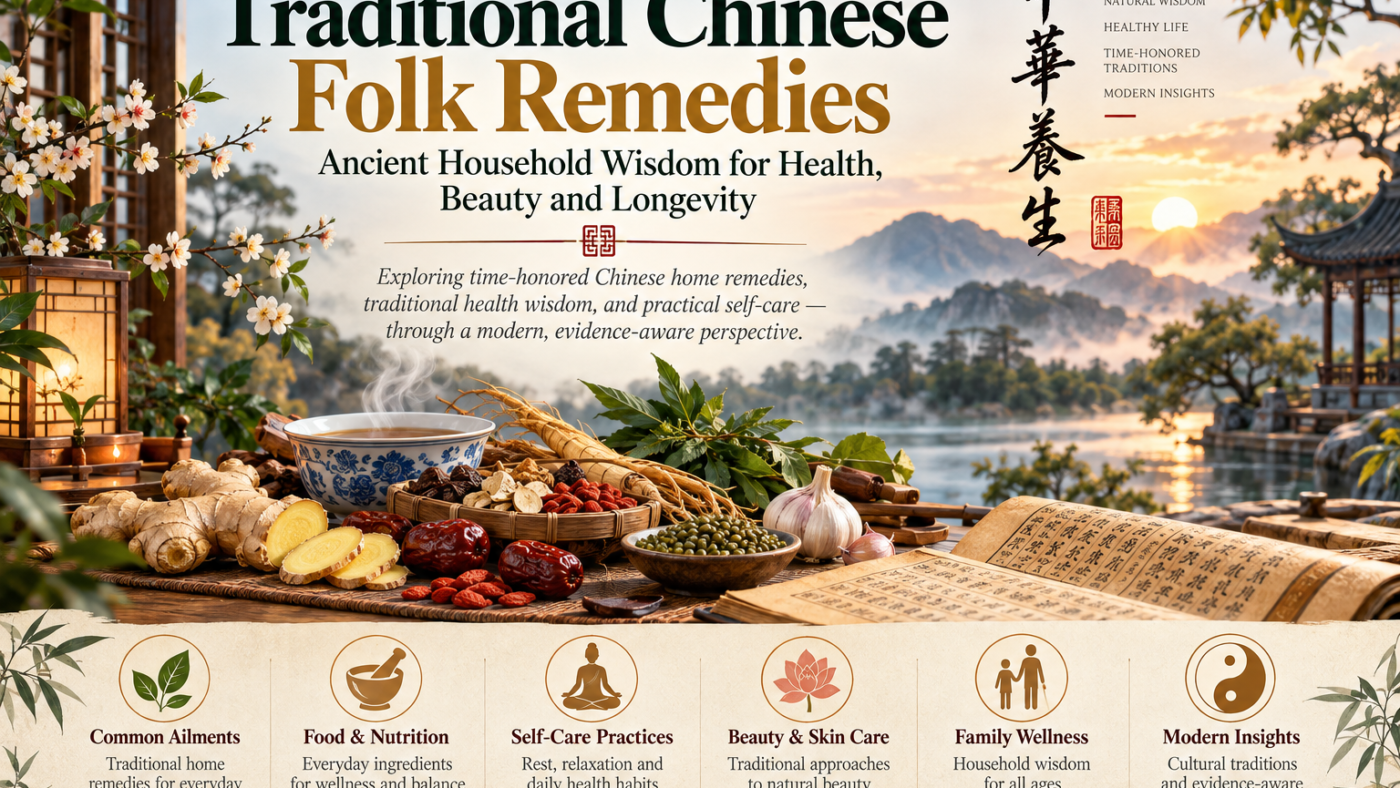
For generations, Chinese families have preserved household health practices involving foods, herbs, roots, seeds, vinegar, ginger, garlic, teas, warming applications, baths, and other everyday materials.
Some of these practices were influenced by Traditional Chinese Medicine. Others developed as regional folk remedies passed from one generation to another.
Old remedy collections often described them with confident phrases such as “highly effective,” “a complete cure,” or “works within several days.”
Today, those statements need to be approached much more carefully.
Traditional knowledge can offer a fascinating view of how earlier generations understood health, but historical use is not the same as modern medical evidence.
Some household practices may overlap with sensible self-care. Others have not been scientifically established. A few involve substances or techniques that should not be used today.
This guide therefore explores traditional Chinese folk remedies as cultural wellness history, while separating traditional claims from modern medical understanding.
What Is a Chinese Folk Remedy?
A folk remedy is a health practice developed and transmitted outside formal modern medical systems.
Traditional Chinese household remedies may involve:
- common foods
- culinary herbs
- plant roots and seeds
- warming or cooling applications
- vinegar or water preparations
- herbal washes
- foot baths
- dietary restrictions
- breathing and rest
- traditional ideas about meridians and body balance
Historically, such remedies were especially important in communities where access to professional medical care was limited.
They were often practical, inexpensive, and based on ingredients available at home.
But folk remedies vary enormously in safety and reliability.
Some may provide comfort.
Some may simply reflect cultural tradition.
Some may be ineffective.
And some can be dangerous.
That distinction is essential when traditional material is presented to modern readers.
Part I: Traditional Internal-Medicine Remedies
The original collection includes a large section devoted to what it calls “internal medicine,” covering colds, cough, digestive problems, blood pressure, liver and kidney conditions, sleep problems, urinary symptoms, and many other complaints.
Ginger, Scallion, and Traditional Cold Care
One of the most familiar Chinese household traditions involves ginger and scallion.
These ingredients have long been used in warming soups and drinks during the early stages of a cold.
The traditional idea is that warmth encourages the body to release what classical Chinese medicine might describe as an external “cold” influence.
From a modern perspective, warm fluids may soothe the throat, provide hydration, and create a sense of comfort.
However, ginger or scallion should not be presented as a cure for viral respiratory infections.
Most uncomplicated colds improve naturally with time.
Persistent fever, breathing difficulty, severe weakness, chest pain, or worsening symptoms deserve appropriate medical attention.
Garlic as a Traditional Household Ingredient
Garlic appears repeatedly in traditional household remedy collections.
Historically it has been used in food, topical applications, and folk treatments for respiratory and digestive complaints.
Garlic contains biologically active compounds and remains an important culinary food.
But traditional claims that garlic preparations can completely eliminate complex diseases should not be accepted automatically.
Food can support health.
It does not replace medical diagnosis or treatment.
Traditional Remedies for Cough
The source includes combinations involving pear, white radish, sesame, sugar, herbs, and other foods for different forms of cough.
This reflects a long-standing Chinese dietary tradition in which certain foods are classified according to their perceived moistening, cooling, warming, or phlegm-transforming qualities.
Pear, for example, is commonly associated in Chinese food therapy with soothing dryness.
White radish is traditionally associated with digestion and phlegm.
These foods can be enjoyed as part of a normal diet.
However, a persistent cough can have many causes, including respiratory infection, asthma, reflux, medication effects, smoking-related disease, or other conditions.
A food remedy should not delay evaluation when a cough is severe or persistent.
Folk Remedies for Digestive Discomfort
Traditional Chinese household practice frequently connects digestive health with overall wellbeing.
The source includes many preparations for:
- indigestion
- abdominal fullness
- diarrhea
- stomach discomfort
- constipation
- poor appetite
Some rely on ordinary foods.
Others use ingredients that would not be considered appropriate modern treatments.
The broader traditional lesson remains valuable:
how, when, and how much we eat can influence how we feel.
Moderate meals, sufficient hydration, adequate fiber, regular movement, and attention to persistent digestive symptoms are generally more useful modern principles than relying on one “secret cure.”
Traditional Sleep Remedies
The collection also includes household approaches for insomnia and excessive dreaming.
One example combines a warm foot soak with vinegar and a traditional food practice before bedtime.
The specific claim should not be treated as proven treatment for insomnia.
But the broader ritual is interesting.
A warm foot bath before bed may help some people relax.
The calming routine itself may be more important than any special ingredient.
This illustrates a recurring theme in traditional wellness:
the ritual surrounding a remedy can matter as much as the remedy itself.
Part II: Serious Diseases Require a Different Standard
The original source includes remedies for conditions such as hypertension, heart disease, hepatitis, kidney disease, diabetes, stroke, epilepsy, and other serious disorders.
These sections must be interpreted very differently from simple household comfort measures.
Diabetes
The source describes a food-based folk preparation involving pork pancreas and winter melon peel and presents it as a treatment for diabetes.
This is a historical folk claim.
It should not be interpreted as an evidence-based treatment.
Diabetes is a chronic metabolic condition that can affect the heart, kidneys, nerves, eyes, and blood vessels.
Proper management may involve nutrition, physical activity, monitoring, medication, and professional care.
Traditional foods may be part of a healthy diet, but they should not replace established diabetes treatment.
Hepatitis and Liver Disease
The source also gives folk preparations for chronic hepatitis.
Again, traditional use is not equivalent to proven treatment.
Viral hepatitis has specific infectious causes.
Different forms of liver disease require different approaches.
A plant used historically in a folk remedy should not be promoted as capable of curing hepatitis unless reliable evidence supports that conclusion.
Stroke and Neurological Disorders
Traditional collections sometimes make very strong claims about stroke, epilepsy, or other neurological conditions.
The original document includes such claims.
These are conditions where delay in appropriate medical care can be dangerous.
Historical remedies may be discussed for cultural understanding.
They should not be presented as substitutes for emergency or specialist treatment.
Part III: Children’s Folk Remedies
The original collection includes a separate pediatric section covering colds, cough, diarrhea, poor appetite, bed-wetting, sweating, abdominal discomfort, and other childhood concerns.
Children require particular caution.
A remedy that seems mild for an adult may not be appropriate for an infant or child.
Dosage, hydration, body size, allergies, development, and the possibility of serious infection all matter.
Historical pediatric remedies can therefore be interesting culturally, but they should never be assumed safe simply because they use familiar household ingredients.
Food and Appetite
Some traditional child-health remedies use hawthorn, poultry-derived ingredients, or other foods to encourage appetite or digestion.
The broader idea—paying attention to digestion and nutrition—is reasonable.
But persistent poor appetite, weight loss, developmental concerns, recurrent abdominal pain, or prolonged diarrhea deserve professional evaluation.
Childhood Respiratory Symptoms
Cough and breathing difficulty in infants and children should be treated cautiously.
A folk remedy should never delay assessment when a child has difficulty breathing, bluish lips, dehydration, high fever, lethargy, or rapidly worsening symptoms.
Part IV: Traditional External Remedies
The source contains a large “external medicine” section dealing with joint discomfort, neck pain, back pain, numbness, hemorrhoids, skin conditions, and other problems.
Many traditional external remedies rely on:
- warmth
- massage
- salt
- herbs
- topical oils
- herbal washes
These approaches reflect a broader traditional principle of improving comfort and circulation.
Heat for Muscular Discomfort
Warm compresses can feel soothing for some forms of muscular stiffness.
Traditional Chinese households often used heated salt or herbal bags.
This is one of the easier historical practices to understand in modern terms: warmth can relax muscles and temporarily reduce discomfort.
However, heat should not be used indiscriminately.
Acute injury, significant swelling, infection, loss of sensation, or unexplained persistent pain may require a different approach.
Joint and Back Pain
The source makes strong claims that certain topical preparations can “cure” arthritis, chronic back pain, cervical problems, or bone spurs.
Those claims go beyond what can responsibly be stated.
Joint and back pain can arise from many different causes.
Temporary symptomatic relief is not the same as reversing structural disease.
Part V: Skin and Hair Folk Remedies
The original material contains a substantial dermatology and beauty section.
It includes traditional approaches for itching, eczema, psoriasis, fungal infections, frostbite, burns, pigmentation, acne, hair loss, wrinkles, and other cosmetic concerns.
Some ingredients are familiar foods or household materials.
Others raise significant safety concerns.
Vinegar in Traditional Skin Care
Vinegar appears frequently in folk skin remedies.
Because vinegar is acidic, it may alter the skin environment.
However, concentrated or repeated vinegar application can irritate or burn skin.
It should not be assumed safe simply because it is used in cooking.
Garlic on the Skin
Garlic is also common in traditional topical remedies.
Raw garlic can irritate the skin and may cause burns in some people.
This is an important example of why “natural” does not always mean “gentle.”
Psoriasis and Eczema
The source provides folk washes for conditions such as psoriasis and eczema.
These are chronic inflammatory skin disorders with complex causes.
A historical wash may be part of traditional practice, but claims of permanent cure should be viewed skeptically.
Modern readers should distinguish between soothing the skin and treating the underlying disease.
Part VI: Beauty Traditions
The beauty section includes remedies for wrinkles, pigmentation, acne, hair loss, hair brightness, whitening, weight control, and unwanted hair.
This section is particularly useful for understanding how traditional beauty culture blended food, household materials, and health beliefs.
Cucumber and Traditional Facial Care
Cucumber frequently appears in traditional beauty routines.
Its high water content and cool sensation may feel refreshing.
However, claims that cucumber can permanently eliminate wrinkles or pigmentation should not be treated as established.
Honey and Traditional Skin Care
Honey also has a long history in cosmetic and wound-related traditions.
It can be soothing in some contexts, although not every household honey product is appropriate for medical use.
Hair Loss
Traditional hair-loss remedies in the document include herbal washes, ginger rubbing, and other approaches.
Hair loss can result from genetics, hormonal change, nutritional deficiency, autoimmune disease, stress, medication, illness, or scalp disorders.
No single traditional remedy should be presented as universally effective.
A Practice That Should Not Be Repeated
One entry recommends using material from old batteries for unwanted hair and claims that it has no side effects.
This should not be followed.
Battery materials may contain hazardous chemicals and metals.
This is precisely why historical collections need modern safety screening before publication.
Part VII: Women’s and Men’s Health Traditions
The document contains folk remedies for menstrual symptoms, vaginal symptoms, fertility, pregnancy-related beliefs, sexual function, prostate conditions, and other reproductive concerns.
These sections reflect historical cultural beliefs as much as medicine.
Some claims are clearly inconsistent with current knowledge.
Predicting a Baby’s Sex
One traditional claim suggests predicting fetal sex by mixing urine with alcohol.
This is a folk belief, not a reliable diagnostic method.
It provides a good example of how old household traditions can be culturally interesting without being medically valid.
Fertility
The collection provides specific food and herbal formulas for infertility in both women and men.
Infertility has many possible causes.
Hormonal factors, ovulation, sperm quality, age, anatomy, chronic disease, genetics, and other issues may all contribute.
Traditional foods cannot be assumed to correct these causes.
Sexual Function
Some historical formulas promise to restore male sexual function.
Such claims should be treated cautiously.
Sexual difficulties may involve cardiovascular health, hormones, medication effects, stress, neurological factors, or relationship issues.
Part VIII: Eye, Ear, Nose, Mouth, and Throat Remedies
The source also includes traditional remedies for toothache, gum disease, eye disorders, ear symptoms, sore throat, hoarseness, bad breath, nasal problems, and fish bones in the throat.
This section contains both familiar home practices and examples that would not meet modern safety standards.
Tea and Throat Comfort
Warm tea and honey are longstanding household approaches for throat discomfort.
For many adults, a warm drink may provide temporary soothing.
That is very different from claiming that it cures bacterial or serious throat disease.
Eye Remedies Require Special Caution
The source includes traditional preparations placed directly into or around the eyes.
Modern readers should be especially cautious.
The eye is highly sensitive to contamination, chemical irritation, and infection.
Unsterile household substances should not be placed directly into the eye.
Ear Remedies Require Caution Too
One historical entry recommends an animal-derived substance for removing an insect from the ear.
This should be understood only as an example of historical folk practice—not something to reproduce.
Part IX: Traditional Food-Combination Taboos
The document includes a section describing foods that allegedly become harmful, toxic, or even fatal when eaten together.
These traditional “food incompatibility” lists are widespread in Chinese popular culture.
Some combinations may genuinely cause digestive discomfort for certain people.
Food allergy and intolerance are also real.
But many dramatic claims in folk incompatibility charts—such as ordinary food combinations causing deafness, organ damage, or death—should not automatically be treated as scientific fact.
The more useful principle is:
evaluate foods according to individual tolerance, nutritional quality, hygiene, preparation, and established safety evidence rather than fear-based combination charts.
Part X: Traditional Preventive Health Advice
The source also contains numerous general health rules about tea, alcohol, food preparation, sleep, aging, menstruation, exercise, and daily habits.
These recommendations are a mixture of:
- sensible lifestyle observations
- traditional beliefs
- outdated ideas
- unsupported causal claims
That mixture is typical of historical household health literature.
Tea
Tea occupies an important place in Chinese health culture.
The document associates tea with alertness, memory, fatigue reduction, aging, and weight control.
Some of these themes overlap with modern interest in tea polyphenols and caffeine.
But claims should still be kept proportionate.
Tea is a beverage, not a universal medicine.
Alcohol
The collection also warns against excessive drinking and drinking during certain illnesses or pregnancy.
The general caution around alcohol is more useful than attempting to use traditional formulas as ways to “neutralize” alcohol.
There is no household trick that makes heavy alcohol consumption harmless.
Sleep
The document advises reducing mental activity and strong tea before bedtime.
This is one of the more practical parts of the collection.
Reducing caffeine and mental stimulation before bed fits well with modern sleep-hygiene principles.
What Can We Learn From These Remedies?
A historical remedy collection should not be judged only by asking:
Does every recipe work?
That is the wrong question.
A more interesting question is:
What does this collection tell us about how people historically cared for themselves?
Several themes appear repeatedly.
1. Health Was Closely Connected With Food
Traditional Chinese families often treated the kitchen as part of the household health system.
Soups, vegetables, roots, seeds, teas, eggs, grains, and other foods were used not only for nourishment but also for comfort and recovery.
2. Prevention Was Highly Valued
Many traditional teachings emphasize preventing imbalance before serious illness develops.
That idea remains valuable even when the historical explanation is different from modern physiology.
3. Daily Habits Were Considered Medicine
Sleep, eating, movement, emotional balance, cleanliness, warmth, and moderation appear repeatedly.
This may be the most enduring part of traditional wellness philosophy.
4. Traditional Language Often Uses Absolute Claims
Old remedy collections frequently use expressions such as:
“works immediately,”
“never returns,”
“completely cured,”
or
“highly effective.”
Modern health communication requires much more caution.
A remedy that helped one person is not automatically effective for everyone.
5. Natural Does Not Mean Risk-Free
This is one of the most important lessons.
Plants can be toxic.
Alcohol can interact with medication.
Acids can burn skin.
Unsterile materials can cause infection.
Animal-derived products can carry pathogens.
Household chemicals can be dangerous.
A substance does not become safe simply because it is traditional or natural.
Traditional Wisdom and Modern Evidence Can Coexist
Respecting traditional Chinese culture does not require pretending that every folk remedy is medically proven.
Likewise, acknowledging scientific uncertainty does not require dismissing generations of cultural knowledge.
A balanced approach can do both.
We can preserve the stories.
We can understand the traditional logic.
We can study the foods, herbs, and rituals.
We can appreciate the emphasis on prevention and daily habits.
And we can also ask:
Is it safe?
Has it been studied?
What does modern evidence show?
Could it delay necessary treatment?
Could it interact with medication?
Could the same traditional goal be achieved through a safer method?
That is a stronger form of respect for tradition because it allows traditional knowledge to survive without turning historical claims into modern misinformation.
The Lasting Value of Chinese Folk Wellness
The greatest value of traditional Chinese household health culture may not lie in finding one forgotten “miracle cure.”
It lies in a broader philosophy.
Pay attention to the body.
Live with moderation.
Eat thoughtfully.
Rest properly.
Stay active.
Respond early when something feels wrong.
Use simple measures for simple discomforts.
And recognize when a problem requires more than home care.
Traditional Chinese folk remedies are part of a living cultural history.
Some deserve further scientific study.
Some may remain useful as gentle wellness rituals.
Some belong primarily to history.
And some should no longer be practiced.
Understanding those differences allows us to appreciate traditional wisdom without confusing tradition with proof.
That is where ancient household knowledge can still have a meaningful place in modern wellness.
Medical Disclaimer
This article is for general educational, historical, and cultural purposes only and is not medical advice. References to traditional Chinese folk remedies describe historical or cultural practices and do not establish that those remedies are safe or effective. Some historical practices may be inappropriate or hazardous. Do not use folk remedies as substitutes for diagnosis, prescribed treatment, emergency care, or professional medical advice. Persistent, severe, or worsening symptoms should be evaluated by an appropriately qualified healthcare professional.
Editorial Note
Traditional uses in this article are presented as historical wellness practices. Statements such as “cure,” “root cure,” “special effect,” or similar claims appearing in older source material have not been reproduced as established medical facts.
This article is for general education and does not replace individualized care from a qualified health professional. Seek appropriate advice for persistent, severe, or concerning symptoms.
Read the full medical disclaimer