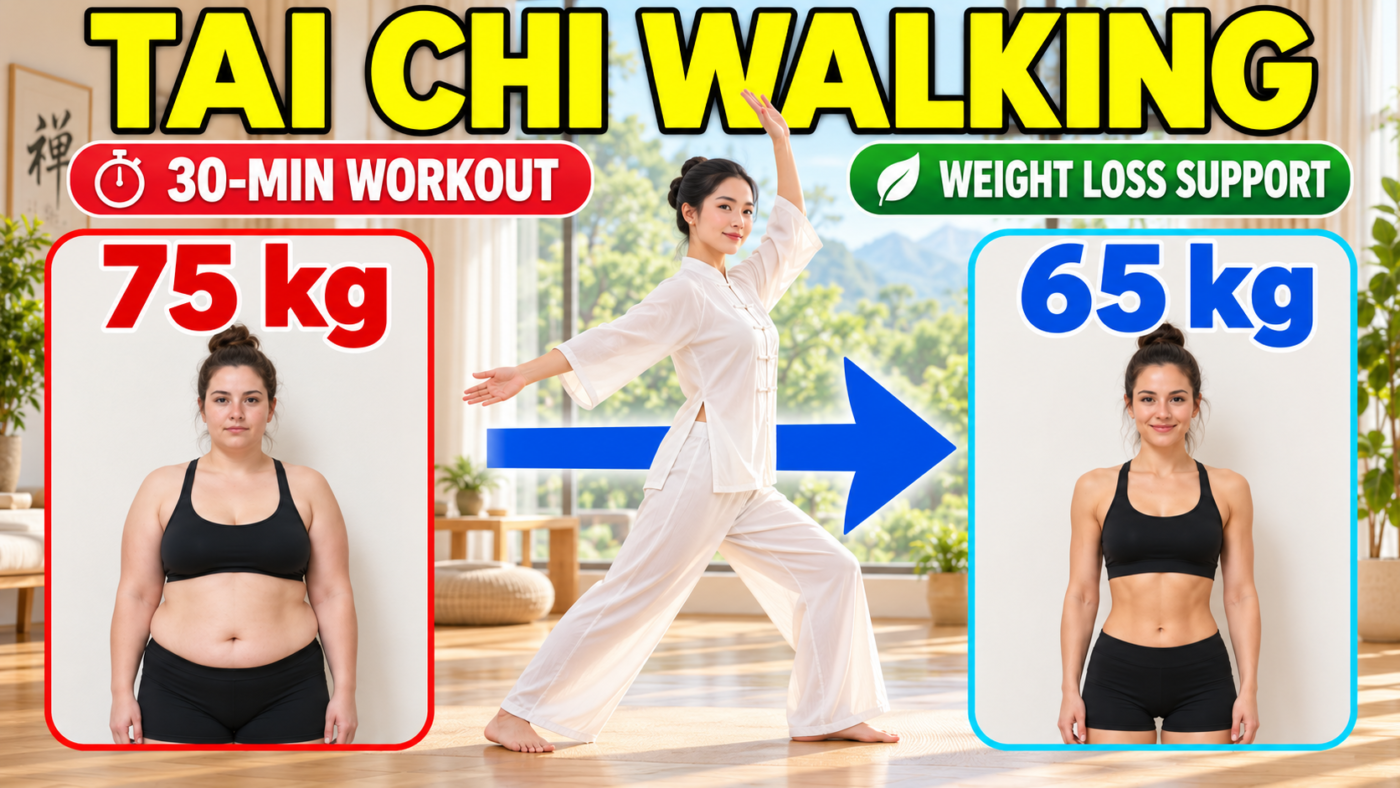
Tai chi walking for weight loss can be a practical low-impact option for people who want to increase physical activity without running or jumping. This 30-minute standing routine combines controlled steps, knee lifts, heel raises, arm swings, balance work, gentle squats, and full-body movement.
Weight loss does not come from one specific “belly-fat” exercise. Instead, long-term changes in body composition depend on overall activity, nutrition, recovery, sleep, and energy balance. This routine is best viewed as one useful part of a sustainable fitness plan.
If you want to lose weight but high-impact cardio feels uncomfortable on your knees or lower back, you do not necessarily need to jump, run, or perform exhausting intervals.
A Tai Chi walking workout can offer a gentler alternative.
This 30-minute standing routine combines controlled stepping, knee lifts, heel raises, arm swings, wide-stance bends, balance challenges, torso rotation, and coordinated full-body movement.
The goal is not to “melt” fat from the belly or thighs with individual exercises. Fat loss happens throughout the body and depends on your overall energy balance, nutrition, activity level, sleep, recovery, and individual physiology.
What this routine can do is keep large muscle groups moving, increase daily physical activity, strengthen the legs and ankles, challenge coordination, and provide a low-impact way to support long-term weight management.
Can You Lose 10 kg in Three Months?
The original workout opens with the example of going from 75 kg to 65 kg in about three months. That may happen for some people, but it should not be treated as a guaranteed result.
Weight-loss speed varies considerably depending on:
Starting body weight
Energy intake
Exercise volume
Muscle mass
Age
Medications
Sleep
Stress
Hormonal and metabolic factors
Rather than chasing one exact number on the scale, a better goal is to build a sustainable routine that increases activity while protecting your joints and preserving strength.
That is where this standing Tai Chi-inspired workout can be useful.
Why Tai Chi Walking Works Well as Low-Impact Exercise
High-intensity exercise is not the only way to increase energy expenditure.
Repeated stepping, heel raises, knee lifts, controlled squats, arm movements, and weight shifts can keep the entire body active without repeated jumping.
This style of exercise may help develop:
Leg strength
Ankle stability
Hip mobility
Core control
Balance
Coordination
Posture
Shoulder mobility
Movement confidence
Daily energy expenditure
The original session contains 24 exercises performed almost entirely in standing positions.
Exercise 1: Alternating Reach Heel Raise
Extend both arms forward.
Raise one arm overhead while sweeping the other behind you.
At the same time, rise onto the balls of your feet.
Lower the heels and switch arms.
This movement warms the ankles, calves, shoulders, and spine while preparing the body for weight shifting.
Heel raises are especially useful because the calves and ankles contribute to every walking step.
Exercise 2: Cross-Arms Knee Lift
Cross the arms in front of the chest.
Swing the arms downward and slightly backward while lifting one knee.
Return and alternate sides.
The knee lift challenges balance and engages the trunk while the arm swing increases whole-body movement.
The original script describes this as helping “shape” the waist, but it is more accurate to say that the abdominal muscles stabilize the torso during each knee lift.
Exercise 3: Arm Swing Heel Raise
Extend both arms in front.
Sweep them behind the body while rising onto the toes.
Return and repeat.
The backward arm swing encourages chest opening while the heel raise strengthens the calves and challenges ankle stability.
Exercise 4: Front Kick Clap
Open the arms.
Lift one leg forward in a gentle kick while bringing the hands together in front of you.
Return and switch sides.
The movement combines single-leg balance with arm-leg coordination.
Keep the kick low if your hamstrings or hips feel tight.
Exercise 5: Wide Knee Bend
Take a wide stance and bring the hands together at chest height.
Bend the knees into a comfortable shallow squat.
Return to standing.
This movement recruits the thighs, glutes, and inner legs.
Because these are large muscle groups, repeated controlled knee bends can contribute meaningfully to the overall workload of a low-impact session.
Exercise 6: Back Step Elbow Open
Cross the arms in front of the chest.
Step one foot backward while bending the front knee slightly.
Open both elbows outward.
Return and switch sides.
Backward stepping trains control during direction changes and requires the hips and standing leg to stabilize the body.
The elbow opening also activates the upper back.
Exercise 7: Forward Step Elbow Lift
Step one foot forward.
Bend the front knee gently while lifting both elbows to approximately shoulder height.
Return and switch sides.
This creates a controlled split stance that can help train leg strength and stability for everyday walking.
Exercise 8: Wide Bend Arm Cross
Stand with the feet wide.
Extend the arms outward.
Bend the knees while swinging both arms across the chest.
Return and repeat.
This combines lower-body strength with continuous upper-body movement.
Rather than thinking of it as “fat burning from the waist,” think of it as increasing total muscular activity and energy demand.
Exercise 9: Back Kick Hand Touch
Bring the palms together in front of the chest.
Bend the knees slightly.
Lift one foot behind you and reach back with the hand on the same side.
Return and switch.
This movement places more demand on single-leg balance and activates stabilizing muscles around the ankle and hip.
Exercise 10: Forward Bend Leg Extend
Reach upward and to one side.
Then sweep the arms behind the body as you hinge slightly forward and extend one heel.
Return and alternate sides.
The movement combines side-body mobility, hip control, and postural stability.
Keep the forward hinge small if your lower back feels sensitive.
Exercise 11: Knee Bounce Arm Sweep
Keep the knees soft and gently bend and straighten them in a relaxed rhythm.
Bring one hand toward the chest while the other arm reaches backward.
Switch sides.
The goal is fluid movement rather than bouncing aggressively.
This can help keep the legs active while introducing easy torso rotation.
Exercise 12: Wide Bend Hand Slide
Stand with the feet wide.
Place the hands beside the hips.
Bend the knees while sliding the hands down the thighs.
Rise slowly.
This provides a simple visual cue for controlled knee tracking and hip lowering.
A shallow range is perfectly acceptable.
Exercise 13: Back Step Overhead Reach
Step one leg behind you and bend the front knee slightly.
Reach the arm on the same side overhead.
Return and switch.
The longer stance can stretch the hip flexors while challenging the front thigh and balance system.
Exercise 14: Arm Pull Heel Raise
Extend both arms forward.
Pull the hands toward the hips while rising onto the toes.
Lower and repeat.
This combines calf strength, ankle stability, chest opening, and upper-back activation.
Exercise 15: Cross-Arm Swing
Stand tall with both arms extended outward.
Swing the arms forward and cross them in front of the chest.
Open again.
This provides gentle movement through the shoulders and upper back without placing significant load on the knees.
Exercise 16: Side Step Arm Open
Bend the elbows in front of the chest.
Step one foot sideways while opening the arms.
Return and switch sides.
Side stepping is valuable because everyday walking is mostly forward.
Lateral movement recruits the outer hips and challenges control in another plane of motion.
Exercise 17: Torso Turn Neck Touch
Extend both arms outward.
Place one hand behind the head and the other near the lower back.
Rotate gently toward one side.
Switch hand positions and repeat.
Keep the movement comfortable.
The goal is smooth trunk rotation rather than forcing the spine.
Exercise 18: Alternating Knee Arm Lift
Lift one knee while opening the arms to the sides.
Lift the opposite knee while bringing the arms forward.
Continue alternating.
Changing the arm position on each repetition increases the coordination challenge while the repeated knee lifts engage the hips and core.
Exercise 19: Wide Bend Arm Sweep
Stand with the feet wide.
Bend the knees while raising the arms overhead.
Then stand tall and sweep the arms backward.
The thighs and glutes work during the knee bend while the large arm sweep restores movement through the shoulders and upper back.
Exercise 20: Wide Bend Down Press
Take a wide stance.
Bring the hands together in front of the chest.
Bend the knees while pressing one hand downward and reaching the other arm backward.
Return and alternate.
This is one of the more demanding movements in the session because the lower body remains under load while the trunk and arms move.
Reduce the squat depth if necessary.
Exercise 21: Knee Lift Front Kick
Place the hands on the hips.
Lift one knee.
Extend the lower leg forward.
Bring it back and switch sides.
The abdominal muscles stabilize the torso during the knee lift, while the leg extension challenges balance and hip control.
Do not interpret the abdominal effort as targeted belly-fat loss.
Exercise 22: Cross Back Step Clap
Open the arms.
Step one foot diagonally behind the other.
Bend the front knee slightly and bring the hands together behind the body if your shoulder mobility allows.
Return and switch sides.
The cross-back step challenges hip control and coordination, while the arm movement opens the chest and shoulders.
Exercise 23: Arm Circle Elbow Pull
Circle both arms upward.
As the arms come down, bend the knees and draw the elbows outward.
Repeat smoothly.
Large arm circles keep the upper body moving while the repeated knee bend adds lower-body work.
Exercise 24: Heel Raise Elbow Lift
Bring the hands together in front of the chest.
Raise the elbows while rising onto the toes.
Lower slowly.
This final movement is gentler and helps transition the session toward a calmer finish.
The original routine uses it as the last exercise before the cool-down.
What This Workout Can Realistically Do
Practiced consistently, a routine like this may support:
More daily movement
Better ankle and calf strength
Improved lower-body endurance
Greater hip mobility
Better balance
Improved coordination
More comfortable posture
Higher total energy expenditure
Weight-management efforts
What it cannot guarantee is a specific amount of weight loss in seven days or three months.
The original video recommends practicing for seven days and suggests changes in the waistline, posture, and balance. Pasted text.txtTXT
Seven days can be a useful consistency challenge, but meaningful body-composition changes usually require a longer-term approach.Tai chi walking for weight loss works best when it is practiced consistently as part of a broader routine that also includes regular walking, strength work, appropriate nutrition, and adequate recovery.
Can Tai Chi Walking Reduce Belly Fat?
Not directly.
No standing exercise, knee lift, side bend, or waist rotation can selectively remove fat from the abdomen.
However, a Tai Chi walking workout can contribute to overall fat loss by increasing physical activity and energy expenditure.A tai chi walking for weight loss routine can be especially useful for people who prefer standing, low-impact exercise and want to improve balance and mobility while staying active.A Tai Chi walking routine for weight loss can be especially useful for people who prefer standing, low-impact exercise and want to improve balance and mobility while staying active.
Over time, overall fat loss may reduce abdominal fat as well.
The best results generally come from combining regular movement with:
A sustainable eating pattern
Appropriate calorie intake
Adequate protein
Sufficient sleep
Strength training
Regular walking or other aerobic activity
Consistent exercise habits
Tai Chi Walking vs High-Impact Cardio
High-impact cardio can be effective, but it is not appropriate or enjoyable for everyone.
Tai Chi walking may be especially appealing if you:
Prefer standing exercise
Want to avoid jumping
Are returning to exercise
Want more balance training
Experience discomfort with running
Prefer slower, controlled movements
Want to combine mobility with activity
That does not mean Tai Chi walking is automatically “better” than running, cycling, brisk walking, swimming, or strength training.
Different forms of exercise provide different benefits.
The best routine is one you can perform safely and consistently.
How to Make the Workout Easier
Use a chair or countertop for balance.
Keep knee lifts low.
Perform smaller steps.
Use shallow knee bends.
Slow down the transitions.
Skip movements that cause pain.
Take extra rest breaks.
Reduce the range of overhead reaches.
Do not force any kick, twist, or back step.
How to Make It More Challenging
Once the movements feel comfortable, you can gradually:
Increase the range of motion.
Perform slightly deeper knee bends.
Increase the pace while maintaining control.
Use longer steps.
Spend more time in single-leg positions.
Reduce unnecessary rest.
The priority should always remain movement quality.
How Often Should You Practice?
You can use this routine several times per week depending on your fitness level, recovery, and total exercise schedule.
A seven-day challenge can help establish a habit, but you do not need to perform the full routine every day indefinitely.
A balanced weekly plan may combine:
Tai Chi walking
Ordinary walking
Strength training
Mobility work
Rest or easier recovery days
Who Should Be More Careful?
Use extra caution if you have significant balance problems, severe joint pain, recent surgery, uncontrolled cardiovascular symptoms, or another medical condition that affects exercise tolerance.
Stop if you experience:
Chest pain
Severe shortness of breath
Dizziness
Faintness
Sharp joint pain
Sudden weakness
Unusual neurological symptoms
Seek appropriate medical evaluation when needed.
The Bottom Line
This 30-minute Tai Chi walking workout uses 24 standing exercises to combine low-impact movement, balance, coordination, mobility, and muscular work.
Heel raises strengthen the calves and ankles.
Knee lifts challenge the core and balance.
Wide bends train the thighs and hips.
Side steps strengthen lateral movement.
Arm swings and reaches mobilize the shoulders.
Back steps and cross steps improve coordination and directional control.
Most importantly, the routine gives you another way to stay active without jumping.
It should not be viewed as a seven-day belly-fat cure or a guaranteed way to lose 10 kg in three months.
Instead, use it as part of a sustainable exercise routine that supports movement, strength, balance, and long-term weight management.
Medical Disclaimer
This article is for general educational purposes only and is not intended to diagnose, treat, cure, or prevent any disease or medical condition. Exercise tolerance varies between individuals. Stop exercising if you experience significant pain, dizziness, chest discomfort, unusual shortness of breath, or other concerning symptoms. Seek appropriate professional guidance if you have a medical condition, recent injury or surgery, or concerns about whether this routine is suitable for you.
This article is for general education and does not replace individualized care from a qualified health professional. Seek appropriate advice for persistent, severe, or concerning symptoms.
Read the full medical disclaimer