Why Standing Core Training Can Be Useful After 40
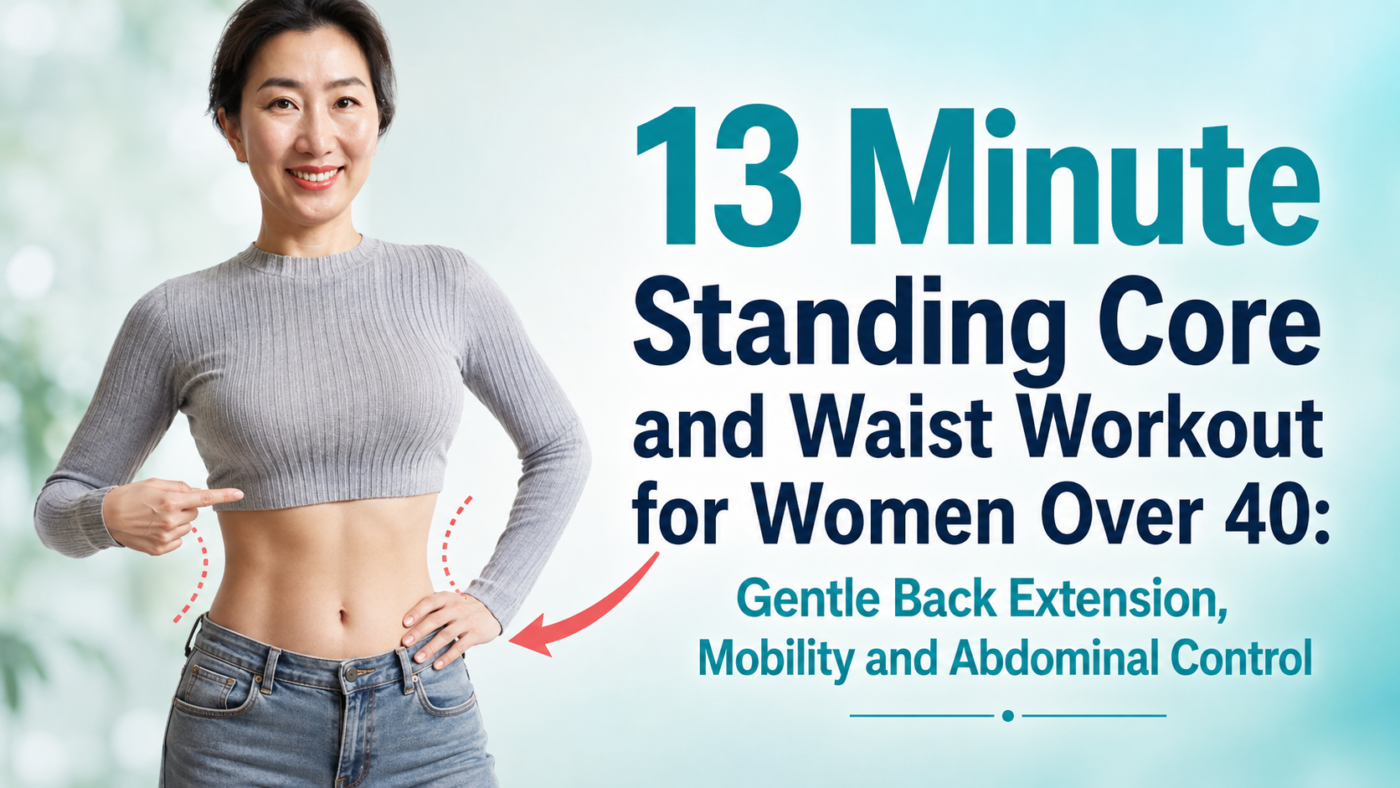
This standing core workout is a gentle 13 minute routine designed for women over 40 who want to improve abdominal control, waist mobility, posture awareness and full body movement without getting down on the floor.Core training does not have to mean crunches on the floor.
It does not have to mean long planks.
And it does not have to involve complicated equipment.
Your trunk muscles work whenever your body has to stabilize, rotate, bend or control movement.
That means a standing routine can still challenge your abdominal muscles, obliques, spinal muscles and pelvis.
For many people over 40, this approach may also feel more approachable than traditional floor exercises.
The routine in this article combines gentle mobility with a standing backward extension movement sometimes described online as a “reverse crunch.”
That name is somewhat misleading.
A traditional reverse crunch is usually performed lying down and involves moving the pelvis toward the rib cage.
The standing movement used here is closer to a controlled spinal and hip extension exercise.
That distinction matters.
Can One Minute a Day Flatten Your Belly?
Not reliably.
A standing exercise may help you improve muscular control.
It may make your posture feel different.
It may strengthen or challenge certain trunk muscles.
But it cannot selectively remove abdominal fat in one minute per day.
Waist size is influenced by several factors.
Body fat.
Bloating.
Posture.
Muscle tone.
Genetics.
Hormonal changes.
Digestive contents.
Fluid balance.
A single exercise cannot control all of them.
Short workouts can still be worthwhile.
They simply should not be marketed as guaranteed instant fat loss.
Why Belly Fat Often Feels More Noticeable After 40
Many adults notice changes in body composition during midlife.
Activity may decrease.
Muscle mass may gradually decline if resistance training is absent.
Sleep may change.
Stress may increase.
Hormonal transitions can influence fat distribution.
All of these factors can affect how the waist looks and feels.
This does not mean metabolism suddenly “breaks.”
It also does not mean belly fat becomes impossible to reduce.
Consistent activity, resistance training, nutrition and adequate recovery still matter.
Start With Gentle Neck Mobility
Stand comfortably.
Relax your shoulders.
Slowly bring your chin toward your chest.
Move gently toward one side.
Continue through a comfortable circle if your neck tolerates it.
Do not throw the head backward.
Do not force the range.
Repeat in the opposite direction.
For many people, slow half circles are more comfortable than full neck rolls.
If you experience dizziness, nerve symptoms or neck pain, skip this movement.
Shoulder Circles
Place your hands lightly over your shoulders.
Rotate your elbows forward.
Move slowly.
Then reverse the direction.
Allow the shoulder blades to move naturally.
This is simply a warm up.
It is not necessary to create the largest circle possible.
Use a comfortable range.
Pelvic Circles
Stand with your feet about hip to shoulder width apart.
Place your hands on your hips.
Make slow circles with the pelvis.
Keep your knees slightly relaxed.
Breathe naturally.
Reverse direction.
This may help reduce stiffness before the main exercise.
It also helps you become more aware of how the pelvis moves relative to the rib cage.
Can Pelvic Circles Prevent Back Pain?
Not by themselves.
Back pain has many possible causes.
Regular movement and strength training may support general function, but one mobility exercise cannot guarantee prevention.
If pelvic circles feel comfortable, use them as preparation.
If they make your back hurt, stop.
Pelvic Tilts
Now move the pelvis forward and backward through a small range.
Avoid exaggerating either direction.
Notice what happens to your lower back.
As the pelvis tilts forward, the lower back may arch slightly.
As it tilts backward, the lower back may flatten slightly.
Keep the movement controlled.
Do not squeeze your abdomen as hard as possible.
The goal is awareness and control.
Inner Thigh Mobility
Stand with your feet wider apart.
Bend one knee.
Shift gently toward that side.
Use your hands on your thighs for light support if needed.
Feel a comfortable stretch along the opposite inner thigh.
Return to center.
Repeat on the other side.
Do not push forcefully on the knee.
The stretch should feel mild to moderate.
Prepare for the Standing Back Extension
Stand with your feet about shoulder width apart.
Use a sofa, bed, wall or stable chair nearby if you are unsure of your balance.
Place your hands behind your head or lightly behind the upper neck.
Do not pull on your neck.
Keep your elbows open.
Take a breath.
Stand tall.
This is your starting position.
The Standing “Reverse Crunch”
Gently lift your chest.
Allow your upper body to move into a small backward extension.
Keep the movement controlled.
Do not collapse into your lower back.
Do not throw your head backward.
Think about distributing the movement through the upper and middle spine rather than forcing everything into the lumbar region.
Breathe.
Hold briefly.
Return to upright.
That is one repetition.
Should You Lift Your Big Toes?
The original routine includes lifting the big toes.
That is not required for core activation.
If lifting your toes helps you become more aware of balance, you can experiment with it.
But it should not make you unstable.
Your feet should remain securely supported.
For most beginners, keeping the whole foot comfortably grounded is perfectly reasonable.
What Muscles Are Working?
A controlled standing extension can involve several muscle groups.
The spinal extensor muscles help control the movement.
The abdominal muscles contribute to trunk stability.
The hips and legs help maintain balance.
The gluteal muscles may assist depending on how the movement is performed.
But this is not a magical way to isolate deep abdominal fat.
Muscle activation and fat loss are separate processes.
Does Backward Bending Train the Abs?
The abdominal muscles may work to control the trunk during extension.
They can help prevent the movement from becoming uncontrolled.
However, backward bending is not equivalent to a traditional abdominal crunch.
Think of this as a trunk control exercise.
Not a replacement for every other core movement.
Do Not Push Into Back Pain
This is particularly important.
Backward extension is comfortable for some people.
It is uncomfortable for others.
If you experience sharp pain, pinching, radiating pain, numbness or tingling, stop.
Do not assume pain means the exercise is working.
More range is not automatically better.
First Round
Move gently backward.
Hold for a short moment.
Keep breathing.
Return to upright.
Relax.
Shake out your arms if necessary.
Repeat only if the first repetition felt comfortable.
Recovery Movement
Place your hands on your thighs.
Allow the knees to soften slightly.
Move the pelvis gently.
Relax your lower back.
Breathe.
This gives you a short break before repeating the extension.
Second Round
Stand tall again.
Place your hands lightly behind your head.
Open your elbows.
Gently extend backward.
Use a smaller range than you think you need.
Continue breathing.
Return to center.
If you feel stable and comfortable, repeat.
The Goal Is Control, Not Maximum Range
A dramatic backbend is unnecessary.
You are not trying to become a gymnast.
The purpose is to practice controlled movement.
A small range performed comfortably may be much more useful than forcing a large arch.
Third Round
Repeat the same pattern.
Stand tall.
Brace lightly.
Extend.
Breathe.
Return.
Relax.
You may begin to feel your trunk muscles working.
That is enough.
There is no need to chase shaking or burning.
Does Shaking Mean You Are Sculpting Your Waist?
No.
Muscles can shake when they are fatigued or when your nervous system is working hard to stabilize a position.
That does not mean abdominal fat is melting.
Treat shaking as a sign to assess your control.
If the movement becomes unstable, stop and rest.
Final Standing Extension
Perform one more controlled repetition if appropriate.
Keep your balance.
Keep your breathing normal.
Return to upright slowly.
Do not snap forward.
Take several relaxed breaths.
Side Body Stretch
Stand with your feet around shoulder width.
Place your hands lightly behind your head.
Shift some weight toward one leg.
Move the opposite leg slightly outward if comfortable.
Lift one elbow toward the ceiling.
Lean gently to the side.
You should feel a stretch along the opposite side of the torso.
Keep breathing.
Return slowly.
Repeat on the other side.
What Does the Side Stretch Train?
The movement primarily provides mobility through the side body.
It may involve the obliques, latissimus dorsi and other muscles around the trunk.
It also challenges balance slightly.
It does not selectively burn “love handles.”
Spot reduction is not how body fat loss works.
Repeat the Side Stretch
Return to the first side.
Reach gently.
Keep the ribs and pelvis controlled.
Do not collapse forward.
Then change sides.
Use similar effort on both sides.
Minor differences in flexibility are normal.
Finish With a Self Hug
Wrap your arms around your torso.
Allow the upper back to round slightly.
Relax your abdomen.
Take a slow breath.
Feel the back of your rib cage expand.
Exhale.
Release your shoulders.
This gives your body a gentle contrast to the extension work.
Can This Workout Reduce Waist Size?
Potentially over time only as part of a larger fitness and lifestyle program.
Strengthening the trunk can change posture and muscular control.
Regular exercise can support fat loss when overall energy balance also changes.
But this specific routine cannot guarantee a particular number of inches lost.
Claims such as “2.2 inches in two weeks” should not be treated as a predictable result.
Be Careful With TV Show Experiments
Fitness programs sometimes cite very small television experiments involving only a handful of participants.
These demonstrations are not equivalent to controlled scientific trials.
Waist measurements can also vary because of measurement location, posture, breathing, bowel contents and time of day.
A dramatic television result should therefore be treated as entertainment or anecdotal evidence rather than proof.
Can Core Exercises Restore a Natural Corset?
The abdominal wall does function as part of a pressure and stability system around the trunk.
The transverse abdominis is sometimes described metaphorically as a corset because of the direction of its fibers.
But there is no switch that becomes permanently restored after one specific exercise.
Core function involves coordination among multiple muscles.
Regular varied training is more useful than searching for one secret muscle.
Can This Workout Prevent Lower Back Pain?
It cannot guarantee prevention.
Some people may find gentle mobility and core control useful.
Others may find extension based movements irritating.
Back pain treatment should be individualized.
A movement that helps one person may not suit another.
Women Over 40 and Core Training
Midlife is a good time to maintain strength.
Core training can help with trunk control during everyday movement.
But it should not be the only exercise you do.
A complete routine also benefits from:
Walking or other aerobic activity.
Squats and other lower body strength work.
Pulling movements for the back.
Pushing movements for the upper body.
Balance training.
Progressive resistance.
Mobility where needed.
The body responds best to variety.
Menopause and Abdominal Fat
Menopause can be associated with changes in fat distribution for some women.
More fat may accumulate around the abdomen compared with earlier life.
This is influenced by hormonal changes along with age, activity and other factors.
That does not mean abdominal fat can be specifically targeted with crunches or back bends.
Whole body lifestyle strategies still matter.
Does Better Posture Make the Belly Look Flatter?
Sometimes.
How you stand changes how the abdomen appears.
A collapsed posture can make the waist look different from a more upright position.
But posture changes do not equal fat loss.
Both can matter visually.
Keep those concepts separate.
Can One Exercise Make You Look 20 Years Younger?
No.
Exercise can support healthy aging.
Strength, mobility and fitness can influence how energetic and capable you feel.
But an exercise should not be advertised as literally reversing your biological age by 20 years.
Healthy aging is a much better goal than age erasure.
How Often Should You Practice?
For a gentle mobility based version, several short sessions per week may be reasonable.
For more demanding strength work, allow recovery.
If you are new to exercise, begin conservatively.
You do not need to repeat the routine multiple times every day.
Consistency matters more than extreme frequency.
Beginner Version
Try this shorter sequence:
One minute shoulder and pelvic mobility.
Three gentle pelvic tilts.
Two small standing extensions.
One side stretch each side.
Several relaxed breaths.
That may be enough for your first session.
More Challenging Version
Once comfortable, you could add:
Slow standing marches.
Resistance band exercises.
Loaded carries.
Squats.
Bird dogs.
Dead bugs.
Pallof presses.
These provide different kinds of core challenge.
You do not need to keep increasing the depth of the back extension.
Standing Core Versus Floor Core Exercises
Neither is automatically superior.
Standing core work is convenient.
Floor exercises may provide different loading opportunities.
Traditional resistance training can challenge the trunk in still other ways.
The best program uses exercises appropriate to your ability and goals.
A Better Strategy for Belly Fat After 40
If reducing abdominal fat is a goal, focus on the broader picture.
Accumulate regular physical activity.
Include resistance training.
Eat in a sustainable way that supports your energy needs and goals.
Get enough protein.
Sleep adequately.
Reduce prolonged sitting.
Manage relevant medical conditions.
Stay consistent for months rather than searching for a seven day trick.
Those habits are less exciting than miracle exercises.
They are also far more realistic.
Frequently Asked Questions
Can standing reverse crunches flatten the stomach?
They may train trunk control, but they do not directly remove abdominal fat.
Can I lose one inch from my waist in one week?
Short term waist measurements can fluctuate, but a guaranteed one inch fat loss from one exercise is not supported.
Are standing core workouts effective?
Yes, they can challenge trunk stability, mobility and muscular control depending on how they are performed.
Is backward bending safe?
It can be comfortable for many people, but it is not appropriate for everyone. Stop if it causes back pain or neurological symptoms.
Can this exercise prevent back pain?
No exercise can guarantee prevention of lower back pain.
Does this strengthen deep abdominal muscles?
Several trunk muscles may contribute to stabilization, but claims about uniquely activating one hidden deep muscle are often overstated.
Can standing exercises reduce muffin top fat?
Not selectively. Overall body fat reduction depends on long term energy balance.
Is this suitable for women over 40?
It can be, provided the movements are comfortable and appropriately modified.
Can women over 50 do it?
Many can, but balance, spinal health and individual medical conditions should be considered.
How often should I practice?
Several short sessions per week can be a reasonable starting point.
Should the exercise make my back hurt?
No. Stop if you experience pain.
Do I need equipment?
No. A nearby wall, bed, sofa or chair may be useful for balance.
Medical Disclaimer
This article is for general educational and informational purposes only and is not medical advice, diagnosis or treatment. Back extension exercises are not appropriate for everyone. Stop immediately if you experience sharp pain, radiating pain, numbness, tingling, dizziness, loss of balance or other concerning symptoms. People with significant spinal disorders, recent surgery, osteoporosis, balance problems or other relevant medical conditions should seek appropriate professional guidance before beginning a new exercise program.
This article is for general education and does not replace individualized care from a qualified health professional. Seek appropriate advice for persistent, severe, or concerning symptoms.
Read the full medical disclaimer