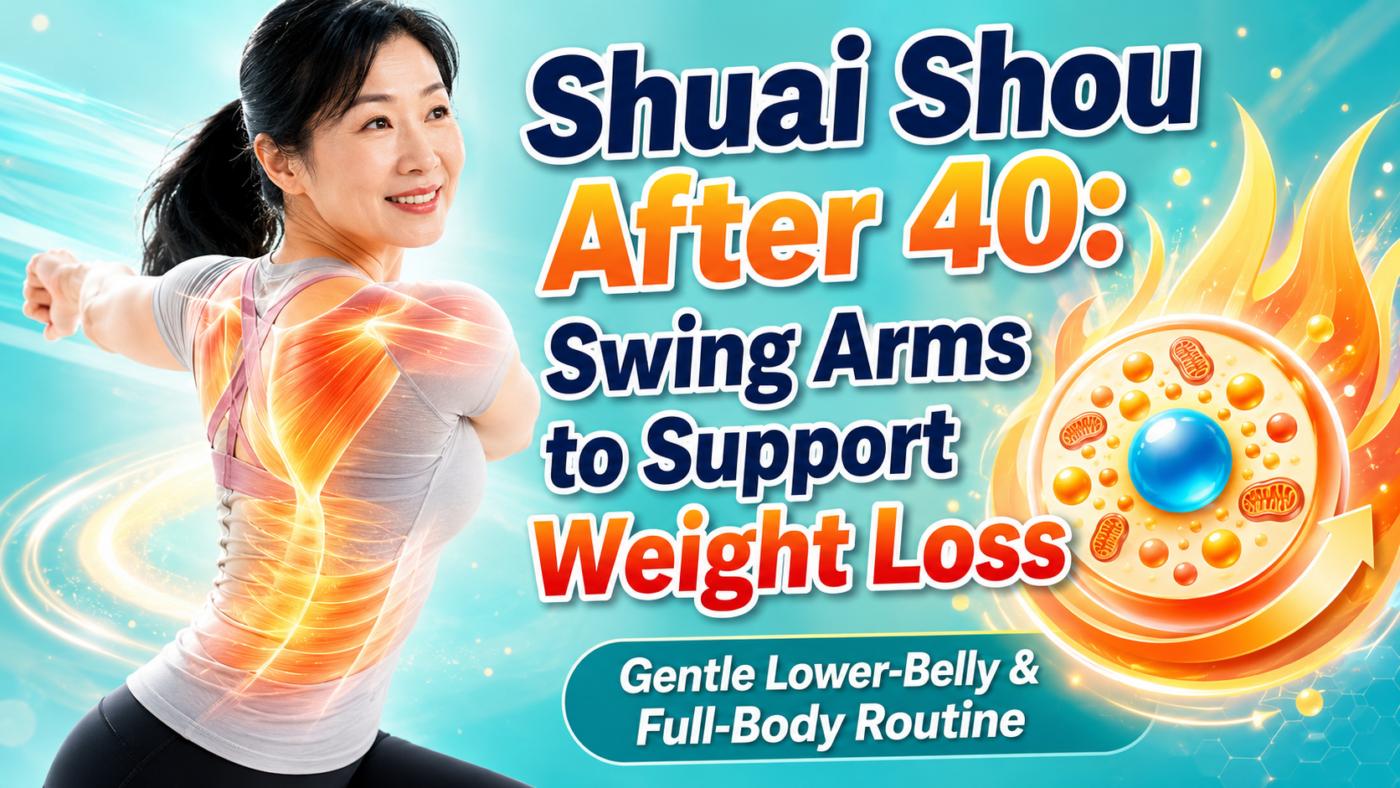
Shuai Shou exercise after 40 can be a simple way to add more movement to your day without getting on the floor, lifting heavy weights, or performing complicated choreography.
Shuai Shou—often translated as arm swinging—appears in several traditional Chinese movement practices and qigong-style routines.
The basic idea is simple:
Stand comfortably.
Relax the shoulders.
Move the arms rhythmically.
Allow the torso and hips to participate naturally.
Because the exercise is low impact and easy to modify, it can be especially appealing to adults who feel stiff, sedentary, or intimidated by conventional workouts.
Online videos sometimes claim that arm swinging can melt lower-belly fat, activate brown fat around the shoulder blades, balance the autonomic nervous system, and even release “negative energy” through the fingertips.
Some of these ideas come from traditional movement language rather than modern physiology.
The more realistic benefits are still worthwhile:
- More whole-body movement
- Shoulder mobility
- Rib-cage rotation
- Pelvic control
- Gentle core engagement
- Increased circulation during activity
- Relaxation
- Better movement confidence
That is enough reason to practice it.
What Is Shuai Shou?
“Shuai Shou” broadly refers to swinging or shaking the arms.
Different traditions teach different versions.
Some use:
- Forward-and-back arm swings
- Side-to-side rotations
- Rib-cage movement
- Pelvic rotation
- Gentle knee bending
- Coordinated breathing
The exercise is often performed rhythmically and continuously.
This makes it part mobility practice, part light aerobic activity, and part relaxation exercise.
Is Shuai Shou the Same as Qigong?
Not exactly, although the practices can overlap.
Qigong is a broad category that includes breathing, posture, attention, slow movement, and meditative practices.
Arm swinging may appear within qigong, traditional exercise systems, warm-ups, or independent wellness routines.
The movement itself does not require belief in any particular energy theory to be useful.
You can practice it simply as gentle physical activity.
Can Shuai Shou Burn Belly Fat?
Not selectively.
No arm swing can tell the body to remove fat specifically from the lower abdomen.
Body fat is reduced systemically.
Your genetics and hormones influence where fat is stored and where it is lost first.
Shuai Shou can contribute to total daily movement and calorie expenditure.
That may support weight management when combined with appropriate nutrition and regular physical activity.
But it is not a spot-reduction technique.
Can Arm Swinging Activate Brown Fat?
This claim needs caution.
Brown adipose tissue, or brown fat, is a real type of metabolically active fat involved in heat production.
Adults can retain brown fat, particularly in regions around the neck and upper torso.
Its activity can be influenced by factors such as cold exposure.
However, evidence does not currently show that simply moving the shoulder blades or swinging the arms dramatically activates brown fat enough to produce major fat loss.
So if your shoulder region becomes warm during exercise, the simplest explanation is:
working muscles + increased blood flow
Not proof that brown fat has switched into a high-fat-burning mode.
What Does Shoulder-Blade Movement Actually Do?
The shoulder blades, or scapulae, move during many upper-body actions.
They can:
- Protract
- Retract
- Elevate
- Depress
- Rotate
Gentle arm swinging may help people become more comfortable moving through these ranges.
That can be especially useful if you spend long periods sitting or working at a computer.
Better scapular movement can also make reaching, lifting, and upper-body exercise feel more natural.
Can Shuai Shou Improve Core Control?
Yes, indirectly.
When the rib cage and pelvis rotate during standing movement, the trunk muscles help control that motion.
These may include:
- Obliques
- Transversus abdominis
- Multifidus
- Spinal muscles
But this is not the same as performing targeted abdominal strength training.
Arm swinging is better viewed as gentle dynamic core coordination.
Does Pelvic Rotation “Lift” the Lower Belly?
Not literally.
Pelvic control and core activation can change how the abdomen looks while standing.
If you move from a relaxed posture into a more controlled position, the lower abdomen may appear flatter.
That is a postural and muscular effect.
It is not localized fat loss.
Can Shuai Shou Help With Stiff Hips?
Potentially.
Gentle pelvic rotation and weight shifting can increase movement through the hips.
This may help some people feel less stiff.
But hip stiffness can arise from many causes, including:
- Arthritis
- Injury
- Weakness
- Reduced activity
- Individual anatomy
Shuai Shou should not be presented as a cure for hip problems.
Can It Prevent Back Pain?
Not guaranteed.
Regular movement is generally beneficial for musculoskeletal health, and gentle exercise can help some people with non-specific stiffness.
But back pain has many possible causes.
One standing routine cannot guarantee prevention.
A more accurate claim is:
Shuai Shou may be a comfortable way to keep the spine, hips, and shoulders moving.
Can It Help Knee Comfort?
It depends.
Because the exercise can be performed with minimal knee bending, many people may find it easier than deep squats or lunges.
But if you add deeper knee bends, the demand increases.
Anyone with knee pain should stay within a comfortable range.
What About the Autonomic Nervous System?
Slow rhythmic movement combined with breathing may promote a sense of relaxation.
That could influence how stressed or calm you feel.
But saying that arm swinging “stabilizes the autonomic nervous system better than other exercise” is much stronger than the evidence supports.
It is safer to say:
Rhythmic movement and slow breathing may help some people feel calmer and more relaxed.
What Does “Releasing Negative Energy” Mean?
Traditional exercise systems often use metaphorical language.
Practitioners may imagine tension, stress, or unwanted energy leaving through the hands.
This can be useful as a mindfulness technique.
But it should be presented as:
a visualization or traditional practice
rather than a literal biomedical process.
There is no known mechanism in which excess metabolic energy physically exits through the fingertips as a beam.
Why Visualization Can Still Be Useful
Mental imagery can influence how people experience movement.
For example, imagining:
- Heavy arms
- Relaxed shoulders
- Energy flowing downward
- Tension leaving the body
may help reduce unnecessary muscular tension.
That makes visualization potentially useful as a relaxation strategy even without interpreting it literally.
A Gentle Shuai Shou Routine After 40
The following routine adapts the useful parts of the original video into a safer standing sequence.
Move comfortably.
There is no need to force large ranges.
1. Gentle Hip Circles
Stand with feet approximately hip-width apart.
Keep the knees soft.
Place your hands on your hips.
Slowly circle the pelvis.
Keep the movement small at first.
Perform 5–10 circles.
Reverse direction.
Breathe naturally.
2. Pelvic Side-to-Side Movement
Keep the feet planted.
Shift the pelvis gently from one side to the other.
Let the knees respond naturally.
Avoid forcing the lower back.
Continue for 30 seconds.
3. Rib-Cage Circles
Place your hands lightly on your ribs.
Move the rib cage gently:
- Forward
- Side
- Back
- Other side
Create a slow circle.
Keep your shoulders relaxed.
Reverse direction.
4. Rib-Cage Rotation
Stand tall.
Rotate your torso gently to the right.
Return to center.
Rotate left.
Let the feet pivot slightly if that feels natural.
Perform 8–12 repetitions.
5. Side-to-Side Upper-Body Swing
Relax the arms.
Rotate the torso gently.
Let the arms follow.
Do not actively fling them.
The movement should feel loose.
Continue for 30–60 seconds.
6. Overhead Reach With Hip Circle
Raise both arms comfortably overhead.
Do not shrug the shoulders.
Slowly circle the hips.
Keep the core lightly engaged.
If overhead movement is uncomfortable, keep the hands at chest height.
7. Pelvic Tilt Practice
Place one hand on the lower abdomen and one on the pelvis.
Gently tilt the pelvis forward.
Then backward.
Keep the range small.
Do not clench excessively.
Repeat 8–12 times.
8. Narrow Arm Swing
Relax both arms beside the body.
Swing them forward and backward through a small range.
Keep the shoulders loose.
Continue for 30–60 seconds.
9. Wider Arm Swing
Gradually allow the swing to become larger.
Keep control.
Let the torso move slightly.
Avoid forcing the shoulders.
10. Chest Open and Round
Stand tall.
Gently open the chest.
Then round the upper back slightly.
Move slowly between the two positions.
Repeat 8–10 times.
This adds spinal mobility.
11. Rib-Led Arm Swing
Begin rotating through the rib cage.
Allow the arms to follow.
Think:
torso first, arms second
This helps prevent aggressive shoulder pulling.
Continue for 30–60 seconds.
12. Relaxed Finish
Gradually reduce the size of the arm swing.
Let the arms hang.
Take several slow breaths.
Relax the shoulders.
How Long Should You Practice?
A useful beginner session may last:
5–15 minutes
There is no need to practice for an hour.
Short, regular sessions are more realistic for many people.
Can You Do It Every Day?
Gentle versions can often be performed daily.
Because intensity is relatively low, recovery demands are usually modest.
But stop or reduce the range if you develop pain.
How Intense Should It Feel?
This routine should feel light to moderate.
You may notice:
- Warmth
- Slightly faster breathing
- Looser shoulders
- More comfortable hips
- Mild core activity
You should not feel:
- Sharp pain
- Dizziness
- Severe shortness of breath
- Joint pain
- Numbness
Is Warmth a Sign of Fat Burning?
Not specifically.
Warmth during exercise usually reflects:
- Muscle activity
- Increased blood flow
- Body-temperature regulation
Your body does use energy during exercise, but local warmth does not tell you where fat is being burned.
Can You Lose Weight With Shuai Shou Alone?
Possibly only if it meaningfully increases total activity and contributes to an overall energy deficit.
For most people, a stronger weight-management plan also includes:
- Walking
- Strength training
- Appropriate nutrition
- Adequate sleep
- Consistency
Shuai Shou can complement those habits.
Why Strength Training Still Matters
Arm swinging improves movement but provides limited resistance.
To maintain muscle after 40, add exercises such as:
- Chair squats
- Wall push-ups
- Rows
- Glute bridges
- Step-ups
- Resistance-band exercises
Strength training becomes increasingly important with age.
A Good Weekly Combination
You might use:
Daily or most days: Shuai Shou / mobility
3–5 days: walking or aerobic exercise
2–3 days: strength training
That creates a much more complete program.
Who Should Be Careful?
Modify the routine if you have:
- Significant balance problems
- Severe vertigo
- Recent shoulder injury
- Hip or knee pain
- Recent surgery
- Severe back pain
Use a chair or wall for support when needed.
The Bottom Line
Shuai Shou exercise after 40 can be a pleasant, accessible way to move more.
It can help you practice:
- Arm movement
- Shoulder-blade mobility
- Rib-cage rotation
- Pelvic control
- Core coordination
- Relaxed breathing
It does not need exaggerated claims to be worthwhile.
There is not strong evidence that swinging the arms dramatically activates brown fat or selectively melts lower-belly fat.
And warmth around the shoulders does not prove that fat is being burned specifically in that area.
The real advantage is simpler:
It gets your body moving.
For many adults over 40, that is an excellent place to start.
Frequently Asked Questions
What is Shuai Shou exercise?
Shuai Shou broadly refers to traditional arm-swinging movements often used in Chinese wellness or qigong-style practices.
Can Shuai Shou burn belly fat?
Not selectively. It can contribute to overall movement and calorie expenditure but cannot target lower-belly fat.
Does arm swinging activate brown fat?
There is not enough evidence to conclude that ordinary arm swinging significantly activates brown fat for meaningful weight loss.
Why do my shoulders feel warm?
Working muscles and increased local blood flow commonly cause warmth during movement.
Can Shuai Shou improve shoulder mobility?
Yes, gentle arm and scapular movement may help some people feel less stiff.
Can it help hip mobility?
Pelvic rotation and weight shifting may improve comfort and movement in some people.
Does it balance the autonomic nervous system?
Rhythmic movement and slow breathing may promote relaxation, but claims of specific autonomic “balancing” should not be overstated.
Can it release negative energy?
That idea is best understood as traditional or meditative imagery rather than a literal physiological process.
Is Shuai Shou safe after 40?
Gentle versions are generally low impact, but people with significant pain, balance problems, or recent injury should modify appropriately.
How long should I practice?
Five to fifteen minutes is a practical starting point.
Medical Disclaimer:
This article is for educational and informational purposes only and is not medical advice. Stop exercising if you experience sharp pain, dizziness, severe shortness of breath, numbness or significant joint discomfort. People with major balance problems, recent surgery, significant shoulder or hip conditions, or cardiovascular concerns should consult a qualified healthcare professional before starting a new exercise program.
This article is for general education and does not replace individualized care from a qualified health professional. Seek appropriate advice for persistent, severe, or concerning symptoms.
Read the full medical disclaimer