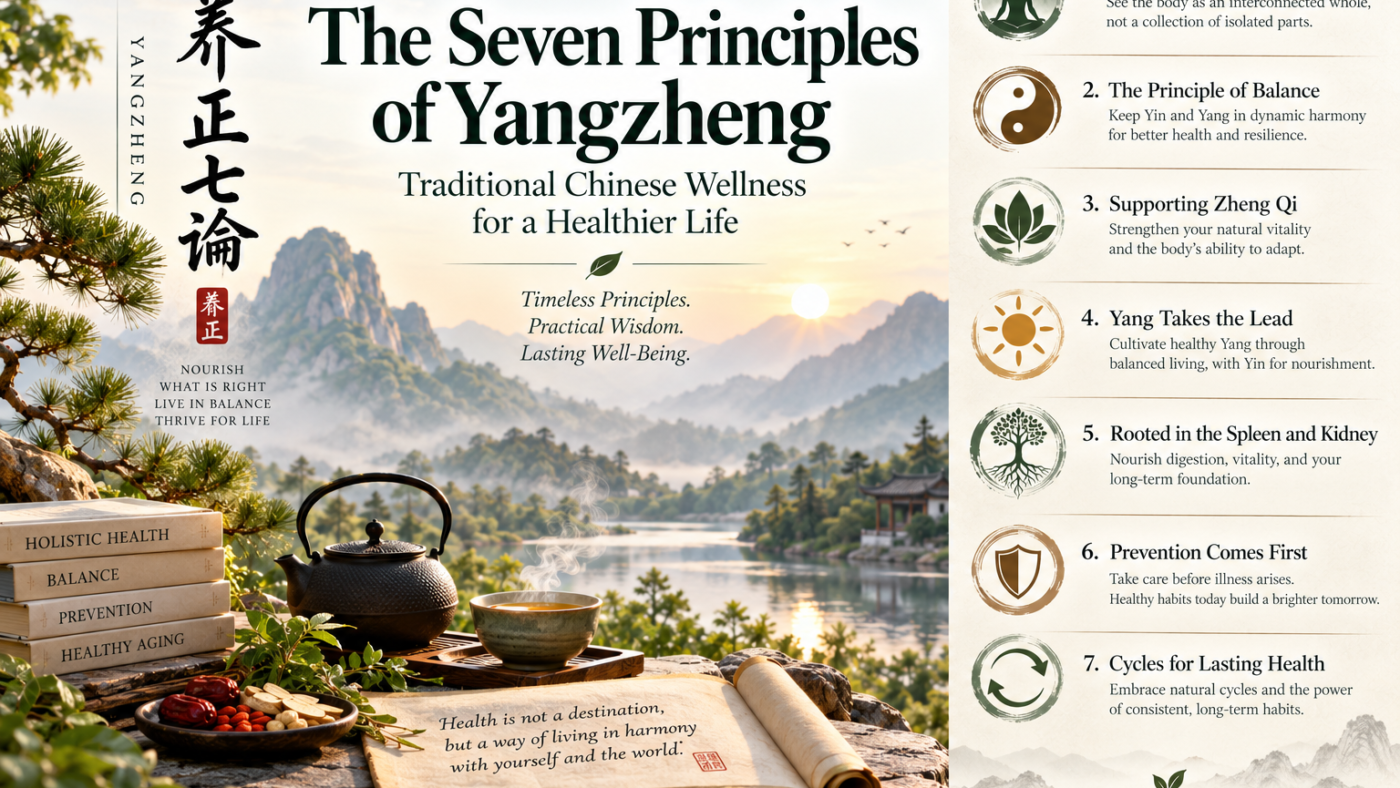
The Seven Principles of Yangzheng offer a traditional Chinese framework for understanding health through wholeness, balance, resilience, prevention, and long-term daily habits. Rooted in ideas associated with the Huangdi Neijing and later Chinese wellness traditions, these principles can be explored today alongside modern knowledge of sleep, nutrition, physical activity, preventive care, and healthy aging.Traditional Chinese health culture has long emphasized a simple but powerful idea: health is not created by treating isolated symptoms alone.
Instead, well-being depends on the relationship among the whole person, daily habits, emotional state, environment, nutrition, movement, rest, and the body’s ability to adapt.
Within this tradition, the concept of yangzheng—literally “nourishing what is upright” or “supporting healthy vitality”—represents an approach centered on maintaining resilience before serious problems develop.
Some modern schools of Chinese wellness have summarized this philosophy into seven broad principles.
These ideas draw on themes found in the Huangdi Neijing and later Chinese medical traditions, but they should not be treated as literal explanations of modern anatomy or physiology.
Their greatest value lies in the way they encourage people to think about health as a dynamic process rather than a collection of disconnected symptoms.
The Seven Principles of Yangzheng are most useful when understood as a traditional framework for healthy living rather than a substitute for modern diagnosis or treatment.
1. The Principle of Wholeness
Holism is one of the most recognizable features of Traditional Chinese Medicine.
Classical Chinese medicine describes the body as an interconnected system in which the organs, meridians, Qi, Blood, body fluids, emotions, and external environment influence one another.
The Five-Phase model—Wood, Fire, Earth, Metal, and Water—was traditionally used to describe patterns of relationship among the Liver, Heart, Spleen, Lung, and Kidney systems.
Within this framework:
The Liver was associated with Wood.
The Heart with Fire.
The Spleen with Earth.
The Lung with Metal.
The Kidney with Water.
These relationships were described through cycles of generation and control.
This system should not be interpreted as a modern anatomical map.
The TCM “Liver,” for example, is broader than the anatomical liver. It includes traditional relationships with movement of Qi, Blood storage, tendons, emotion, and other functions.
The same is true of the other traditional organ systems.
Still, the underlying holistic idea remains relevant.
Modern health science also recognizes that organ systems are deeply interconnected.
Cardiovascular health affects the brain.
Sleep influences metabolism.
Stress can affect digestion.
Kidney function influences blood pressure.
Physical activity influences muscle, bone, insulin sensitivity, mood, and cardiovascular function.
The body is not a collection of isolated parts.
That does not mean every local disease is caused by one global imbalance, but it does mean that health problems are often best understood within a wider physiological and lifestyle context.
2. The Principle of Balance
Balance is central to classical Chinese philosophy.
The Huangdi Neijing describes health through the dynamic relationship of Yin and Yang.
Yin and Yang are not simply opposites.
They represent complementary tendencies such as rest and activity, cooling and warming, structure and function, inward and outward movement, recovery and exertion.
In classical theory, health emerges when these forces remain coordinated rather than fixed at equal levels.
Modern physiology uses different language but recognizes a similar general principle.
Blood glucose is regulated within ranges.
Body temperature is controlled.
Blood pressure changes according to need.
Fluid and electrolyte balance are constantly adjusted.
Hormones rise and fall.
The nervous system shifts between activation and recovery.
This ability to maintain internal stability is often described as homeostasis.
Traditional Yin-Yang theory and modern homeostasis are not the same concept, but both emphasize something important:
Health depends on regulation.
The practical lesson is not to chase a perfect state of balance every moment.
It is to support the body’s capacity to adapt.
Regular sleep, appropriate nutrition, physical activity, recovery, stress management, and medical care when needed all contribute to this capacity.
3. Supporting Zheng Qi and Resilience
Traditional Chinese medicine often refers to Zheng Qi, sometimes translated as upright Qi, correct Qi, or healthy Qi.
Historically, Zheng Qi represented the body’s ability to maintain integrity and resist harmful influences.
A famous classical idea states that when Zheng Qi is strong, harmful influences have greater difficulty disturbing the body.
It is tempting to translate Zheng Qi directly as “immunity,” but that would be too simplistic.
The modern immune system includes white blood cells, antibodies, lymphatic tissues, signaling molecules, barriers, microbiota, and many highly specific biological processes.
Zheng Qi is a broader traditional concept encompassing vitality, adaptability, recovery, and resistance.
A useful modern interpretation is therefore resilience.
Resilience is supported by many ordinary behaviors:
Adequate sleep.
Balanced nutrition.
Regular physical activity.
Vaccination when appropriate.
Good metabolic health.
Avoiding tobacco.
Limiting harmful substance use.
Managing chronic conditions.
Maintaining social and emotional support.
These behaviors do not make a person “immune to all disease.”
But they can support the body’s capacity to function and recover.
4. Yin and Yang as a Dynamic Relationship
Some traditional schools placed special emphasis on Yang, describing it as the active, warming, functional aspect of life.
Classical texts sometimes compare Yang to the sun because sunlight was associated with movement, warmth, growth, and activity.
This symbolism remains culturally important.
However, it would be misleading to interpret Yang as a measurable biological energy that can be increased without limit.
Traditional Chinese medicine itself emphasizes that Yin and Yang depend on one another.
Activity requires recovery.
Warmth requires regulation.
Function depends on structure.
Wakefulness depends on sleep.
Exercise depends on rest.
The more useful modern interpretation is dynamic balance rather than “the more Yang, the better.”
For example, chronic sleep deprivation may increase stimulation and activity, but it does not create better health.
Excessive exercise without recovery may weaken performance.
Persistent psychological arousal may impair sleep and cardiovascular health.
True balance involves knowing when to act and when to recover.
5. Constitutional Vitality, Digestion, and the Traditional Spleen-Kidney Model
Traditional Chinese medicine often describes the Kidney as the “root of the pre-heaven” and the Spleen and Stomach as the “root of the post-heaven.”
These phrases are highly symbolic.
The Kidney system was traditionally associated with inherited constitution, growth, development, reproduction, aging, bones, hearing, and long-term vitality.
The Spleen and Stomach systems were associated with digestion, transformation of food, nourishment, and the production of Qi and Blood.
These concepts should not be interpreted literally as statements that the anatomical kidneys control all aging or that the anatomical spleen manages digestion.
Modern physiology assigns these functions across many systems, including the gastrointestinal tract, endocrine system, kidneys, liver, nervous system, immune system, muscles, and reproductive organs.
Still, the traditional model points toward two practical themes:
What we inherit matters.
And what we do with daily nourishment matters.
Genetics influence health.
So do diet, movement, sleep, stress, smoking, alcohol, education, environment, healthcare, and countless other factors.
In this sense, healthy aging depends on both constitution and lifestyle.
6. Prevention Comes First
One of the most enduring ideas in Chinese medicine is zhi wei bing—“treating before disease.”
The Huangdi Neijing famously values prevention over waiting for illness to become established.
This principle remains highly compatible with modern preventive medicine.
Today, prevention may include:
Vaccination.
Blood-pressure screening.
Cancer screening.
Cholesterol management.
Diabetes prevention.
Tobacco cessation.
Regular physical activity.
Healthy body composition.
Balanced nutrition.
Adequate sleep.
Dental care.
Mental-health support.
Fall prevention.
Bone-health strategies.
The strongest form of prevention is not a mysterious formula.
It is systematic risk reduction over time.
Traditional health culture was correct to emphasize that waiting until a problem becomes severe is often less effective than addressing risks earlier.
“Subhealth” and Early Warning Signs
The term “subhealth” is common in Chinese wellness discussions and usually describes people who do not have a clearly diagnosed disease but feel persistently fatigued, irritable, poorly rested, physically uncomfortable, or generally unwell.
These symptoms are real, but they can have many different causes.
Poor sleep.
Stress.
Depression or anxiety.
Anemia.
Thyroid problems.
Sleep apnea.
Medication effects.
Nutrient deficiencies.
Sedentary behavior.
Infections.
Chronic diseases.
And many other conditions may produce similar symptoms.
There is no reliable rule that “two years of subhealth becomes organic disease,” nor is there a fixed seven- or eight-year progression from functional symptoms to structural disease.
Persistent symptoms should therefore not simply be labeled an imbalance.
They deserve appropriate evaluation.
7. Cycles, Renewal, and Long-Term Health
Traditional wellness literature sometimes places special importance on cycles of approximately 100 days.
In Chinese culture, the first hundred days of an infant’s life have long carried symbolic importance, and later health traditions sometimes extended this number into ideas about rebuilding the body.
Modern biology does confirm that many tissues continually renew themselves.
But there is no single 100-day cycle in which all human cells are replaced.
Different cells have very different lifespans.
Some intestinal cells turn over rapidly.
Red blood cells typically circulate for months.
Skin cells renew on another timescale.
Some liver cells can persist for years.
Many neurons may remain for a lifetime.
So the idea that the entire body becomes “new” every hundred days is not biologically accurate.
But the broader lesson is still useful:
The body changes gradually.
Health habits work through accumulation.
Muscle becomes stronger through repeated training.
Blood pressure may improve through sustained lifestyle change and treatment.
Metabolic health changes over time.
Sleep patterns can be rebuilt.
Dietary habits can be transformed.
Recovery is usually a process, not an event.
Why Long-Term Habits Matter
One of the most useful ideas behind the traditional “hundred-day” concept is that meaningful change usually requires consistency.
A single healthy meal does not transform health.
One night of good sleep cannot reverse months of sleep deprivation.
One exercise session does not build durable strength.
Likewise, one stressful day does not destroy health.
The body responds to repeated patterns.
This is why sustainable habits are usually more valuable than dramatic short-term interventions.
The Five Organ Systems as a Traditional Map
Traditional Chinese Medicine organizes many symptoms and patterns around five major organ networks:
Liver.
Heart.
Spleen.
Lung.
Kidney.
These should be understood as traditional functional categories rather than direct descriptions of modern anatomy.
For example, a classical pattern involving the Heart and Kidney may include symptoms such as insomnia, palpitations, dizziness, tinnitus, or fatigue.
Modern medicine would not assume that these symptoms prove a single Heart-Kidney disorder.
Each symptom could have multiple causes requiring appropriate assessment.
The traditional framework can therefore be useful as cultural and historical context, but it should not replace modern diagnosis.
Holistic Care Does Not Mean Ignoring Local Disease
A holistic approach should never be interpreted as meaning that local disease does not need specific treatment.
A bacterial infection may need antibiotics.
A blocked coronary artery may require urgent intervention.
A fracture needs appropriate orthopedic management.
Cancer requires evidence-based oncology care.
A serious asthma attack may need immediate medication.
Whole-person care and disease-specific treatment are not opposites.
They work best together.
A person is more than a diagnosis.
But a diagnosis still matters.
Prevention Without Overpromising
Traditional wellness systems sometimes promise that restoring balance will allow the body to eliminate nearly every disease.
That claim goes too far.
The body does possess remarkable repair mechanisms.
Wounds heal.
Immune responses fight infections.
Tissues adapt.
Muscles strengthen.
But self-repair has limits.
Some conditions require medication.
Some require surgery.
Some need long-term monitoring.
Some cannot currently be cured.
A responsible wellness philosophy should support the body without exaggerating what self-healing can accomplish.
Healthy Aging Through the Seven Principles
When the seven traditional principles are translated into modern language, they become remarkably practical.
Think about the whole person.
Support physiological balance.
Build resilience.
Balance activity with recovery.
Protect digestion and long-term vitality.
Prevent problems before they become severe.
Think in months and years rather than searching for overnight transformation.
These ideas can form a strong foundation for healthy aging.
A Modern Interpretation of Yangzheng
The deepest meaning of yangzheng is not that one must constantly “increase Yang,” strengthen one organ, or correct every sensation through herbs.
Its greater value lies in supporting the conditions in which health is easier to maintain.
Eat well.
Sleep regularly.
Move every day.
Maintain muscle.
Avoid tobacco.
Keep alcohol low or avoid it.
Protect cardiovascular health.
Manage stress.
Stay socially connected.
Receive preventive care.
Seek medical attention when symptoms are persistent or serious.
And give healthy changes enough time to work.
Traditional Wisdom Without Medical Absolutes
The Huangdi Neijing remains one of the most influential texts in the history of Chinese medicine.
Its language of Yin and Yang, Five Phases, Qi, organ networks, prevention, and harmony shaped Chinese health thinking for centuries.
That cultural legacy deserves careful study.
But traditional philosophy becomes more useful—not less—when we distinguish symbolic frameworks from modern biological mechanisms.
The value of a tradition does not depend on claiming that every classical statement has been proven by contemporary science.
It can instead offer another way of thinking about balance, moderation, prevention, rhythm, and the relationship between daily life and long-term health.
The Deeper Lesson of the Seven Principles
The Seven Principles of Yangzheng can ultimately be reduced to one idea:
Health is built over time.
It is influenced by the whole person.
It depends on regulation rather than extremes.
It benefits from prevention.
And it responds to repeated habits.
Traditional Chinese thinkers expressed these ideas through the language of Qi, Yin and Yang, the Five Phases, Zheng Qi, the Spleen, the Kidney, and natural cycles.
Modern health science uses different language.
But both remind us that longevity is not created by a single remedy.
It is shaped by the accumulated pattern of how we eat, sleep, move, recover, connect with others, respond to stress, and care for the body over a lifetime.
That is the most enduring meaning of nourishing what is healthy within us.
A modern understanding of the Seven Principles of Yangzheng preserves their emphasis on balance, prevention, resilience, and long-term habits while respecting the boundaries between traditional philosophy and modern medical science.
FAQ
What are the Seven Principles of Yangzheng?
The Seven Principles of Yangzheng are a modern summary of traditional Chinese wellness ideas centered on wholeness, balance, Zheng Qi, Yin and Yang, constitutional vitality, prevention, and long-term cycles of health.
What does Yangzheng mean?
Yangzheng can be understood as “nourishing what is upright” or supporting healthy vitality. In a wellness context, it emphasizes strengthening healthy habits and maintaining resilience rather than focusing only on symptoms.
Is Yangzheng the same as Yangsheng?
They are closely related but not identical. Yangsheng broadly means nourishing life, while Yangzheng emphasizes supporting what traditional Chinese medicine describes as healthy or upright vitality.
What is Zheng Qi?
Zheng Qi is a traditional Chinese medical concept referring broadly to the body’s ability to maintain stability and resist harmful influences. It should not be treated as identical to the modern immune system.
Are Yin and Yang the same as homeostasis?
No. Yin and Yang belong to traditional Chinese philosophy, while homeostasis is a modern physiological concept. Both describe regulation and balance in different ways, but they are not scientifically equivalent.
What does Traditional Chinese Medicine mean by the Five Phases?
The Five Phases—Wood, Fire, Earth, Metal, and Water—are a traditional framework used to describe patterns and relationships among organ systems, seasons, functions, and natural processes.
What does “prevention comes first” mean in Chinese medicine?
Traditional Chinese medicine has long emphasized zhi wei bing, often translated as treating before disease. In modern terms, this can be understood through preventive care, healthy lifestyle habits, screening, vaccination, and risk reduction.
Is the traditional Kidney system the same as the anatomical kidneys?
No. The TCM Kidney is a broader functional concept traditionally associated with reproduction, growth, development, aging, bones, hearing, and constitutional vitality. It is not identical to the anatomical kidneys.
Do all human cells renew every 100 days?
No. Different cells have very different lifespans. Some renew rapidly, others over months or years, and some may persist for most of a person’s life. The traditional hundred-day concept is better understood symbolically as an emphasis on sustained change over time.
Medical Disclaimer: This article is for educational and informational purposes only. Traditional Chinese concepts including Qi, Yin and Yang, Zheng Qi, Five-Phase relationships, Kidney and Spleen systems, and Yangzheng reflect historical medical and philosophical frameworks and should not be interpreted as direct equivalents of modern anatomy or physiology. Traditional wellness practices should not be used as substitutes for appropriate diagnosis or treatment of medical conditions.
This article is for general education and does not replace individualized care from a qualified health professional. Seek appropriate advice for persistent, severe, or concerning symptoms.
Read the full medical disclaimer