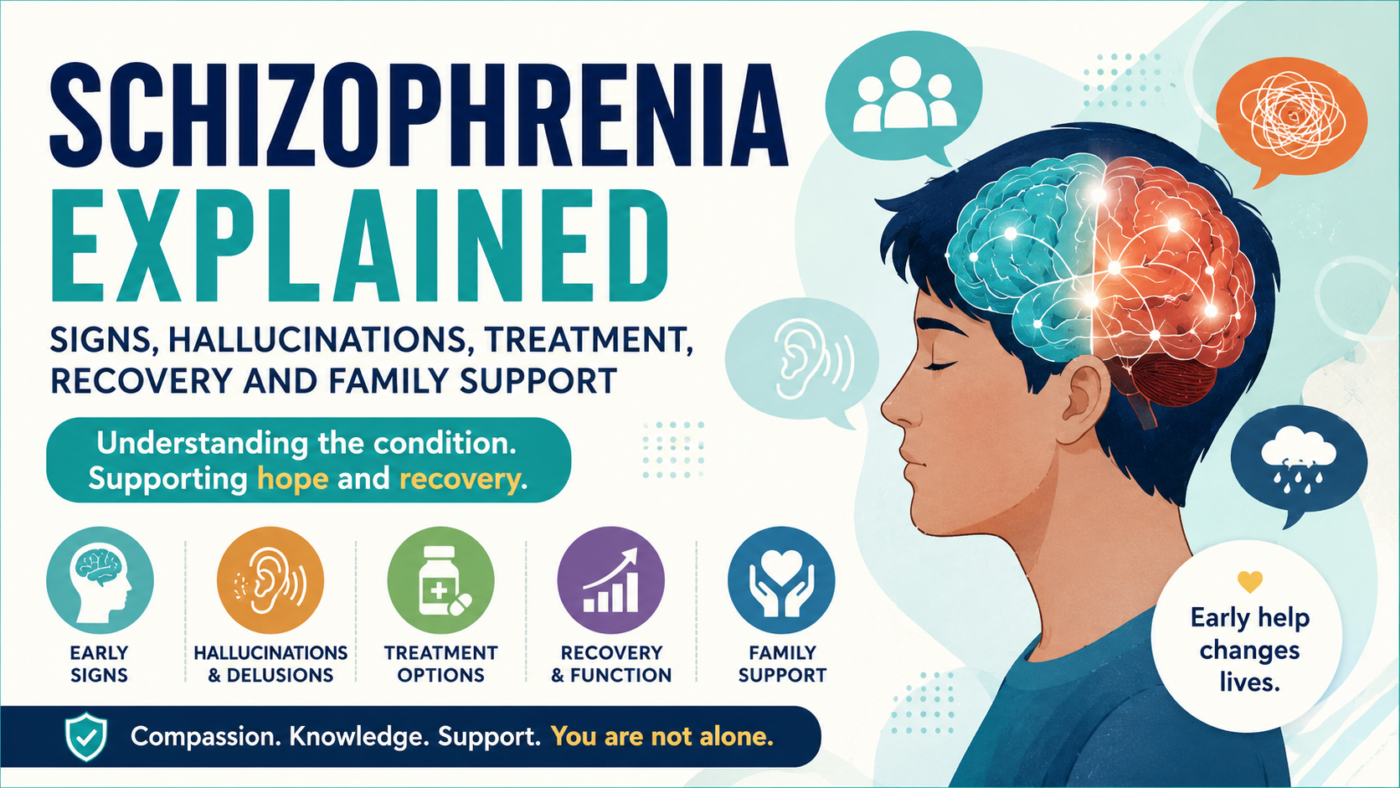
Schizophrenia is one of the most misunderstood psychiatric disorders. Popular dramas and news stories have made many people familiar with the term, but familiarity does not always mean understanding.
The condition does not mean that a person’s mind has literally “split.” Rather, it involves disturbances in how the brain processes perception, thought, judgment and reality. A person may hear voices that others do not hear, develop fixed beliefs that feel unquestionably true, struggle to organize thoughts, or gradually lose motivation, concentration and social engagement.
The discussion below focuses on several practical questions: What does schizophrenia actually look like? Why does it often begin in adolescence or early adulthood? Can people recognize their own symptoms? How do hallucinations feel to the person experiencing them? Why is early treatment so important? And how can families support recovery without increasing conflict?
Schizophrenia Is Not a “Split Personality”
One reason public misunderstanding persists is the older terminology historically used in Chinese-speaking societies.
That language could easily suggest that the personality itself had “split,” which is not an accurate description of the condition.
Schizophrenia is better understood as a disorder involving disturbances in areas such as:
- perception
- thought organization
- judgment
- reality testing
- motivation
- attention
- memory
- social functioning
The supplied discussion emphasizes that the problem is not that the person has two separate personalities. Instead, the brain’s processing of external information and internal experience becomes distorted.
This can lead to errors in perception and reasoning that feel completely real to the person experiencing them.
Major Stress Does Not Automatically Cause Schizophrenia
People often assume schizophrenia begins because of a severe emotional shock, family conflict or major stress.
The discussion makes an important distinction:
Stress may be relevant, but it is not an absolute or sufficient explanation.
A person may develop symptoms in the context of conflict or stress, but schizophrenia cannot simply be reduced to “something terrible happened.”
In fact, in some situations it may even be difficult to determine whether an apparent external event really occurred or whether part of the experience was already being influenced by hallucinations or altered perception.
That is one reason careful clinical assessment matters.
Hallucinations Can Feel Completely Real
Hallucinations are often portrayed dramatically, but the central issue is not how strange they look from the outside.
The important point is that they can feel fully real to the person experiencing them.
If someone hears a voice that no one else hears, telling them:
- someone is watching them
- someone is criticizing them
- someone is threatening them
- people are talking about them
the experience may feel no less real than an ordinary conversation feels to anyone else.
That is why simply saying:
“That is not real.”
may not help.
From the patient’s perspective, the perception itself feels authentic.
Are Hallucinations Always Negative?
Not always.
The discussion includes examples of people who experienced voices that were friendly, humorous or comforting.
A voice might:
- tell jokes
- provide companionship
- talk throughout the day
- feel like a close friend
For someone who is lonely or socially isolated, such an experience may even become emotionally meaningful.
Some people may therefore feel reluctant to lose the hallucination.
However, the discussion also notes that many hallucinations are negative, threatening, critical or frightening.
The exact reason negative hallucinations are so common is not fully explained in the source material, and cultural differences may influence how hallucinations are interpreted.
Auditory Hallucinations Are More Common Than Visual Hallucinations
Among people with schizophrenia, the discussion emphasizes auditory hallucinations as especially common.
A young person may say they hear:
- classmates laughing at them
- familiar voices when no one is present
- strangers speaking
- several people talking about them
- someone commenting on their actions
Sometimes the person believes they recognize the voice.
Sometimes they cannot identify it.
Sometimes several voices appear to be having a conversation.
Visual hallucinations can also occur, but the discussion describes them as less common than auditory hallucinations in schizophrenia.
It also notes that visual hallucinations can arise in other circumstances, including substance-related states.
Delusions Can Become Incorporated Into Current Events
Symptoms often reflect what is happening in the person’s environment or in the broader culture.
The discussion gives examples of patients incorporating well-known public figures or news events into their beliefs.
For example, someone might become convinced that a famous political leader is communicating with them personally.
The specific content can change from era to era, but the underlying problem is similar: ordinary external information becomes incorporated into an altered interpretation of reality.
Why Early Schizophrenia Can Be Hard to Recognize
One of the most difficult features of schizophrenia is that insight may decline as the illness progresses.
Early in the course, a young person may still think:
“Why am I having such a strange experience?”
At that stage, they may recognize that something feels unusual and may be willing to seek help.
But as symptoms strengthen, the distinction between internal experience and external reality can become harder to maintain.
Eventually, the person may completely believe the hallucination or delusion.
At that stage, offers of help may be interpreted as suspicious.
A family member who says:
“I think you should see a doctor.”
may be perceived as someone trying to control, expose or harm them.
This is why family and friends often become essential in helping a person reach professional care.
Earlier Treatment Matters
The discussion strongly emphasizes one point supported by psychiatric literature:
Reducing the amount of time that severe psychotic symptoms remain untreated is important.
The longer psychosis continues without treatment, the more difficult recovery can become.
Earlier recognition may help protect:
- school performance
- work functioning
- relationships
- daily routines
- judgment
- social connection
- confidence
The practical message is simple:
If a young person begins showing clearly abnormal changes in perception, behavior or reality testing, it is better to seek evaluation earlier rather than waiting for the symptoms to become overwhelming.
Schizophrenia Often Begins in Adolescence or Early Adulthood
The source describes schizophrenia as commonly emerging in younger people.
It cites a typical onset range of roughly:
15–25 years in males
and a somewhat later age pattern in females, around:
25–35 years
The exact age varies between individuals, but the broader point is that the disorder often begins during periods of major brain development.
The discussion links this to the extensive neurological remodeling that occurs during adolescence, including processes often described as synaptic pruning and neural refinement.
Genetics may contribute, but heredity does not fully determine who develops the disorder.
A parent with schizophrenia does not automatically mean that a child will also develop it.
Normal Teenage Behavior and Early Psychosis Are Not the Same
Parents face a difficult problem because adolescence itself can involve:
- moodiness
- privacy
- irritability
- unusual fashion
- withdrawal
- resistance to parents
- changing friendships
Not every unusual teenage behavior is a psychiatric disorder.
The concern becomes greater when there are clear disturbances in reality testing.
For example:
“I can hear my classmates laughing at me inside the house even though they are not here.”
That is fundamentally different from ordinary adolescent rebellion.
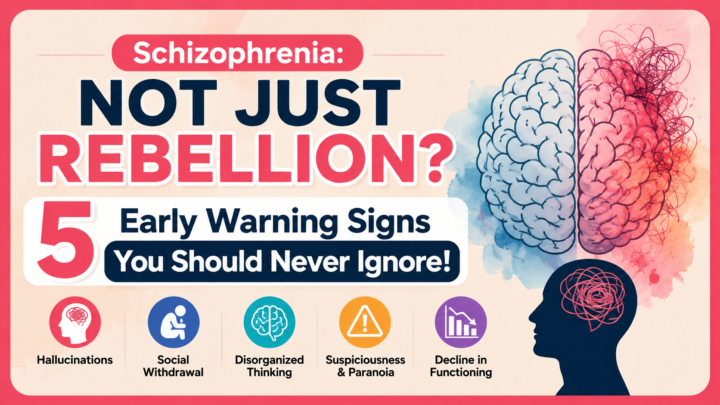
Early Warning Signs May Be Behavioral
Some young people do not tell their parents that they are hearing voices or experiencing suspicious beliefs.
Instead, families may first notice a decline in everyday functioning.
The discussion highlights changes such as:
- no longer caring about appearance
- stopping regular grooming
- avoiding bathing
- repeatedly forgetting school items
- declining concentration
- withdrawal from people
- reduced interest in normal activities
- behaving very differently from usual
None of these signs alone proves schizophrenia.
But when several changes occur together—especially alongside unusual perceptions, suspiciousness or clear problems distinguishing reality from imagination—they warrant professional assessment.
Emotional Reactions Depend on the Content of Symptoms
People with schizophrenia are not always simply “sad” or “angry.”
Their emotions may reflect what they are experiencing.
A person who hears threatening voices may become:
- frightened
- defensive
- depressed
- agitated
- angry
Someone who feels constantly watched may appear suspicious.
Someone who is overwhelmed by internal experiences may seem distracted or emotionally distant.
Understanding the symptom behind the behavior can change how family members respond.
Dopamine Is Part of the Biological Explanation—but the Reality Is Complex
The source discussion uses dopamine as a way to explain why different symptoms may appear.
It describes excessive dopamine activity in certain brain systems as being associated with symptoms such as:
- hallucinations
- delusions
- suspiciousness
It also describes lower dopamine-related activity in frontal brain systems as being associated with difficulties in:
- decision-making
- attention
- working memory
- motivation
- social interaction
This simplified explanation can be useful for education, but schizophrenia is biologically complex and should not be understood as a single “dopamine problem.”
Multiple brain systems and developmental factors are involved.
Why Antipsychotic Medication Helps
The discussion describes antipsychotic medication as working primarily through regulation of dopamine signaling.
The treatment goal is not simply to sedate the patient.
Ideally, treatment reduces:
- hallucinations
- delusions
- severe suspiciousness
- disorganized thinking
while allowing the person to maintain normal function.
That means the real goal is not:
“Make the patient quiet.”
It is:
“Help the person return to school, work, relationships and ordinary life.”
Functional Recovery Is More Important Than Perfect Symptom Elimination
This is one of the strongest points in the discussion.
Some people may continue to experience occasional mild voices even after substantial improvement.
The source suggests that roughly a minority of patients may retain some residual hallucinations despite treatment.
Increasing medication aggressively in an attempt to eliminate every remaining symptom may sometimes increase side effects.
Therefore, treatment may prioritize:
- restoring daily functioning
- reducing symptoms enough that they no longer control the person’s life
- minimizing unnecessary treatment burden
A person who occasionally hears a mild voice but can study, work, maintain relationships and care for themselves may be functioning far better than someone who is heavily medicated but unable to participate in life.
Medication decisions must always be individualized by a psychiatrist.
Long-Acting Injectable Medication Can Improve Stability
The supplied discussion pays significant attention to long-acting injectable antipsychotic medications.
These treatments may be given at extended intervals rather than requiring daily oral medication.
Depending on the specific medication and treatment plan, injections may be administered every few weeks or at longer intervals.
The discussion suggests several possible advantages:
- more stable medication delivery
- fewer missed doses
- lower risk of relapse related to medication interruption
- reduced daily conflict between patients and family members
- less pressure on caregivers to monitor every dose
Some people still require additional oral medication.
Long-acting injections are not automatically the right treatment for everyone, but they can be valuable for selected patients.
Do Not Stop Medication Simply Because Someone Feels Better
One of the recurring problems described in the discussion is medication discontinuation after symptoms improve.
A person may think:
“I feel normal again, so I probably do not need treatment.”
Family members may also mistakenly encourage medication reduction or discontinuation.
But improvement does not necessarily mean that the underlying vulnerability has disappeared.
Stopping treatment without medical supervision can increase the risk of relapse.
Medication changes should therefore be made collaboratively with the treating psychiatrist.
Relapse Is Often Most Chaotic Early in the Illness
During the first episode or early relapses, families may not yet understand what is happening.
They may struggle with:
- medication adherence
- recognizing early warning signs
- knowing when hospitalization is needed
- communicating with the patient
- managing fear and conflict
Over time, many families become more experienced.
They begin to recognize patterns.
They learn what helps.
They understand that the person can still function well with consistent treatment.
As that understanding improves, long-term outpatient stability may become more achievable.
Caregivers Carry a Heavy Emotional Burden
Schizophrenia affects families as well as patients.
A parent may feel:
- grief
- fear
- guilt
- anger
- confusion
- helplessness
- exhaustion
They may wonder:
“Will my child ever be the same again?”
They may struggle with whether to:
- challenge delusions
- agree with the patient
- insist on treatment
- avoid conflict
- encourage activity
- protect the person from stress
There is no single sentence that solves these dilemmas.
Caregiver education is therefore an important part of treatment.
Excessive Protection Can Limit Recovery
Families sometimes become so frightened after an acute episode that they stop expecting anything from the patient.
The person stays home.
They are not encouraged to study.
They do not return to work.
Social interaction gradually disappears.
The discussion warns that this can be counterproductive.
Having schizophrenia does not mean a person has permanently lost the ability to learn.
After the acute phase improves, appropriate encouragement toward:
- social interaction
- daily routines
- education
- vocational rehabilitation
- exercise
- meaningful activity
can support recovery.
Positive and Negative Symptoms Require Different Strategies
The discussion distinguishes between two broad categories.
Positive symptoms
These include experiences that are added to ordinary functioning, such as:
- hallucinations
- delusions
- disorganized thought
Medication is often particularly helpful for these symptoms.
Negative symptoms
These may include:
- reduced motivation
- social withdrawal
- decreased emotional expression
- reduced initiative
- less interest in activities
These symptoms are often more difficult to treat with medication alone.
That is why psychosocial rehabilitation, activity, social interaction and vocational support remain important.
Recovery Should Include Returning to Real Life
The ideal outcome is not simply:
“No hallucinations.”
It is:
“A person can live.”
That may mean returning to:
- school
- employment
- family life
- hobbies
- friendships
- independent routines
Recovery is therefore broader than symptom control.
It includes rebuilding function, confidence and participation in society.
Can People With Schizophrenia Use Social Media and AI?
The supplied discussion raises a very modern question.
Digital tools can be helpful, but they can also create risks.
If a person repeatedly uses an AI system or online communities to reinforce a delusional belief—such as repeatedly asking whether someone is secretly monitoring them—the interaction could potentially strengthen an inaccurate interpretation.
That is an important concern.
On the other hand, AI may also help a recovering person with practical tasks such as:
- planning work
- organizing communication
- preparing for social interactions
- structuring daily routines
- generating neutral problem-solving strategies
Therefore, the source does not argue that AI is entirely good or entirely bad.
The better principle is:
Use it with judgment and support.
Family members and clinicians can help identify which types of questions are useful and which may reinforce symptoms.
AI Should Never Replace Psychiatric Care
AI should not be used to confirm whether hallucinations or delusions are “real.”
It should also not replace professional diagnosis or medication management.
For someone experiencing psychosis, the safest use of AI is generally practical and supportive rather than diagnostic.
Examples may include:
- preparing questions for a doctor
- organizing a daily schedule
- practicing a workplace conversation
- writing reminders
- learning general information
Questions involving medication changes, diagnosis, paranoia, self-harm, suicide or severe behavioral changes should be addressed with qualified mental-health professionals.
How Families Can Help
The discussion suggests several practical principles.
Learn about the illness
Understanding schizophrenia reduces fear and blame.
Do not assume unusual behavior is intentional
Some behaviors arise from symptoms, not defiance.
Encourage treatment consistency
Medication adherence and regular follow-up can reduce relapse risk.
Support activity after the acute phase
Encourage education, work, rehabilitation and social connection when appropriate.
Avoid daily medication battles when better systems are available
For some patients, long-acting medication may reduce family conflict.
Use encouragement rather than humiliation
A person recovering from psychosis still needs dignity.
Watch for relapse signals
Changes in sleep, suspiciousness, withdrawal, functioning or medication use may deserve attention.
Seek professional help early
Do not wait until a crisis becomes unmanageable.
Schizophrenia Does Not Mean Life Is Over
Perhaps the most important message in the source discussion is one of realistic hope.
Schizophrenia can be a serious long-term psychiatric illness.
But serious does not mean hopeless.
With:
- early recognition
- appropriate medication
- consistent follow-up
- family support
- rehabilitation
- vocational assistance
- social engagement
many people can regain substantial function.
Some study.
Some work.
Some maintain relationships.
Some live independently.
The goal of treatment is not simply to suppress symptoms.
It is to help a person build a meaningful life.
Frequently Asked Questions
Is schizophrenia the same as split personality?
No. Schizophrenia is not dissociative identity disorder. It involves disturbances in perception, thinking, reality testing and functioning.
At what age does schizophrenia usually begin?
The supplied discussion describes onset as commonly occurring in adolescence or early adulthood, often earlier in males and somewhat later in females.
Are auditory hallucinations common?
Yes. Hearing voices is one of the better-known symptoms of schizophrenia and is described in the discussion as more common than visual hallucinations.
Can hallucinations be pleasant?
Yes. Some people report friendly or comforting voices, although distressing and negative hallucinations are also common.
Can people realize they are becoming psychotic?
Sometimes, especially early in the illness. As symptoms progress, insight may decline and the person may become convinced that their altered perceptions are completely real.
Why is early treatment important?
Earlier intervention may shorten the period of untreated psychosis and help protect educational, occupational and social functioning.
Can schizophrenia be treated successfully?
Symptoms and functional outcomes vary, but many people improve substantially with appropriate treatment and rehabilitation.
Do long-acting injections eliminate the need for oral medication?
Not always. Some patients do well primarily with long-acting medication, while others still need additional oral treatment.
Can someone with schizophrenia work or return to school?
Yes. After stabilization, many people can return to education, employment or vocational rehabilitation, depending on individual circumstances.
Can AI help someone with schizophrenia?
AI may be useful for practical organization and communication, but it should not be used to validate delusions or replace psychiatric treatment.
Medical Disclaimer
This article is for general educational purposes only and is not a substitute for diagnosis or treatment by a psychiatrist or other qualified mental-health professional. Hallucinations, delusions, severe confusion, suicidal thoughts, violent behavior or major loss of contact with reality require prompt professional assessment. Medication should never be started, stopped or changed without guidance from the treating clinician.
This article is for general education and does not replace individualized care from a qualified health professional. Seek appropriate advice for persistent, severe, or concerning symptoms.
Read the full medical disclaimer