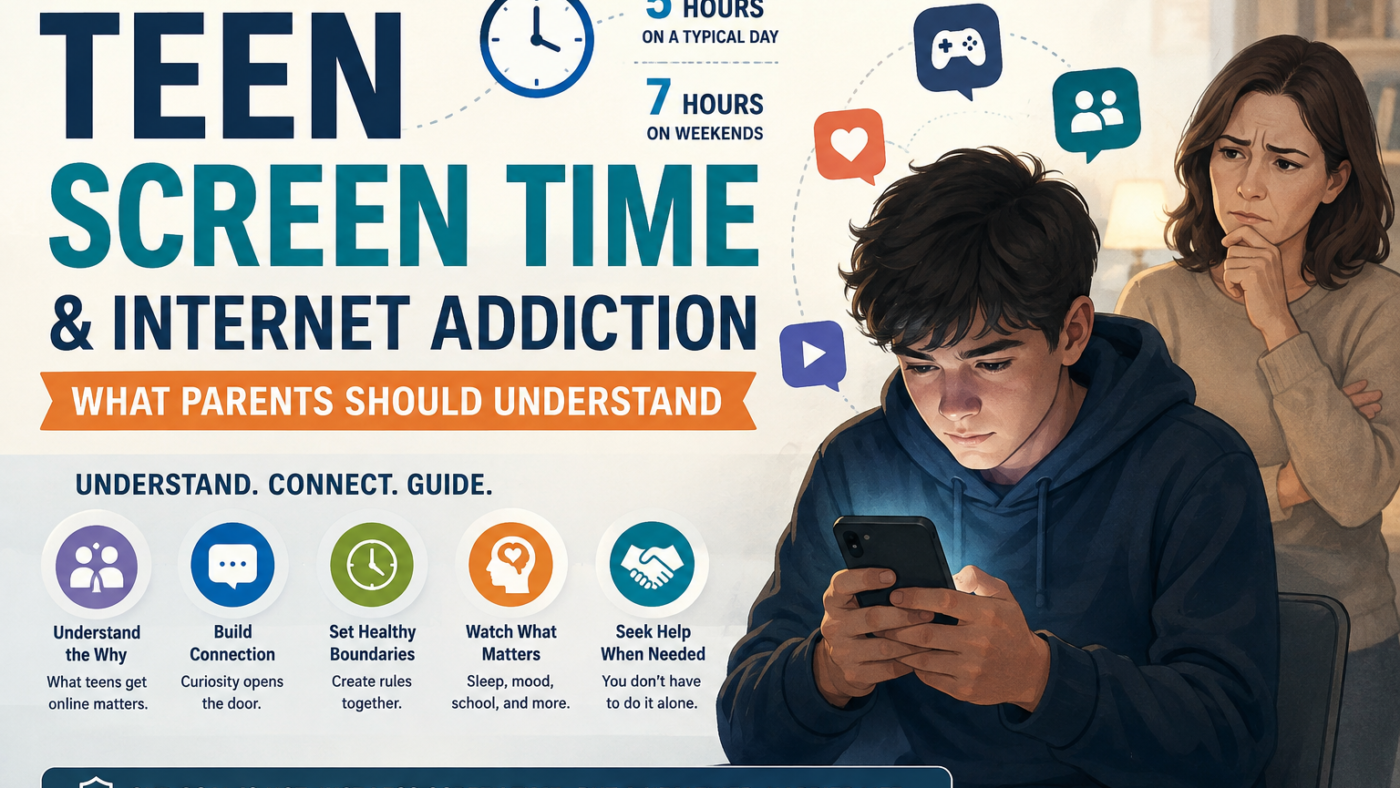
For many families, the smartphone has become one of the most difficult subjects in the home.
A teenager says the phone is necessary for homework, research, class discussions and staying connected with friends. A parent looks over and sees gaming, social media, short videos and late-night scrolling. Attempts to set limits turn into arguments. Bedtime moves later. Conversations become shorter. Eventually, every discussion about the internet feels like a battle.
It is tempting to reduce the problem to one question: How many hours of screen time is too much?
But that may be the wrong place to begin.
The more important questions are what a teenager is doing online, what the digital world is providing emotionally, whether online activity is displacing sleep and ordinary life, and whether the parent-child relationship has deteriorated to the point that conversations about technology can no longer happen without conflict.
Understanding those questions can help families distinguish ordinary digital use from genuinely problematic patterns and respond without making the situation worse.
Teenagers Are Spending a Large Part of Their Day Online
The discussion that inspired this article cited Taiwanese estimates suggesting that adolescents may spend around five hours online on an ordinary day and as much as seven hours on holidays.
The exact number will vary widely among individuals, and total screen time alone does not tell us whether a young person has a problem.
A teenager may use the same device for:
- school assignments
- searching for information
- messaging classmates
- gaming
- social media
- streaming entertainment
- short-form videos
- creative work
- talking with AI systems
These activities do not have the same psychological effects.
A teenager spending several hours preparing a project is in a very different situation from someone repeatedly staying awake until 1 or 2 a.m. because they cannot stop gaming or scrolling.
That distinction matters.
Screen Time Is Not the Same as Internet Addiction
Parents sometimes see prolonged phone use and immediately conclude that their child is addicted.
Problematic internet use is more complicated.
A stronger warning sign is not merely how long someone is online, but whether they are losing control over their behavior despite meaningful consequences.
For example, concern becomes more justified when a teenager repeatedly:
- intends to stop but continues for hours
- stays online until very late despite needing to wake early
- gives up schoolwork or important responsibilities
- stops participating in hobbies they previously enjoyed
- withdraws from offline friendships and family activities
- becomes increasingly irritable or distressed
- experiences worsening sleep and concentration
- recognizes the negative consequences but still feels unable to reduce use
In the discussion, an estimate of roughly 5%–7% was mentioned for people who may reach the level commonly described as gaming disorder or serious problematic gaming behavior.
That number should not be treated as a universal prevalence figure, because estimates differ substantially according to population and diagnostic method. The broader point remains important: heavy gaming is not automatically the same as a clinical disorder.
Ask What the Internet Is Replacing
One of the most useful questions parents can ask is:
When did the internet become the only thing my child seems interested in?
If a teenager once enjoyed basketball, music, drawing, meeting friends, reading or another hobby but gradually abandoned nearly everything except online activity, the problem may extend beyond the device itself.
The internet may have become a source of:
- social belonging
- emotional comfort
- competence
- achievement
- distraction from distress
- escape from conflict
- relief from loneliness
- predictable stimulation
Simply removing the phone does not automatically replace any of those needs.
This is why families sometimes become confused when confiscating a device produces an unexpectedly intense emotional reaction.
The reaction may not only mean, “I want my phone.”
For some teenagers it may feel closer to:
“You just removed the place where most of my friendships, entertainment, comfort and sense of belonging exist.”
That does not mean parents should never establish boundaries. It means the emotional function of the digital world should be understood before deciding how to intervene.
Before Setting Limits, Learn What Your Teenager Actually Does Online
When parents complain that a child has been playing a particular game for years but cannot name the game, the situation reveals an important problem.
The parent knows the behavior but may know very little about the teenager’s world.
Instead of immediately asking:
“Why are you wasting your time on that?”
try becoming genuinely curious.
Ask:
“What game are you playing?”
“What do you like about it?”
“Who do you usually play with?”
“Are they classmates or people you met online?”
“What makes this game fun?”
“What happened in your group today?”
Curiosity and surveillance sound very different to a teenager.
Compare:
“What are you playing? Show me—I don’t really understand it.”
with:
“What are you playing again? Turn it off right now.”
The words may seem similar, but the emotional message is completely different.
The first opens a door.
The second closes one.
Sometimes Joining Their World Helps Rebuild the Relationship
Parents do not need to become serious gamers.
But occasionally entering a teenager’s digital world can create an unexpected point of connection.
Imagine playing the game with your child and being terrible at it.
They may laugh, complain that you are ruining the team, and spend half an hour explaining how everything works.
Something important has happened.
For those 30 minutes, the teenager is no longer simply “using the internet.”
They are talking to you.
A connection has formed.
Once communication exists, conversations about sleep, responsibilities, emotions and limits become easier.
The objective is not to pretend that every digital behavior is healthy.
It is to avoid making the internet the only subject parents and teenagers ever discuss.
Why Suddenly Taking Away the Phone Can Backfire
There are families in which conflict becomes so severe that parents eventually:
- disconnect the Wi-Fi
- confiscate the phone
- remove the computer
- destroy gaming equipment
- impose sudden total bans
Sometimes a strong restriction may be necessary, particularly where immediate safety is involved.
But as a routine strategy, abrupt confiscation can intensify an already damaged relationship.
The key question is:
What happened before the conflict became this extreme?
If the teenager has reached a point where the digital world feels like their only meaningful source of friendship, pleasure or emotional regulation, suddenly taking it away may provoke enormous distress.
Extreme reactions reported in real-world situations have included running away, aggression and self-harm.
Those reactions should never be dismissed as simple disobedience. They may indicate serious underlying emotional or psychiatric difficulties that require professional evaluation.
If a young person threatens self-harm, suicide or violence, or appears unable to remain safe, families should seek urgent professional or emergency assistance rather than treating the situation solely as a screen-time dispute.
Social Media May Affect More Than Time Management
Among digital activities, social media deserves particular attention.
Long periods of social media use may coincide with:
- later sleep
- sleep deprivation
- emotional tension
- anxiety
- social comparison
- cyberbullying
- constant attention switching
Adolescence is also a period during which impulse control, emotional regulation and judgment are still developing.
This can make teenagers particularly susceptible to environments built around constant novelty and immediate feedback.
The problem is not simply that social media exists.
It is that many platforms are designed to keep people engaged.
Infinite scrolling, algorithmic recommendations and continuous notifications can make stopping surprisingly difficult.
Short-Form Video Can Be Especially Hard to Put Down
Short-form video introduces another challenge.
A person watches one clip.
Then another.
Then another.
Every few seconds something new appears.
This pattern provides frequent novelty and repeated opportunities for reward.
The original discussion raised concerns that very heavy use may be associated with poorer attention, more difficulty controlling impulses, disrupted sleep and emotional problems such as anxiety or depressive symptoms.
Those relationships should be interpreted carefully. Observational studies cannot always prove that short-form video directly causes these problems; teenagers who already struggle emotionally may also use digital media more heavily.
Nevertheless, if hours of short-form video are replacing sleep, exercise, schoolwork, relationships or ordinary life, reducing exposure is sensible.
Gaming Is Not Automatically Bad
Gaming deserves a more balanced discussion.
For many teenagers, games provide:
- entertainment
- friendship
- cooperation
- strategic thinking
- challenge
- mastery
- competition
The important issue is whether gaming remains one part of life or begins to dominate nearly everything else.
A common pattern in online multiplayer games is:
“One more game.”
Then another.
Then another.
Suddenly it is morning.
A teenager may know perfectly well that they are sleeping too little, concentrating poorly and becoming irritable, yet still find it extremely difficult to stop.
That loss of control is more meaningful than the simple fact that someone enjoys gaming.
A Digital Detox Camp Is Not a Complete Solution
Some programs remove teenagers from phones and online access for days or weeks while introducing outdoor activities, group tasks and structured routines.
Such experiences may show a young person something valuable:
Life without constant internet access can still be enjoyable.
They may rediscover:
- exercise
- teamwork
- outdoor activity
- face-to-face friendship
- accomplishment
- creative interests
These experiences can be beneficial.
But they are not necessarily a permanent cure.
The real test comes afterward.
A teenager may function beautifully during a structured camp and then return home to exactly the same loneliness, stress, family conflict, academic pressure or lack of alternative activities that existed before.
Long-term change therefore requires something more difficult:
building an offline life worth returning to.
AI Has Become Part of the Teen Digital World
A newer development is the growing number of adolescents and young adults who discuss personal problems with AI.
There are understandable reasons.
An AI assistant may be available at any hour.
It does not become impatient.
It can respond gently.
A teenager who feels embarrassed talking to parents, teachers or friends may find it easier to start typing.
Used appropriately, AI can help someone:
- organize thoughts
- prepare questions
- learn basic information
- explore possible coping strategies
- prepare for a conversation with a doctor, counselor or parent
But there is also an important limitation.
AI does not automatically know whether the assumptions hidden inside someone’s question are correct.
A person might repeatedly ask variations of:
“Is my doctor wrong?”
“Are medications basically placebo?”
“Does this prove I have this diagnosis?”
Repeated questioning can sometimes reinforce an inaccurate interpretation instead of correcting it.
For medical or mental-health concerns, AI should therefore be treated as an informational tool rather than a replacement for qualified clinical evaluation.
For teenagers in particular, conversations involving diagnosis, medication, self-harm, suicide, abuse or severe emotional distress should involve trusted adults and appropriate professionals.
When Parent and Teenager Are Already in Conflict
Once the relationship has deteriorated, establishing screen limits becomes much more difficult.
At that stage, the first objective may not be:
Reduce screen time.
It may be:
Restore communication.
That requires a different style of conversation.
Instead of saying:
“You make me furious because you never stop using your phone.”
try:
“I became very angry earlier and unplugged the router. That was my reaction, and I am responsible for it. I’m sorry that I handled it that way.”
This is an example of speaking from one’s own experience rather than assigning all responsibility to the teenager.
It does not mean abandoning rules.
It means lowering the emotional temperature enough that rules can eventually be discussed.
Do Not Expect an Immediate Response
Parents sometimes try a calmer approach once and become discouraged when their teenager responds with:
“Okay.”
“Whatever.”
“Uh-huh.”
Silence does not necessarily mean the attempt failed.
A teenager accustomed to criticism may initially be suspicious of a sudden change in communication.
They may wonder:
“Why are my parents acting differently?”
“What do they really want?”
“Is there a catch?”
Trust is rebuilt through consistency, not one conversation.
That means continuing small ordinary interactions:
asking about school,
sharing dinner,
going somewhere together,
asking about a game,
listening without immediately correcting,
showing interest without interrogation.
Eventually the teenager may lower their guard.
Talk About the Consequences They Can Actually Feel
Once communication improves, parents can discuss limits more effectively.
Instead of beginning with:
“You are on your phone too much.”
begin with something observable.
For example:
“I’ve noticed you have been going to sleep very late.”
“Do you feel tired when you wake up?”
“Do you feel that it is getting harder to concentrate?”
“Do you ever want to stop scrolling but find that you can’t?”
“I’m concerned about your sleep. I’m not trying to attack you.”
This helps the teenager evaluate the behavior themselves.
The most useful question may become:
“Is this causing a problem that you also want to change?”
Once the teenager recognizes a consequence, solutions can become collaborative rather than imposed.
Let Teenagers Participate in Creating the Rules
Parents still have responsibility for boundaries.
But whenever possible, teenagers should participate in designing them.
Possible agreements may include:
- a phone-free period before sleep
- devices charging outside the bedroom
- gaming only after essential responsibilities are completed
- agreed stopping times
- scheduled breaks
- protected family meals
- screen-free activities during part of the weekend
Rules work better when they are understandable, predictable and consistently applied.
They work poorly when they suddenly appear in the middle of an argument.
Do Not Simply Tell a Teenager to “Get a Hobby”
Suppose a teenager once loved basketball.
A parent says:
“You used to love basketball. Go play basketball instead of sitting on your phone.”
That advice may be perfectly logical.
It may also accomplish nothing.
Adolescents often resist activities that suddenly feel like parental prescriptions.
A more effective approach may be creating opportunities without turning them into commands.
Invite someone to play.
Leave space for a previous hobby.
Show genuine interest.
Take the family somewhere connected to that activity.
Allow the teenager to rediscover the interest themselves.
The objective is not merely replacing one source of stimulation with another.
It is helping the young person rebuild a broader life.
What Parents Should Watch Most Carefully
Total screen hours matter, but they should not be the only measurement.
Pay more attention to whether digital use is damaging:
Sleep
Is the teenager routinely awake deep into the night?
School functioning
Are attendance, homework or grades deteriorating?
Relationships
Has the teenager withdrawn from family and offline friends?
Emotional health
Are anxiety, irritability, hopelessness or mood changes increasing?
Control
Can they stop when they intend to stop?
Physical activity
Has movement almost disappeared?
Interests
Have most previous hobbies been abandoned?
Safety
Are cyberbullying, exploitation, dangerous online relationships or self-harm concerns present?
A teenager who uses technology heavily but sleeps adequately, maintains relationships, completes responsibilities and enjoys other activities is very different from someone whose entire functioning is collapsing around digital use.
When Professional Help May Be Appropriate
Professional support should be considered when internet or gaming behavior is associated with substantial impairment or serious family conflict.
A pediatrician, adolescent psychiatrist, psychologist, counselor or other qualified clinician may help assess whether the digital behavior is the primary problem or whether it is connected to something else, such as:
- depression
- anxiety
- ADHD
- loneliness
- bullying
- family conflict
- academic stress
- sleep disorders
- social difficulties
Sometimes an outside professional can also help families negotiate boundaries when every suggestion from a parent is immediately experienced as criticism.
Seeking help does not mean the parents have failed.
Sometimes a neutral third person changes the entire tone of the conversation.
The Most Important Goal Is Bigger Than Screen Time
Parents understandably want a number.
Two hours?
Three hours?
Five?
But parenting in the digital age cannot be reduced to a stopwatch.
A teenager needs to develop the ability to manage technology while still building a real life containing:
sleep,
relationships,
responsibility,
physical activity,
interests,
purpose,
and emotional resilience.
If the only strategy is taking technology away, the family may miss the question underneath the behavior.
What is the teenager getting from the digital world that they are not getting elsewhere?
Approaching that question with genuine curiosity can transform the conversation.
Sometimes screen time decreases naturally as relationships improve and offline life becomes richer.
Sometimes structured limits are still necessary.
And sometimes professional treatment is needed.
But the most productive starting point is usually not war over the phone.
It is connection.
Frequently Asked Questions
How do I know if my teenager is addicted to the internet?
Long screen time alone does not establish addiction. More concerning signs include loss of control, persistent use despite negative consequences, major sleep disruption, declining school performance, withdrawal from offline activities and an inability to reduce use despite repeated attempts.
Should parents confiscate a teenager’s phone?
Temporary restrictions may sometimes be necessary, but sudden confiscation during an emotionally charged confrontation can escalate conflict. Whenever safety permits, it is generally better to establish predictable rules and understand what role the phone plays in the teenager’s emotional and social life.
Is gaming harmful to teenagers?
Gaming is not inherently harmful. Problems arise when gaming becomes difficult to control and begins replacing sleep, responsibilities, relationships or other important areas of life.
Can social media increase anxiety or depression?
Heavy social-media use has been associated in research with sleep problems, anxiety, depressive symptoms and other mental-health concerns, although the relationship is complex and does not prove that social media alone causes these conditions.
Are short videos bad for attention?
Very heavy short-form-video consumption may be associated with attentional difficulties, sleep disruption and poorer impulse control. The strongest practical concern is when constant short-form content begins displacing sleep, schoolwork, exercise or sustained activities.
Is it safe for teenagers to discuss emotional problems with AI?
AI may help teenagers organize thoughts or obtain general information, but it should not replace qualified medical or mental-health professionals. Serious concerns involving diagnosis, medication, self-harm, suicide, abuse or severe emotional distress require appropriate human support.
When should parents seek professional help?
Seek professional guidance when digital behavior is significantly disrupting sleep, school, relationships or emotional functioning, or when repeated attempts at family-based limits have failed. Urgent help is appropriate when self-harm, suicide, violence or immediate safety concerns are present.
Medical Disclaimer
This article is for general educational purposes only and is not a substitute for individualized medical, psychiatric or psychological advice. If a young person is experiencing severe emotional distress, self-harm thoughts, suicidal thoughts, violent behavior or another immediate safety concern, seek appropriate emergency or professional assistance.
This article is for general education and does not replace individualized care from a qualified health professional. Seek appropriate advice for persistent, severe, or concerning symptoms.
Read the full medical disclaimer