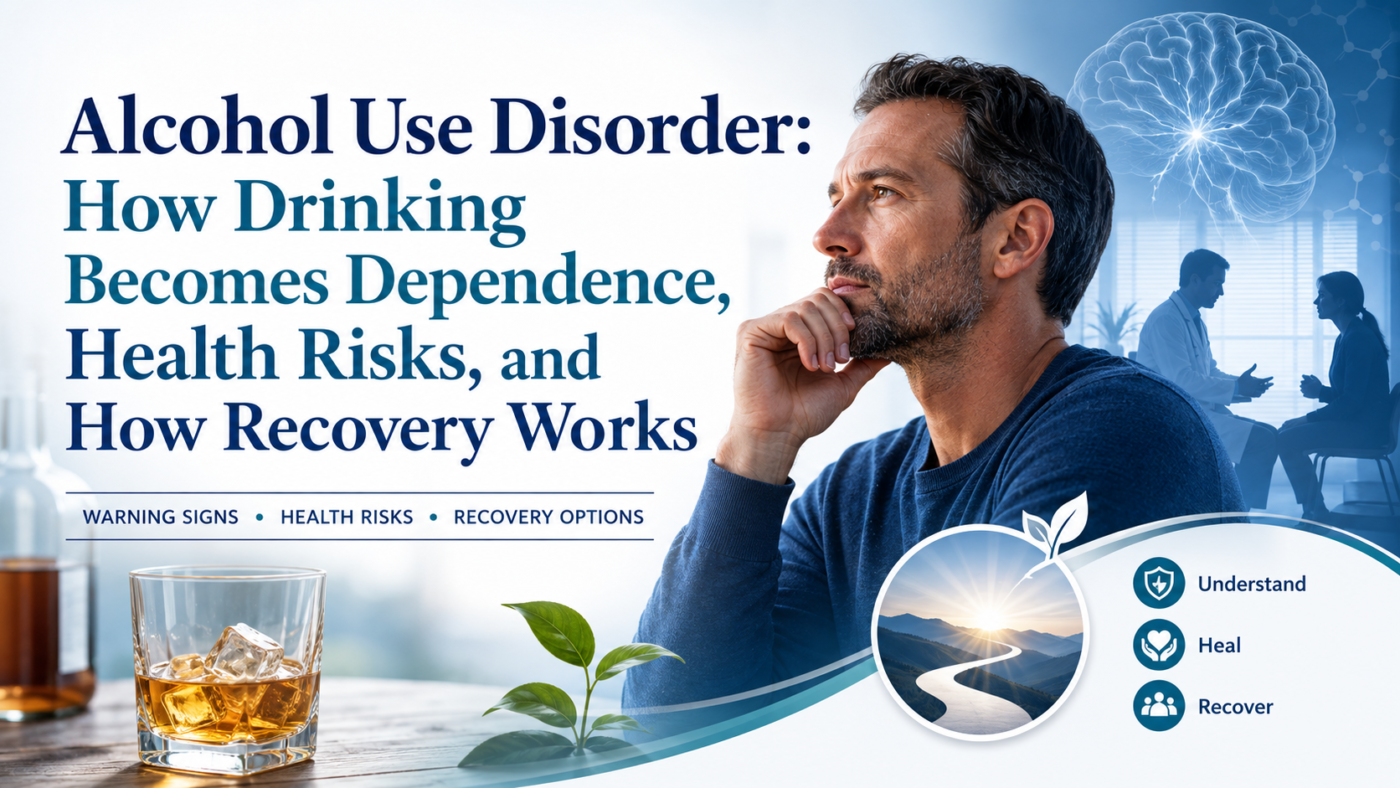
Alcohol use can begin innocently. Some people drink socially, others use alcohol to relax after work, and some start having a drink at night because they believe it helps them sleep. Over time, however, the pattern can change. What once felt optional may begin to feel necessary.
That shift—from “I want a drink” to “I feel like I need a drink”—is one of the central features of alcohol use disorder.
Alcohol problems do not develop in exactly the same way for everyone. Some people drink heavily for years before recognizing a problem, while others notice earlier warning signs such as hangovers, falls, missed work, arguments with family, worsening sleep, or an increasing inability to control how much they drink.
The important point is that alcohol use disorder is treatable, and treatment does not have to wait until someone reaches a crisis.
Alcohol Use Disorder Is More Than “Drinking Too Much”
Alcohol use disorder is a medical condition characterized by impaired control over drinking, continued alcohol use despite harmful consequences, and—in more severe cases—physical dependence and withdrawal.
It is not simply a matter of weak willpower.
Repeated alcohol exposure can change brain circuits involved in reward, stress, impulse control, and habit formation. As drinking becomes more deeply embedded in daily life, a person may find it increasingly difficult to stop even when they understand that alcohol is harming their health, relationships, or work.
This is why repeated criticism such as “just stop drinking” is often ineffective.
A person may already know alcohol is causing problems. What they need is a practical way to change the underlying pattern.
When Drinking Becomes a Habit
Alcohol is often connected to a trigger.
A person may drink when they feel lonely, anxious, angry, exhausted, or unable to sleep. Others drink because alcohol is built into their work culture or social life.
Over time, the brain begins to associate the trigger with drinking.
Stress appears, and the brain expects alcohol.
A difficult day ends, and alcohol becomes the automatic reward.
This is why replacing the habit can be more effective than simply repeating, “I will not drink.”
Someone who drinks to cope with stress might experiment with exercise, cycling, walking, music, social activities, relaxation techniques, or another structured evening routine. The best substitute depends on the function alcohol has been serving.
Recovery is not merely the removal of alcohol. It is often the construction of a healthier routine that makes alcohol less necessary.
Alcohol and the Brain
Long-term heavy alcohol use can damage the nervous system in several ways.
One important mechanism involves thiamine, or vitamin B1. People with chronic heavy alcohol use may develop thiamine deficiency because of poor nutrition, impaired absorption, altered metabolism, or reduced storage.
Severe thiamine deficiency can contribute to Wernicke encephalopathy and, if untreated, Korsakoff syndrome, which can cause profound memory impairment.
A person may appear to have dementia-like symptoms, including severe forgetfulness and difficulty forming new memories.
Early treatment can sometimes reverse part of the neurological damage, especially when thiamine deficiency is recognized promptly. But advanced, chronic injury may not fully recover.
This is why serious memory changes in a person who drinks heavily should not be dismissed as normal aging.
Vitamin B Supplements Do Not Make Heavy Drinking Safe
Because thiamine deficiency is associated with chronic heavy alcohol use, it may be tempting to assume that taking vitamin B supplements can prevent the neurological consequences of drinking.
That is an oversimplification.
Thiamine replacement can be medically important, particularly in people at risk of deficiency, but alcohol can harm the brain, liver, cardiovascular system, digestive system, immune system, and many other organs through mechanisms that vitamins cannot neutralize.
A supplement should never be viewed as protection that makes heavy drinking safe.
People with chronic heavy alcohol use, poor nutrition, unexplained confusion, severe memory problems, or withdrawal symptoms should be medically evaluated.
Alcohol and Cancer Risk
Earlier public-health discussions sometimes suggested that small amounts of alcohol—especially red wine—might protect the heart.
More recent evidence has substantially weakened that idea.
Alcohol is a recognized carcinogen. Its metabolism produces acetaldehyde, a toxic compound that can damage DNA and contribute to cancer development.
Alcohol consumption has been linked to several cancers, including cancers of the mouth, throat, larynx, esophagus, liver, colon and rectum, and breast.
For cancer prevention, less alcohol is better, and not drinking avoids alcohol-related cancer risk entirely.
This does not mean that every person who drinks will develop cancer. Risk depends on dose, duration, genetics, smoking, nutrition, and other factors. But there is no level of alcohol consumption that can be considered completely risk-free for cancer.
Why Some People Flush When They Drink
Alcohol is converted first into acetaldehyde and then into acetate.
One of the enzymes involved in clearing acetaldehyde is aldehyde dehydrogenase 2, or ALDH2.
A common ALDH2 variant, especially prevalent in East Asian populations, reduces the body’s ability to clear acetaldehyde efficiently.
People with this variant may flush, develop palpitations, feel unwell, or become intoxicated more easily after drinking.
The flushing response should not be viewed as a harmless sign that someone “cannot hold their liquor.” It reflects elevated acetaldehyde exposure, which can increase health risks.
Trying to “train” the body to tolerate alcohol does not correct the underlying enzyme deficiency.
Binge Drinking Is Not Safer Than Spreading Drinks Across the Week
Some people avoid alcohol during the week and then consume a large amount in one sitting.
This pattern can be especially dangerous.
Binge drinking can sharply increase the risk of injuries, falls, alcohol poisoning, arrhythmias, impaired judgment, violence, aspiration, accidents, and acute stress on the liver and cardiovascular system.
The body cannot simply “average out” a large dose because no alcohol was consumed on other days.
From a harm-reduction perspective, avoiding large single-session drinking episodes is extremely important.
Alcohol Should Not Be Used as a Sleep Aid
Alcohol can make a person feel sleepy initially, which is why some people start drinking at night.
But alcohol does not reliably improve healthy sleep.
As the night progresses, it can fragment sleep, worsen snoring and sleep apnea, increase nighttime awakenings, and reduce restorative sleep quality.
The result can become a cycle:
poor sleep → alcohol → temporarily faster sleep onset → poorer sleep quality → more fatigue → more alcohol.
Treating insomnia directly is generally safer and more effective than using alcohol to induce sleep.
Four Questions That Can Reveal a Drinking Problem
A widely used screening tool is the CAGE questionnaire.
It asks four simple questions:
- Have you ever felt you should Cut down on your drinking?
- Have people Annoyed you by criticizing your drinking?
- Have you ever felt Guilty about drinking?
- Have you ever needed an Eye-opener, or a drink first thing in the morning, to steady yourself or feel normal?
One positive answer may be worth discussing with a clinician, especially if drinking is already causing problems.
Two or more positive answers increase concern for a clinically significant alcohol problem and usually warrant further assessment.
The questionnaire is a screening tool, not a diagnosis.
Other Warning Signs
Alcohol use deserves attention when a person repeatedly:
- drinks more than intended
- tries unsuccessfully to cut down
- experiences strong cravings
- misses work or responsibilities because of drinking
- continues drinking despite family conflict
- drinks in physically hazardous situations
- develops tolerance and needs more alcohol to achieve the same effect
- experiences withdrawal symptoms
- drinks in the morning to relieve withdrawal
- gives up important activities because of alcohol
The more of these patterns that are present, the more important professional assessment becomes.
Alcohol Withdrawal Can Be Dangerous
People who drink heavily every day may develop physical dependence.
When alcohol suddenly stops, withdrawal symptoms can include anxiety, tremor, sweating, nausea, rapid heart rate, insomnia, agitation, and increased blood pressure.
Severe withdrawal can cause seizures, hallucinations, or delirium tremens, a potentially life-threatening condition.
For someone with significant physical dependence, suddenly stopping alcohol without medical guidance may be unsafe.
Medical detoxification can provide medications, thiamine, fluids, monitoring, and other treatment to reduce complications.
How Alcohol Use Disorder Is Treated
Effective treatment often combines several approaches.
Medication
Medication may be used to manage withdrawal, reduce cravings, decrease the rewarding effects of alcohol, or support abstinence.
The appropriate medication depends on the individual’s medical history, liver and kidney function, other medications, treatment goals, and severity of alcohol use.
Medication should be prescribed and monitored by a qualified clinician.
Treatment of Underlying Problems
Alcohol is sometimes used to cope with depression, anxiety, trauma, chronic stress, or insomnia.
If those conditions remain untreated, stopping alcohol can become much more difficult.
Treating the underlying issue may substantially reduce the urge to drink.
Psychological Therapy
Psychological treatment can help a person identify triggers, develop coping strategies, restructure habits, strengthen motivation, and recover from trauma or relationship problems.
Common approaches include cognitive behavioral therapy, motivational interviewing, relapse-prevention therapy, and trauma-informed care.
Case Management
Some people need help coordinating medical care, mental-health treatment, social services, family support, work-related issues, and follow-up appointments.
Case management can act as a bridge between the patient and the treatment team.
Peer Support
Mutual-help groups such as Alcoholics Anonymous and other recovery communities can provide social support, accountability, shared experience, and long-term encouragement.
Some areas also offer groups specifically for women or for people who prefer alternatives to traditional 12-step programs.
What Family Members Can Do
Families often become exhausted, angry, frightened, and frustrated after years of living with alcohol-related problems.
But constant criticism rarely changes the disorder.
A more productive approach is to begin with concern.
Instead of saying:
“You drink too much. Why can’t you stop?”
a family member might say:
“I’ve noticed you haven’t been sleeping well and you seem exhausted lately. I’m worried about how alcohol may be affecting you.”
The difference is important.
Concern opens a conversation.
Accusation often closes it.
Family members can also seek professional advice even if the person drinking is not ready for treatment. In many cases, helping the family understand alcohol use disorder changes the way everyone responds and can eventually make treatment more acceptable.
Social Drinking and Workplace Pressure
Some people drink because refusing alcohol feels socially difficult.
Business dinners, celebrations, industry gatherings, and workplace culture can make abstaining uncomfortable.
Practical strategies include saying that you are driving, taking medication that should not be mixed with alcohol, preparing for a medical examination, reducing alcohol for health reasons, or simply choosing a nonalcoholic drink from the beginning.
People who do drink can reduce immediate risk by avoiding binge drinking, eating before and while drinking, drinking slowly, alternating alcohol with nonalcoholic beverages, and never driving after drinking.
These measures reduce harm; they do not make alcohol risk-free.
Recovery Does Not Have to Begin With Perfection
Some people are ready to stop drinking completely.
Others initially aim to reduce alcohol substantially.
Both can be meaningful starting points, depending on the severity of dependence and the treatment plan.
A person who moves from heavy daily drinking to much lower consumption may experience meaningful improvements in sleep, blood pressure, liver function, mood, cognition, and daily functioning.
For some individuals, however, abstinence is medically safer—particularly when there is severe alcohol use disorder, repeated relapse, liver disease, pregnancy, high-risk medication use, previous severe withdrawal, or an inability to reliably control intake.
The safest goal should be individualized with a healthcare professional.
When to Seek Medical Help
Professional help is especially important when alcohol use is associated with:
- morning drinking
- severe tremor or sweating when alcohol wears off
- seizures
- hallucinations
- confusion
- severe memory problems
- repeated falls
- liver disease
- suicidal thoughts
- repeated inability to cut down
- drinking that is damaging work or relationships
Urgent medical care is required for seizures, severe confusion, hallucinations, loss of consciousness, breathing problems, suspected alcohol poisoning, or severe withdrawal.
The Most Important Message
Alcohol use disorder is not defined by a stereotype.
A person does not have to lose a job, destroy a marriage, or drink from morning to night before help is justified.
The earlier a harmful pattern is recognized, the more options a person usually has.
Recovery may involve medication, psychotherapy, treatment of insomnia or depression, family support, habit replacement, case management, peer support, or a combination of these approaches.
The goal is not merely to remove alcohol.
It is to help a person regain control of health, relationships, work, sleep, emotions, and everyday life.
Medical Disclaimer
This article is for educational purposes only and is not a substitute for individualized medical diagnosis or treatment. People who drink heavily every day should not abruptly stop alcohol without medical advice because severe withdrawal can be dangerous.
This article is for general education and does not replace individualized care from a qualified health professional. Seek appropriate advice for persistent, severe, or concerning symptoms.
Read the full medical disclaimer