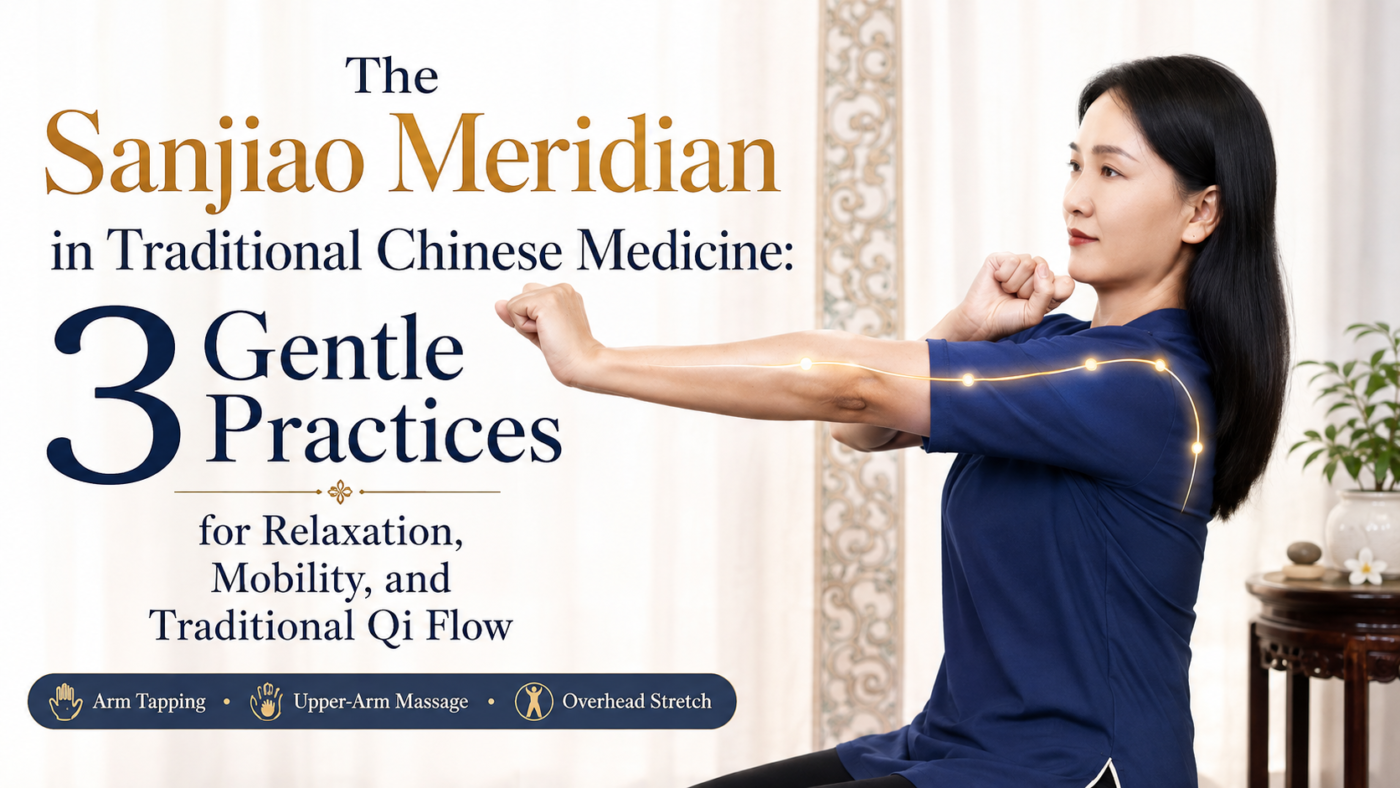
Stress rarely stays confined to the mind.
After a difficult day, many people notice tight shoulders, a stiff neck, shallow breathing, clenched muscles, poor sleep, or a general sense that the body cannot fully relax.
Traditional Chinese Medicine has long described experiences like these through the language of Qi, meridians, and the Sanjiao, also called the Triple Energizer or Triple Burner.
Within that traditional system, the Sanjiao is considered unusual because it is not simply identified with one anatomical organ.
Instead, it represents a functional framework that traditionally connects different regions of the body and helps explain the movement and transformation of Qi and fluids.
Modern anatomy does not recognize a physical “Sanjiao organ” or a literal channel through which trapped emotions or toxins are expelled.
But the traditional concept remains important within Chinese medicine, and several gentle practices associated with the Sanjiao pathway can also be understood in a modern way—as forms of self-massage, stretching, breathing, movement, and relaxation.
This guide explores three of those practices:
gentle tapping along the back of the arms,
comfortable pressure and massage around the upper arm,
and
a full-body overhead stretch with heel raises.
The goal is not to “force open” a blocked meridian.
It is to move, breathe, relax, and reconnect with parts of the body that may spend far too much time tense and motionless.
What Is the Sanjiao in Traditional Chinese Medicine?
The Chinese term 三焦, Sānjiāo, literally refers to the Three Burners or Three Jiao.
Traditional Chinese medicine divides the trunk conceptually into three regions:
Upper Jiao — traditionally associated with the chest, heart, lungs, and upper body.
Middle Jiao — traditionally associated with digestion and the stomach-spleen region.
Lower Jiao — traditionally associated with the lower abdomen, urinary and reproductive functions, and elimination.
These are traditional functional categories.
They should not be interpreted as three actual anatomical compartments with valves that become physically clogged.
Likewise, Qi is part of the theoretical language of Chinese medicine. It is not a substance that has been demonstrated to accumulate inside a measurable meridian in the same way blood accumulates inside a vessel.
NCCIH describes TCM as a collection of traditional practices that evolved over thousands of years. Some approaches, such as acupuncture and tai chi, have been investigated scientifically, but evidence varies substantially depending on the condition and treatment.
That gives us a useful way to approach the Sanjiao:
respect the traditional model,
but avoid turning metaphor into anatomy.
Where Does the Sanjiao Meridian Run?
In the standardized acupuncture system, the Sanjiao meridian is also known as the Triple Energizer, Triple Burner, or Hand Shaoyang channel.
Its traditional external pathway begins near the ring finger, travels across the back of the hand and forearm, continues along the posterior-lateral side of the upper arm, crosses the shoulder and neck, and reaches the region around the ear and side of the head.
The WHO standardized nomenclature lists 23 points along this channel, TE1 through TE23.
For a simple home wellness practice, you do not need to memorize all 23 points.
The easiest region to explore is the back and outer portion of the arm, particularly between the shoulder and elbow.
Practice 1: Gentle Tapping Along the Back of the Arm
One traditional method is rhythmic tapping.
Instead of hitting hard enough to create pain or bruising, use a relaxed, hollow palm and make the contact light and comfortable.
Sit or stand comfortably.
Relax one arm.
With the opposite hand, begin near the back of the shoulder.
Gently tap downward along the posterior-lateral upper arm toward the elbow.
Then return to the top and repeat.
Continue for approximately 30–60 seconds.
Change arms.
You can perform another round if it feels pleasant.
What Should It Feel Like?
You may notice:
warmth,
a mild tingling sensation,
greater awareness of the arm,
or temporary relaxation around the shoulder.
Those sensations do not prove that a meridian blockage has been removed.
They can occur because rhythmic touch stimulates skin receptors, muscle tissue, and sensory nerves.
That alone can make the area feel different.
Do Not Try to Create Bruising
Traditional scraping, cupping, and forceful tapping practices sometimes intentionally produce red or purple marks.
That is not necessary for this routine.
A bruise forms when trauma damages small blood vessels and allows blood to leak beneath the skin. It is therefore inaccurate to say that a purple mark demonstrates that “stagnant Qi” or “toxins” have been released.
If your tapping creates visible bruising, reduce the intensity or stop.
This becomes particularly important as people age, because skin becomes thinner and bruises more easily. Aspirin, anticoagulants, antiplatelet drugs, and several other medicines can also make bruising more likely.
The objective is stimulation—not injury.
Practice 2: Gentle Upper-Arm Pressure
The second method focuses on a smaller area of the upper arm.
The original routine describes a tender region several finger-widths beneath the shoulder.
There is an important technical correction here.
The point commonly called Binao (臂臑), LI14, belongs to the Large Intestine meridian, not the Sanjiao meridian.
On the Sanjiao channel, a relevant standardized upper-arm point is Naohui, TE13 (臑会), located on the posterior upper arm near the lower border of the deltoid region. WHO nomenclature clearly separates these points into different channels.
For home self-care, however, there is no need to perform diagnostic acupuncture-point hunting.
A safer approach is to massage the soft tissue of the posterior upper arm rather than searching for the most painful point you can find.
How to Do It
Bend one elbow comfortably.
With the opposite hand, feel the muscular area on the back and outer side of the upper arm.
Use two or three fingertips to make small circles.
Use mild pressure.
Explore the area slowly.
If one spot feels slightly tight or tender, spend 10–20 seconds there.
Then move on.
Total time can be about 1–2 minutes per arm.
Pain Is Not Proof That You Found a “Blockage”
This is another important distinction.
A tender area may reflect:
muscle tension,
recent exercise,
trigger-point sensitivity,
minor strain,
local nerve sensitivity,
or simply individual anatomy.
Severe tenderness is not evidence that Qi is dangerously trapped.
And you do not need to “break up” hard tissue with your fingers.
Do not repeatedly dig into a painful lump.
Persistent lumps, swelling, unexplained tenderness, weakness, numbness, or pain radiating into the hand deserve appropriate medical assessment.
Does Upper-Arm Massage Treat Thyroid Problems?
No evidence supports using upper-arm massage or a Sanjiao acupoint as a treatment for thyroid disease.
The traditional Sanjiao channel travels through the neck region, which may explain why historical TCM descriptions sometimes connect certain points with neck swelling.
But that does not mean pressing the upper arm regulates thyroid hormone production.
Thyroid conditions such as hypothyroidism, hyperthyroidism, thyroiditis, nodules, and thyroid cancer have specific biological causes and require appropriate evaluation.
Do not use acupressure as a substitute for thyroid testing or medical treatment.
Practice 3: The Full-Body Overhead Reach
The third practice is the most active.
It combines an overhead stretch with a controlled heel raise.
Similar upward-reaching movements appear in several traditions.
Chinese health practices include the Baduanjin movement commonly translated as “Two Hands Hold Up the Heavens to Regulate the Sanjiao.”
Yoga traditions also contain standing upward-stretching movements.
These traditions developed their own explanations, so they should not be presented as identical practices.
What they do share is a simple movement principle:
lengthen upward through the entire body.
How to Perform the Movement
Stand comfortably with your feet together or approximately hip-width apart.
If balance is a concern, stand near a wall or sturdy chair.
Allow the shoulders to relax.
Inhale gently.
Raise both arms outward and upward.
Bring them overhead.
You may interlace your fingers and turn the palms upward if that position is comfortable.
Do not force the wrists or shoulders.
Slowly rise onto the balls of your feet.
Imagine reaching upward through the crown of the head while lengthening the arms.
Keep the abdomen gently engaged.
Avoid pushing the belly forward.
Avoid excessively arching the lower back.
Remain here for 2–5 comfortable breaths.
Then exhale.
Lower the heels slowly.
Bring the arms back down.
Rest for several breaths.
Repeat approximately 5–10 times.
Fifteen repetitions are not necessary if your calves, shoulders, or balance begin to fatigue.
Keep the Shoulders Relaxed
A common mistake is to force the arms upward while the shoulders climb aggressively toward the ears.
Instead, create length without unnecessary tension.
Reach upward through the arms while allowing the neck to remain long.
If overhead movement causes shoulder pain, reduce the range.
There is no requirement that your arms become perfectly vertical.
What the Heel Raise Adds
Rising onto the toes activates the calf muscles and increases the balance challenge.
This makes the movement more than a simple shoulder stretch.
Your ankles must stabilize you.
Your calves contract.
Your trunk works to keep you upright.
Your nervous system coordinates the position.
If you feel unstable, keep both heels on the floor.
You still receive the overhead mobility component.
A wall or chair is also perfectly acceptable.
Safety is more valuable than achieving the deepest or tallest position.
A Traditional Sanjiao Interpretation
From a classical TCM perspective, lifting the arms overhead lengthens the pathway associated with the Sanjiao along the posterior arm and shoulder.
The movement may traditionally be described as:
regulating Sanjiao,
moving Qi,
opening the channels,
harmonizing upper and lower regions,
and encouraging smoother circulation of Qi and fluids.
Those descriptions belong to traditional medical theory.
A modern movement interpretation would instead emphasize:
shoulder elevation,
elbow extension,
wrist movement,
thoracic positioning,
calf contraction,
ankle stability,
postural control,
slow breathing,
and general physical activity.
Both descriptions can be presented side by side without pretending that one proves the other.
Can These Practices Reduce Stress or Anxiety?
Relaxation practices, touch, controlled breathing, and gentle movement can certainly help some people feel calmer.
Research on acupressure has also produced some promising findings.
A systematic review and meta-analysis involving 27 studies reported reductions in anxiety with acupressure, although study quality varied and heterogeneity was very high, meaning results differed substantially between studies. The authors specifically advised caution when interpreting the findings.
That is very different from claiming:
“Opening the Sanjiao eliminates anxiety.”
Anxiety disorders are multifactorial.
Persistent or severe anxiety deserves proper assessment and evidence-based treatment.
Self-massage and movement can be supportive tools.
They are not guaranteed cures.
What About Sleep?
There is also some research suggesting that certain acupressure programs may improve sleep outcomes in selected populations.
For example, a recent systematic review of hospitalized adults found improvements in several sleep measures, although the studies varied in design and intervention.
Other reviews in specific populations have produced more mixed findings, illustrating why broad claims such as “this meridian exercise cures insomnia” are not justified.
If gentle tapping, stretching, and breathing before bed help you relax, that is a reasonable wellness use.
Chronic insomnia, however, should not automatically be attributed to “blocked Qi.”
Does Clearing the Sanjiao Remove Facial Spots?
This is one of the original video’s strongest claims—and one that needs substantial correction.
There is no established evidence that tapping the Sanjiao meridian makes pigmentation, acne, enlarged pores, or facial spots disappear.
Skin appearance can be influenced by many things:
sun exposure,
genetics,
hormonal changes,
inflammation,
acne,
medications,
sleep,
smoking,
nutrition,
age,
and specific dermatologic conditions.
Stress can certainly affect some skin conditions, but that does not mean pigmentation represents “dirty internal Qi.”
Nor does it mean professional skin care or dermatologic treatment becomes unnecessary after meridian massage.
The better way to express the traditional idea is:
TCM historically regarded the appearance of the face as one reflection of overall internal balance.
That is an interesting traditional perspective.
It is not a substitute for dermatologic diagnosis.
A Simple 10-Minute Sanjiao-Inspired Routine
If you enjoy the traditional framework, here is a gentler and more practical version.
Minutes 1–2: Sit quietly and breathe slowly.
Minutes 2–4: Lightly tap the posterior and outer portion of both arms.
Minutes 4–6: Massage the upper-arm muscles gently.
Minutes 6–9: Perform 5–8 slow overhead reaches, adding a small heel raise if balance allows.
Minute 10: Stand or sit quietly and breathe normally.
Notice:
your shoulders,
your neck,
your arms,
your breathing,
and your overall level of tension.
You do not need to prove that Qi moved.
Simply notice whether your body feels more relaxed.
When Should You Avoid Tapping or Strong Massage?
Avoid forceful tapping or pressure over:
recent injuries,
open wounds,
skin infections,
large unexplained bruises,
swollen areas,
suspected fractures,
or painful masses.
Be especially cautious if you:
take anticoagulants,
take antiplatelet medication,
have a bleeding disorder,
have very fragile skin,
or bruise easily.
Medicines including anticoagulants and antiplatelet drugs can increase bruising because bleeding from damaged small vessels takes longer to stop.
If bruising repeatedly appears without an obvious cause, discuss it with a healthcare professional rather than assuming it represents meridian detoxification.
Respecting TCM Without Exaggerating It
Traditional Chinese Medicine deserves better than exaggerated claims.
Its concepts do not need to become modern anatomical facts in order to remain culturally meaningful.
The Sanjiao can be presented accurately as a traditional functional system.
Meridians can be discussed as part of classical Chinese medical theory.
Tapping and massage can be practiced as forms of self-care.
Baduanjin-inspired reaching movements can be valued as gentle exercise.
And modern research can be used where evidence genuinely exists.
NCCIH’s overall assessment reflects this balanced approach: some TCM-related physical practices have evidence for specific outcomes, but many broader traditional claims remain uncertain, and complementary practices should not replace necessary medical care.
That is not a rejection of the tradition.
It is what allows traditional wellness material to remain credible in a modern health publication.
The Bottom Line
The Sanjiao is one of the most distinctive concepts in Traditional Chinese Medicine.
Traditionally, it connects ideas about the upper, middle, and lower regions of the body and the movement of Qi and fluids.
It should not be interpreted as a literal anatomical exhaust pipe.
Nor should pain, bruising, acne, thyroid problems, anxiety, or insomnia automatically be attributed to a “blocked Sanjiao.”
But the practices associated with this tradition can still be useful when approached responsibly.
Gently tap the arms.
Massage rather than attack tender tissue.
Stretch upward.
Rise onto your toes only if your balance allows.
Breathe.
Relax.
And stop before discomfort becomes injury.
The aim is not to force something out of the body.
It is to give the body a few minutes of movement, touch, attention, and quiet.
Frequently Asked Questions
What is the Sanjiao meridian?
The Sanjiao, or Triple Energizer, is a traditional TCM concept associated with regulation and functional relationships among the upper, middle, and lower regions of the body. It does not correspond directly to a single anatomical organ.
Does modern medicine recognize the Sanjiao meridian?
Not as a discrete anatomical structure. Meridians belong to the theoretical framework of traditional Chinese medicine.
Where does the Sanjiao meridian run?
Traditional descriptions place the external pathway from the ring finger along the back of the hand and arm, over the shoulder and neck, and around the ear toward the side of the head. WHO nomenclature standardizes the channel as TE1–TE23.
Is Binao an acupoint on the Sanjiao meridian?
No. Binao (LI14) belongs to the Large Intestine meridian. Naohui (TE13) is a Sanjiao point located on the posterior upper arm.
Should tapping produce bruises?
No. Bruising means blood has leaked from damaged small blood vessels under the skin. You do not need bruising for a wellness tapping routine to be effective or meaningful.
Does a painful point mean the meridian is blocked?
Not necessarily. Tenderness can have many musculoskeletal and neurological explanations and is not a validated diagnostic test for meridian blockage.
Can Sanjiao exercises treat anxiety?
Gentle exercise, breathing, and touch may promote relaxation. Some acupressure research suggests possible anxiety benefits, but evidence varies and these practices should not be described as cures for anxiety disorders.
Can the routine remove facial pigmentation?
There is no good evidence that stimulating the Sanjiao meridian removes pigmentation, acne, or facial spots.
Can it treat thyroid nodules or thyroid disease?
No reliable evidence supports that claim. Persistent thyroid symptoms or neck swelling require proper medical evaluation.
Medical Disclaimer
This article is for educational purposes and discusses traditional Chinese medicine alongside modern health information. Concepts such as Qi, meridians, Sanjiao, and channel blockage are traditional theoretical concepts and should not be treated as direct equivalents of modern anatomy or physiology.
Do not use forceful tapping or massage to deliberately create pain or bruising. Seek professional medical care for persistent pain, unusual swelling, unexplained bruising, thyroid symptoms, severe anxiety, persistent insomnia, significant skin changes, or other concerning symptoms.
This article is for general education and does not replace individualized care from a qualified health professional. Seek appropriate advice for persistent, severe, or concerning symptoms.
Read the full medical disclaimer