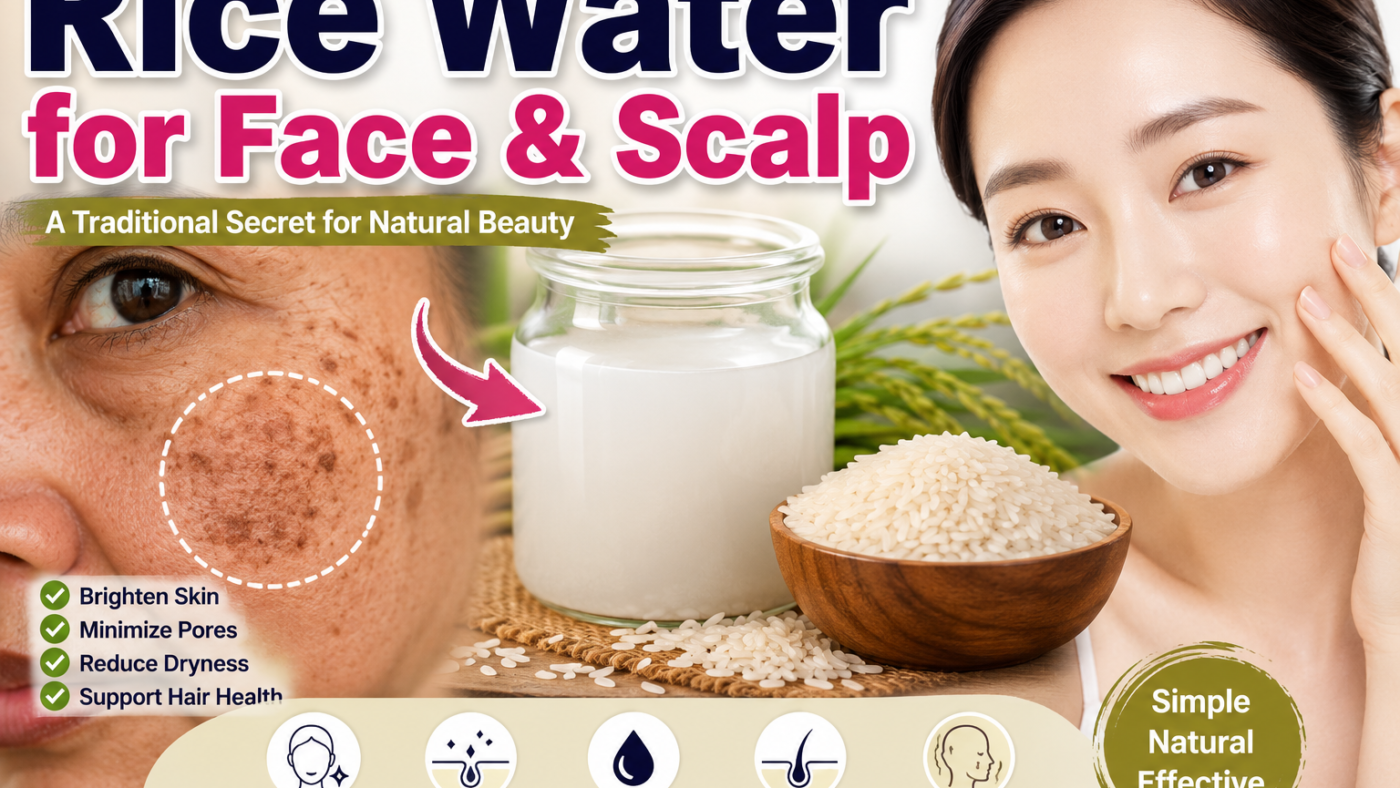
Rice water has become one of the most talked-about natural beauty remedies on social media. It is inexpensive, easy to make, and connected to long-standing East Asian beauty traditions. Videos often claim that the cloudy liquid left after rinsing rice can fade dark spots, brighten dull skin, tighten enlarged pores, reduce wrinkles, calm breakouts, firm sagging skin, strengthen thinning hair, and even encourage hair growth.
That is an impressive list for something that costs almost nothing.
But can ordinary rice water really do all of that?
The most accurate answer is more interesting than either “yes” or “no.” Rice and rice-derived ingredients do contain compounds with potential cosmetic benefits, and scientific studies have investigated rice water, rice bran, fermented rice extracts, and other rice-derived ingredients for skin and hair care. However, much of the strongest research involves standardized extracts or professionally formulated products—not a jar of homemade rice water sitting on a kitchen counter.
Rice water may be a gentle, low-cost addition to some skincare or hair-care routines, but it should not be treated as a cure for acne, pigmentation, enlarged pores, skin aging, or hair loss.
Here is what the evidence actually tells us, where the tradition comes from, how rice water may help, and how to experiment with it more safely.
What Is Rice Water?
Rice water is the cloudy, starch-rich liquid produced when rice is rinsed, soaked, or cooked in water.
The simplest version is rinse water. When dry rice is moved around in water, some starch and water-soluble compounds are released from the surface of the grains, producing the characteristic milky appearance.
Depending on the rice variety, processing method, soaking time, temperature, and amount of water used, the composition of homemade rice water can vary considerably.
This matters because the phrase “rice water” is often used as though it were one standardized ingredient. It is not.
A laboratory-produced rice extract, fermented rice filtrate, rice bran extract, rice bran oil, and homemade rice-rinsing water can all contain very different concentrations of active compounds.
Therefore, research showing benefits from one type of rice-derived ingredient cannot automatically be applied to every homemade rice-water recipe.
Rice Water Has a Real History in Japanese Hair Care
The traditional connection between rice water and Japanese beauty is not entirely a modern internet invention.
Historical research published in the Journal of the Society of Cosmetic Chemists of Japan described the use of rice-rinsing water known as Yu-Su-Ru among Japanese women during the Heian period, which lasted from 794 to 1185.
Women of the imperial court were famous for extremely long hair, and historical accounts indicate that rice-rinsing water was used as part of their hair-care practices.
Researchers later examined Yu-Su-Ru experimentally and found that it could reduce surface friction and increase hair elasticity.
That is a fascinating connection between traditional beauty culture and cosmetic science.
However, the same study also reported that untreated rice-rinsing water could leave deposits or flaking on the surface of the hair. Researchers therefore investigated processed rice-water extracts rather than concluding that ordinary kitchen rice water was an ideal modern hair treatment.
Most importantly, reduced friction and improved hair elasticity are not the same thing as stimulating new hair growth.
What Is Actually in Rice?
Rice contains carbohydrates and smaller amounts of proteins, minerals, vitamins, lipids, antioxidants, and other bioactive compounds.
Rice-derived cosmetic research has examined compounds including phenolic compounds, ferulic acid, vitamin E-related compounds, squalene, tricin, inositol, phytosterols, and gamma-oryzanol.
Several of these substances have interesting antioxidant, moisturizing, soothing, or skin-protective properties.
This is probably where many viral rice-water claims begin.
But there is an important scientific distinction.
Finding a beneficial substance in rice does not prove that enough of that substance moves into homemade rice-rinsing water to produce a clinically meaningful effect on human skin.
Gamma-oryzanol, for example, is particularly associated with rice bran and rice bran oil. It should not be assumed that a quick second rinse of polished white rice contains a therapeutically significant amount.
The same caution applies to vitamins and other compounds frequently listed in social-media videos.
Can Rice Water Brighten Dull Skin?
Possibly, but expectations should remain modest.
Research reviews suggest that several rice-derived ingredients have potential antioxidant, moisturizing, anti-inflammatory, and pigmentation-related effects.
Laboratory studies of fermented rice extracts have also found effects on pathways involved in melanin production and oxidative stress.
This makes rice-derived ingredients interesting candidates for cosmetic formulations designed to improve the appearance of uneven or dull skin.
What has not been established is that ordinary homemade rice water reliably removes dark spots or significantly treats conditions such as melasma or post-inflammatory hyperpigmentation.
Pigmentation is complex.
Sun exposure, inflammation, hormones, acne, genetics, medications, and other factors can all contribute.
For persistent dark spots, daily broad-spectrum sunscreen remains far more important than rice water. Dermatologists may also recommend ingredients such as azelaic acid, retinoids, vitamin C, hydroquinone in appropriate circumstances, or professional treatment depending on the cause.
Think of rice water as an optional cosmetic experiment—not a replacement for established pigmentation care.
Can Rice Water Make Enlarged Pores Disappear?
No skincare ingredient can permanently make pores disappear.
Pore visibility is influenced by genetics, oil production, skin elasticity, clogged pores, sun damage, and aging.
Because rice water contains starch, it may leave the skin temporarily feeling smoother or slightly tighter as it dries. That temporary sensation can make skin texture appear more refined.
This is very different from permanently shrinking pores.
People with visible pores may benefit more from proven approaches such as sunscreen, gentle cleansing, salicylic acid for clogged pores, retinoids when appropriate, and consistent moisturization.
Can Rice Water Help Dry Skin?
This is one of the more plausible cosmetic uses.
A small study published in Cosmetics investigated a gel containing a high proportion of rice water. The formulation demonstrated antioxidant and elastase-inhibiting activity in laboratory testing and was well tolerated by a small group of volunteers.
Rice-derived and fermented rice ingredients have also been studied for hydration and skin-barrier-related effects.
However, a professionally formulated gel is not equivalent to untreated kitchen rice water.
Rice water may make skin temporarily feel softer or smoother, but people with dry skin should still use a properly formulated moisturizer containing ingredients such as ceramides, glycerin, hyaluronic acid, petrolatum, or other proven barrier-supporting ingredients.
Rice water should be an optional step before moisturizer rather than the moisturizer itself.
What About Wrinkles and Sagging Skin?
Rice-derived ingredients are scientifically interesting in the field of skin aging.
Laboratory studies involving standardized fermented rice products have reported antioxidant activity and effects on collagen-related pathways, oxidative stress, hydration, and other markers associated with skin aging.
A 2024 study of red rice fermented with Aspergillus oryzae, for example, found promising effects in cell and reconstructed-skin models involving antioxidant activity, hydration-related markers, barrier-related markers, and melanin synthesis.
Other research has examined fermented rice-derived ingredients in models of photoaging.
These findings are promising for the development of cosmetic ingredients.
But they do not prove that homemade fermented rice water will lift sagging skin or erase wrinkles.
Human facial aging involves changes in collagen, elastin, fat compartments, bone structure, muscle, sun exposure, and genetics. No homemade liquid can reverse all of these changes.
The foundations of evidence-based skin-aging prevention remain sun protection, avoiding smoking, good nutrition, adequate sleep, appropriate moisturization, and clinically supported skincare ingredients.
Can Rice Water Treat Pimples and Acne?
Rice water should not be considered an acne treatment.
Some rice-derived compounds have demonstrated anti-inflammatory or antioxidant properties in research, but clinical evidence showing that homemade rice water clears acne is lacking.
For mild acne, better-supported over-the-counter ingredients include adapalene, benzoyl peroxide, salicylic acid, and azelaic acid, depending on the type of acne and individual skin tolerance.
People with painful cysts, nodules, acne scarring, or persistent breakouts should consider seeing a dermatologist.
Another concern is that aggressively wiping the face with rice-water-soaked cotton pads may irritate acne-prone skin.
Gentle application is better than repeated rubbing or scrubbing.
Does Rice Water Help Hair?
This claim needs to be divided into two completely different questions.
Can Rice Water Improve How Hair Feels?
Possibly.
The Japanese Yu-Su-Ru research found reduced surface friction and improved elasticity in treated hair.
A starch-rich rinse may also temporarily coat the hair shaft, potentially changing its texture and making some hair feel smoother or fuller.
However, too much residue can have the opposite effect.
Hair may become stiff, coated, rough, or dry, particularly when concentrated rice water is used frequently.
People with dry, damaged, curly, coily, bleached, or fragile hair should therefore be especially conservative.
Does Rice Water Make Hair Grow?
There is currently insufficient evidence to conclude that homemade rice water stimulates hair follicles or treats hair loss.
Hair thinning can result from androgenetic alopecia, hormonal changes, nutritional deficiencies, illness, medication, stress-related shedding, autoimmune disease, scalp disorders, traction, and many other causes.
A topical kitchen rinse cannot address all of those possibilities.
If you notice progressive thinning, widening of the part, bald patches, sudden shedding, scalp inflammation, or substantial changes in hair density, identifying the underlying cause is far more important than experimenting with rice water.
What About Rice Water Scalp Massage?
Scalp massage and rice water should also be considered separately.
Gentle scalp massage may feel relaxing and temporarily increase local blood flow. It can also help distribute a liquid treatment across the scalp.
But feeling warmth during massage does not prove that hair follicles have been activated or that new hair growth will occur.
Likewise, massaging the sides or hairline of the scalp should not be advertised as a reliable way to lift facial tissues or reduce forehead sagging.
If you enjoy scalp massage, use it for relaxation and gentle scalp care rather than expecting a face-lifting effect.
Is Fermented Rice Water Better?
This is where the biggest distinction between traditional DIY advice and modern cosmetic science becomes important.
Controlled fermentation can change the chemical composition of rice ingredients. Scientific studies have investigated fermented rice extracts and identified potentially useful metabolites and bioactive compounds.
But professionally controlled fermentation is very different from leaving homemade rice water at room temperature.
A laboratory or cosmetic manufacturer can control microorganisms, temperature, pH, fermentation time, preservation, contamination, ingredient concentrations, and product stability.
A jar on a kitchen counter does not provide those controls.
The idea that spontaneous homemade fermentation automatically creates “good bacteria” that improve the skin microbiome is therefore much more certain on social media than it is in clinical science.
Unpreserved water-based mixtures can support microbial growth.
For this reason, we do not recommend keeping homemade rice water at room temperature for 24–48 hours and then storing the resulting mixture for a week as though it were a preserved cosmetic.
If you specifically want fermented rice skincare, a professionally manufactured cosmetic containing fermented rice filtrate or standardized rice-derived ingredients is a more predictable option.
A Safer Way to Make Fresh Rice Water
For people who still want to experiment with traditional rice water, the simplest approach is to keep the preparation fresh and uncomplicated.
You Will Need
- Plain rice
- Clean drinking water
- A thoroughly cleaned bowl
- A clean container with a lid
Step 1: Briefly Rinse the Rice
Place the rice in a clean bowl, add water, move the grains around briefly, and discard the first rinse.
This removes loose surface debris.
Step 2: Make the Second Rinse
Add fresh clean water and gently swirl the rice for approximately 30–60 seconds.
The water should become cloudy.
Collect this second rinse in a clean container.
There is no need to make an enormous batch.
Step 3: Refrigerate Immediately
Homemade rice water does not contain the preservative system found in commercial skincare.
Because there is no standardized, validated shelf life for homemade rice water, a conservative approach is to make a small amount, refrigerate it immediately, and discard it quickly rather than storing it for several days.
If its odor, appearance, or texture changes, discard it.
Never continue using a homemade product simply because a sour smell is being interpreted as “healthy fermentation.”
How to Try Rice Water on Your Face
Before putting rice water all over your face, test a small amount on a limited area of skin.
Wait and watch for redness, itching, burning, swelling, or irritation.
If your skin tolerates it, try the following routine.
1. Cleanse Gently
Wash your face using your usual gentle cleanser.
Pat the skin dry.
2. Apply a Small Amount
Use clean hands to pat a thin layer of fresh refrigerated rice water over the skin.
Avoid the eyes, eyelids, lips, inside of the nose, open wounds, active dermatitis, or areas of broken skin.
There is no need to saturate the face.
3. Leave It Briefly
Five to ten minutes is enough for an experimental rinse or mask.
Longer exposure is not necessarily better.
4. Rinse If Desired
Rinse the face gently with clean lukewarm water, particularly if the skin feels sticky or tight.
5. Moisturize
Finish with a fragrance-free moisturizer suitable for your skin type.
During the daytime, use broad-spectrum SPF 30 or higher.
Sun protection will do far more for preventing premature skin aging and worsening pigmentation than rice water alone.
How Often Should You Use It?
More is not better.
Start once or twice per week.
If the skin remains comfortable, some people may choose to use it somewhat more frequently.
Stop if you develop:
- Redness
- Itching
- Burning
- Dryness
- Flaking
- Swelling
- Increased breakouts
People with eczema, rosacea, highly reactive skin, active infections, or a damaged skin barrier should be especially cautious about homemade skincare.
A Gentler Rice Water Hair and Scalp Routine
If you want to experiment with rice water for hair rather than skin, keep the treatment brief.
After shampooing, apply a small amount of fresh rice water to the hair and, if your scalp tolerates it, lightly across the scalp.
Use the pads of the fingers rather than the fingernails.
Massage gently for approximately one or two minutes.
Leave the rice water on for around five to ten minutes and then rinse thoroughly.
Apply conditioner to the hair lengths afterward if needed.
Start once per week.
If your hair becomes stiff, dry, coated, rough, tangled, or brittle, stop using it or reduce the frequency.
There is no evidence-based reason to saturate the scalp with large amounts or sleep overnight with homemade rice water.
Should You Use a Cotton Pad?
You can, but it is not necessary.
Many online rice-water routines repeatedly wipe the skin with soaked cotton pads, including around the nose, cheeks, forehead, eyelids, mouth, neck, and chest.
The mechanical wiping itself can irritate sensitive or acne-prone skin.
Patting the liquid on gently with clean hands is usually simpler.
Avoid wiping aggressively around the eyes.
Should You Leave Rice Water on Overnight?
For homemade rice water, we prefer a short-contact approach.
Leaving an unpreserved food-derived liquid on the skin overnight has not been demonstrated to provide greater benefits, and longer exposure can increase the opportunity for irritation.
A properly formulated moisturizer is a much better overnight leave-on product.
Who Should Avoid DIY Rice Water?
Consider skipping homemade rice water if you:
- Have an active skin infection
- Have open wounds or broken skin
- Are experiencing an eczema or rosacea flare
- Develop recurrent reactions to homemade skincare
- Have a very irritated or damaged skin barrier
- Have an inflamed or infected scalp
- Have experienced an allergic reaction to rice or rice-derived products
People receiving prescription dermatologic treatment should also avoid adding multiple experimental products without discussing them with their clinician.
Rice Water vs. Fermented Rice Cosmetics
This distinction can prevent a great deal of confusion.
Homemade rice water is inexpensive, variable, unpreserved, and poorly standardized.
Commercial fermented rice skincare can be produced using controlled fermentation, purified ingredients, standardized concentrations, stability testing, microbial testing, and preservatives.
Therefore, a scientific study involving a fermented rice extract should not be used as proof that homemade rice water fermented on the kitchen counter has the same properties.
They are related concepts, but they are not interchangeable products.
The Seven-Day Rice Water Challenge: What Should You Expect?
Seven-day before-and-after demonstrations are popular online, but dramatic conclusions should be viewed cautiously.
Skin hydration and surface smoothness can change quickly. Lighting, camera settings, makeup, sleep, menstrual cycles, ambient humidity, facial expression, and ordinary day-to-day variation can also make skin appear different.
Meaningful changes in pigmentation, collagen structure, acne, or hair density generally cannot be established from an uncontrolled seven-day personal experiment.
If you want to test rice water yourself, judge it by modest questions instead:
Does your skin feel comfortable?
Does it feel temporarily smoother?
Does your hair feel easier to manage?
Does it cause dryness or irritation?
Those are much more realistic outcomes to monitor.
The Bottom Line
Rice water deserves a more balanced reputation than either internet hype or complete dismissal.
Its use in East Asian beauty traditions is real, and research into rice-derived ingredients has uncovered interesting potential benefits involving antioxidant activity, skin hydration, pigmentation pathways, barrier support, hair friction, and hair elasticity.
But those findings do not prove that ordinary homemade rice water can erase dark spots, permanently shrink pores, lift sagging skin, cure acne, remove wrinkles, or regrow thinning hair.
The scientific evidence becomes particularly easy to misinterpret when studies of standardized rice extracts, rice bran ingredients, or carefully controlled fermented products are presented as proof for kitchen-made rice water.
If you enjoy traditional beauty rituals and your skin tolerates rice water, a fresh, simple rinse used occasionally can be a reasonable experiment.
Keep expectations modest. Keep preparation clean. Avoid uncontrolled fermentation. Stop if irritation occurs. And continue relying on the fundamentals that matter most: sunscreen, gentle cleansing, moisturization, appropriate evidence-based treatments, nutritious food, sleep, and professional evaluation when a skin or hair problem is persistent.
Sometimes a traditional practice does not need to be a miracle cure to be interesting.
Rice water is a perfect example.
Frequently Asked Questions
Is rice water scientifically proven to brighten skin?
Rice-derived ingredients have shown promising antioxidant and pigmentation-related effects in laboratory and cosmetic research, but there is not strong clinical evidence proving that homemade rice water reliably fades dark spots or significantly lightens skin.
Can rice water permanently shrink pores?
No. Rice water may temporarily make skin feel smoother or tighter, but it cannot permanently change pore size.
Does fermented rice water work better than normal rice water?
Controlled fermentation can produce interesting cosmetic compounds, but research on standardized fermented rice extracts cannot automatically be applied to spontaneously fermented homemade rice water. Home fermentation also introduces contamination concerns.
Can rice water treat acne?
Rice water is not an established acne treatment. Proven over-the-counter ingredients such as adapalene, benzoyl peroxide, salicylic acid, and azelaic acid have considerably stronger evidence.
Can rice water grow hair?
There is insufficient evidence that homemade rice water stimulates new hair growth. Research has suggested possible effects on hair friction and elasticity, which is different from treating hair loss.
Can I use rice water every day?
It is better to start conservatively, such as once or twice weekly, and watch how your skin or hair responds. Daily use is unnecessary and can cause dryness or residue in some people.
Can I leave rice water on my face overnight?
There is no proven advantage to leaving homemade rice water on overnight. A short-contact application followed by moisturizer is a more conservative approach.
How long can homemade rice water be stored?
There is no standardized validated shelf life for homemade cosmetic rice water. Because it is an unpreserved water-based mixture, make small batches, refrigerate immediately, and discard promptly rather than treating it like a shelf-stable commercial cosmetic.
Is sour-smelling rice water safe?
A sour odor may indicate fermentation, but smell alone cannot confirm which microorganisms are present or whether the mixture is safe. When homemade rice water changes noticeably in odor, appearance, or texture, the safest choice is to discard it.
References
- Inamasu S, Ikuyama R, Fujisaki Y, Sugimoto K. The Effect of Rinse Water Obtained from the Washing of Rice (YU-SU-RU) as a Hair Treatment. Journal of the Society of Cosmetic Chemists of Japan. 2010;44(1):29–33. doi:10.5107/sccj.44.29.
- Dias MFRG et al. Rice Water: A Traditional Ingredient with Anti-Aging Efficacy. Cosmetics. 2018;5(2):26.
- Wu Y et al. Dermatological Uses of Rice Products: Trend or True? Journal of Cosmetic Dermatology. 2022.
- Chen M, Sun Y, Zhu L, Li L, Zhao Y. Study on the Skincare Effects of Red Rice Fermented by Aspergillus oryzae In Vitro. Molecules. 2024;29(9):2066.
- Li Y et al. Effects of Rice Fermentation and Its Bioactive Components on UVA-Induced Oxidative Stress and Senescence in Dermal Fibroblasts. Photochemistry and Photobiology. 2025;101(2):392–403.
- U.S. Food and Drug Administration. Microbiological Safety and Cosmetics.
- American Academy of Dermatology. Evidence-based guidance on acne, pigmentation, and hair-loss evaluation.
Medical Disclaimer: This article is for educational and informational purposes only and is not medical advice. Rice water and other homemade skincare preparations are not treatments for acne, pigmentation disorders, eczema, hair loss, or other medical conditions. Stop use if irritation occurs and consult a qualified healthcare professional or dermatologist for persistent skin, scalp, or hair concerns.
This article is for general education and does not replace individualized care from a qualified health professional. Seek appropriate advice for persistent, severe, or concerning symptoms.
Read the full medical disclaimer