Neck hump posture exercises are often promoted online, but a visible bump at the base of the neck can have several different causes.A noticeable fullness or bump at the base of the neck is sometimes referred to in Chinese wellness culture as a “wealth bag.” Despite the name, this is not a medical diagnosis, and not every bump in this area has the same cause.
For some people, the appearance is related mainly to forward-head posture, rounded shoulders, or increased curvature of the upper back. For others, the fullness may actually be a dorsocervical fat pad, meaning an accumulation of fatty tissue behind the neck and between the shoulders.
That distinction matters because posture exercises can help improve alignment and muscular control, but they cannot be expected to remove every type of neck or upper-back prominence.
What Is a Dorsocervical Fat Pad?
A true dorsocervical fat pad is an accumulation of fatty tissue at the back of the neck.
According to MedlinePlus, possible causes include obesity, long-term use of glucocorticoid medications such as prednisone, excess cortisol associated with Cushing syndrome, and certain disorders affecting fat distribution. A dorsocervical fat pad by itself does not identify a specific disease; its significance depends on the person’s other symptoms, medical history, and examination findings. MedlinePlus
This means it is inaccurate to say that every visible bump is simply caused by “poor circulation,” “blocked qi and blood,” or spending too much time looking down at a phone.
Poor posture can certainly change the way the neck and upper back look, but posture and fat accumulation are not the same thing.
How Posture Can Change the Appearance of the Neck
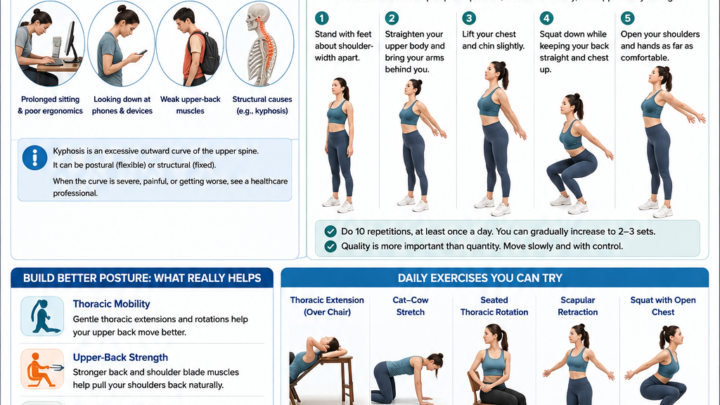
Modern lifestyles often involve long periods of sitting, computer use, and looking down at phones.
Over time, some people develop a forward-head posture in which the head sits farther in front of the shoulders. Rounded shoulders and altered upper-back posture may occur at the same time.
This can make the transition between the neck and upper back appear more prominent, particularly when combined with soft-tissue fullness.
Therapeutic exercise can help some people improve forward-head posture and neck symptoms. Research has found support for exercises such as chin tucks, pectoral stretching, and scapular retraction as components of posture-correction programs. When posture is a major contributor, gentle neck hump posture exercises may improve alignment, muscular control, and comfort over time.
However, improving posture should not be confused with “melting” or mechanically removing a dorsocervical fat pad.
A Simple Wall Posture Exercise
One useful exercise can be performed against a wall.
Stand with your back facing the wall and your feet a comfortable distance away from it.
Keep your body relaxed and look straight ahead.
Instead of forcefully pushing your head backward, gently draw your chin straight back, as though you are making a small double chin.
The movement should be horizontal rather than looking downward.
Keep your eyes level.
You should feel a mild lengthening sensation along the back of your neck rather than pain or strong compression.
Hold briefly, relax, and repeat slowly.
For beginners, a small number of comfortable repetitions is enough. There is no need to force the head against the wall or press aggressively with the fingers.
Add Gentle Shoulder-Blade Control
The next step is to improve awareness of the shoulders and upper back.
While standing tall, gently draw the shoulder blades slightly backward and downward.
Avoid aggressively squeezing them together.
Do not push the chest excessively forward or arch the lower back.
Think instead about creating a relaxed, upright position in which the ears sit more naturally above the shoulders.
Scapular stabilization exercises have been studied in people with neck pain and forward-head posture, with research suggesting potential improvements in posture, pain, and function when these exercises are incorporated appropriately. PubMed
Try a Short Wall Alignment Hold
After practicing the chin tuck and shoulder-blade movement separately, combine them.
Stand comfortably against the wall.
Gently draw the chin backward.
Allow the shoulders to relax.
Lightly engage the muscles around the shoulder blades.
Breathe normally.
Maintain the position only while it feels comfortable.
There is no scientific requirement to hold the posture for exactly three minutes, nor is there evidence that a specific number of minutes will eliminate a neck hump.
The purpose of the exercise is to develop awareness and muscular control, not to force the body into a rigid position.
What You Should Not Do
Avoid aggressively pushing the head backward with your hands or fingers.
Do not force the neck into a position that produces pain, dizziness, numbness, tingling, headache, or symptoms traveling into the arm.
You also do not need to walk around all day consciously squeezing the shoulder blades together. Good posture is dynamic rather than rigid.
The goal is comfortable movement and better control, not maintaining one “perfect” posture every minute of the day.
Can These Exercises Get Rid of a Neck Hump?
That depends entirely on what is creating the appearance.
If forward-head posture and rounded shoulders are major contributors, improving neck and shoulder mechanics may make the area look less prominent and may help reduce certain types of mechanical neck discomfort. Exercise programs aimed at forward-head posture have shown improvements in posture and, in some populations, neck pain.
But if the prominence is primarily fatty tissue, exercise cannot selectively remove fat from that exact location.
And if the prominence is related to an underlying hormonal, medication-related, structural, or metabolic condition, treating the underlying cause is more important than simply performing posture exercises.
When a Neck or Upper-Back Bump Should Be Evaluated
A new or changing bump should not automatically be assumed to be a posture problem.
Consider speaking with a healthcare professional if the area is rapidly becoming larger, unusually firm, painful, or clearly asymmetric, or if it appears together with other unexplained health changes.
Medical evaluation is especially worthwhile if you have been taking glucocorticoid medications for a long time or have symptoms that could suggest abnormal cortisol levels. Excess cortisol and prolonged glucocorticoid exposure are recognized causes of dorsocervical fat accumulation.
A clinician can help distinguish between fat accumulation, postural changes, spinal curvature, a localized mass, or another cause.
What Traditional Chinese Medicine Says
Traditional Chinese medicine may interpret neck and shoulder stiffness through concepts involving qi, blood circulation, meridians, or local stagnation.
These ideas belong to a traditional medical framework and can be discussed as part of the historical context of Eastern wellness.
They should not, however, be presented as established anatomical explanations for a dorsocervical fat pad.
From a modern medical perspective, the first step is determining whether the visible prominence primarily reflects body-fat distribution, posture, spinal alignment, soft tissue, or another health condition.
Keeping traditional theory and modern medical explanations clearly separated makes health information more accurate and useful.
The Bottom Line
A bump at the base of the neck is not one single condition.
Sometimes posture plays an important role. Sometimes excess fatty tissue is involved. In other cases, both may contribute.
Gentle chin tucks, shoulder-blade control, regular movement, strengthening, and reducing long periods in one fixed position can be useful components of a healthy neck and upper-back routine.
But posture exercises should not be advertised as a guaranteed way to “eliminate a wealth bag.”
The better goal is to improve movement, strength, comfort, and postural awareness while identifying any underlying medical cause when necessary.
Medical Disclaimer
This article is intended for general health education and wellness information only. It does not provide a diagnosis or replace individualized medical advice.
If you have a new or rapidly enlarging bump at the base of your neck, significant neck pain, numbness, weakness, unexplained physical changes, or concerns about medication or hormonal conditions, consult a qualified healthcare professional.
This article is for general education and does not replace individualized care from a qualified health professional. Seek appropriate advice for persistent, severe, or concerning symptoms.
Read the full medical disclaimer