Knee crepitus is the clicking, popping, or cracking sound many people notice when they squat, stand up, climb stairs, or bend their knees.Do your knees make clicking, popping, or cracking sounds when you squat, stand up, climb stairs, or simply bend your legs?
Many people also notice that their knees feel stiffer or less comfortable when the weather turns colder. This often raises a common concern.
Does a noisy knee mean something is wrong with the joint? Should you try exercises such as kneeling to improve it?
In most cases, the sound itself is not the most important issue. What matters more is whether the noise is accompanied by pain, swelling, locking, instability, or reduced mobility.
Why Do Knees Make Cracking or Popping Sounds?
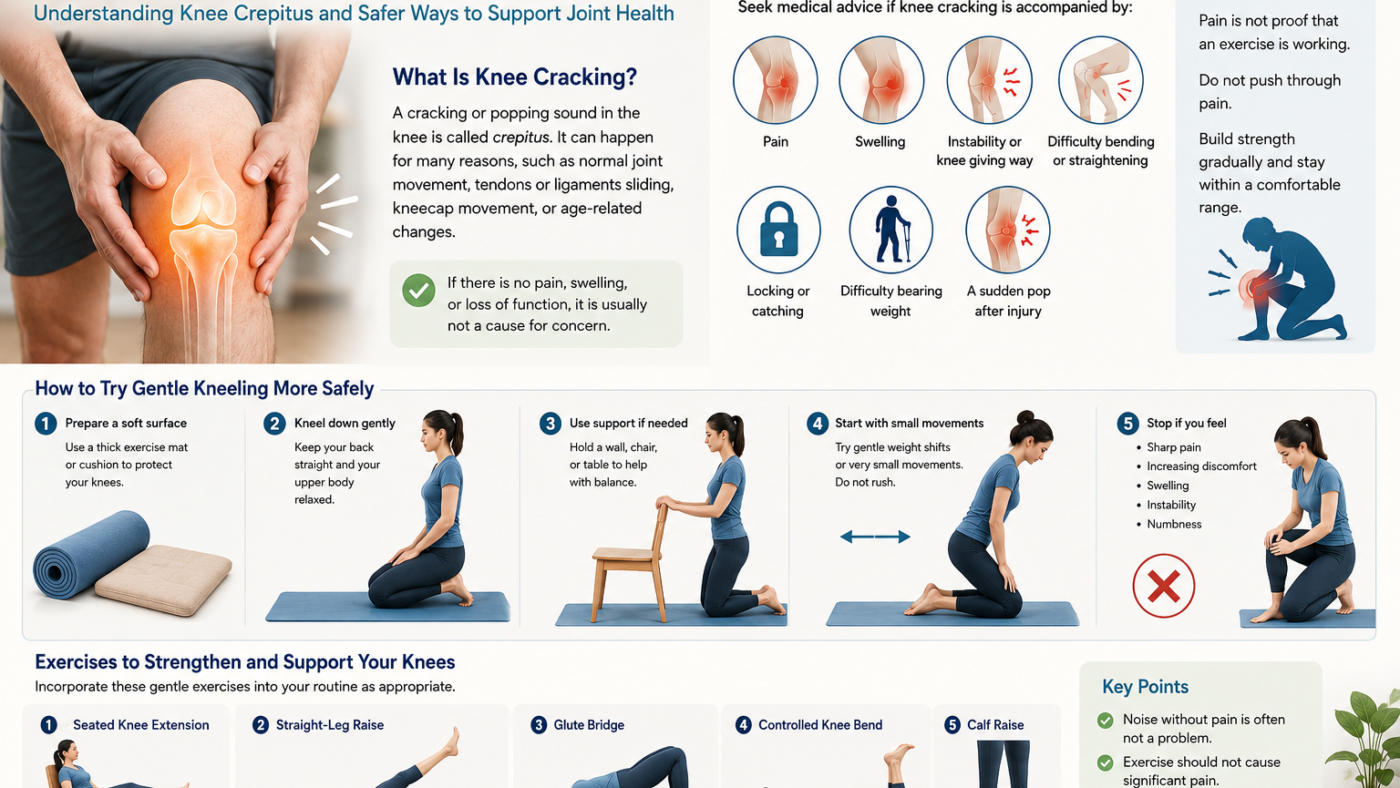
Joint noises are very common. In medical terminology, grinding, crackling, or popping sensations around a joint are often described as crepitus.
Knee sounds may occur because of normal movement within the joint, tendons or ligaments moving over nearby structures, movement of the kneecap during bending and straightening, or age-related changes in cartilage and surrounding tissues.
Many people with healthy and functional knees experience occasional cracking or popping.
A noisy knee does not automatically mean a damaged knee.
If the sound occurs without pain, swelling, or loss of function, it is often not a reason for concern.
When Knee Cracking Deserves More Attention
Knee sounds become more important when they occur together with persistent or worsening pain, noticeable swelling, difficulty bearing weight, a feeling that the knee is giving way, inability to fully straighten or bend the knee, locking or catching inside the joint, or a sudden loud pop during an injury.
These symptoms may sometimes be associated with problems involving cartilage, ligaments, the meniscus, or other structures within the knee.
A sudden pop after twisting or injuring the knee, especially when followed by pain, swelling, or instability, should not simply be treated with home exercise.
Professional medical assessment may be appropriate.
Knee crepitus is common and does not always indicate joint damage.
In many people, knee crepitus occurs without pain or loss of function.
If knee crepitus is accompanied by pain, swelling, locking, or instability, professional evaluation may be appropriate.
Can Kneeling Exercises Help the Knees?
Some traditional exercise routines recommend kneeling on a padded surface and gently shifting or moving the body while remaining on the knees.
For someone with healthy knees who can kneel comfortably, a short period of kneeling may simply be another form of movement.
However, there is not strong evidence that kneeling or knee walking can eliminate knee cracking or treat knee disease.
It should not be considered a universal treatment.
Most importantly, you should not force yourself to continue an exercise that causes significant pain.
Pain is not proof that an exercise is working.
If kneeling causes noticeable discomfort, there is no reason to force the joint to tolerate it.
How to Try Gentle Kneeling More Safely
If you have no significant knee pain, swelling, recent injury, or known joint condition and would still like to try gentle kneeling, comfort should come first.
Place a thick exercise mat or soft cushion on the floor so your knees are not pressing directly against a hard surface.
Lower yourself gently onto your knees while keeping your upper body relaxed and upright.
If necessary, use a wall, chair, or stable piece of furniture for support.
Do not immediately begin walking on your knees.
First, simply notice how the position feels.
If it remains comfortable, you may gently shift your weight or make small and controlled movements.
Stop if you experience sharp pain, increasing discomfort, swelling, instability, numbness, or unusual sensations.
There is no need to force yourself to kneel for ten minutes or for any predetermined amount of time.
Exercise should be adapted to your body.
Stronger Muscles Matter More Than Making the Knee Stop Cracking
If your goal is to support your knees and improve everyday movement, strengthening the muscles around the joint is generally more useful than repeatedly putting pressure directly on the knees.
The quadriceps, hamstrings, calf muscles, and gluteal muscles all contribute to lower-body stability and knee function.
Depending on your individual condition, suitable activities may include comfortable walking on level ground, seated knee extensions, straight-leg raises, glute bridges, controlled knee bending and straightening, and gradual lower-body strengthening.
The goal is not to perform as many repetitions as possible.
The goal is to gradually improve strength, mobility, balance, and confidence.
Your Knees Do Not Have to Be Completely Silent
One of the most common misconceptions about knee health is that healthy knees should never make noise.
That is not necessarily true.
Exercise does not need to eliminate every click or crack.
A better way to judge knee health is to consider how well your knees function.
Can you walk comfortably?
Can you climb stairs without significant pain?
Can you bend and straighten your knees normally?
Is there swelling or instability?
Do your legs feel strong and functional?
These questions are generally more meaningful than whether the knee occasionally makes a sound.
If your knees function well and are pain-free, an occasional crack or click does not necessarily indicate a serious problem.
What About Knees That Feel Worse in Cold Weather?
Some people report greater stiffness or discomfort around the knees during colder seasons.
Rather than responding with aggressive exercise, it is usually more sensible to focus on consistent movement and gradual conditioning.
Try to avoid sudden increases in exercise intensity after long periods of inactivity.
Regular physical activity can help maintain joint mobility, muscle strength, balance, and overall lower-body function.
For many people, gentle and consistent movement is more useful than searching for one special exercise.
Three Principles Worth Remembering
First, knee noise without pain is usually less concerning than knee noise accompanied by pain, swelling, or loss of function.
Second, knee exercise should not require you to tolerate significant pain.
Third, long-term knee health depends more on appropriate movement, strength, mobility, and gradual progression than on any single exercise technique.
Your knees support you during walking, standing, climbing stairs, exercising, and countless everyday activities.
Instead of searching for one movement that promises to fix every knee problem, pay attention to how your knees feel and function.
Stay active within a comfortable range, build strength gradually, and seek professional assessment if knee cracking is accompanied by persistent pain, swelling, locking, instability, reduced movement, or symptoms following an injury.
This article is intended for general health education and informational purposes only. It is not a substitute for medical diagnosis, treatment, or individualized advice from a physician, physical therapist, or other qualified healthcare professional.
If you experience persistent or severe knee pain, significant swelling, inability to bear weight, joint locking, instability, recent trauma, or worsening symptoms, seek appropriate medical evaluation.
This article is for general education and does not replace individualized care from a qualified health professional. Seek appropriate advice for persistent, severe, or concerning symptoms.
Read the full medical disclaimer