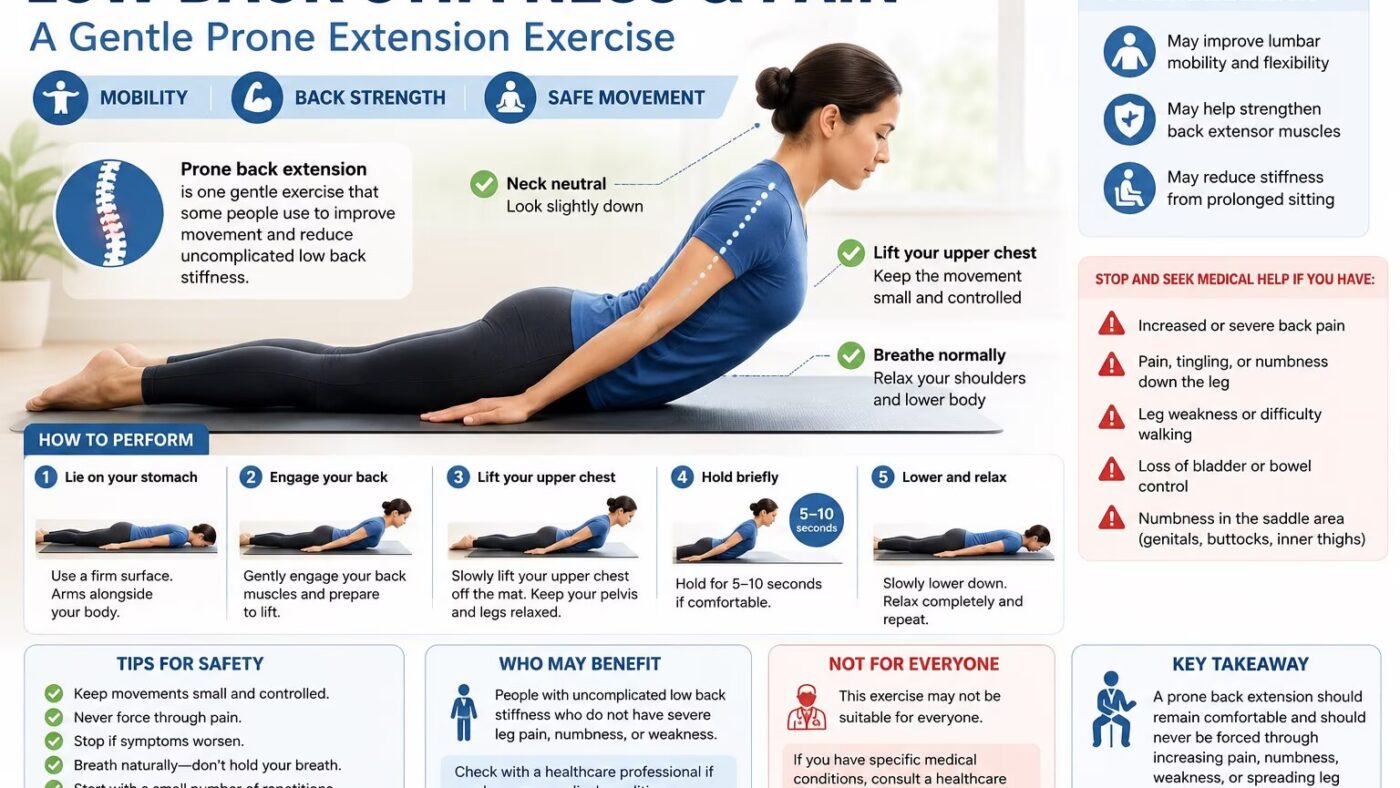
Prone back extension is one gentle exercise that some people use to improve movement and reduce uncomplicated low back stiffness.Low back pain and stiffness are extremely common, and many people become unsure about what kind of exercise is safe once their back starts bothering them.
A common misconception is that people with a “bad lumbar spine” should avoid most exercise, including running, sports, bending, or strengthening.
That is usually too simplistic.
Current guidelines generally encourage people with uncomplicated low back pain to remain active and continue normal activities as much as reasonably possible. Exercise can be useful, but the right type and intensity should reflect the individual’s symptoms, abilities, preferences, and medical situation.
One simple movement that some people find comfortable is a gentle prone back-extension exercise.
It can be used to introduce movement to the spine and activate muscles along the back, but it is not appropriate for everyone and should never be forced through pain.
Exercise Is Usually Better Than Avoiding Movement
When the lower back hurts, it can be tempting to stop moving altogether.
But prolonged inactivity and excessive bed rest are generally not recommended for uncomplicated low back pain. Staying active, changing positions regularly, and gradually returning to comfortable movement are commonly encouraged.
The World Health Organization also includes structured exercise programs among recommended approaches for chronic primary low back pain. Treatment is best viewed as a combination of appropriate movement, education, self-management, and—in some cases—additional physical or psychological interventions rather than reliance on one “magic” exercise.
Running and Basketball Are Not Automatically Forbidden
The original advice suggests that anyone with lumbar problems should avoid activities such as long-distance running or basketball.
That is not a universal rule.
Some people with low back pain can eventually participate safely in running, resistance training, recreational sports, and other forms of exercise. Others may need to temporarily modify high-impact or twisting activities when symptoms are irritated.
NICE recommends selecting exercise according to the person’s specific needs, preferences, and capabilities rather than treating one form of exercise as appropriate—or inappropriate—for everyone.
A better principle is:
Choose activity according to your symptoms and gradually build what your back can tolerate.
What Is a Prone Back-Extension Exercise?
“Prone” simply means lying face down.
A gentle prone extension involves slightly lifting or extending the upper trunk while keeping the movement controlled.
Depending on the person, the exercise may activate muscles along the back and provide a different movement direction after long periods of sitting and bending forward.
However, extension is not automatically beneficial for every type of back pain.
Some people feel better with extension movements.
Others feel worse.
That response matters more than trying to achieve a particular range of motion.
Starting Position
Choose a firm but comfortable surface.
A yoga or exercise mat on the floor is usually easier to control than a very soft mattress.
Lie comfortably on your stomach.
Allow your legs to rest naturally rather than forcing them tightly together.
Keep your shoulders relaxed.
Your arms can rest comfortably beside your body or in another position that allows you to remain relaxed.
Most importantly, keep your neck in a relatively neutral position.
You do not need to throw your head backward.
How to Perform the Movement
Begin by gently engaging the muscles through your upper and lower back.
Slowly lift your upper chest a small distance away from the mat.
Think about creating length through the spine rather than trying to bend as far backward as possible.
Keep your pelvis and lower body comfortably supported.
Look slightly downward so that your neck remains aligned with the rest of your spine.
Breathe normally.
Pause briefly if the position feels comfortable.
Then slowly lower yourself back down.
Relax completely before repeating.
The movement should be smooth rather than explosive.
Do Not Try to Lift as High as Possible
One of the most important changes from the original routine is this:
More extension is not necessarily better.
There is no need to push the spine to its maximum range.
The purpose is to practice comfortable movement and muscular control.
If you have to strain, hold your breath, throw your head backward, or aggressively contract your lower back to achieve the position, reduce the movement.
Exercise should be adapted to what your body tolerates.
How Many Repetitions?
There is no medical rule requiring:
10 sets on the first day,
15 sets the next time,
and eventually 20 sets.
That is an unnecessarily rigid progression.
For someone who has never performed the movement before, a small number of comfortable repetitions is a more sensible starting point.
For example, you might perform several slow repetitions, rest, and observe how your back feels both during the exercise and afterward.
Progress gradually only if the movement remains comfortable.
WHO guidance for chronic low back pain supports exercise as part of care, but it does not identify one universal exercise or repetition count that everyone must perform. 世界卫生组织
What Should You Feel?
You might notice mild muscular work along the back.
You may also feel a gentle stretch or change in stiffness.
That can be acceptable.
You should not continue if the movement causes:
sharp or rapidly increasing back pain,
pain spreading farther down the leg,
new numbness or tingling,
leg weakness,
loss of balance,
or unusual neurological symptoms.
A movement that repeatedly makes your symptoms worse is not something you should keep forcing simply because it is described online as a “lumbar exercise.”
What If You Have Sciatica?
Low back pain accompanied by pain, tingling, numbness, or weakness extending into the leg requires additional care when selecting exercises.
NICE specifically addresses low back pain both with and without sciatica and emphasizes individualized self-management and exercise according to a person’s needs and capabilities.
For some people with radiating symptoms, extension movements may feel helpful.
For others, they may aggravate symptoms.
If pain begins traveling farther down the leg or neurological symptoms increase during this exercise, stop rather than pushing harder.A prone back extension should remain comfortable and should never be forced through increasing pain, numbness, weakness, or spreading leg symptoms.
A physiotherapist or other qualified clinician can help determine which movement direction is appropriate.
What About Lumbar Spinal Stenosis?
People sometimes use the broad phrase “bad lumbar spine” to describe very different conditions.
Lumbar spinal stenosis, disc-related symptoms, nonspecific mechanical low back pain, arthritis, muscle strain, and nerve irritation are not the same problem.
Because extension can aggravate symptoms in some people with particular spinal conditions, the exercise should not be promoted as universally suitable.
This is another reason to judge an exercise by your symptoms rather than by the name of the movement.
Will One Week Fix Back Pain?
There is no good basis for promising that seven days of one exercise will restore the lumbar spine or eliminate longstanding back pain.
Low back pain is influenced by many factors, and recovery varies widely.
WHO recommends a person-centered approach for persistent low back pain, noting that a combination of interventions may be required rather than isolated treatment techniques.
Some people may feel less stiff after a single movement session.
Others improve gradually over weeks.
And some people need assessment to determine whether another condition is contributing to their symptoms.
The goal should be gradual improvement in movement and function, not a seven-day cure.
A Better Everyday Back Routine
Instead of relying exclusively on one exercise, think about the whole day.
Helpful habits may include:
regular walking,
changing position throughout the day,
gradually strengthening the trunk and hips,
maintaining general physical activity,
taking breaks from prolonged sitting,
and choosing activities you can perform consistently.
WHO identifies exercise, physical activity, and supportive self-management as important components of low back pain care.
There is rarely one universally “perfect posture.”
Changing position and maintaining the capacity to move is usually more useful than trying to hold the body rigidly in one position for hours.
When Back Pain Needs Medical Evaluation
Most low back pain is not caused by a dangerous condition, but certain symptoms require more urgent attention.
Seek prompt medical evaluation if back pain occurs together with:
new difficulty controlling the bladder or bowel,
numbness around the genitals, buttocks, or inner thighs,
significant or progressive weakness in both legs,
major changes in walking or coordination,
or severe back pain with rapidly developing neurological symptoms.
These can be warning signs of cauda equina syndrome, a rare but serious condition involving compression of the nerves at the lower end of the spinal canal.
Back pain after significant trauma, or pain accompanied by other concerning systemic symptoms, also deserves appropriate medical assessment.
Should You Rest When Your Back Hurts?
Short periods of comfortable rest can sometimes be useful during a painful flare.
But spending days in bed is generally not the preferred strategy for ordinary low back pain.
NICE recommends encouraging people to continue normal activities, while NHS musculoskeletal guidance emphasizes staying active and avoiding prolonged periods in the same position.
That does not mean ignoring pain.
It means finding a manageable level of movement and gradually rebuilding confidence and capacity.
The Bottom Line
A gentle prone back-extension exercise can be one option for people experiencing uncomplicated lower-back stiffness.
Performed comfortably, it may provide movement, muscular activation, and a break from prolonged sitting or flexed postures.
But the exercise should not be treated as a universal solution for every lumbar condition.
You do not need to:
force your head backward,
lift your body as high as possible,
perform 20 sets,
or expect your lumbar spine to recover in seven days.
Instead:
Start gently, breathe normally, monitor your symptoms, remain generally active, and gradually build the kind of movement your back tolerates.
Current guidelines support activity and appropriate exercise for low back pain, but the program should be adapted to the individual rather than dictated by a single routine.
This article is provided for general educational and wellness purposes only. It is not intended to diagnose, treat, cure, or prevent low back pain, disc disease, spinal stenosis, sciatica, or any other medical condition.
Stop the exercise if it causes significant or worsening pain, spreading leg symptoms, numbness, tingling, weakness, dizziness, or other unusual symptoms. Seek urgent medical attention for new bladder or bowel dysfunction, numbness around the saddle area, significant bilateral leg weakness, or other symptoms suggesting serious neurological involvement.
This article is for general education and does not replace individualized care from a qualified health professional. Seek appropriate advice for persistent, severe, or concerning symptoms.
Read the full medical disclaimer