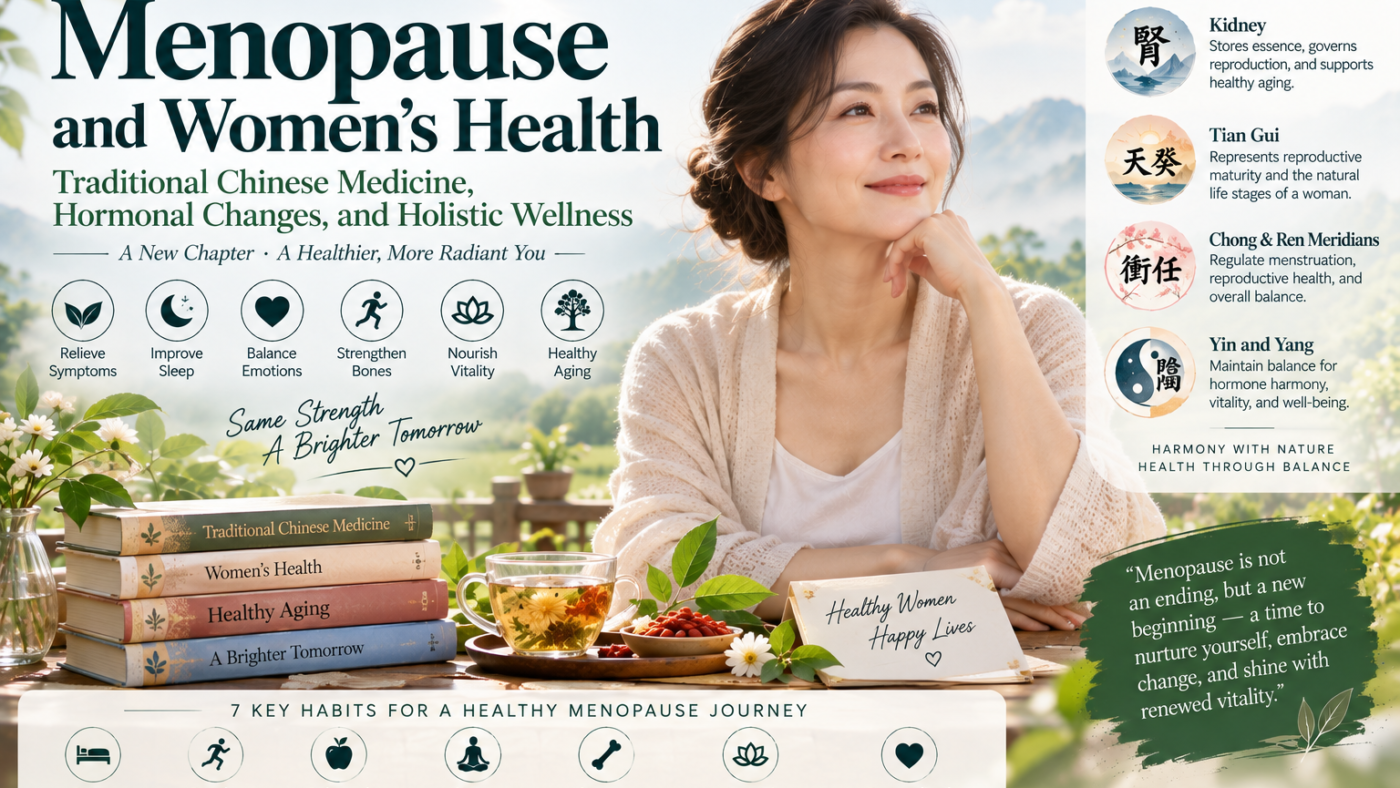
Menopause and Women’s Health: Understanding Hormonal Changes and Healthy Aging
Menopause and women’s health are closely connected to the natural hormonal transitions that occur throughout middle age. As ovarian function changes, women may experience irregular menstrual cycles, hot flashes, night sweats, sleep disturbances, vaginal dryness, and changes in emotional well-being.
Understanding menopause and women’s health involves recognizing the relationship between reproductive aging, hormonal changes, bone health, cardiovascular wellness, and other aspects of long-term physical functioning.
Traditional Chinese Medicine offers a historical perspective through Kidney Essence, Tian Gui, Yin-Yang balance, and the Chong and Ren meridians. Modern medicine provides a scientific understanding of ovarian aging, estrogen and progesterone changes, and individualized treatment options.
A comprehensive approach combines appropriate healthcare, balanced nutrition, restorative sleep, physical activity, emotional support, and sustainable lifestyle habits to help women navigate menopause with confidence and maintain long-term well-being.Menopause and women’s health are closely connected to the natural transitions that occur throughout middle age. As reproductive hormone levels change, many women begin to notice differences in their menstrual cycles, sleep patterns, emotional well-being, body composition, and overall physical comfort.
For some women, this transition occurs with relatively few symptoms. Others experience hot flashes, night sweats, sleep disturbances, vaginal dryness, or changes in mood that interfere with everyday life.
Traditional Chinese Medicine (TCM) approaches this stage of life through the historical concepts of Kidney Essence, Tian Gui, Yin-Yang balance, and the Chong and Ren meridians.
Within this framework, menopause is viewed as part of the body’s natural progression through different stages of development and aging.
Modern medicine explains the menopausal transition through changes in ovarian function, estrogen and progesterone production, and the biological processes associated with reproductive aging.
These perspectives use different explanatory systems, but both can encourage attention to overall health during an important life transition.
A comprehensive approach to menopause should focus not on resisting aging, but on maintaining vitality, supporting physical and emotional well-being, and helping women navigate this stage of life with appropriate information and individualized care.
What Is Menopause?
Menopause marks the end of the reproductive years.
Natural menopause is generally confirmed after 12 consecutive months without menstrual bleeding when no other physiological or medical explanation is present.
The average age of natural menopause is approximately 51 years, although the timing varies among individuals.
The years leading up to menopause are known as perimenopause.
During perimenopause, ovarian hormone production becomes increasingly variable.
Menstrual cycles may become shorter, longer, lighter, heavier, or less predictable.
Some women begin experiencing changes in their early or mid-40s, while others notice symptoms later.
A woman who experiences menopause before age 40 may have premature ovarian insufficiency or another condition requiring medical evaluation.
Menopause occurring between ages 40 and 45 is generally described as early menopause.
These distinctions matter because unusually early loss of ovarian function may have implications for fertility, bone health, cardiovascular health, and long-term well-being.
Menopause itself is not a disease.
However, some symptoms associated with the transition can be significant enough to require medical treatment.
The Traditional Chinese Medicine Concept of Kidney Essence
Traditional Chinese Medicine describes the Kidney as the foundation of inherited vitality.
Within this historical framework, Kidney Essence is associated with growth, development, reproduction, aging, and the maintenance of the body’s foundational resources.
Classical Chinese medical theory describes the reproductive lifespan through the gradual development and transformation of Kidney Essence.
A related concept is Tian Gui (天癸), a traditional term associated with reproductive maturity and the capacity for menstruation and conception.
The Huangdi Neijing, or Yellow Emperor’s Inner Classic, describes women’s reproductive development through a series of seven-year stages.
Within this framework, menstrual function emerges as reproductive vitality develops and eventually declines as the body moves into later life.
The classical description reflects an early attempt to understand reproductive aging through the language of Qi, Essence, Yin, and Yang.
Modern reproductive medicine provides a different explanation involving ovarian follicles, endocrine signaling, and changing hormone production.
Kidney Essence should therefore not be equated directly with estrogen levels, ovarian reserve, or anatomical kidney function.
The traditional concept can nevertheless be appreciated as part of a broader philosophy emphasizing appropriate nourishment and care throughout the different stages of life.
Yin, Yang, and the Menopausal Transition
Traditional Chinese Medicine describes Yin and Yang as complementary aspects of the body’s functional balance.
Yin is associated with nourishment, cooling, stillness, and restoration.
Yang is associated with warmth, movement, activity, and transformation.
Within the classical framework, some menopausal symptoms are interpreted through patterns involving Kidney Yin deficiency, Kidney Yang deficiency, or a combination of traditional imbalances.
A traditional Kidney Yin deficiency pattern may be associated with sensations of heat, nighttime sweating, restlessness, or disturbed sleep.
A traditional Kidney Yang deficiency pattern may involve cold sensitivity, fatigue, or reduced vitality.
These descriptions are historical diagnostic categories.
They are not equivalent to established medical diagnoses or specific laboratory measurements.
For example, hot flashes during menopause are associated with changes in thermoregulation related to declining and fluctuating estrogen levels.
They do not demonstrate that a measurable substance called Kidney Yin has become depleted.
Similarly, cold hands and feet do not prove that a woman has insufficient Kidney Yang or that she will develop uterine fibroids.
The value of the traditional framework lies in its emphasis on individualized well-being rather than its ability to replace modern physiological explanations.
Why Hot Flashes and Night Sweats Occur
Hot flashes are among the most recognizable symptoms of the menopausal transition.
A hot flash may produce a sudden sensation of warmth, particularly across the face, neck, and chest.
Some women experience flushing, perspiration, or a rapid heartbeat.
Night sweats occur when these episodes happen during sleep.
The symptoms can vary considerably in frequency, intensity, and duration.
For some women, occasional hot flashes are mildly inconvenient.
For others, repeated nighttime episodes can disrupt sleep and contribute to fatigue, difficulty concentrating, or reduced quality of life.
Modern research links these symptoms to changes in the body’s temperature-regulation system associated with menopausal hormonal changes.
Several treatment options are available for women whose symptoms are troublesome.
These may include menopausal hormone therapy or appropriate nonhormonal treatments, depending on medical history, personal preferences, and individual risk factors.
Traditional relaxation practices may support general well-being, but they should not be presented as guaranteed treatments for severe hot flashes.
Sleep Disturbances and Emotional Well-Being During Menopause
Sleep problems are common during the menopausal transition.
Some women have difficulty falling asleep, while others wake repeatedly or feel unrefreshed in the morning.
Night sweats can contribute to sleep disruption.
However, not every sleep problem during middle age is caused by menopause.
Stress, sleep apnea, chronic pain, medication effects, and other medical conditions may also play a role.
Mood changes may occur during perimenopause.
Some women report increased irritability, emotional sensitivity, anxiety, or difficulty concentrating.
These experiences deserve attention without assuming that every emotional change is caused by hormones.
Traditional Chinese Medicine sometimes interprets sleep disturbances and emotional tension through the relationships among the Heart, Kidney, and Liver systems.
The concept of Heart-Kidney disharmony is commonly discussed in relation to restlessness and sleep difficulties.
Liver Qi stagnation may be considered when emotional tension is prominent.
These traditional patterns can provide historical context, but they should not replace appropriate assessment for insomnia, depression, anxiety, or another medical condition.
A sustainable approach may include consistent sleep routines, regular activity, stress management, and professional support when needed.
The Chong and Ren Meridians in Women’s Health
Classical Chinese Medicine associates the Chong and Ren meridians with menstruation, reproductive vitality, and women’s health.
The Chong meridian is traditionally described as the Sea of Blood.
The Ren meridian is associated with the regulation and nourishment of reproductive functions.
Together, these concepts form part of the historical understanding of menstrual changes and the transition away from reproductive maturity.
Traditional theory describes the harmonious interaction of Kidney Essence, Tian Gui, and the Chong and Ren meridians as important for reproductive functioning.
When this process changes with age, the traditional framework interprets it as part of the natural transformation of the body.
However, these meridians are not anatomically established structures that directly regulate the uterus, ovaries, or breasts.
Modern medicine explains reproductive function through ovarian hormones, the hypothalamic-pituitary-ovarian axis, and the tissues of the reproductive system.
The traditional framework can be included in wellness education without presenting it as a substitute for anatomical or endocrine science.
Menopause and Uterine Fibroids
Uterine fibroids are common noncancerous growths that develop from the muscle tissue of the uterus.
They are also known as leiomyomas or myomas.
Fibroids vary considerably in size, number, and location.
Some remain small and produce no noticeable symptoms.
Others contribute to heavy menstrual bleeding, pelvic pressure, painful periods, urinary frequency, or discomfort during sexual activity.
Fibroids are particularly common during the reproductive years and may be identified during perimenopause.
Their growth is influenced by reproductive hormones, including estrogen and progesterone.
Genetic factors and individual biological characteristics also contribute.
Because estrogen levels generally decline after menopause, many fibroids become smaller during the postmenopausal years.
However, the pattern varies among individuals.
Not every fibroid disappears after menopause, and not every uterine growth should be assumed to be a fibroid.
Uterine Fibroids in Traditional Chinese Medicine
Traditional Chinese Medicine may interpret certain uterine masses through historical concepts involving blood stasis, Qi stagnation, phlegm accumulation, or deficiencies in foundational vitality.
The traditional term Zheng Jia (癥瘕) is sometimes used in discussions of abdominal masses.
Classical explanations may connect such patterns with the Kidney, Liver, Spleen, and Chong and Ren meridians.
Within this framework, the goal of Fu Zheng Tiao Ping (扶正调平) is described as supporting foundational vitality while encouraging balance.
However, uterine fibroids are not simply unused nutrients or stagnant blood that the body failed to absorb.
They are growths composed of uterine smooth muscle cells and associated connective tissue.
There is no established scientific basis for concluding that Kidney Yang deficiency is the fundamental cause of all uterine fibroids.
Likewise, warming the body or using traditional Kidney-tonifying preparations has not been established as a reliable method for preventing fibroid formation.
Traditional concepts may support a broader discussion of health preservation, but fibroid diagnosis and management require modern gynecological evaluation.
Can Uterine Fibroids Return After Surgery?
Some women undergo a myomectomy, a surgical procedure that removes fibroids while preserving the uterus.
This treatment may be considered when fibroids cause troublesome symptoms or affect reproductive goals.
Myomectomy removes existing fibroids, but new fibroids may develop later.
The likelihood of finding additional fibroids after treatment varies according to age, number of fibroids, surgical findings, and other individual factors.
Recurrence should not be interpreted as proof that the original surgery failed to address an underlying traditional Kidney deficiency.
The biological mechanisms of fibroid development are complex and cannot be reduced to a single constitutional pattern.
Women who have undergone fibroid treatment should follow the monitoring plan recommended by their healthcare professional.
Persistent heavy bleeding, new pelvic pressure, or other returning symptoms may require reassessment.
Ultrasound or other imaging may be used when clinically appropriate.
There is no established evidence that herbal Kidney tonification prevents fibroids from developing after myomectomy.
Ovarian Cysts and the Menopausal Transition
Ovarian cysts are fluid-filled or otherwise cystic structures associated with the ovaries.
They are not the same as uterine fibroids.
Many ovarian cysts are benign.
During the reproductive years, some cysts develop as part of normal ovarian activity.
Others arise from different biological processes.
The significance of an ovarian cyst depends on factors such as age, menopausal status, size, appearance on imaging, symptoms, and medical history.
A newly identified ovarian cyst after menopause deserves appropriate assessment because its risk profile differs from that of many functional cysts found in younger women.
Some cysts can be monitored, while others require additional investigation or treatment.
The presence of a cyst cannot be determined by whether a woman has cold hands, fatigue, or symptoms classified as Kidney Yang deficiency.
Pelvic ultrasound and appropriate medical evaluation are central to understanding ovarian findings.
Breast Pain and Breast Lumps During Middle Age
Breast health is another important concern during the menopausal transition.
Some women experience breast tenderness, fullness, or discomfort related to changing hormone levels.
Breast pain may fluctuate with the menstrual cycle during perimenopause.
Other women notice a new lump or an area of thickened breast tissue.
Several benign conditions can produce these symptoms.
Breast cysts, fibroadenomas, and other noncancerous changes are possible explanations.
However, breast symptoms should not automatically be attributed to hormonal changes or traditional Qi stagnation.
Most breast changes are not cancer, but a new breast lump still requires appropriate assessment.
A healthcare professional may recommend a clinical breast examination, ultrasound, mammography, or other investigations according to age, symptoms, and individual risk factors.
Persistent localized pain, unusual nipple discharge, skin dimpling, or a new mass should not be managed solely through traditional wellness practices.
The Traditional Relationship Between the Liver, Kidney, and Breast Health
Classical Chinese Medicine describes relationships among the Kidney, Liver, Chong and Ren meridians, and the breast.
The Liver is associated with the smooth movement of Qi and the storage of blood within traditional theory.
The Kidney is associated with foundational vitality and reproductive development.
Some traditional practitioners interpret breast discomfort through patterns involving Liver Qi stagnation, blood stasis, or traditional deficiencies.
These concepts may be discussed as part of the cultural history of women’s health.
However, they should not be used to determine whether a breast lump is benign or malignant.
There is no reliable clinical basis for concluding that warming the hands and feet prevents breast cysts, fibroadenomas, or breast cancer.
Breast awareness and appropriate screening remain important regardless of a person’s traditional constitutional classification.
Menopause, Skin Changes, and Healthy Aging
Many women notice changes in their skin during middle age.
These may include dryness, reduced elasticity, changes in texture, or increased visibility of fine lines.
Several factors contribute to skin aging.
Hormonal changes, genetics, accumulated sunlight exposure, lifestyle habits, and the skin’s natural biological processes all influence appearance.
Traditional Chinese Medicine associates skin vitality with the nourishment of Qi and blood and the functional relationships among the Kidney, Liver, Spleen, Heart, and Lung systems.
The classical concept of beauty from within encourages attention to overall well-being.
However, delaying menopause has not been established as a safe or effective anti-aging strategy.
The timing of menopause cannot be reliably controlled through a particular herbal formula, warm foot baths, or Kidney-tonifying practices.
Healthy aging should instead emphasize skin protection, physical strength, metabolic health, emotional well-being, and preventive medical care.
A healthy complexion does not require the absence of wrinkles or the preservation of a particular youthful appearance.
Bone Health and Cardiovascular Wellness After Menopause
Menopause has implications beyond reproductive health.
Estrogen contributes to the regulation of bone remodeling, and declining estrogen levels can accelerate bone loss.
This makes osteoporosis prevention an important consideration during and after the menopausal transition.
Weight-bearing movement, strength training, adequate nutrition, and appropriate calcium and vitamin D intake can help support bone health.
Bone density testing may be recommended according to age and individual risk factors.
Cardiovascular health is also important.
Blood pressure, blood glucose, blood lipids, smoking status, physical activity, and family history are relevant components of preventive care.
A comprehensive menopause wellness plan should therefore address more than hot flashes or menstrual changes.
Maintaining physical strength and reducing preventable health risks can support independence and quality of life throughout later adulthood.
7 Healthy Habits for Menopause and Women’s Health
The menopausal transition provides an opportunity to develop sustainable habits that support physical and emotional well-being.
1. Maintain a Consistent Sleep Routine
Aim for sufficient, restorative sleep and reasonably consistent waking times.
If night sweats interfere with rest, discuss appropriate treatment options with a healthcare professional.
Persistent insomnia may require more than general sleep-hygiene advice.
2. Stay Physically Active
Walking, cycling, swimming, strength training, and other suitable activities can support overall health.
Tai Chi and Qigong may provide enjoyable opportunities for gentle movement, balance, and relaxation.
The intensity and type of exercise should reflect individual fitness and medical needs.
3. Support Bone and Muscle Health
Include appropriate resistance exercise and weight-bearing activity.
Adequate protein, calcium, vitamin D, and overall nutrition are important for maintaining physical function.
People with osteoporosis or significant joint problems may require individualized exercise guidance.
4. Follow a Balanced Eating Pattern
Choose a varied diet containing vegetables, fruits, whole grains, suitable protein sources, and healthy fats.
Avoid extreme dieting or unnecessary restrictions.
Nutritional needs may change with age, activity level, health conditions, and medication use.
5. Address Stress and Emotional Well-Being
Make time for meaningful activities, social connection, and relaxation.
Walking outdoors, Tai Chi, gentle stretching, and mindful breathing can contribute to a balanced daily routine.
Persistent depression, anxiety, or significant mood changes deserve appropriate care.
6. Maintain Breast and Gynecological Awareness
Become familiar with what is normal for your own body.
Seek assessment for new breast lumps, unusual bleeding, persistent pelvic pain, or other concerning changes.
Follow age-appropriate screening recommendations and individualized medical advice.
7. Seek Individualized Menopause Care
Severe hot flashes, sleep disruption, vaginal dryness, or other symptoms do not have to be endured without support.
A healthcare professional can discuss available treatment options and their benefits and risks.
The most appropriate approach depends on symptoms, medical history, treatment preferences, and individual health goals.
Modern Treatment Options for Menopausal Symptoms
Menopause care should be individualized.
For women experiencing troublesome hot flashes or night sweats, menopausal hormone therapy may be an appropriate option.
Hormone therapy can be effective for vasomotor symptoms, but its suitability depends on age, medical history, time since menopause, and individual risk factors.
Women who have a uterus generally need appropriate endometrial protection with a progestogen when using systemic estrogen therapy.
Hormone therapy is not suitable for everyone.
Certain medical conditions and histories may affect treatment choices.
Nonhormonal prescription treatments are also available for selected women.
For vaginal dryness and other symptoms associated with genitourinary syndrome of menopause, treatments may include vaginal moisturizers, lubricants, or appropriate local hormonal therapy.
These options should be discussed with a healthcare professional.
Menopause management is not limited to accepting symptoms or relying exclusively on traditional remedies.
Effective care combines informed treatment choices with sustainable daily health practices.
Can Traditional Chinese Medicine Help With Menopause?
Traditional Chinese Medicine has a long history of discussing women’s reproductive transitions through the concepts of Kidney Essence, Tian Gui, Yin-Yang balance, and the Chong and Ren meridians.
Traditional practitioners may consider different patterns depending on the individual’s symptoms.
Some women also use acupuncture, herbal products, Tai Chi, Qigong, or other complementary approaches during menopause.
However, evidence for these interventions varies.
Mind-body practices may support general well-being, stress management, or aspects of sleep quality.
Their effects should not be confused with established treatment of severe menopausal hot flashes.
Traditional herbal products require particular caution.
Some supplements promoted for menopause have limited evidence of benefit and may cause adverse effects or interact with medications.
Women with a history of breast cancer, uterine cancer, liver disease, blood-clotting disorders, or other significant conditions should discuss any herbal or hormone-related products with an appropriate healthcare professional.
There is no established evidence that a traditional herbal regimen can reliably delay natural menopause, prevent all uterine fibroids, or eliminate the risk of breast lumps.
The most responsible role of traditional wellness practices is to support general well-being alongside appropriate medical care.
When Menopausal Symptoms Require Medical Attention
Some changes during perimenopause are expected, but not every symptom should automatically be attributed to menopause.
Very heavy bleeding, bleeding between periods, persistent pelvic pain, or significant changes in menstrual patterns may require evaluation.
Any vaginal bleeding that occurs after menopause has been established should be medically assessed, even if it happens only once.
A new breast lump, nipple discharge, or persistent breast change also deserves assessment.
Women experiencing menopause unusually early should discuss potential health implications and treatment options with a healthcare professional.
Persistent sleep problems, severe emotional symptoms, or symptoms that interfere substantially with daily life should not be ignored.
Early assessment helps distinguish expected reproductive changes from conditions that require specific treatment.
Menopause and Women’s Health: Supporting Vitality and Healthy Aging
Menopause is a natural life transition, not a failure of the body or the end of a woman’s vitality.
Traditional Chinese Medicine offers a historical philosophy emphasizing the preservation of Kidney Essence, the nourishment of Qi and blood, and the harmonious interaction of Yin and Yang.
Modern medicine provides a scientific understanding of ovarian aging, hormonal changes, bone health, cardiovascular wellness, and the diagnosis and treatment of gynecological conditions.
These perspectives can coexist when their different purposes and limitations are clearly understood.
For some women, menopause may bring significant physical or emotional challenges.
For others, the transition is relatively comfortable.
Neither experience determines a woman’s strength, value, or future well-being.
The most sustainable approach combines individualized medical care with balanced nutrition, regular movement, restorative sleep, emotional support, and appropriate preventive screening.
Uterine fibroids, ovarian cysts, and breast lumps should be evaluated according to their specific medical characteristics rather than attributed to a universal constitutional deficiency.
The deeper lesson of traditional health cultivation is that wellness requires continued attention throughout every stage of life.
By understanding menopausal changes, recognizing symptoms that deserve assessment, and developing supportive daily habits, women can maintain physical confidence, preserve independence, and embrace healthy aging with greater comfort and understanding.
FAQ
What is menopause?
Menopause is a natural stage of life marking the end of menstrual periods. It is generally confirmed after 12 consecutive months without menstruation when no other physiological or medical explanation is present. The average age of natural menopause is approximately 51 years.
What is the difference between perimenopause and menopause?
Perimenopause is the transitional period leading up to menopause, during which ovarian hormone levels fluctuate and menstrual cycles may become irregular. Menopause is reached after 12 consecutive months without menstrual bleeding.
What are the most common symptoms of menopause?
Common symptoms include hot flashes, night sweats, sleep disturbances, vaginal dryness, changes in menstrual patterns, and mood-related concerns. The severity and duration of symptoms vary among individuals.
Can Traditional Chinese Medicine delay menopause?
Traditional Chinese Medicine describes reproductive aging through Kidney Essence, Tian Gui, and Yin-Yang balance. However, there is no established scientific evidence that traditional Kidney-tonifying herbs can reliably delay natural menopause or reverse ovarian aging.
Do uterine fibroids disappear after menopause?
Many uterine fibroids become smaller after menopause as estrogen levels decline, but they do not always disappear. Persistent or changing symptoms may require medical evaluation.
Can uterine fibroids return after surgery?
Myomectomy removes existing fibroids while preserving the uterus. New fibroids can develop later, although the likelihood varies according to individual factors. Follow-up should be based on symptoms, clinical findings, and medical advice.
Are breast lumps during menopause always harmless?
No. Many breast lumps are benign, but a new lump or persistent breast change requires appropriate evaluation. Hormonal changes or traditional constitutional patterns should not be used to determine whether a lump is harmless.
Can Tai Chi and Qigong help with menopause symptoms?
Tai Chi and Qigong may support gentle movement, balance, relaxation, and general well-being. Evidence for specific menopausal symptom benefits varies, and these practices should not replace effective treatment for severe symptoms.
When should women seek medical attention during menopause?
Persistent severe symptoms, unusual menstrual bleeding, pelvic pain, or new breast changes deserve medical assessment. Any vaginal bleeding after menopause has been established should be evaluated, even if it occurs only once.
Medical Disclaimer
This article is intended for educational and informational purposes only and does not constitute medical advice, diagnosis, or treatment. Traditional Chinese Medicine concepts are presented for historical and educational understanding and should not be considered equivalent to established medical diagnoses. Menopausal symptoms, uterine fibroids, ovarian cysts, breast lumps, and abnormal uterine bleeding may require individualized medical evaluation and treatment. Do not replace prescribed hormone therapy, necessary gynecological care, breast screening, or other medical treatment with herbal remedies or complementary practices. Consult a qualified healthcare professional before using herbal products, hormone-related supplements, or menopausal hormone therapy, particularly if you have a history of hormone-sensitive cancer, liver disease, cardiovascular disease, or blood-clotting disorders. Any vaginal bleeding after menopause or a new breast lump should be medically assessed.
This article is for general education and does not replace individualized care from a qualified health professional. Seek appropriate advice for persistent, severe, or concerning symptoms.
Read the full medical disclaimer