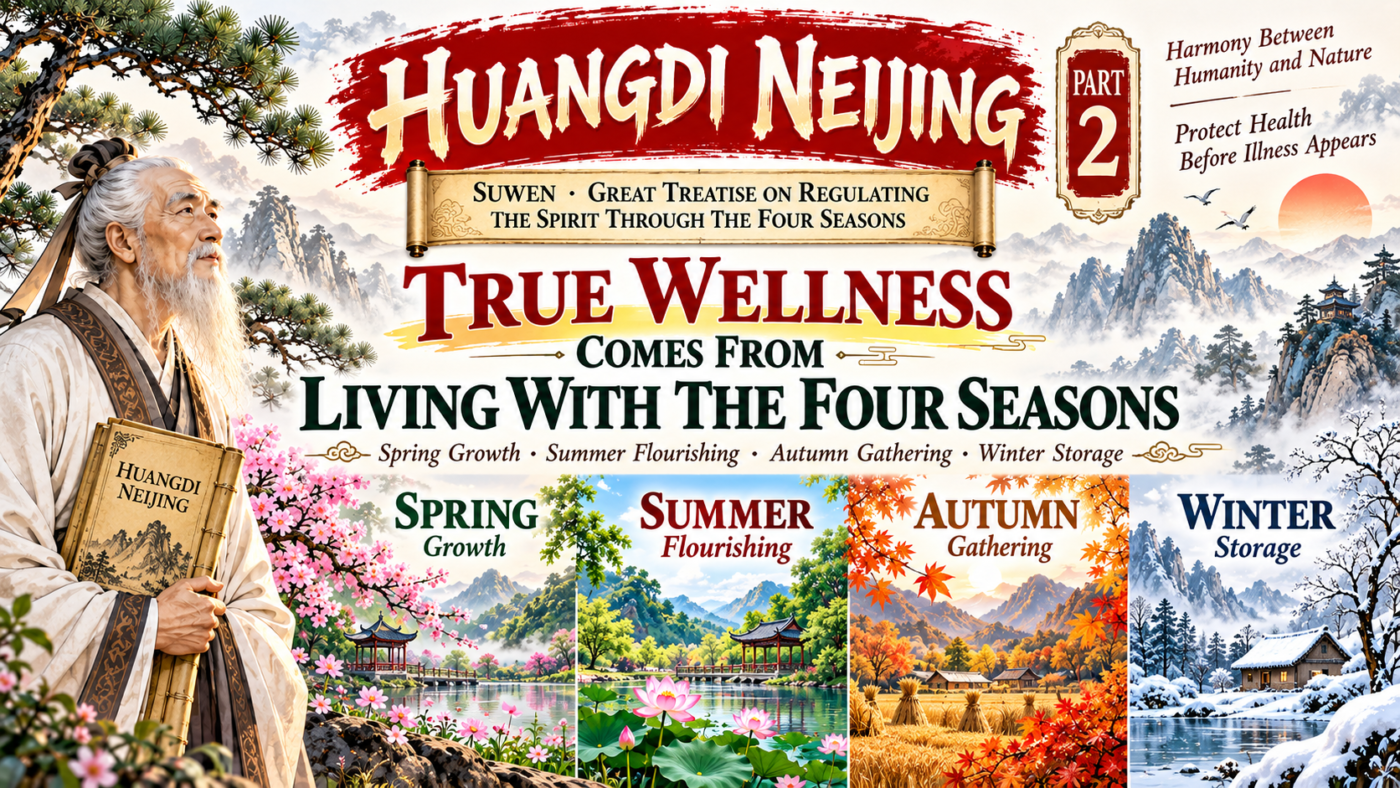
The Huangdi Neijing, also known as the Yellow Emperor’s Inner Classic, presents a distinctive approach to seasonal wellness. Its central rhythm is simple: spring encourages emergence, summer supports growth, autumn emphasizes gathering, and winter favors storage. Rather than following exactly the same routine throughout the year, the text encourages people to adapt movement, rest, daily rhythm, and emotional balance as the seasons change.
We usually explain these changes simply by saying that the weather has become warmer or colder. More than two thousand years ago, however, the Huangdi Neijing—the Yellow Emperor’s Inner Classic—described seasonal change from a much broader perspective.
According to this classical Chinese medical text, the seasons do not merely change the temperature around us. They represent different phases in the rhythm of nature itself.
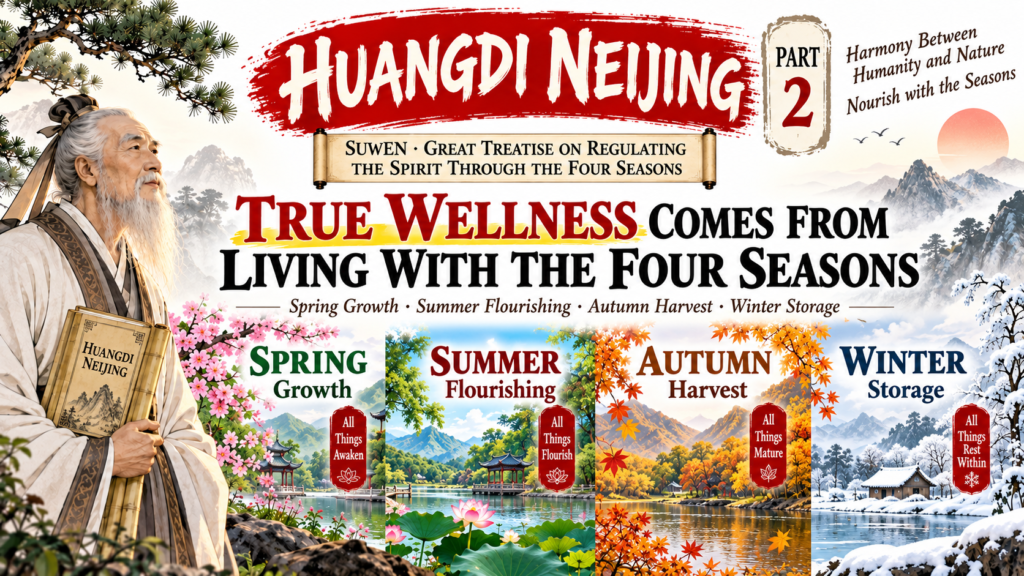
Spring is associated with emergence.
Summer with growth.
Autumn with gathering.
Winter with storage.
In Chinese, these four ideas are often summarized as:
生 · 长 · 收 · 藏
Sheng · Zhang · Shou · Cang
To understand the seasonal wellness philosophy of the Huangdi Neijing, these four words are the place to begin.
Human Life Within the Rhythm of Nature
The natural world is never static.
In spring, plants begin to sprout. In summer, leaves and branches flourish. During autumn, fruits mature and vegetation gradually contracts. By winter, many plants have shed their leaves, some animals reduce their activity, and much of nature enters a period of relative stillness.
The ancient physicians who developed the ideas recorded in the Huangdi Neijing observed that human beings do not exist separately from this environment.
Temperature changes. Daylight changes. The length of the day changes. Patterns of activity, food availability, sleep, and exposure to the outdoors change as well.
From this perspective, maintaining health does not mean following exactly the same routine every day of the year. It means learning how to adjust appropriately as circumstances change.
The guiding rhythm is simple:
Spring: emerge.
Summer: grow.
Autumn: gather.
Winter: store.
Spring: The Season of Emergence
The Huangdi Neijing describes the three months of spring as a period when heaven and earth come alive and the natural world begins to flourish.
After the stillness of winter, life starts moving outward again.
Buds appear on branches. Grass becomes green. Temperatures rise. Daylight gradually increases.
For human beings, the traditional message is not that spring requires a particular supplement or a specific “spring food.” The deeper principle is that the body and mind can gradually move from the relative quiet of winter toward greater activity and openness.
In practical terms, spring may be a good time to spend more time outdoors when conditions allow, walk regularly, enjoy moderate sunlight, practice gentle stretching, Tai Chi, or other comfortable movement, and gradually rebuild activity after a less active winter.
The important word is gradually.
Someone who has been relatively inactive throughout winter does not need to begin spring with exhausting exercise. A twenty-minute walk that feels comfortable may be more appropriate than suddenly attempting an intense workout.
The goal is not to force the body.
It is to help it become active again.
Spring and Emotional Openness
The spring section of the Huangdi Neijing also places unusual emphasis on a person’s mental and emotional state.
This does not mean that a person must never become angry in spring, nor does it mean that a single episode of anger automatically causes disease.
A more useful interpretation is that prolonged tension, suppression, anxiety, and anger can make both the body and mind feel persistently constricted.
Spring therefore offers a simple reminder to create a little more room in life.
Walk outside.
Look at trees and flowers.
Talk with friends.
Practice Tai Chi.
Spend less time continuously confined indoors.
If one word captures the spirit of spring, it may be:
Open.
Let the body open.
Let the mind open.
Let activity return gradually.
Summer: The Season of Growth
If spring represents emergence, summer represents expansion.
Vegetation that produced tender shoots in spring becomes abundant. Leaves fill out. Flowers bloom. Fruits begin to develop.
The Huangdi Neijing therefore describes summer as a period when life reaches outward and flourishes.
For human life, the principle is to remain appropriately active rather than becoming completely sedentary because of the heat.
But there is an important distinction:
Seasonal activity does not mean exhausting yourself.
Traditional descriptions of summer sometimes speak about allowing the body’s activity to move outward. This should not be interpreted as meaning that the more a person sweats, the healthier they become.
Especially for older adults, prolonged strenuous exercise in intense heat may increase the risk of dehydration, heat exhaustion, or heatstroke.
A modern practical approach is much simpler.
Remain active, but choose the conditions wisely.
Walking, Tai Chi, Baduanjin, mobility exercises, and other moderate forms of movement can be performed in the cooler parts of the day, such as the morning or evening.
Summer is not a competition to see how much heat or exercise the body can tolerate.
The aim is to remain active without creating unnecessary exhaustion.
Keeping the Mind from “Boiling”
The classical text also discusses emotional balance during summer.
Hot weather itself can make some people more irritable. Small problems may feel larger when the body is already uncomfortable.
The traditional message is therefore not only to avoid excessive physical strain, but also to avoid remaining mentally “overheated.”
When possible, slow down before reacting.
Do not struggle unnecessarily with yourself.
Do not turn every minor disagreement into another source of exhaustion.
The summer principle can be summarized as:
Flow.
Keep the body moving.
Allow the mind to remain relatively open.
But avoid excessive depletion.
Autumn: The Season of Gathering
Autumn marks a turning point.
Spring and summer emphasize outward development. Autumn begins to bring that movement inward.
Plants mature. Fruits are harvested. Leaves begin to fall. Temperatures decline, and the contrast between daytime and nighttime may increase.
The Huangdi Neijing describes this season in terms of gathering and settling.
For daily life, this can mean gradually becoming more regular with sleep, reducing unnecessary physical and mental expenditure, and allowing the pace of life to become calmer than it was during summer.
This does not mean withdrawing from life or becoming inactive.
Exercise can continue.
Walking, Tai Chi, and other moderate forms of movement remain suitable for many people.
The important difference is that exercise does not need to pursue exhaustion or heavy sweating every day.
Autumn Is Not Simply a Season for Supplements
One of the most common traditional ideas associated with autumn is “taking tonics.”
Yet the seasonal philosophy of the Huangdi Neijing is broader than a list of foods or supplements.
Its emphasis is on living appropriately within the season.
A person whose diet is already varied and adequate does not automatically need large quantities of tonic foods simply because autumn has arrived.
The more fundamental principle remains moderation and regularity.
The autumn keyword is:
Gather.
Let activity become more measured.
Let routines become steadier.
Let attention become less scattered.
And conserve some energy instead of using all of it.
Winter: The Season of Storage
Winter completes the cycle.
The classical text describes the winter months as a period of closing and storing.
Temperatures fall.
Days become shorter.
Nights become longer.
Vegetation becomes dormant, and many animals reduce their activity.
The traditional recommendation is therefore to avoid unnecessary depletion.
This does not mean that everyone must follow an ancient timetable or remain indoors throughout the winter. Modern people have jobs, families, and responsibilities that make rigid seasonal schedules unrealistic.
The principle is more useful than the exact clock time:
Do not spend the entire winter chronically overextended.
Rest matters.
Warmth matters.
Recovery matters.
Winter Exercise: Move Without Overdoing It
Winter does not require complete inactivity.
A better principle is:
Move, but not excessively.
Exercise when weather conditions are reasonably comfortable. Dress appropriately. Adjust intensity according to age, physical condition, and personal capacity.
There is little benefit in forcing yourself into strenuous exercise before sunrise in severe cold simply to prove that you can tolerate it.
Likewise, exercising until clothing is soaked with sweat and then becoming chilled in cold wind is unnecessary.
People with cardiovascular or other chronic medical conditions should be especially cautious about strenuous exercise in cold conditions and should follow individualized medical advice.
The winter principle can be summarized as:
Store.
Stay warm without overheating.
Remain active without exhaustion.
Rest without becoming completely sedentary.
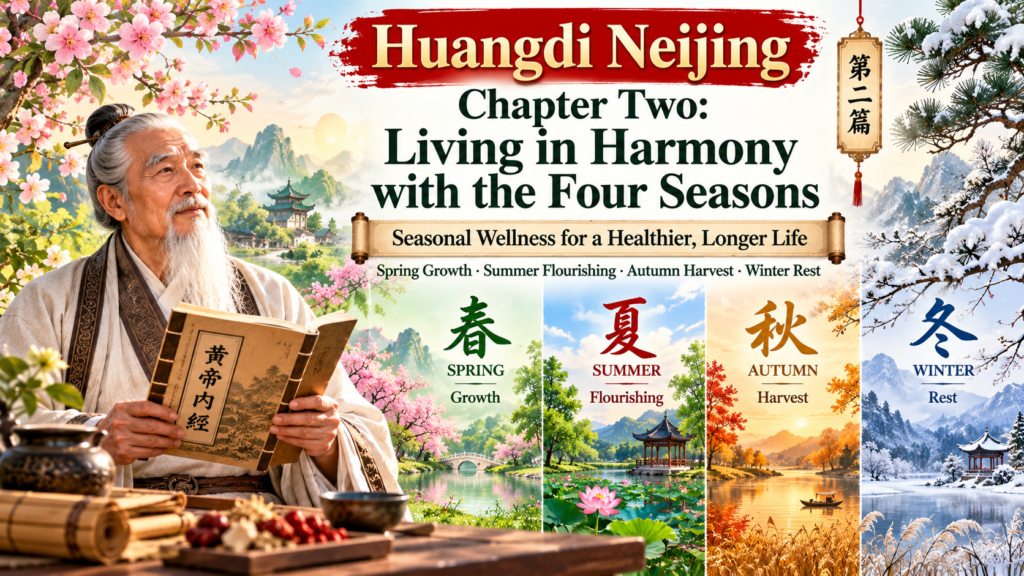
The Four Seasons Form One Continuous Cycle
Spring, summer, autumn, and winter are not four unrelated wellness programs.
They form one cycle.
Spring prepares for summer.
Summer develops what emerged in spring.
Autumn gathers what has developed.
Winter preserves resources for the next spring.
This is one of the most important ideas in the seasonal philosophy of the Huangdi Neijing.
Health is not created by responding only when something goes wrong.
What we do today influences the condition in which we enter tomorrow.
Sleep patterns accumulate.
Exercise habits accumulate.
Dietary habits accumulate.
Stress accumulates.
Recovery accumulates as well.
Seasonal living therefore encourages us to think beyond today’s symptom and today’s quick solution.
Heaven, Seasons, Environment, and Life
The Huangdi Neijing places human beings within a much larger relationship:
Heaven → seasons → environment → life
In traditional Chinese thought, this relationship is often discussed through the idea of correspondence between humanity and nature.
The terminology belongs to an ancient philosophical and medical framework, but the underlying observation is easy to understand.
Living organisms are affected by their environment.
Temperature changes.
Rainfall changes.
Daylight changes.
Seasonal conditions change.
Plants, animals, and humans all respond in different ways.
The classical approach therefore does not view the individual body as an isolated object. It considers health in relation to time, climate, behavior, and the surrounding environment.
“Nourish Yang in Spring and Summer, Nourish Yin in Autumn and Winter”
One of the best-known statements associated with this chapter is often translated as:
“In spring and summer, nourish yang; in autumn and winter, nourish yin.”
This phrase is sometimes reduced to a seasonal shopping list:
What should I eat to “tonify yang” in spring?
What should I take to “nourish yin” in winter?
But within the broader context of the chapter, its meaning is more fundamental.
Spring and summer are periods of emergence and outward development. Human activity can appropriately follow that movement.
Autumn and winter gradually turn toward contraction, recovery, and conservation. Human life can also reduce unnecessary expenditure.
In other words, the teaching is first a principle of seasonal living, not automatically a prescription for supplements.
That distinction matters.
The Deeper Principle: Prevention Before Crisis
Near the end of the discussion comes one of the most influential concepts in the Huangdi Neijing:
治未病 — zhi wei bing
The idea is often understood as addressing health before illness has fully developed.
The text uses a vivid analogy.
Waiting until a serious problem appears before taking action is compared to becoming desperately thirsty and only then beginning to dig a well.
The message remains relevant today, even when interpreted within modern healthcare rather than literally through ancient medical theory.
Do not wait for years of unhealthy habits to produce serious consequences before paying attention.
Attend appropriate health screenings.
If blood pressure, blood glucose, blood lipids, or other clinical measurements are abnormal, follow qualified medical advice rather than ignoring them because you “feel fine.”
Maintain regular physical activity.
Protect sufficient sleep.
Address persistent weight gain when appropriate.
Seek medical evaluation for ongoing or concerning symptoms.
These actions may seem ordinary.
That is precisely the point.
Much of effective long-term health management comes not from dramatic interventions, but from ordinary protective behaviors repeated consistently over time.
What Are We Really “Nourishing” Through the Four Seasons?
Spring is not simply about the liver.
Summer is not simply about the heart.
Autumn is not simply about the lungs.
Winter is not simply about the kidneys.
Those organ-season correspondences belong to the traditional theoretical system of Chinese medicine, but reducing the entire chapter to those associations misses its broader message.
The chapter is fundamentally concerned with the relationship between human life and time.
When is it appropriate to become more active?
When is it appropriate to conserve?
When should life expand?
When should it settle?
When should the mind become more outward-looking?
When should we allow ourselves more recovery?
That is the deeper meaning of seasonal regulation.
The Four Words to Remember
If you remember only four ideas from this entire discussion, remember these:
Spring — Emerge
Spend more time outdoors when conditions are suitable. Gradually increase activity. Stretch the body and create more emotional space.
Summer — Grow
Remain active and engaged, but avoid excessive exertion, overheating, and dehydration.
Autumn — Gather
Bring routines back toward greater regularity. Reduce unnecessary physical and mental expenditure.
Winter — Store
Protect warmth, recovery, and sleep. Continue appropriate movement without chronically overextending yourself.
And remember one final principle:
Do not wait until the body is already in serious difficulty before beginning to care for it.
The lasting value of the Huangdi Neijing is not that it gives us a collection of seasonal tricks.
It asks us to think differently about health itself.
Health is shaped by rhythm.
By repetition.
By time.
By the relationship between activity and recovery.
And by the small choices we continue making long before a crisis appears.
That is the deeper lesson of spring emergence, summer growth, autumn gathering, and winter storage.
FAQ
What does the Huangdi Neijing say about the four seasons?
The Huangdi Neijing describes seasonal life through four broad movements: spring is associated with emergence, summer with growth, autumn with gathering, and winter with storage. These ideas form part of a traditional framework for adjusting daily life according to seasonal change.
What does “spring emergence, summer growth, autumn gathering, winter storage” mean?
The phrase describes a natural cycle. Spring encourages renewed activity, summer represents fuller development, autumn begins a gradual inward shift, and winter emphasizes conservation and recovery. In seasonal wellness, these principles are applied to activity, rest, routines, and mental balance.
Does seasonal wellness mean taking different supplements every season?
Not necessarily. The seasonal philosophy of the Huangdi Neijing is much broader than supplements. It emphasizes adapting daily routines, activity levels, rest, emotional rhythm, and other lifestyle patterns to changing seasonal conditions.
What does “nourish yang in spring and summer, nourish yin in autumn and winter” mean?
Within traditional Chinese medicine, this phrase reflects the changing rhythm of the seasons. Spring and summer are associated with outward development, while autumn and winter emphasize gathering and conservation. It should not automatically be interpreted as a requirement to take specific herbs or supplements.
Is vigorous exercise recommended during summer?
The classical idea of seasonal activity should not be interpreted as exercising as hard as possible or deliberately producing excessive sweat. In hot conditions, excessive exertion can increase the risk of dehydration and heat-related illness. Moderate activity at appropriate times of day is generally more practical.
Should people stop exercising in winter?
No. Winter seasonal wellness does not require complete inactivity. The principle is to avoid unnecessary exhaustion, exercise under suitable conditions, stay appropriately warm, and adapt intensity to individual health and physical capacity.
What is “zhi wei bing”?
Zhi wei bing (治未病) is a classical Chinese medical concept commonly interpreted as addressing health before illness becomes established. In modern everyday terms, it can be understood as placing greater emphasis on prevention, healthy habits, appropriate screening, and early attention to health risks.
Is the Huangdi Neijing scientifically proven?
The Huangdi Neijing is an ancient medical and philosophical text rather than a modern scientific medical guideline. Some of its lifestyle observations may overlap with modern health principles, but traditional concepts such as yin, yang, qi, and organ-season correspondences should not automatically be treated as equivalent to modern physiology or clinical evidence.
Medical Disclaimer: This article discusses traditional concepts from the Huangdi Neijing for educational and cultural purposes. Traditional Chinese medicine terminology should not be interpreted as equivalent to modern medical diagnosis or physiology. The information is not a substitute for individualized medical advice, diagnosis, or treatment. People with medical conditions, persistent symptoms, or concerns about exercise, sleep, diet, medications, or other aspects of health should consult an appropriately qualified healthcare professional.
This article is for general education and does not replace individualized care from a qualified health professional. Seek appropriate advice for persistent, severe, or concerning symptoms.
Read the full medical disclaimer