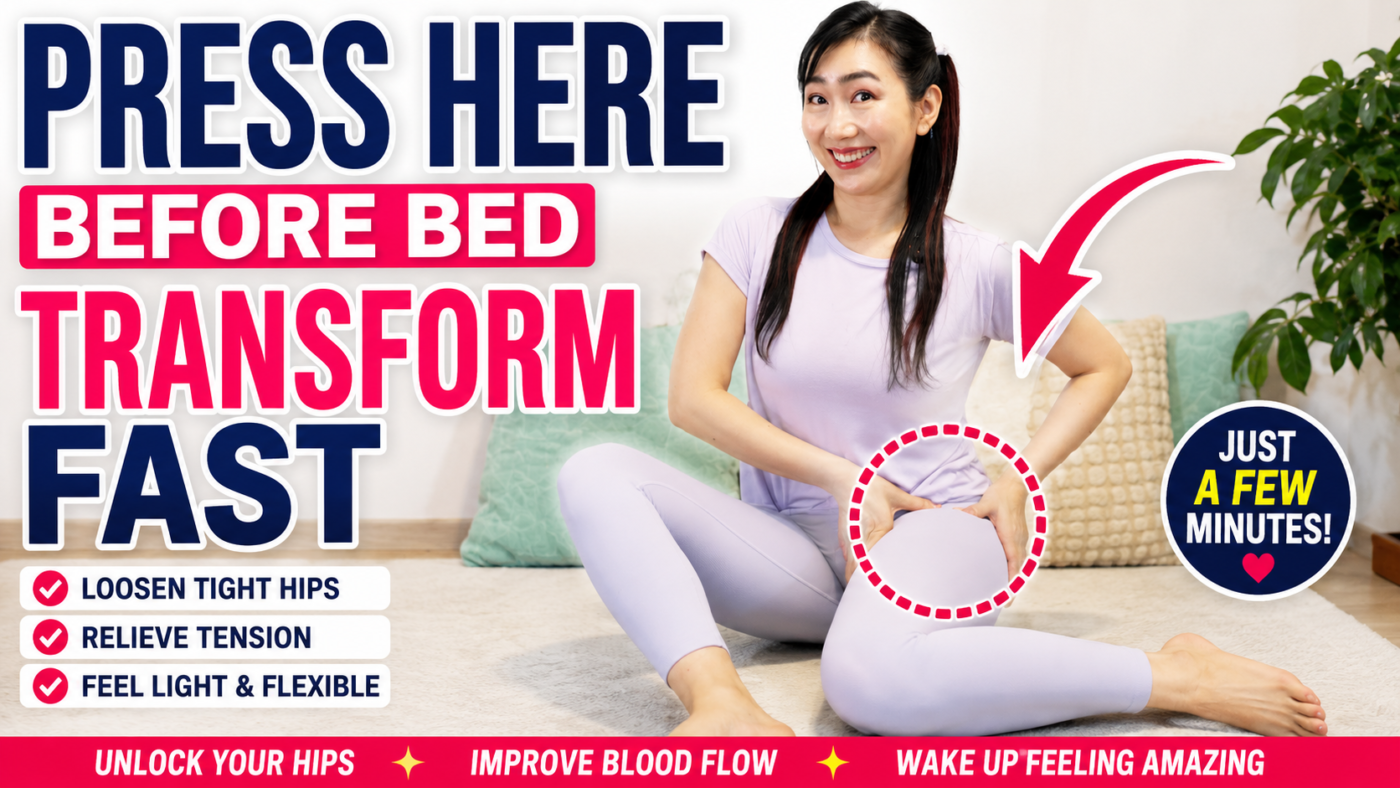
Hip mobility before bed can be a simple way to unwind after a long day of sitting, walking, commuting, or working at a desk. Tight hips do not necessarily mean that something is “blocked,” and you do not need painful stretching, aggressive massage, or dramatic detox claims to make useful progress.
A better approach is gentle, controlled movement.
A short evening routine that combines ankle motion, hip rotation, 90/90 positions, butterfly stretching, breathing, and light self-massage may help reduce the sensation of stiffness, improve movement confidence, and make the hips feel more comfortable before sleep.
The goal is not to force the hips open.
The goal is to give them more comfortable movement options.
Why Hips Can Feel Tight at the End of the Day
Hip stiffness can have many causes.
Long periods of sitting keep the hips in relatively similar positions for hours. This does not automatically damage the joints, but it can make deeper ranges of hip flexion, rotation, and abduction feel unfamiliar.
Reduced activity, strength imbalances, previous injuries, age-related changes, stress, and habitual posture can also influence how the hips feel.
Some people describe their hips as “locked,” but in many cases the sensation is better understood as limited mobility, muscular tension, reduced tolerance to certain positions, or joint stiffness.
That distinction matters because forcing a painful stretch is rarely the best solution.
1. Start With Relaxed Leg Shaking
Sit comfortably on the floor or on a firm mat.
Extend your legs in front of you and allow them to relax.
Gently shake or wiggle the legs for 20 to 30 seconds.
This simple movement can help reduce unnecessary muscular tension before deeper mobility work.
Do not try to create a large range of motion.
The purpose is simply to relax.
2. Add Ankle Circles
Slowly rotate one ankle in a comfortable circle.
Change direction.
Then repeat on the other side.
Ankle motion may seem unrelated to the hips, but lower-body movement is interconnected. The feet, ankles, knees, and hips all contribute to walking and balance.
Improving awareness and mobility throughout the lower limb can make the entire routine feel smoother.
Perform five to ten slow circles in each direction.
3. Practice Gentle Hip Rotation
Sit with your knees bent.
Slowly allow the knees to move from side to side.
Keep the movement small at first.
This introduces internal and external rotation at the hips without requiring an aggressive stretch.
Move only through a pain-free range.
If one side feels tighter, do not force it to match the other.
Asymmetry is common.
4. Try the Butterfly Stretch
Bring the soles of your feet together and allow your knees to fall outward.
Sit as tall as comfortably possible.
If your pelvis rolls backward or your lower back rounds significantly, sit on a folded blanket or cushion.
You can remain upright or lean forward slightly.
The important part is that you can breathe comfortably.
Do not push your knees toward the floor.
Stay for approximately 30 to 60 seconds.
5. Use a 90/90 Hip Position
The 90/90 position is a useful way to explore hip rotation.
Sit with one leg in front of you and the other to the side or behind you, with both knees bent approximately 90 degrees.
Do not worry if your position does not look perfect.
Place your hands on the floor for support.
Sit tall and notice where you feel tension.
You can lean slightly forward over the front leg if that feels comfortable.
Hold for 20 to 40 seconds.
Then switch sides.
Why the 90/90 Position Can Feel So Effective
The 90/90 position places the two hips in different rotational demands at the same time.
One hip is generally more externally rotated, while the other is more internally rotated.
This makes it a useful mobility exercise for people who spend most of the day with the hips facing straight ahead.
It does not “unlock” the hip instantly.
Instead, repeated exposure may gradually make these positions feel more familiar and comfortable.
6. Add Gentle Torso Rotation
While sitting in a comfortable hip position, place one hand behind you and the other near the opposite knee.
Slowly rotate your torso.
Keep the movement gentle.
Do not wrench the spine or force the hip.
Take a slow breath in.
Exhale and relax.
Return to center.
Repeat on the other side.
This combines hip mobility with trunk rotation and can feel especially good after a day of sitting.
7. Try Light Self-Massage Around the Hips and Thighs
Self-massage can be a pleasant addition to mobility work.
Use your hands to gently massage the outer hip, upper thigh, inner thigh, and surrounding muscles.
Pressure should remain comfortable.
Avoid the idea that you need to find a brutally painful “trouble spot.”
Pain is not proof that massage is working.
If a spot is tender, reduce pressure.
Gentle pressure, slow breathing, and gradual exposure are usually more sensible than aggressive digging.
Should You Press on Painful Spots?
Not aggressively.
Some people enjoy light pressure over muscular trigger points or tense areas.
But a sharp, electric, burning, or deeply painful sensation is a reason to stop.
Pain may reflect muscle irritation, tendon problems, joint issues, nerve sensitivity, or other conditions.
Do not assume every painful spot is simply “tight fascia.”
Does Fascia Need to Be “Melted”?
Fascia is real connective tissue that surrounds and connects muscles and other structures.
But phrases such as “melting fascia” are usually metaphors rather than literal descriptions.
Stretching and massage may temporarily change how tissues feel, how much movement you tolerate, and how relaxed an area feels.
That does not mean fascia is physically melting.
The more useful goal is improved movement comfort.
Can Hip Mobility Improve Blood Flow?
Movement naturally influences circulation because muscles contract and joints move.
A short mobility routine can increase local warmth and make the legs feel more active.
But claims that stretching causes blood flow to “skyrocket” or sends the body into a special detox state are not supported by strong evidence.
You do not need a detox explanation to justify moving.
Movement itself is beneficial.
Can Hip Stretching Help You Lose Weight While You Sleep?
No.
Hip mobility exercises do not cause meaningful fat loss during sleep.
Weight management is influenced by overall energy intake and expenditure, physical activity, sleep, hormones, genetics, medications, and other factors.
Stretching can support an active lifestyle, but it is not a fat-burning shortcut.
A smaller waist after a mobility routine may reflect posture, reduced bloating, or temporary changes in muscular tension—not fat loss.
Is Bedtime a Good Time for Hip Mobility?
For many people, yes.
Gentle evening mobility can be relaxing and may help transition from a busy day into rest.
The key word is gentle.
A highly intense stretching session immediately before bed may be stimulating or uncomfortable for some people.
Aim for movements that leave you feeling calmer rather than exhausted.
A Simple 10-Minute Hip Mobility Before Bed Routine
Minute 1: Relaxed leg shaking and breathing.
Minute 2: Ankle circles.
Minute 3: Gentle knee side-to-side hip rotation.
Minute 4: Butterfly stretch.
Minute 5: 90/90 position on the first side.
Minute 6: 90/90 position on the second side.
Minute 7: Gentle torso rotation.
Minute 8: Light inner-thigh massage.
Minute 9: Light outer-hip and thigh massage.
Minute 10: Sit or lie comfortably and breathe slowly.
You do not need to complete every movement perfectly.
The routine should feel restorative.
What About the Inner Thighs?
The adductor muscles along the inner thigh help stabilize and move the hips.
They are active during walking, balance, direction changes, and many strength exercises.
Gentle massage or stretching may make this area feel more comfortable if it is tense.
The inner thighs also work together with other muscles around the pelvis, but it is inaccurate to say that strengthening or massaging them automatically “fixes” the pelvic floor.
Pelvic-floor function is complex and can involve weakness, overactivity, coordination problems, childbirth-related changes, pain, and other factors.
Persistent pelvic-floor symptoms deserve professional assessment.
Who Should Be Careful?
Use caution if you have:
- recent hip or knee surgery
- severe arthritis
- recent fractures
- significant osteoporosis
- severe groin pain
- unexplained hip pain
- numbness or weakness
- pain that radiates down the leg
- difficulty getting safely onto or off the floor
People with recent postpartum complications or pelvic-floor symptoms should also consider individualized guidance.
Stop any movement that causes sharp or worsening pain.
When Hip Pain Needs Medical Evaluation
Hip stiffness and hip pain are not the same thing.
Seek professional evaluation if pain is persistent, severe, worsening, or interfering significantly with walking or sleep.
Also seek care if symptoms follow a major injury, involve inability to bear weight, are accompanied by fever, or occur with significant neurological symptoms.
Do not try to “massage through” unexplained pain.
The Bottom Line
Hip mobility before bed does not need to involve extreme stretching or painful pressure.
A few minutes of gentle movement can be enough.
Ankle circles, hip rotations, butterfly stretching, 90/90 positions, torso movement, and light self-massage may help reduce the sensation of stiffness and make the hips feel more comfortable.
The most useful principle is simple:
Do not force range. Build comfort gradually.
Your hips do not need to “open instantly.”
They need regular opportunities to move.
Frequently Asked Questions
Is hip mobility before bed good for tight hips?
It can be. Gentle mobility exercises may help reduce the sensation of stiffness and improve comfort, especially after prolonged sitting.
How long should I stretch my hips before bed?
Five to ten minutes is enough for many people. Longer sessions are not automatically better.
Is the 90/90 stretch good for hip mobility?
The 90/90 position is a useful way to explore internal and external hip rotation. It should remain comfortable and supported.
Should hip stretches hurt?
No. Mild stretching tension is normal, but sharp, burning, electric, or intense pain is a reason to stop.
Can hip stretching burn fat?
No. Stretching does not selectively burn hip, belly, or waist fat.
Can hip mobility improve sleep?
A gentle routine may help some people relax before bed, although it is not a treatment for insomnia.
Does self-massage loosen fascia?
Massage may temporarily reduce the sensation of tension and improve movement comfort, but claims that fascia literally “melts” are oversimplified.
Medical Disclaimer:This article is for general educational purposes only and is not medical or physical-therapy advice. Hip pain can have many causes. Stop any stretch or massage that causes sharp, worsening or unusual symptoms and seek appropriate professional care for persistent or severe pain.
This article is for general education and does not replace individualized care from a qualified health professional. Seek appropriate advice for persistent, severe, or concerning symptoms.
Read the full medical disclaimer