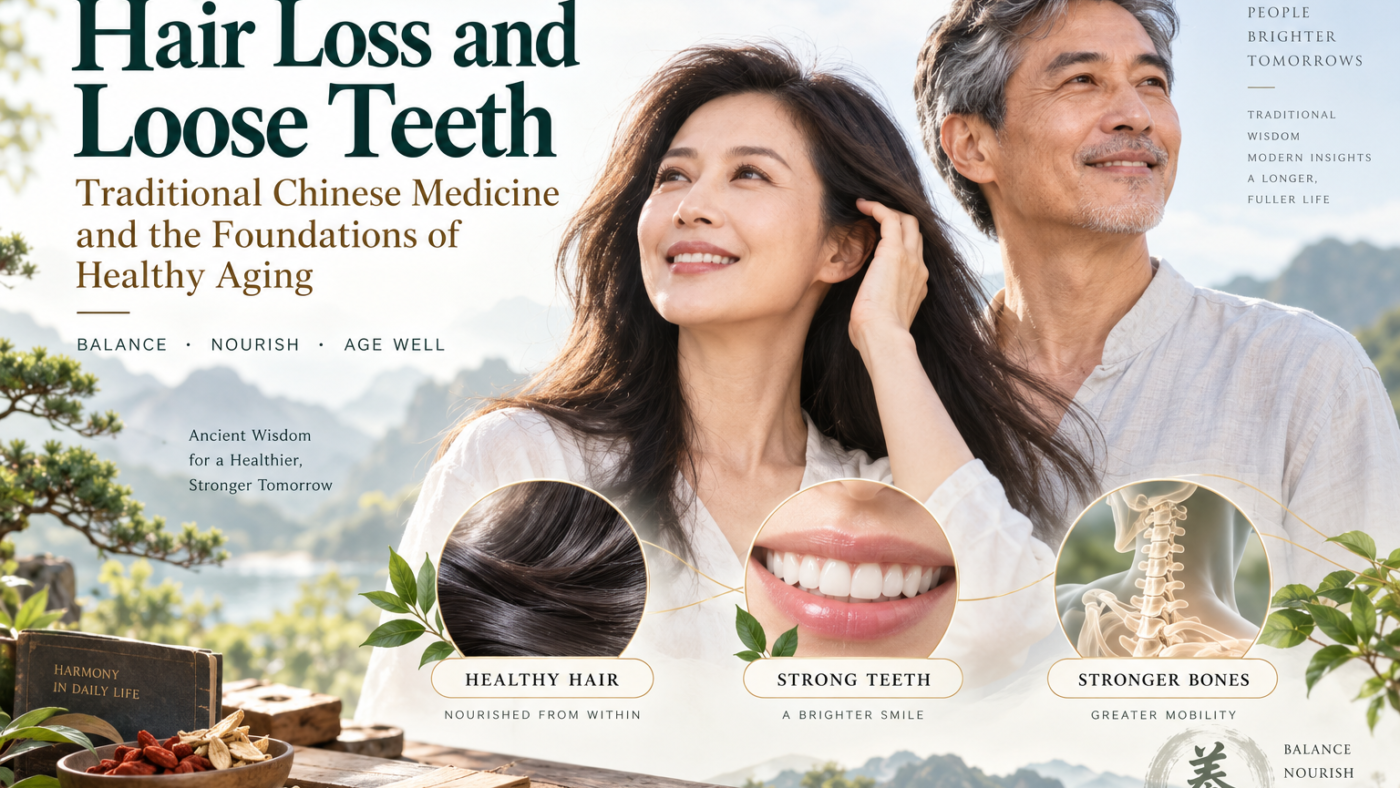
Understanding the traditional connection between Kidney vitality, hair health, oral health, and long-term well-being.
Healthy aging is not simply about living longer. It is about preserving the body’s strength, resilience, and ability to function well throughout life.
In Traditional Chinese Medicine (TCM), changes in hair, teeth, bones, and physical vitality are often interpreted as signs of deeper changes in the body’s internal balance. Rather than viewing each symptom in isolation, traditional practitioners consider the relationships among the body’s functional systems, nutritional status, lifestyle, and overall constitution.
This perspective provides an interesting framework for understanding why hair thinning, dental problems, and declining musculoskeletal health may become more noticeable during middle age and later life.
However, traditional concepts and modern medical diagnoses are not interchangeable. Hair loss and loose teeth have many potential causes, and identifying those causes is essential for effective care.
Hair loss and loose teeth may become more noticeable with age, but they can have different underlying causes that require individual assessment.
Hair Loss and Loose Teeth: The Traditional Chinese Medicine Perspective
In Traditional Chinese Medicine, the Kidneys are regarded as a foundational source of vitality, growth, development, reproduction, and aging.
The traditional concept of Kidney function extends beyond the anatomical kidneys. It represents a broader system associated with inherited constitution, physiological development, and the maintenance of essential bodily functions.
Classical Chinese medical theory describes hair as closely connected to the condition of Blood and Kidney Essence.
The Liver is traditionally associated with storing Blood, while the Kidneys are associated with preserving Essence. These two systems are considered interconnected, giving rise to the classical idea that the Liver and Kidneys share a common source.
Within this framework, healthy hair is traditionally associated with sufficient nourishment and balanced internal function.
Conversely, dry, brittle, thinning, or prematurely graying hair may be interpreted as a sign that nourishment, Blood, or Kidney Essence has become insufficient.
These traditional interpretations are not equivalent to a modern diagnosis of kidney or liver disease. They represent a historical framework for describing patterns of health and illness.
Modern dermatology recognizes that hair health depends on a complex interaction of genetics, hormones, nutritional status, immune function, aging, and the biological activity of hair follicles.
Why Hair Loss Becomes More Common With Age
Hair growth follows a repeating biological cycle involving active growth, transition, resting, and shedding.
As people age, changes in the growth cycle may contribute to reduced hair density and thinner individual strands.
Several other factors can contribute to hair loss, including inherited androgenetic alopecia, thyroid disorders, iron deficiency, significant emotional or physical stress, certain medications, autoimmune conditions, and scalp disorders.
Hair loss may also occur following major illness, surgery, or substantial weight loss.
Because these conditions require different approaches, not all forms of hair loss respond to the same treatment.
A holistic approach to hair health begins with understanding the underlying cause while supporting the body’s general nutritional and physiological needs.
Supporting Healthy Hair Naturally
A balanced diet helps provide the nutrients necessary for normal hair growth.
Protein is particularly important because hair is composed primarily of keratin, a structural protein produced by specialized cells within the hair follicle.
Iron, zinc, vitamin D, and other nutrients also contribute to normal physiological function. Deficiencies may affect hair health, although supplementation is most useful when a specific deficiency or clinical need has been identified.
Adequate sleep, stress management, regular physical activity, and gentle hair-care practices can support general health and help reduce avoidable hair damage.
Traditional wellness practices such as Tai Chi, Qigong, meditation, and gentle movement may also support relaxation and quality of life.
These practices can complement appropriate dermatological care, but they should not be presented as guaranteed methods of restoring hair growth.
Visible improvement in hair density typically requires months rather than days, and results depend on the underlying condition and treatment.
The Traditional Connection Between Kidney Vitality, Bones, and Teeth
Traditional Chinese Medicine also associates Kidney Essence with the nourishment and development of bones.
According to classical theory, the Kidneys govern the bones, and the teeth are considered an extension of the skeletal system.
This relationship helps explain why traditional practitioners have historically considered dental strength, skeletal health, and aging together.
Within this framework, weakening teeth, declining physical strength, and changes in the skeletal system may be interpreted as part of a broader pattern involving Kidney vitality.
Modern medicine approaches these concerns through the biological processes that maintain bones, teeth, periodontal tissues, muscles, and connective structures.
Although teeth and bones share some mineral components, they are anatomically and physiologically distinct.
A loose tooth does not, by itself, establish a nutritional deficiency, impaired kidney function, or a traditional Kidney-deficiency pattern.
Why Teeth Become Loose in Middle Age and Later Life
Adult teeth are normally held firmly in place by the periodontal ligament, surrounding gum tissues, and supporting alveolar bone.
When these structures become damaged, teeth may gradually lose stability.
One important cause is periodontal disease, a condition involving inflammation and damage to the tissues supporting the teeth.
Periodontal disease often develops when bacterial plaque accumulates along and below the gumline.
Over time, persistent inflammation may damage periodontal tissues and contribute to the loss of supporting bone.
Other causes of tooth mobility include dental trauma, excessive biting forces, and certain dental or medical conditions.
Common warning signs include bleeding gums, persistent bad breath, gum recession, discomfort while chewing, and changes in the position or stability of teeth.
Importantly, tooth loss is not an inevitable consequence of aging.
With appropriate prevention, dental treatment, and ongoing oral hygiene, many people can preserve their natural teeth throughout life.
Protecting Dental Health Through Daily Habits
Long-term dental health depends on maintaining healthy gum tissues and controlling the factors that contribute to periodontal disease.
Brushing twice daily with fluoride toothpaste and cleaning between the teeth regularly help reduce bacterial plaque.
Professional dental examinations and cleanings are important for identifying problems that may not produce noticeable symptoms during their early stages.
Avoiding tobacco, managing diabetes when present, and maintaining a nutritionally balanced diet can further support oral health.
When a permanent tooth becomes loose, prompt dental assessment is essential.
Depending on the underlying cause, treatment may involve professional cleaning, periodontal therapy, management of excessive biting forces, or other dental procedures.
Traditional wellness practices can support general well-being, but they cannot replace treatment for infection, damaged periodontal tissues, or loss of supporting bone.
Bone Health, Neck Mobility, and Healthy Aging
The traditional association between Kidney vitality and skeletal strength also provides a starting point for discussing the importance of maintaining healthy bones and muscles.
With aging, some people develop degenerative changes in the cervical spine, including alterations in the intervertebral discs, joints, and surrounding structures.
These changes may be accompanied by bone spurs, also known as osteophytes.
Although osteophytes are sometimes associated with neck stiffness or pain, their presence on an imaging study does not necessarily mean that they are causing symptoms.
Maintaining muscle strength, physical activity, and appropriate mobility can help support musculoskeletal function.
Walking, resistance training, gentle stretching, and individualized rehabilitation exercises may contribute to healthier movement and improved physical resilience.
Tai Chi can also be incorporated into an active lifestyle, particularly for individuals seeking gentle movement, balance training, and mind-body relaxation.
Nevertheless, persistent neck pain, progressive weakness, numbness, impaired coordination, or difficulty walking requires medical evaluation.
No nutritional supplement or traditional Kidney-tonifying treatment has been established as a reliable method for reversing cervical bone spurs.
A Balanced Approach to Lifelong Vitality
The enduring value of traditional health cultivation lies partly in its emphasis on prevention, balance, and consistent daily care.
Rather than waiting for physical decline to become severe, individuals can cultivate habits that support long-term well-being.
Healthy aging requires attention to nutrition, sleep, physical activity, emotional health, dental care, and the timely recognition of medical problems.
Traditional Chinese Medicine offers a historical perspective on the relationships among vitality, nourishment, and the aging process.
Modern medicine contributes diagnostic tools and evidence-based treatments that can identify specific causes of hair loss, dental instability, and skeletal disorders.
These approaches can be discussed together without assuming that their concepts are medically equivalent.
The goal of healthy aging is not to promise that every age-related change can be reversed. It is to preserve function, recognize treatable problems early, and create the conditions for a healthier, more active life.
Medical Disclaimer:
This article is intended for educational purposes only and does not constitute medical or dental advice. Traditional Chinese Medicine concepts should not be interpreted as established biomedical diagnoses. Consult a qualified healthcare professional for persistent hair loss, loose teeth, neck pain, or other concerning symptoms. Do not delay necessary medical or dental treatment in favor of unproven remedies.
This article is for general education and does not replace individualized care from a qualified health professional. Seek appropriate advice for persistent, severe, or concerning symptoms.
Read the full medical disclaimer