Why Getting Down to the Floor Matters More Than You Think
Lowering yourself into a deep squat or sitting on the floor can feel surprisingly difficult if you have spent years sitting mostly in chairs.
The ankles may feel stiff. The hips may resist. The thighs begin working harder than expected. Standing back up without using your hands can be even more challenging.
Yet this apparently simple movement reveals something important about functional health.
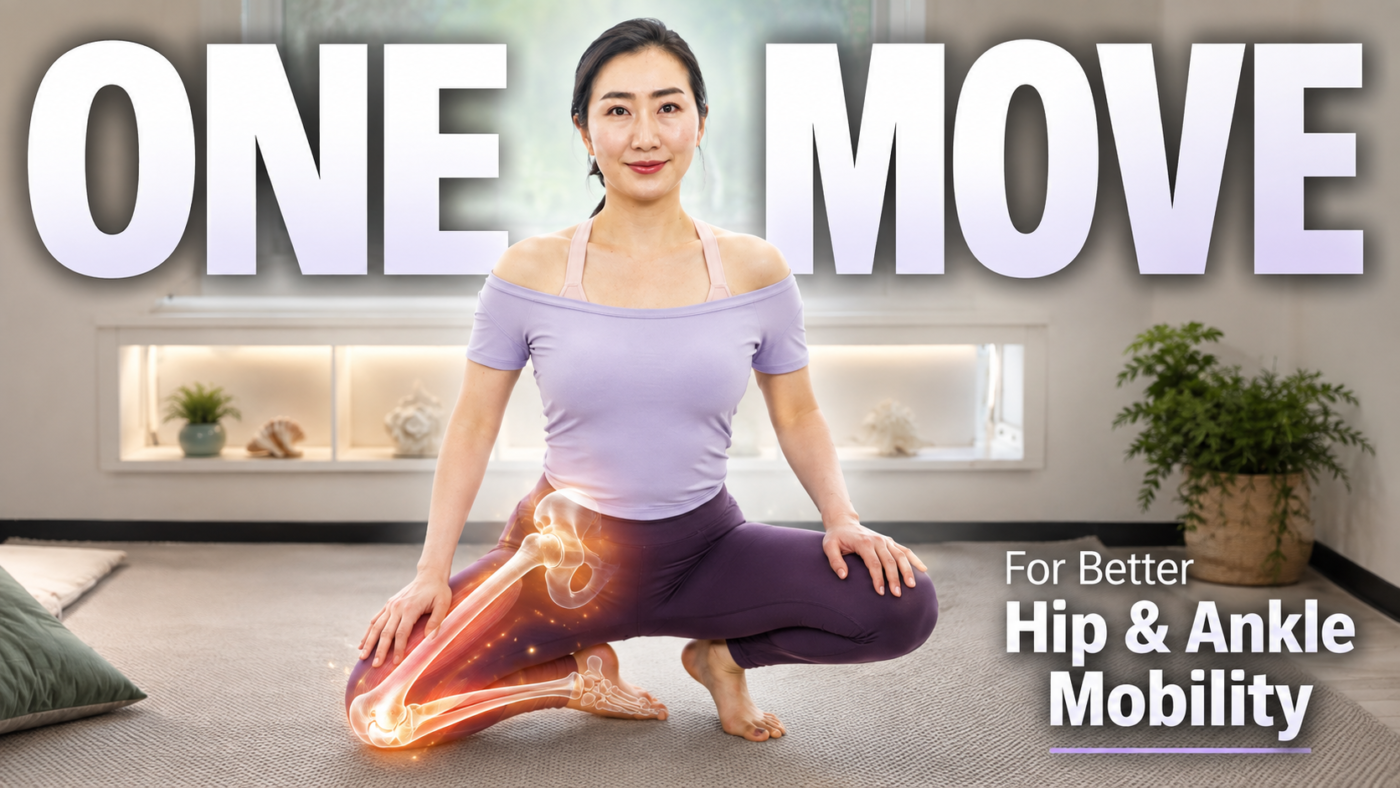
Getting down to the floor and returning to standing requires ankle mobility, hip mobility, leg strength, balance, coordination and trunk control. These are exactly the physical qualities that help people remain active and independent as they grow older.
This does not mean that everyone needs to perform a perfect deep squat. Nor does the ability to sit on the floor guarantee longevity.
But maintaining the physical capacity to change levels, rise from the floor and control your body through a large range of motion can be a valuable part of healthy aging.
What Japanese Floor Culture Can Teach Us About Movement
Traditional Japanese homes and cultural practices have historically included much more floor-level activity than many modern Western environments.
People may sit on tatami mats, kneel in seiza, move between kneeling and standing, or participate in activities such as tea ceremony that require controlled transitions close to the floor.
One traditional movement sometimes described in connection with this style of movement is Issoku Dachi, a controlled transition from a low position toward standing while keeping the body coordinated and balanced.
The exact cultural form is less important for general fitness than the movement principle behind it.
Instead of avoiding the floor, the body repeatedly practices moving toward it and away from it.
Over a lifetime, that kind of movement exposure may help preserve abilities that otherwise decline simply because they are rarely used.
Floor-to-Stand Ability Is a Whole-Body Skill
Standing up from a low position is not simply a leg exercise.
The toes help stabilize the foot.
The ankles must move through enough dorsiflexion to allow the body to travel forward and downward.
The knees flex deeply.
The hips must control both mobility and force.
The gluteal muscles and thighs generate power.
The abdominal and trunk muscles help stabilize the torso.
At the same time, the nervous system continuously monitors balance and body position.
This is why floor-to-stand movement can feel dramatically harder than an isolated exercise performed on a machine.
The entire body must cooperate.
Why Ankle Mobility Is So Important
Many people assume that difficulty with deep squatting comes entirely from weak legs.
Often, ankle mobility is part of the problem.
When the ankle cannot move forward adequately over the foot, the body must compensate somewhere else. The heels may rise, the feet may turn outward, the torso may fall forward or the knees and hips may alter their movement.
Limited ankle mobility can arise from inactivity, previous injuries, footwear habits or simply years of rarely using deep ranges of motion.
Gentle ankle circles, calf mobility work and supported squatting can gradually expose the ankle to larger ranges of comfortable movement.
The goal should not be forcing the ankle into a painful position.
Mobility improves through repeated, tolerable exposure rather than aggressive stretching.
Do Not Forget the Toes and Feet
The feet contain a remarkably complex system of bones, joints, muscles, tendons and sensory receptors.
Yet modern life gives them surprisingly little variety.
Many people spend most of the day in structured footwear and rarely challenge their toes to stabilize the body independently.
Simple foot movements can therefore be useful.
Moving the toes, gently spreading them, rotating the ankles and allowing the feet to experience different positions can help maintain awareness and mobility.
For older adults in particular, foot and ankle function matters because balance begins where the body meets the ground.
Hip Mobility Makes the Squat Possible
The hips are another major part of comfortable floor movement.
When hip mobility is limited, the knees, ankles or lower back may compensate.
This does not mean that everyone needs extraordinary flexibility.
The goal is simply enough comfortable motion to perform everyday tasks safely.
Gentle hip rotations, supported squats and controlled transitions between sitting, kneeling and standing can help people explore this range.
For someone who has been sedentary for years, even a small improvement can make activities such as getting out of a low chair, gardening or picking something up from the floor noticeably easier.
Strength and Mobility Must Work Together
Flexibility alone is not enough.
Someone may be able to reach a deep squat but still struggle to stand up because the legs cannot generate enough force.
Conversely, a strong person may have difficulty reaching the floor because the ankles or hips are too stiff.
Healthy movement requires both mobility and strength.
That is one reason controlled floor-to-stand practice can be useful.
You are not merely stretching.
You are learning to control your body through the range.
This concept becomes increasingly important with age because independence depends not only on having strong muscles but on being able to use that strength in real-life positions.
Balance Is Also a Brain Skill
Every time you lower your center of gravity, shift your weight or rise from the floor, your nervous system performs thousands of small calculations.
Your eyes, inner ear, joints, muscles and brain continuously exchange information about where your body is in space.
This process is known broadly as sensorimotor control.
Balance therefore is not simply a matter of strong legs.
It is a learned neurological skill.
Activities that safely challenge balance and coordination give the nervous system opportunities to keep practicing.
That might include walking on varied terrain, tai chi, controlled squatting, single-leg exercises or floor-to-stand transitions.
Is Floor-to-Stand Ability Related to Longevity?
This question needs careful interpretation.
Some observational research has found associations between physical function and long-term health outcomes. Measures such as walking speed, grip strength, balance, chair-rise performance and the ability to perform everyday tasks can provide useful information about overall physical resilience.
However, being able to stand up from the floor does not itself add a specific number of years to your life.
It would therefore be misleading to claim that practicing a Japanese squat will make someone live to 100 or automatically extend lifespan by ten years.
A better conclusion is that the movement trains physical qualities associated with independent living.
That distinction matters.
The goal is not to chase a longevity trick.
The goal is to maintain a body capable of participating in life.
Why This Matters More After 40 and 60
Muscle mass and power tend to decline with age, especially when people become less active.
Joint range of motion may also gradually narrow because everyday life stops demanding it.
A person who never gets onto the floor may eventually discover that getting onto the floor has become difficult.
A person who never practices standing from low positions may gradually lose confidence doing so.
The encouraging part is that physical capacity is trainable at many ages.
Strength training, walking, balance work and mobility practice can produce meaningful benefits even when started later in life.
The exercises simply need to be appropriate for the individual’s starting point.
A Safer Progression for Beginners
You do not need to begin with a full floor squat.
Start with a stable chair or countertop nearby.
Practice lowering into a comfortable supported squat and standing again.
Then gradually explore deeper positions as your ankles, hips and legs become more comfortable.
You can also practice getting down to the floor using your hands and then standing again with support.
Using assistance is not failure.
It is progression.
Over time, the amount of support may decrease as strength, balance and confidence improve.
For many people, that is a much safer strategy than repeatedly forcing a deep squat.
What About Seiza?
Seiza is the traditional Japanese kneeling posture in which a person sits back toward the heels.
Some people find it comfortable.
Others experience significant pressure in the knees, ankles or feet.
There is no health requirement to sit in full seiza.
Using cushions, sitting for shorter periods or avoiding the position entirely may be appropriate.
People with significant knee arthritis, previous knee surgery, severe ankle problems or other musculoskeletal conditions should be especially cautious.
Traditional does not automatically mean appropriate for every body.
Mobility Is Really About Freedom
The most meaningful reason to maintain mobility is not to perform impressive exercises.
It is to preserve choices.
Can you get down to play with a child?
Can you garden?
Can you pick something up?
Can you stand from a low seat?
Can you walk through an airport?
Can you climb stairs?
Can you travel without constantly worrying about whether your body will manage the next movement?
That is functional mobility.
A capable body gives you more ways to participate in life.
The Best Exercise Is Not Necessarily the Most Extreme
Modern fitness culture often rewards intensity.
But healthy aging depends heavily on consistency.
A person does not need punishing workouts every day to preserve movement.
Walking, resistance training, balance practice, tai chi, gentle mobility work and occasional floor-based movement can all contribute.
The most effective routine is one that challenges the body enough to create adaptation without repeatedly causing injury or exhaustion.
Progress should feel gradual.
A Five-Minute Mobility Practice
A simple session could include gentle ankle circles, comfortable toe movement, supported hip rotations, several controlled sit-to-stand repetitions and a few supported squats.
Someone who is comfortable on the floor could then practice lowering toward kneeling and returning to standing while holding a stable support.
There is no need to complete every movement.
The quality of control matters more than depth.
When You Should Be Cautious
Deep squatting and kneeling are not appropriate for everyone.
Stop if you experience sharp knee pain, significant hip pain, severe ankle pain, dizziness, numbness, sudden weakness or a feeling that a joint is unstable.
People with a recent joint replacement, significant arthritis, osteoporosis, neurological conditions, balance disorders or recent surgery should discuss new floor-based exercises with an appropriate healthcare professional or physical therapist.
Older adults who are concerned about falling should practice near stable support rather than attempting unsupported floor transitions alone.
The Bigger Lesson From Japanese Movement Culture
The most useful lesson may not be a particular squat at all.
It is the idea that movement can remain integrated into everyday life.
Mobility does not have to exist only during a scheduled workout.
Getting down to the floor, standing up, walking, carrying, reaching, kneeling and changing positions are all opportunities for the body to practice being capable.
When those movements disappear from daily life, our range of movement may gradually shrink.
When we continue using them, we give the body a reason to maintain them.
Healthy aging is not about preserving the body in a perfect state.
It is about preserving options.
The ability to move confidently from the floor to standing is one small but meaningful example.
FAQ
Is deep squatting good for older adults?
It can be useful for some people because it challenges ankle and hip mobility, leg strength and balance. However, the depth and level of support should match the individual’s mobility, joint health and experience.
Do I need to squat all the way to the floor?
No. A comfortable supported squat can still be valuable. Increasing depth gradually is preferable to forcing a position.
Can floor-to-stand exercises prevent falls?
No single exercise can guarantee fall prevention, but lower-body strength, balance, coordination and mobility are important components of fall-risk reduction.
Does sitting on the floor increase lifespan?
There is no evidence that floor sitting itself adds a specific number of years to life. Greater physical function and mobility are associated with healthier aging, but longevity depends on many factors.
Why are my heels lifting when I squat?
Limited ankle mobility is one possible reason, although hip structure, balance, technique and individual anatomy may also contribute.
Can people with knee arthritis practice these movements?
Some can, but modifications may be necessary. Painful deep squatting or kneeling should not be forced. A physical therapist or other qualified professional can help determine appropriate variations.
Is Japanese seiza necessary for healthy aging?
No. Seiza is a cultural sitting posture, not a requirement for physical health.
How often should I practice floor mobility?
Small amounts practiced consistently are usually more useful than occasional aggressive sessions. Even several minutes a few times per week can provide regular movement exposure.
Medical Disclaimer
This article is for educational purposes only and is not medical advice. Floor-to-stand movements, deep squats, kneeling and ankle or hip exercises may not be appropriate for everyone. Stop if you experience significant pain, dizziness, instability, numbness or other concerning symptoms. People with joint disease, osteoporosis, balance problems, neurological conditions, recent surgery or other medical concerns should consult a qualified healthcare professional before beginning a new exercise program.
This article is for general education and does not replace individualized care from a qualified health professional. Seek appropriate advice for persistent, severe, or concerning symptoms.
Read the full medical disclaimer