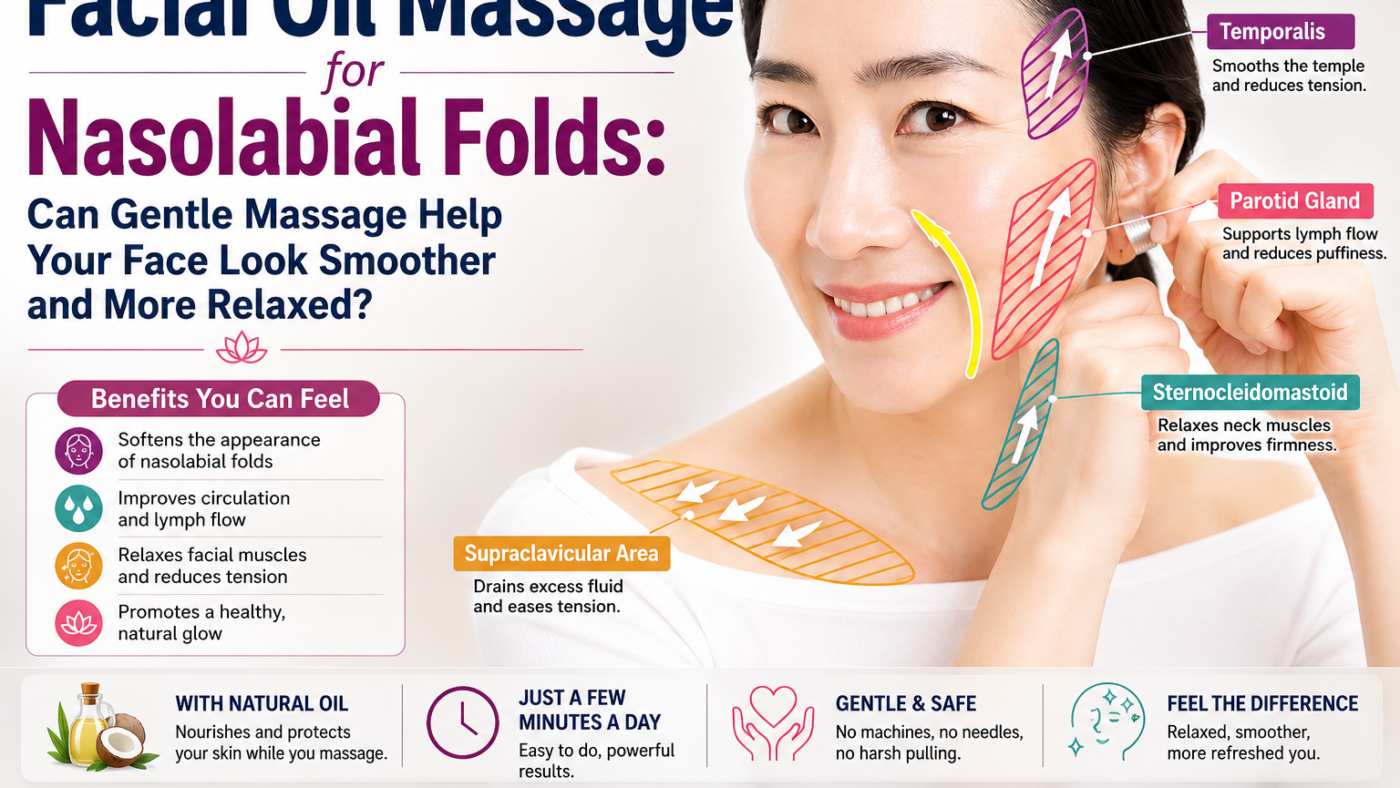
Facial massage for nasolabial folds has become a popular natural beauty practice for people hoping to make their face look smoother, less tense, and more refreshed.Nasolabial folds—the lines running from the sides of the nose toward the corners of the mouth—are a normal part of facial anatomy. They often become more noticeable with age as skin elasticity changes, facial fat compartments shift, collagen declines, and repeated facial expressions shape the way the skin folds. Genetics, sun exposure, smoking, weight changes, and individual facial structure can also influence their appearance.
Social media sometimes claims that nasolabial folds develop because facial tissues become “stagnant,” fascia becomes “sticky,” or lymphatic fluid stops flowing. These explanations are oversimplified. Facial massage cannot erase the structural causes of nasolabial folds or permanently lift sagging tissue. However, gentle massage combined with an appropriate facial oil may temporarily make the face look more relaxed, hydrated, and refreshed.
That distinction matters. Facial massage does not need to reverse aging to be a useful self-care practice.
What Actually Causes Nasolabial Folds?
Nasolabial folds are influenced by several layers of facial anatomy rather than one isolated muscle or skin problem.
As we age, collagen and elastin gradually change, the skin becomes thinner, facial fat distribution shifts, and deeper structural support changes. Repeated smiling and other expressions also continually fold the skin along predictable anatomical lines.
Sun exposure is particularly important because ultraviolet radiation accelerates collagen breakdown and other features of photoaging.
This means nasolabial folds are not simply caused by poor circulation or “blocked lymph.”
They are a normal result of facial structure, movement, genetics, and aging.
What Can Facial Massage Realistically Do?
Gentle facial massage may produce several short-term effects that change how the face looks and feels.
Mechanical stimulation can temporarily increase local skin blood flow. Massage may also help relax areas that feel tense, while using an oil or moisturizer reduces friction between the hands and skin.
The result can be skin that temporarily looks warmer, more hydrated, softer, or slightly fuller.
Massage may also create a subjective sense of reduced facial tension, particularly around the jaw, cheeks, temples, and neck.
What it cannot reliably do is permanently reposition facial fat, rebuild lost bone, regenerate large amounts of collagen in minutes, or permanently erase deep folds.
A useful goal is therefore:
relax, moisturize, and gently mobilize—not aggressively reshape the face.
Why Use Oil During Facial Massage?
The main purpose of facial oil during massage is lubrication.
Repeatedly dragging dry fingers across the face creates unnecessary friction. A small amount of oil allows the hands to glide more smoothly.
The oil can also act as an emollient, helping soften the outer layer of the skin and reduce moisture loss.
Suitable options depend on your skin type. Squalane, jojoba oil, and other well-tolerated facial oils may work for many people. Some people also use coconut, sesame, or castor oil, but these are not appropriate for everyone.
Coconut oil, for example, may feel too heavy for acne-prone skin. Essential oils can also irritate sensitive skin and generally should not be applied undiluted.
Patch-test unfamiliar products before spreading them across the face.
Step 1: Prepare Your Skin and Hands
Start with clean hands and a clean face.
Place a small amount of facial oil between your palms and gently rub your hands together. You need enough slip to prevent pulling, but your face should not be dripping with oil.
Spread it lightly across the cheeks, jaw, chin, and other areas you intend to massage.
Avoid getting oil directly into your eyes.
The massage should feel comfortable from beginning to end.
Step 2: Begin Around the Collarbone
Instead of immediately pulling on the nasolabial folds, begin lower down.
Place your fingertips gently around the upper chest and collarbone area and make small, comfortable movements.
This can be a pleasant way to relax the upper chest and transition into the routine.
There is no need to press hard or attempt to “drain toxins.”
The lymphatic system is a real physiological system, but ordinary cosmetic massage claims about manually removing toxins or dramatically changing facial aging are often exaggerated.
Keep the pressure light.
Step 3: Warm and Relax the Neck
Apply a little more oil if necessary.
Use your palms to make gentle upward and outward strokes along the sides of the neck.
Avoid forceful pressure over the front of the throat.
Do not aggressively press on blood vessels or attempt to manipulate the carotid arteries.
The purpose is simply to create comfortable movement and warmth.
Slow breathing can make this part of the routine particularly relaxing.
Step 4: Massage Around the Ears and Jaw
Place your fingertips around the area in front of and behind the ears.
Use small circular movements without digging deeply into the tissue.
Then move toward the jaw.
Jaw tension is common, particularly in people who clench their teeth during stressful periods or while sleeping.
Massage cannot correct temporomandibular joint disorders, but gentle external massage may feel soothing when muscular tension is present.
If you experience persistent jaw pain, locking, significant clicking, or difficulty opening your mouth, seek professional evaluation rather than increasing massage pressure.
Step 5: Work Gently Around the Cheeks
Place your palms or fingertips against the cheeks and slowly glide outward.
Keep the movement smooth.
You do not need to pull the skin dramatically upward.
Small, comfortable strokes are sufficient.
Your skin may become slightly pink or warm during massage because mechanical stimulation can temporarily influence superficial blood flow.
That temporary flush should not be confused with permanent rejuvenation.
Step 6: Massage Around the Nasolabial Folds
Now focus on the area that many people are most interested in.
Place the pads of your fingers beside the nose and move gently outward across the cheeks.
You can also make very small circles around—not aggressively inside—the nasolabial fold.
Keep the pressure comfortable.
Avoid repeatedly stretching the skin as far as possible.
A few slow passes are enough.
Afterward, the area may look slightly softer because the skin is moisturized and the surrounding muscles and tissues feel relaxed.
Deep structural folds, however, will not permanently disappear from massage alone.
Step 7: Relax the Area Around the Mouth
Place clean fingertips around the corners of the mouth.
Make gentle outward or slightly upward movements without stretching the lips aggressively.
You can then place your palms lightly over the lower cheeks and pause for several breaths.
Massage may temporarily make the lips and surrounding skin appear more flushed because of local stimulation, but claims that massage permanently enlarges or “firms” the lips are not supported.
Avoid massaging active cold sores, cracked skin, infections, or irritated areas.
Step 8: Use Gentle Jawline Strokes
Place the pads of your fingers or thumbs beneath the jaw and glide gently from the chin toward the ears.
Do not use your fingernails.
Repeat several times on each side.
This movement can feel relaxing around the jaw and lower face.
It may temporarily reduce the appearance of mild puffiness in some people, but it cannot permanently sculpt the jawbone or remove facial fat.
Be particularly gentle around sensitive structures of the neck.
Step 9: Finish With the Cheeks
Place your palms over your cheeks.
Rather than pulling, simply allow the hands to rest against the skin.
Take several slow breaths.
This is a good point to notice how your face feels compared with the beginning of the routine.
You may notice warmth, softness, relaxation, or increased awareness of facial tension.
Those modest changes are realistic outcomes.
Can Facial Massage Improve Blood Flow?
Massage can temporarily alter local skin blood flow.
That does not mean you should deliberately press on facial arteries.
The face has an extensive vascular network, and there is no need to identify or compress individual blood vessels to obtain the relaxing effects of facial massage.
In fact, deliberately pressing strongly over vascular structures is unnecessary and potentially unsafe.
Gentle surface massage is enough.
What About Lymphatic Drainage?
The lymphatic system helps maintain fluid balance and participates in immune function.
Specialized manual lymphatic drainage is a recognized therapeutic technique used in certain medical circumstances, particularly lymphedema management.
That is different from claiming that everyday facial wrinkles occur because lymph has become “blocked.”
Very gentle facial movements may temporarily influence superficial fluid distribution and make mild morning puffiness look less noticeable in some people.
But nasolabial folds are not simply collections of trapped lymphatic fluid.
Does Massage Release Facial Fascia?
Fascia is connective tissue that surrounds and connects structures throughout the body.
It is real anatomy, but social-media descriptions such as “sticky fascia causes your face to fall” go considerably beyond current evidence.
Massage can mechanically stimulate skin and underlying soft tissues and may change how an area feels temporarily.
That is different from proving that facial aging results from fascia becoming stuck or that massage permanently restores youthful tissue architecture.
Can Facial Massage Lift the Face?
The answer depends on what “lift” means.
Immediately after massage, the face may look somewhat refreshed because of hydration, temporary changes in puffiness, warmth, and muscular relaxation.
That can create the impression of a subtle lift.
But massage cannot reproduce the structural changes produced by medical or surgical procedures.
Before-and-after photographs can also be misleading when lighting, facial expression, camera angle, posture, or skin hydration changes.
Judge facial massage primarily by comfort and skin care—not dramatic transformation photographs.
Can Facial Massage Remove Nasolabial Folds?
No home massage technique has been shown to permanently erase established nasolabial folds.
That does not mean massage has no cosmetic value.
A well-lubricated, gently massaged face may temporarily look smoother and more hydrated, and relaxed facial tension can influence overall appearance.
The healthiest expectation is improvement in skin feel and relaxation, rather than permanent removal of normal facial anatomy.
How Often Should You Massage Your Face?
There is no universal schedule.
For many people, approximately five to ten minutes several times per week is more than enough.
Longer and harder are not necessarily better.
If your skin becomes persistently red, sore, swollen, irritated, or sensitive, reduce the pressure or frequency—or stop.
People with highly reactive skin may prefer much shorter sessions.
Which Facial Oil Is Best?
There is no single best oil for everyone.
For oily or acne-prone skin, a lightweight non-comedogenic moisturizer or squalane may provide enough slip.
Dry skin may tolerate richer emollients.
Sensitive skin generally benefits from simple, fragrance-free formulations with fewer potential irritants.
Do not assume that “natural” automatically means safer.
Botanical extracts and essential oils can trigger irritation or allergic reactions.
When Should You Avoid Facial Massage?
Avoid or postpone facial massage over active infections, open wounds, severe irritation, sunburn, painful cystic acne, active herpes lesions, or immediately after certain cosmetic procedures unless your treating professional has specifically approved massage.
People who have recently received fillers, neuromodulator injections, facial surgery, laser treatment, chemical peels, microneedling, or other procedures should follow the aftercare instructions provided by their clinician.
If you develop unexplained facial swelling, weakness, numbness, severe pain, or sudden facial asymmetry, do not attempt to treat the problem with massage. Seek appropriate medical care.
The Bottom Line
Nasolabial folds are not evidence that your face has stopped “flowing.”
They are normal anatomical folds influenced by facial structure, expressions, skin aging, collagen changes, fat distribution, genetics, and environmental factors.
Facial oil massage cannot permanently erase them.
But gentle massage can still be worthwhile.
It provides a few quiet minutes to moisturize the skin, reduce friction, explore areas of facial tension, and potentially create a temporary sense of warmth, softness, and relaxation.
The safest approach is simple:
Use enough slip. Keep the pressure gentle. Avoid aggressive pulling. Never press hard on the throat or blood vessels. Stop if your skin becomes irritated.
Healthy beauty does not require promising that every line can disappear.
Sometimes taking good care of the skin you already have is enough.
Frequently Asked Questions
Can facial massage reduce nasolabial folds?
It may temporarily make the area appear smoother through hydration, relaxation, and changes in mild puffiness, but there is insufficient evidence that massage permanently removes established nasolabial folds.
Can facial massage tighten loose skin?
Massage can temporarily affect how the skin looks and feels, but it should not be expected to permanently tighten significantly loose skin or reverse structural facial aging.
Does facial massage increase circulation?
Mechanical massage can temporarily increase local skin blood flow. There is no need to press directly on facial arteries to achieve this effect.
Can facial massage improve lymphatic drainage?
Very gentle massage may influence superficial fluid movement and temporarily reduce mild puffiness in some people. This should not be confused with medical manual lymphatic drainage or claims that wrinkles are caused by blocked lymph.
Is coconut oil good for facial massage?
It provides substantial lubrication and may suit some dry skin types, but it can feel heavy and may not be suitable for acne-prone skin. Patch-testing is sensible.
Is castor oil safe for facial massage?
Some people tolerate it, but it is thick and may irritate sensitive skin. A small patch test should be performed before widespread use.
Can facial massage permanently sculpt the jawline?
No good evidence shows that routine massage permanently reshapes the jawbone or removes facial fat. Temporary changes in puffiness and muscular tension can alter appearance.
How long should facial massage last?
Around five to ten minutes can be sufficient. There is no established benefit to aggressive or excessively long massage.
Medical Disclaimer
This article is for general educational purposes only and does not constitute medical or dermatological advice. Facial changes, swelling, pain, weakness, numbness, or asymmetry can have medical causes. Consult an appropriately qualified healthcare professional if you have concerning or persistent symptoms or if you have recently undergone cosmetic or surgical treatment.
This article is for general education and does not replace individualized care from a qualified health professional. Seek appropriate advice for persistent, severe, or concerning symptoms.
Read the full medical disclaimer