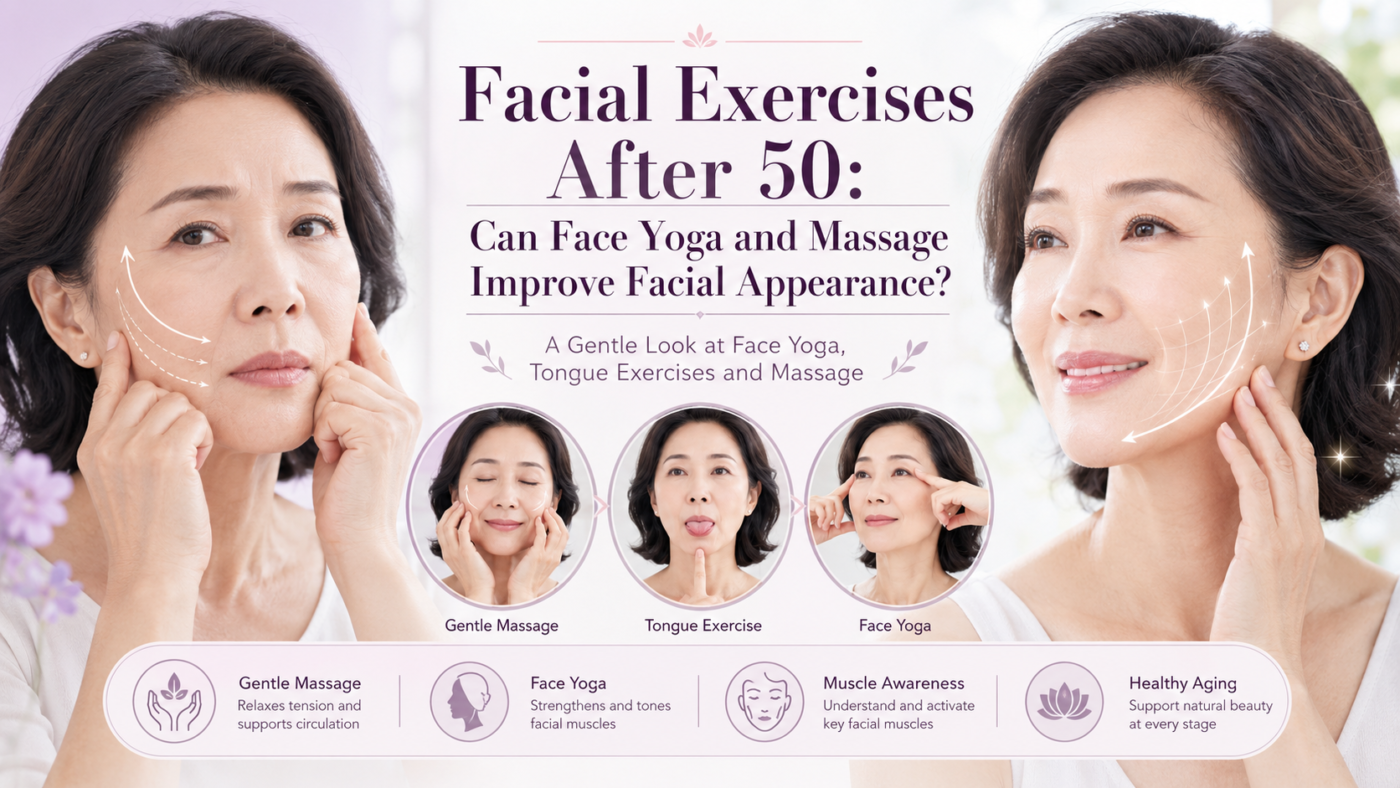
Reaching your 40s, 50s or beyond does not mean you have to give up on caring for your face. But it is equally important to separate realistic self-care from exaggerated promises about “lifting” the face or reversing aging.
Facial exercises, sometimes called face yoga, have become increasingly popular as a noninvasive way to exercise the muscles around the cheeks, mouth, eyes and jaw. Gentle facial massage is also commonly used to reduce a feeling of tension and make the face feel more relaxed.
Can either one actually make you look younger?
The answer is more interesting than a simple yes or no.
A small clinical study has suggested that a sustained facial exercise program may modestly improve cheek fullness in some middle-aged women. However, the study was small, had no control group and involved a demanding 20-week routine. More recent scientific reviews continue to conclude that the evidence for mechanical facial rejuvenation techniques remains limited and uncertain.
That means facial exercises can be explored as a gentle wellness practice—but they should not be marketed as a guaranteed facelift.
Why Facial Exercises After 50 Are Getting So Much Attention
Facial aging is much more complicated than simply having “weak facial muscles.”
Over time, changes can occur in the skin, facial fat, connective tissue, muscles and deeper facial structures. The 2018 JAMA Dermatology facial-exercise study noted that visible facial aging involves not only superficial skin changes but also deeper volume changes involving fat and muscle.
Sun exposure is another major factor.
The American Academy of Dermatology emphasizes that accumulated ultraviolet exposure contributes to premature skin aging, including wrinkles, uneven pigmentation and loose skin. Dermatologists therefore consider daily sun protection one of the foundations of an anti-aging skin-care routine.
Genetics, hormonal changes, smoking, sleep, nutrition, repeated facial expressions and natural changes in collagen and elasticity can also influence how an individual face ages.
So there is no single facial exercise capable of controlling all these processes.
Can Face Yoga Really Make You Look Younger?
There is some intriguing evidence, but not enough to make strong promises.
In a frequently cited JAMA Dermatology study, middle-aged women learned a program containing 32 facial exercises. Participants initially practiced for about 30 minutes daily and later continued every other day for a total of 20 weeks.
Among the participants who completed the study, blinded physicians observed improvements in upper- and lower-cheek fullness. The estimated average facial age also decreased modestly.
However, only 16 women completed the full program, there was no untreated control group and participants knew they were performing a facial-rejuvenation routine. The researchers themselves concluded that further studies were needed.
An earlier systematic review also found that the evidence supporting facial exercises for rejuvenation was insufficient because existing studies were generally small and lacked appropriate controls.
A newer systematic review published in 2025 similarly noted that the effectiveness and safety evidence for facial exercises, massage and related mechanical techniques remains unclear.
So the most accurate conclusion is:
Face yoga may have some potential, particularly for facial muscle awareness and cheek fullness, but it has not been proven to reliably eliminate wrinkles, jowls or sagging skin.
Facial Exercise 1: Gentle Smile and Cheek Activation
Begin with a relaxed face.
Allow your jaw to remain loose and your forehead relaxed.
Slowly smile while focusing on lifting the corners of your mouth rather than squeezing your eyes tightly.
Hold the expression for several seconds.
Then completely relax.
Repeat approximately five times.
You may place clean fingertips lightly over the cheeks to become more aware of the muscles moving underneath the skin.
The goal is not to pull aggressively upward.
It is simply to practice controlled facial movement.
Avoid Excessive Facial Straining
More intensity is not necessarily better.
Making extremely forceful facial expressions can create considerable tension around the forehead, eyes and mouth. There is no good evidence that facial exercises need to hurt or become exhausting to produce a benefit.
A gentle routine is more appropriate than repeatedly forcing the face into painful positions.
If an exercise causes jaw pain, headache, muscle spasms or eye discomfort, stop.
Facial Exercise 2: Controlled Tongue Circles
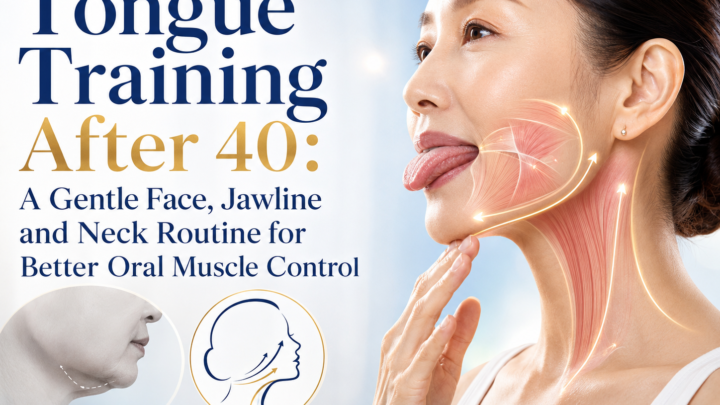
The tongue is an important muscular organ involved in speaking, chewing and swallowing.
You can gently move your tongue around the inside of your mouth as an oral-motor exercise.
With your mouth closed, slowly move your tongue around the inside of your lips and cheeks.
Complete several circles in one direction.
Then reverse.
Keep your jaw relaxed.
This can create noticeable activity in the tongue and surrounding oral muscles.
However, claims that the tongue is connected to “70 muscles” in a way that allows tongue exercises to lift the entire face oversimplify anatomy.
Tongue exercises should therefore be considered oral-muscle movements—not a proven full-face lifting treatment.
Can Tongue Training Eliminate Jowls?
There is currently no convincing clinical evidence showing that tongue circles or tongue stretching can reliably eliminate jowls.
Jowls develop through a combination of changes in facial fat distribution, connective tissues, skin elasticity and underlying facial structures.
Strengthening one muscle cannot simply pull all of these tissues back to where they looked decades earlier.
That does not make tongue exercises useless.
They can still be an interesting component of facial movement practice, particularly when performed gently.
They simply should not be sold as a substitute for a facelift.
Facial Exercise 3: Gentle Mouth and Cheek Movements
Relax your jaw.
Move your lips gently toward one side of your face.
Return to the center.
Then move toward the other side.
Avoid forcing your jaw sideways.
Repeat several times.
Another option is to form exaggerated—but comfortable—vowel shapes such as:
A – E – O
Move slowly and notice the muscles around your lips and cheeks contracting and relaxing.
These exercises may improve awareness and coordination of facial movements.
They are not proven treatments for permanently tightening loose skin.
What About Exercises Under the Eyes?
The skin surrounding the eyes is delicate.
Instead of aggressively pulling or rubbing it, use very light contact.
Place clean fingertips gently below the eyes without pressing directly on the eyeball.
Make a very small squint and feel the muscles around the eyes activate.
Relax completely.
Repeat only a few times.
Do not drag the skin downward or repeatedly stretch it.
Eye-area exercises have not been proven to eliminate under-eye bags or wrinkles, so the goal should remain gentle muscle awareness rather than aggressive “lifting.”
Facial Massage: Relaxation Rather Than a Facelift
Massage may feel particularly pleasant around the cheeks and jaw, especially for people who unknowingly clench their teeth.
Use clean hands and enough moisturizer or facial oil to prevent excessive friction if appropriate for your skin.
Place your fingertips over the cheeks.
Apply light circular movements.
Move gradually toward the jaw.
The pressure should feel comfortable.
There is no need to force the tissue upward or attempt to physically “put facial muscles back into place.”
Facial massage does not permanently reposition facial fat, muscles or bones.
Gentle Jaw Massage
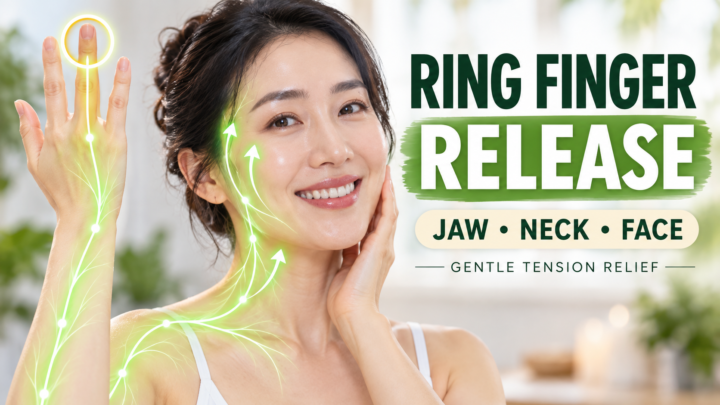
One part of the original routine focuses strongly on the muscles near the jaw.
This can make sense for relaxation—but pain is not the goal.
The masseter muscles used for chewing can become tense, particularly in people who clench or grind their teeth. Cleveland Clinic notes that massage and appropriate exercises may help some people relieve muscular tension associated with temporomandibular disorders.
To try a gentler version, relax your jaw and place two or three fingertips over the masseter muscle between your cheekbone and jaw.
Massage slowly with small circles.
Keep the pressure comfortable.
Stop if the area becomes painful.
A massage that “hurts like hell,” as described in the original video, is not necessary for a better jawline or healthier jaw muscles.
Do Not Treat Jaw Pain as a Beauty Problem
Persistent jaw pain deserves attention.
Symptoms of temporomandibular disorders can include facial or jaw pain, stiffness, clicking, headaches and difficulty opening or closing the mouth.
If these symptoms persist, forcing deep massage or extreme jaw exercises may not be appropriate.
A dentist, physician or physical therapist familiar with temporomandibular disorders can help determine the cause.
Can Massage Remove “Toxins” From Your Face?
Claims that facial massage releases stored “toxins” or trapped emotions from facial tissues are not scientifically established.
Your liver, kidneys, lungs and other physiological systems continuously process and eliminate metabolic waste.
A massage can feel relaxing.
It may make tight muscles feel less tense.
It may temporarily change the sensation or appearance of the face.
But this does not mean that years of toxins are being physically squeezed out of your cheeks or jaw.
There is no need to add pseudoscientific explanations to a pleasant self-care practice.
What About Neck Wrinkles?
Facial and voice exercises do not reliably erase neck wrinkles.
Neck skin changes with age for many of the same reasons facial skin does: changes in collagen and elasticity, repeated movement, genetics and cumulative ultraviolet exposure.
One of the most useful things you can do for both facial and neck aging is remarkably simple:
Protect the skin from ultraviolet radiation.
The American Academy of Dermatology recommends broad-spectrum sunscreen with an SPF of at least 30 as part of an anti-aging strategy.
The neck is frequently forgotten when sunscreen is applied, so extend appropriate sun protection beyond the face.
A Simple 5-Minute Facial Wellness Routine
If you enjoy face yoga, you do not need a 20-minute high-intensity facial workout.
A simple routine might include:
Minute 1: Relaxed smile and cheek activation.
Minute 2: Slow tongue circles and gentle oral movements.
Minute 3: Controlled side-to-side lip and cheek movements.
Minute 4: Gentle cheek and masseter massage.
Minute 5: Relax the forehead, jaw, lips and shoulders while breathing slowly.
There is no need to chase pain, extreme fatigue or a burning sensation.
Consistency and comfort are more important than intensity.
What Actually Helps Skin Age Well?
If your primary goal is healthier-looking skin after 40 or 50, facial exercises should be considered an optional addition rather than the foundation of your routine.
Dermatologists place much greater emphasis on proven skin-care habits.
Daily sun protection is especially important because cumulative ultraviolet exposure contributes directly to premature aging. AAD recommends broad-spectrum, water-resistant SPF 30 or higher along with shade and protective clothing when appropriate.
Moisturizer can also temporarily improve the appearance of some fine lines by increasing hydration in the outer layer of the skin.
Other evidence-based options may include topical retinoids or retinol products, depending on your skin and medical circumstances, as well as professional dermatologic treatments for people seeking more substantial changes.
Your Genes Matter—but They Are Not the Whole Story
The statement “your genes do not decide your face” is too absolute.
Genetics certainly influence facial anatomy, skin characteristics and aspects of how people age.
But genetics are not the only influence.
Sun exposure and other environmental and lifestyle factors also contribute significantly.
This is actually more empowering than pretending genetics do not exist.
You cannot choose your genetic starting point, but you can still influence many aspects of skin health through sun protection, appropriate skin care and healthy lifestyle habits.
Aging Is Not a Facial Failure
There is another important point that often gets lost in anti-aging content.
Aging itself is not something your face has failed to prevent.
Lines, changes in facial volume and changes in skin texture are normal parts of life.
You can absolutely enjoy beauty routines, facial massage, skin care and exercise while also avoiding the idea that every visible sign of age needs to be “fixed.”
The healthiest approach is often somewhere between giving up on self-care and declaring war on every wrinkle.
Can Face Yoga Replace Cosmetic Procedures?
No.
Facial exercises should not be presented as equivalent to treatments such as botulinum toxin injections, dermal fillers, lasers, ultrasound or radiofrequency procedures, or surgical lifting.
Those treatments work through entirely different biological and mechanical mechanisms.
If sagging, pigmentation, deep wrinkles or other changes genuinely bother you, a board-certified dermatologist or appropriately qualified medical professional can explain which options have evidence behind them.
AAD notes that dermatologists often combine different approaches because facial aging involves several different processes rather than one simple cause.
The Bottom Line
Facial exercises after 50 may be an enjoyable way to practice facial movement and muscle awareness, and a small clinical study has suggested possible improvements in cheek fullness after months of consistent practice.
But scientific evidence remains too limited to promise that face yoga will remove jowls, erase wrinkles, tighten loose skin or produce a natural facelift.
Gentle facial and jaw massage may also help some people relax tense muscles, but painful massage is unnecessary and persistent jaw pain should not be treated as a cosmetic issue.
For long-term skin health, continue focusing on the fundamentals: sun protection, appropriate skin care, healthy habits and realistic expectations.
You do not need to stop caring about your appearance as you age.
You simply deserve beauty advice that respects both you and the science.
FAQ
Do facial exercises work after 50?
Age does not prevent facial muscles from contracting and adapting. A small study involving middle-aged women found modest improvements in cheek fullness after a 20-week facial exercise program, but larger controlled trials are still needed.
Can face yoga eliminate jowls?
There is currently insufficient evidence to show that face yoga can reliably eliminate jowls. Facial sagging involves skin, connective tissue, fat distribution and deeper anatomical changes—not only muscle strength.
Can tongue exercises lift your face?
Tongue exercises activate oral muscles involved in speaking, chewing and swallowing, but there is no convincing evidence that tongue exercises alone produce a full facial lift.
Can facial massage tighten loose skin?
Facial massage may temporarily make the face feel relaxed or less tense, but it has not been proven to permanently tighten loose skin or reposition sagging facial tissue.
Should jaw massage hurt?
No. Strong pain is not necessary. Gentle massage may help some people with muscular jaw tension, while persistent pain, locking or difficulty opening the mouth should be evaluated by a healthcare professional.
What is the most important anti-aging habit for skin?
Daily protection from ultraviolet radiation is one of the most evidence-supported ways to prevent premature skin aging. Dermatologists recommend broad-spectrum SPF 30 or higher along with other sun-protection measures.
Medical Disclaimer
This article is for educational and informational purposes only and is not medical advice. Facial exercises and massage are not substitutes for diagnosis or treatment by a qualified healthcare professional. Stop any exercise or massage that causes significant pain, numbness, dizziness, visual symptoms, jaw locking or persistent discomfort. If you have temporomandibular joint problems, recent facial surgery, injectable treatments, dental procedures, facial nerve disorders, active skin disease or another medical condition affecting the face or jaw, consult an appropriate healthcare professional before beginning a new facial exercise or massage routine.
This article is for general education and does not replace individualized care from a qualified health professional. Seek appropriate advice for persistent, severe, or concerning symptoms.
Read the full medical disclaimer