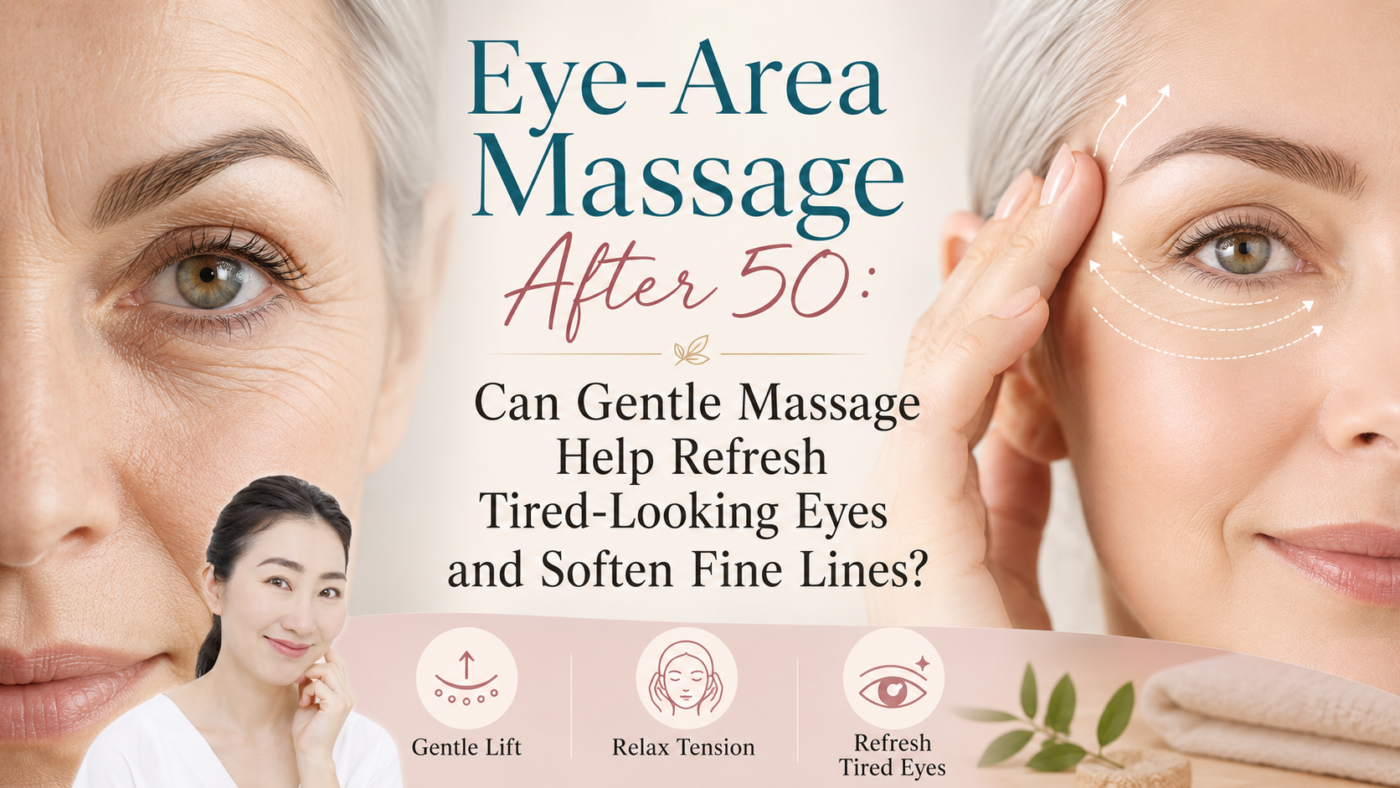
The skin around the eyes is one of the first places many people notice age-related change.
Fine lines may become more visible.
The upper eyelids may appear heavier.
The under-eye area may look tired or puffy.
The temples and forehead can also feel tense after hours of screen use, concentrating, squinting or frowning.
That is why eye-area massage has become such a popular part of facial self-care.
A few minutes of gentle massage can make the face feel warmer, more relaxed and temporarily refreshed.
But massage is often promoted with claims that go much further—that it can rebuild lost capillaries, permanently lift eyelids, improve eyesight or reverse facial aging.
Those promises go beyond what the evidence supports.
A better approach is to understand what facial massage can realistically do:
Temporarily increase superficial blood flow.
Reduce the sensation of muscular tension.
Help relieve the feeling of a tight forehead or scalp.
Redistribute mild superficial fluid and puffiness in some people.
Encourage relaxation.
Improve the way dry skin looks when paired with moisturizer.
Those effects may be subtle, but they are still useful.
What Happens to Facial Circulation With Age?
The skin’s microcirculation changes with age.
Blood vessels, skin thickness, connective tissue and vascular responsiveness all evolve over time.
Aging skin may receive and regulate blood flow differently than younger skin.
However, it is too simplistic to say that everyone loses exactly 40 percent of facial capillaries after age 50.
The exact degree of vascular change varies by individual, skin region, health status, sun exposure and other factors.
There is no universal cutoff at age 50.
The important point is simpler:
Healthy skin depends on an intact microvascular system, and aging can alter that system.
Does Massage Improve Facial Blood Flow?
Massage and mechanical stimulation can temporarily increase superficial blood flow.
That is why the skin may feel warmer or appear slightly pink afterward.
This response may contribute to the temporary “glow” people notice after facial massage.
But increased blood flow does not mean the skin has been permanently rejuvenated.
Nor does it mean lost capillaries have been regenerated.
The effect is mainly short term.
Why the Eye Area Changes With Age
The skin around the eyes is thin and highly expressive.
Age-related changes can include:
Reduced collagen and elastin.
Changes in skin hydration.
Loss or redistribution of facial fat.
Changes in ligaments and supporting tissues.
Bone remodeling.
Repeated blinking and squinting.
Sun exposure.
Genetics.
These factors combine to create fine lines, crow’s feet, puffiness and changes in eyelid contour.
Massage can influence only a small part of that process.
Can Massage Permanently Lift the Eyelids?
No reliable evidence shows that gentle eye massage can permanently hold the eyelids in a higher position.
You may see a temporary difference immediately after touching or supporting the skin.
Muscle relaxation, mild fluid redistribution and the physical position of your fingers can all change appearance.
But once the skin and muscles return to normal resting position, the effect may fade.
True eyelid drooping, or ptosis, involves structures that massage cannot reliably correct.
When Eyelid Drooping Needs Medical Attention
New, sudden or one-sided eyelid drooping should not be treated as a cosmetic massage problem.
Seek medical evaluation if it is accompanied by:
Double vision.
Facial weakness.
Severe headache.
Pupil changes.
Difficulty speaking.
Arm or leg weakness.
Sudden neurological symptoms.
Persistent ptosis can also have non-emergency causes, but it still deserves appropriate assessment.
Start With the Shoulders
The original routine begins with shoulder circles.
That is a good place to start.
Sit or stand comfortably.
Roll the shoulders forward several times.
Then backward.
Keep the neck relaxed.
Breathe normally.
This does not physically lift the face.
But reducing upper-body tension can make the entire routine feel more comfortable.
Shoulder Tension Does Not Directly Cause Facial Sagging
It is common to hear that tight shoulders “pull the face downward.”
That explanation is too literal.
Shoulder and neck tension can influence posture and facial expression.
People who are stressed may also clench the jaw, squint or frown more.
Relaxing those patterns can make the face look softer.
But shoulder tightness itself is not the main cause of age-related facial sagging.
Gentle Neck Massage
Use the pads of your fingers.
Massage the sides and back of the neck.
Avoid deep pressure over the front of the throat.
Move slowly.
If the neck is tender, use less pressure.
The goal is relaxation.
Scalp Massage
Place fingertips over the scalp.
Use small circular movements.
Shift the skin gently rather than scratching.
Many people find scalp massage deeply relaxing.
It may temporarily increase local superficial circulation and reduce the sensation of tightness.
It should not be described as permanently improving facial blood supply.
Does Scalp Massage Lift the Face?
Not permanently.
The scalp and facial tissues are anatomically continuous through fascia and connective tissue.
But massaging the scalp does not mechanically pull the face upward and keep it there.
Any immediate change is likely due to temporary tension and tissue effects.
Forehead Massage
Place fingertips on the forehead.
Use gentle circular motions.
Move from the center outward.
Avoid aggressive rubbing.
If the skin is dry, apply a moisturizer first to reduce friction.
The frontalis muscle may feel less tense afterward.
What Is Forehead Fascia?
The forehead contains muscle, connective tissue, skin and fascia.
These tissues move together during facial expression.
Calling the forehead fascia “stuck” is usually too simplistic.
People may feel tightness because of repeated muscle contraction or sensory tension.
Gentle massage may help that sensation.
The Lift-and-Shake Technique
The original routine uses two fingers to gently lift a small area of skin and create a subtle shaking movement.
This can be reframed as a gentle skin-mobilization technique.
Place two fingertips lightly over the forehead or temple.
Move the skin only slightly.
Use a small controlled vibration.
Do not pull hard.
Do not stretch the skin aggressively.
Around the Eyes: Less Pressure Is Better
The skin around the eyes is delicate.
Use extremely light pressure.
Avoid pressing directly on the eyeball.
Avoid aggressive rubbing over the eyelids.
Use the ring finger or fingertip pads if that helps you stay gentle.
The goal is comfort.
Outer-Eye Massage
Place fingertips near the outer corner of the eye.
Support the skin gently.
Breathe slowly.
Do not yank the skin upward.
Hold for a few seconds.
Release.
This may help the area feel relaxed.
Eyebrow Massage
Move toward the outer eyebrow.
Use small circular motions along the brow bone.
Avoid the eyeball.
Then move toward the inner brow.
Again, keep the pressure light.
Many people find this area tender during periods of screen fatigue or headaches.
Can Eyebrow Massage Improve Vision?
No good evidence shows that massage of the eyebrow or temple improves eyesight.
It may make tired eyes feel more comfortable.
That is different from improving visual acuity.
Changes in vision require proper eye care.
When Eye Symptoms Need an Eye Doctor
Seek professional evaluation if you experience:
Blurred vision.
Sudden vision loss.
Flashes or floaters.
Persistent eye pain.
Severe redness.
Double vision.
New visual distortion.
Massage should never substitute for eye care.
Temple Massage
Place the fingertips over the temples.
Use slow circular movements.
Do not press hard.
This can feel particularly relaxing after prolonged screen use.
Some people with tension-type headaches find temple massage soothing.
But headache relief varies by cause.
Why the Skin May Tingle
A tingling sensation during massage can come from:
Mechanical stimulation of sensory nerves.
Changes in superficial circulation.
Temperature.
Pressure.
It does not prove that energy is moving through the fingertips.
If traditional imagery helps you relax, you may use it as a mindfulness cue.
Just do not confuse the metaphor with a proven biological mechanism.
A Better Meaning for “Warm Energy”
Instead of thinking of warm energy as a literal invisible substance, think of it as:
Warmth.
Attention.
Gentle touch.
Breathing.
Relaxation.
That keeps the ritual meaningful without making unsupported physiological claims.
Does Conscious Breathing Help?
Yes, mainly through relaxation.
Slow breathing can reduce stress and muscular tension.
It may also make you more aware of unnecessary facial contraction.
That can help the forehead and jaw relax.
The benefit comes from nervous-system regulation and attention, not from a miracle lift.
A Gentle 10-Minute Eye-Area Routine
Minute 1: Shoulder Rolls
Forward and backward.
Minute 2: Neck Relaxation
Gentle massage along the sides and back.
Minute 3: Scalp Massage
Small circles with fingertips.
Minute 4: Forehead Massage
Move from the center outward.
Minute 5: Brow Massage
Follow the brow bone.
Minute 6: Outer-Eye Support
Light fingertip contact.
Minute 7: Temple Massage
Slow circular movements.
Minute 8: Gentle Skin Mobilization
Very small lift-and-release motions.
Minute 9: Warm Palms Over the Face
No pressure on the eyes.
Minute 10: Slow Breathing and Facial Relaxation
Let the forehead soften.
Unclench the jaw.
Relax the eyes.
What Can You Expect After One Session?
You may notice:
A warmer face.
Less forehead tension.
A more relaxed expression.
Reduced sensation of eye strain.
Temporary improvement in puffiness.
A subtle glow.
These are realistic outcomes.
What You Should Not Expect
One massage session will not:
Permanently lift the eyelids.
Rebuild facial capillaries.
Erase crow’s feet.
Improve eyesight.
Restore lost collagen.
Prevent all future facial sagging.
That does not make the routine useless.
It simply keeps expectations honest.
Why Puffiness May Change
Mild facial puffiness can fluctuate with:
Sleep.
Salt intake.
Allergies.
Hydration.
Hormones.
Position during sleep.
Inflammation.
Gentle massage may temporarily redistribute superficial fluid.
That can make the eye area look slightly less puffy.
Persistent Puffiness Needs More Than Massage
If eye swelling is:
One-sided.
Painful.
Red.
Sudden.
Associated with breathing problems.
Persistent for weeks.
It should be medically evaluated.
Does Massage Help Fine Lines?
Indirectly, perhaps.
Massage itself does not erase structural wrinkles.
But if you use moisturizer during the routine, better hydration can make very fine lines look less noticeable temporarily.
Relaxing repeated squinting may also change how visible dynamic lines appear.
What Actually Helps With Eye-Area Aging?
Daily Sun Protection
UV exposure contributes substantially to collagen breakdown and photoaging.
Sunglasses
Reducing squinting can help protect the eye area from both UV exposure and repeated facial contraction.
Moisturizer
Hydration can improve the appearance of fine surface lines.
Retinoids
Appropriate retinoid use can improve photoaging over time, though the eye area requires care because irritation is common.
Sleep
Poor sleep can make the eye area look more tired and puffy.
Avoid Smoking
Smoking accelerates skin aging.
What About Collagen?
Massage does not reliably rebuild large amounts of collagen.
Collagen remodeling is a slow biological process.
Treatments with stronger evidence for collagen stimulation include certain professionally administered procedures and evidence-based topical ingredients.
Manual massage is primarily a comfort and relaxation tool.
Facial Aging Is Not a Circulation Failure
This is one of the most important corrections.
Aging skin is not simply skin that stopped receiving enough blood.
It reflects complex structural changes involving:
Collagen.
Elastin.
Fat.
Bone.
Ligaments.
Muscles.
Pigmentation.
Vascular biology.
Hormones.
Genetics.
Sun exposure.
Circulation is only one part of the picture.
Do Not Pull the Skin Hard
Aggressive stretching around the eyes can irritate delicate tissue.
If a routine requires you to pull hard enough to distort the eyelid dramatically, use less force.
Gentle touch is safer.
Who Should Avoid Eye-Area Massage?
Be cautious if you have:
Recent eye surgery.
Active eye infection.
Severe dermatitis.
Fresh cosmetic procedures.
Significant eyelid inflammation.
Open wounds.
Recent fillers or other injections near the area.
Follow your clinician’s aftercare instructions.
Facial Massage After Botox or Fillers
Do not automatically massage treated areas.
Timing and recommendations vary according to the procedure.
Follow the instructions from the clinician who performed it.
The Role of Positive Facial Expression
The routine ends with a large smile.
There is nothing wrong with that.
Smiling can change mood and facial expression.
It may make the face appear more vibrant immediately.
But it does not prevent all future sagging.
Think of smiling as emotional and expressive—not structural anti-aging treatment.
Aging Does Not Need to Be “Defeated”
The goal of facial self-care does not need to be creating a face that never changes.
A more useful goal is:
Healthy skin.
Comfortable facial muscles.
Good eye health.
Consistent sun protection.
Relaxed expression.
Realistic expectations.
That approach is both healthier and more sustainable.
Final Takeaway
Gentle eye-area, scalp and forehead massage can be a soothing addition to a skincare routine after 50.
It may temporarily increase superficial circulation, reduce the sensation of tension and help mildly puffy or tired-looking eyes feel refreshed.
But it does not permanently lift the eyelids, improve eyesight or reverse facial aging.
The safest approach is simple:
Use very light pressure around the eyes. Relax the forehead and shoulders. Breathe slowly. Protect the skin from the sun. And treat massage as supportive self-care—not a replacement for medical or dermatologic treatment.
Frequently Asked Questions
Does facial massage improve blood circulation?
It can temporarily increase superficial blood flow.
Does facial circulation decline with age?
Skin microcirculation does change with age, but there is no single universal percentage loss for everyone after 50.
Can massage permanently lift the eyelids?
No strong evidence supports permanent eyelid lifting from massage.
Can eye massage improve eyesight?
No. Massage may feel relaxing but does not improve visual acuity.
Can massage reduce eye puffiness?
It may temporarily reduce mild superficial puffiness in some people.
Is scalp massage useful for the face?
It can promote relaxation and reduce the sensation of scalp tightness, but it does not permanently lift facial tissues.
Should eye massage hurt?
No. The eye area should be handled very gently.
Can massage erase crow’s feet?
No. It may temporarily soften their appearance through hydration and relaxation, but it cannot permanently erase them.
Is tingling during massage normal?
Mild tingling can occur from sensory stimulation and circulation, but persistent numbness or pain is not normal.
How often can I do this routine?
A short gentle routine can be used regularly if the skin remains comfortable and non-irritated.
Medical and Skincare Disclaimer
This article is for educational purposes only and is not medical diagnosis, ophthalmic care or individualized dermatologic advice. Sudden eyelid drooping, double vision, severe eye pain, sudden vision changes, facial weakness or other neurological symptoms require prompt medical evaluation. Avoid pressure directly on the eyeball.
This article is for general education and does not replace individualized care from a qualified health professional. Seek appropriate advice for persistent, severe, or concerning symptoms.
Read the full medical disclaimer