Autumn occupies a special place in traditional Chinese wellness. In the Huangdi Neijing, often translated as the Yellow Emperor’s Inner Classic, autumn is described as a season of ripening, gathering, and inward settling. Spring and summer are associated with expansion and outward activity, while autumn traditionally marks a gradual return toward calm, conservation, and preparation for winter.
In classical Chinese medicine, this seasonal transition is described through the language of qi, yin and yang, meridians, and organ systems. These concepts belong to a traditional medical framework rather than modern anatomy or physiology. Still, many of the movements traditionally used to “regulate qi” involve very recognizable physical actions: opening the chest, mobilizing the shoulders and hips, stretching the posterior chain, strengthening the legs, improving balance, and coordinating movement with slow breathing.
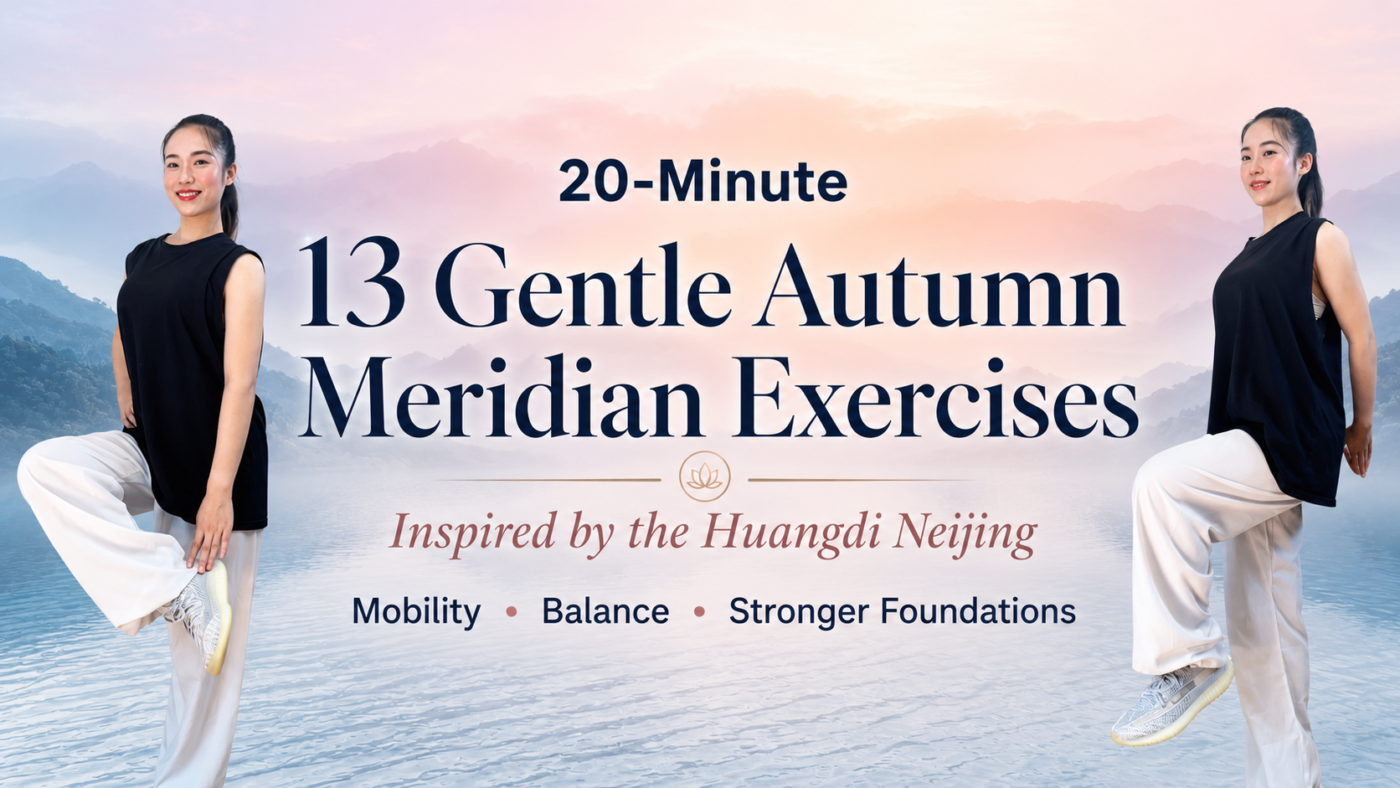
The following 13-movement routine preserves that traditional seasonal philosophy while presenting the exercises in a practical, modern, and safe way.
Why Autumn Practice Emphasizes Calm and Gathering
Traditional Chinese wellness views autumn as a time to reduce excessive outward expenditure and cultivate steadiness. The body is encouraged to move without agitation, the breath to become slower and more deliberate, and the mind to become quieter.
That does not mean becoming inactive. Instead, autumn movement is traditionally gentle, rhythmic, and controlled.
From a modern perspective, this type of practice can support several useful goals:
Maintaining shoulder and spinal mobility
Reducing stiffness associated with prolonged sitting
Improving hip and lower-body movement
Training balance and coordination
Encouraging deeper, slower breathing
Maintaining leg strength
Creating a calming daily movement ritual
The value of the routine lies primarily in regular movement, mobility, balance, muscular engagement, and breathing rather than in any scientifically proven ability to “open meridians” or direct invisible energy through specific pathways.
1. Shoulder Touch and Chest Opening
Place both hands lightly on your shoulders.
As you inhale, bring the elbows gradually toward one another in front of the chest. Then exhale and open the elbows outward, allowing the chest to expand comfortably.
Continue slowly without forcing the shoulders.
Traditional interpretation describes the shoulder region as an important passage for several yang meridians and the Governing Vessel on their way toward the head.
In practical anatomical terms, this movement mobilizes the shoulders, upper back, and chest. It may be particularly useful for people who spend long hours sitting at a desk or looking downward at a screen.
As the elbows come together, the muscles between and around the shoulder blades lengthen. As the arms open, the chest and front of the shoulders expand.
The goal is not to force the chest backward but to restore comfortable movement through an area that often becomes stiff with prolonged sitting.
2. Hip Rotation with Arm Rotation
Stand with your feet approximately shoulder-width apart.
Exhale as you gently rotate your hips and upper body toward one side while allowing the arms to follow naturally.
Inhale as you return to the center.
Repeat on the opposite side.
Keep your spine tall and avoid twisting aggressively through the knees.
Traditional Chinese medicine describes the hip and waist as important crossroads for the yin and yang meridians of the lower body. The Dai Mai, or Girdle Vessel, is traditionally associated with the waist and the horizontal organization of qi.
From a movement perspective, the exercise combines hip rotation, trunk rotation, shoulder movement, and weight shifting.
This can help maintain rotational mobility, something that often declines when daily life involves prolonged sitting and very little twisting movement.
3. Forward Bow and Toe Reach
Stand with the legs comfortably straight without locking the knees.
Slowly hinge forward from the hips as you exhale.
Reach toward one foot or toward the floor, depending on your flexibility.
Inhale as you return toward the center.
Alternate sides.
You should feel a gentle stretch through the backs of the thighs and possibly the calves.
In traditional meridian theory, the Foot Taiyang Bladder Meridian travels along much of the back of the body and down the posterior legs.
Modern anatomy describes the tissues being stretched here more simply: the hamstrings, calves, gluteal region, and spinal extensor muscles all participate.
Avoid bouncing. The movement should feel like a controlled stretch rather than a test of flexibility.
4. Overhead Side Stretch
Stand with your feet about hip-width apart.
Raise both arms overhead.
Exhale and gently lean or rotate toward one side, allowing the ribs and side waist to lengthen.
Inhale as you return to the center.
Repeat on the other side.
Traditional practice associates this movement with the Dai Mai and with the Liver and Gallbladder meridian pathways running along the sides of the body.
Physically, the movement stretches the lateral trunk, rib area, shoulders, and waist.
It may also help people who spend much of the day sitting in a relatively fixed forward-facing position.
Keep both feet grounded and avoid collapsing the lower back.
5. Elbow Retraction and Chest Expansion
Bring your fists in front of your chest.
As you exhale, pull the elbows backward while opening the chest. At the same time, step one foot backward and lower slightly into a small squat.
Inhale as you return to the starting position.
Alternate sides.
Traditional descriptions associate chest-opening movements with the Lung and Pericardium meridians and describe them as supporting the movement of qi through the chest.
In modern terms, this movement strengthens the upper back, mobilizes the shoulders, opens the chest, and engages the thighs and glutes.
The combination of stepping, squatting, and pulling the arms backward also adds a useful coordination challenge.
6. Knee Lift with Forward and Backward Palm Push
Stand upright.
Exhale as you lift one knee toward the chest while extending or pressing the arms backward.
Lower the foot under control.
Then extend the arms forward.
Alternate legs.
Traditional explanations emphasize the Laogong point in the palm and the Pericardium meridian, while the knee lift is said to engage the meridians of the lower limbs.
From a modern perspective, the exercise trains single-leg balance, hip flexion, abdominal stabilization, shoulder movement, and coordination.
Move slowly enough that you can remain stable without grabbing nearby furniture.
If balance is difficult, perform the movement beside a wall or chair.
7. Side Squat with Lateral Waist Stretch
Stand with the feet wider than shoulder-width.
Shift your weight toward one side and bend that knee slightly.
Keep the knee tracking in the same general direction as the toes.
At the same time, raise the opposite arm and reach gently overhead to lengthen the side of the body.
Return to the center and repeat on the opposite side.
Traditional theory associates this movement with the Spleen, Stomach, Liver, Gallbladder, and Dai Mai pathways.
Physically, the side squat engages the glutes, thighs, hips, and inner legs while the arm movement stretches the lateral trunk.
It combines flexibility and strength in one movement.
Do not squat deeper than your hips and knees can comfortably tolerate.
8. Arm Extension with Heel Raise
Reach your arms forward.
Exhale as you swing the arms backward, bend the knees slightly, and rise onto the balls of the feet.
Inhale as you lower the heels and return to the starting position.
Traditional Chinese medicine associates the sole of the foot with Yongquan, Kidney 1, and describes the point as an important location within the Kidney meridian system.
Whether or not one uses that traditional framework, heel raises are highly practical exercises.
They strengthen the calf muscles, train ankle control, and challenge balance.
Swinging the arms backward simultaneously opens the chest and engages the upper back.
For safety, avoid rising too high onto the toes if your balance is uncertain.
9. Side Arm Rotation and Waist Stretch
Stand with the feet shoulder-width apart and the arms slightly below shoulder height.
Exhale as one arm rotates backward and the waist turns gently in the same direction.
Inhale as you return to the center.
Repeat on the opposite side.
Traditional descriptions associate the back of the arm with the Sanjiao and Small Intestine meridian pathways and connect the side waist with the Dai Mai and Gallbladder meridian.
In movement terms, this is another useful combination of shoulder rotation, thoracic rotation, rib movement, and waist mobility.
Keep the hips controlled and avoid forcing the neck to turn farther than feels comfortable.
10. Arm Raise with Backward Leg Kick
Stand with the feet about hip-width apart.
Raise the arms while extending one leg backward.
Return the foot to the floor and lower the arms.
Alternate legs.
Traditional theory describes this movement as stretching several hand meridians while engaging the posterior Bladder meridian pathway through the back of the leg.
Modern movement science offers a more straightforward explanation.
The backward leg movement activates the glutes and hip extensors, while the arm raise challenges posture, shoulder mobility, and balance.
Do not kick forcefully.
Think of the movement as a controlled backward leg extension.
11. Cross-Body Heel Touch
Stand upright with the arms extended comfortably to the sides.
Lift one leg and bring the opposite hand toward the heel or lower leg, similar to a slow shuttlecock-kicking motion.
Return to the center and repeat on the other side.
Afterward, you may lower into a comfortable horse stance if your hips and knees tolerate it.
Traditional Chinese medicine associates the inner thigh with the Liver, Spleen, and Kidney meridian pathways.
Physically, this exercise requires hip mobility, single-leg balance, coordination, and trunk control.
The horse stance component strengthens the thighs and glutes.
Move within your own range rather than trying to achieve a high leg lift.
12. Horse Stance Side Stretch
Begin in a stable, moderately wide stance.
Turn the palms upward and raise the arms as you inhale.
You may gently rise onto the toes if your balance allows.
Exhale as you lower one arm and stretch the waist toward that side.
Return to the center.
Repeat on the opposite side.
Traditional interpretations connect the movement with the Pericardium, Sanjiao, Kidney, and Gallbladder systems.
In practical terms, the exercise combines calf strengthening, lower-body stability, shoulder elevation, lateral trunk stretching, and balance.
Keep the movement smooth and avoid holding your breath.
13. Forward Leg Extension with Toes Flexed
Stand upright.
Exhale as you extend one leg forward and pull the toes gently toward you.
At the same time, reach the arms forward and slightly upward.
Inhale as you return to the center.
Alternate sides.
You may feel a stretch through the calf and back of the leg.
Traditional meridian practice associates this movement with points such as Chengshan and Kunlun along the Bladder meridian.
From a modern anatomical perspective, dorsiflexing the foot and extending the leg stretches the calf and posterior leg while also challenging standing balance.
The arm reach adds a full-body coordination component.
How to Practice the Routine
The sequence does not need to be fast.
A slow rhythm is more appropriate.
Try performing each movement for approximately 30 to 60 seconds before moving to the next.
Coordinate the movement with comfortable breathing, but do not force unusually deep inhalations or exhalations.
A complete routine may take approximately 15 to 25 minutes depending on pace.
Beginners do not need to complete all 13 movements at once. Performing five or six movements consistently is often more valuable than performing the whole routine irregularly.
The key is controlled repetition.
What These Exercises May Actually Help With
The traditional explanations often use phrases such as “moving qi,” “clearing meridians,” “raising yang,” or “harmonizing the Heart and Kidney.”
These ideas should be understood within the historical framework of Chinese medicine.
They should not be interpreted as proven physiological mechanisms.
However, the movements themselves include many elements that are well suited to everyday health:
Gentle stretching
Shoulder mobility
Hip mobility
Spinal rotation
Balance training
Calf strengthening
Leg strengthening
Postural control
Breathing coordination
Reduced sedentary time
These practical benefits are sufficient reason to include the routine in a healthy lifestyle.
Autumn Wellness Beyond Exercise
Traditional seasonal practice also emphasizes lifestyle.
Autumn is often presented as a time to become slightly more regular and grounded after the greater activity of summer.
A practical modern version might include going to bed at a consistent time, spending less time sitting continuously, walking regularly, maintaining adequate hydration, eating a balanced diet, and creating periods of mental quiet during the day.
Seasonal wellness does not require rigid rules.
The deeper principle is simply to notice that the body responds to changing schedules, temperatures, daylight, activity levels, and stress.
A Safer Way to Think About Meridian Exercise
Meridian exercises can be valuable without treating every traditional explanation as literal biomedical fact.
The traditional language provides historical meaning and a coherent philosophy of movement.
Modern anatomy provides another layer of understanding.
The two perspectives do not need to be forced into equivalence.
When practiced safely, the routine can simply be appreciated as a form of gentle seasonal movement inspired by centuries of Chinese wellness culture.
Final Thoughts
Traditional autumn practice emphasizes gathering rather than exhausting, steadiness rather than agitation, and preparation rather than excess.
These 13 movements reflect that philosophy.
They mobilize the shoulders, open the chest, rotate the hips, stretch the legs, strengthen the lower body, challenge balance, and coordinate breathing with movement.
The traditional saying that one should “nourish the meridians in autumn to prepare for winter” can be understood today in a practical way: maintain mobility, keep moving, preserve strength, and avoid allowing the colder months to become an excuse for prolonged inactivity.
Consistency matters more than intensity.
A few minutes of calm movement every day can become a useful seasonal ritual.
FAQ
Are meridians scientifically proven anatomical structures?
Meridians are concepts within traditional Chinese medicine and are not recognized by modern anatomy as discrete physical channels. The movements associated with meridian exercise can still provide conventional benefits through stretching, strengthening, balance training, and mobility.
How often can I practice this routine?
Most healthy adults can perform gentle mobility exercises daily, provided the movements remain comfortable and do not cause pain.
Should I feel strong stretching?
No. Mild to moderate tension is enough. Sharp pain, joint pain, numbness, or dizziness are reasons to stop.
Can older adults practice these movements?
Many of the movements can be adapted for older adults, especially when performed slowly and near a stable support. People with significant balance problems, joint disease, recent surgery, or cardiovascular conditions should obtain appropriate medical advice before beginning a new exercise program.
Is autumn the only time to practice these exercises?
No. Although the routine is traditionally associated with autumn wellness, the mobility, balance, and strengthening components can be useful throughout the year.
Medical Disclaimer
This article is for educational purposes only and is not medical advice. Traditional Chinese medicine concepts such as qi, meridians, yin and yang are presented as historical and cultural wellness frameworks and should not be interpreted as established biomedical mechanisms. Stop exercising if you experience pain, dizziness, shortness of breath, or unusual symptoms, and consult a qualified healthcare professional when appropriate.
This article is for general education and does not replace individualized care from a qualified health professional. Seek appropriate advice for persistent, severe, or concerning symptoms.
Read the full medical disclaimer