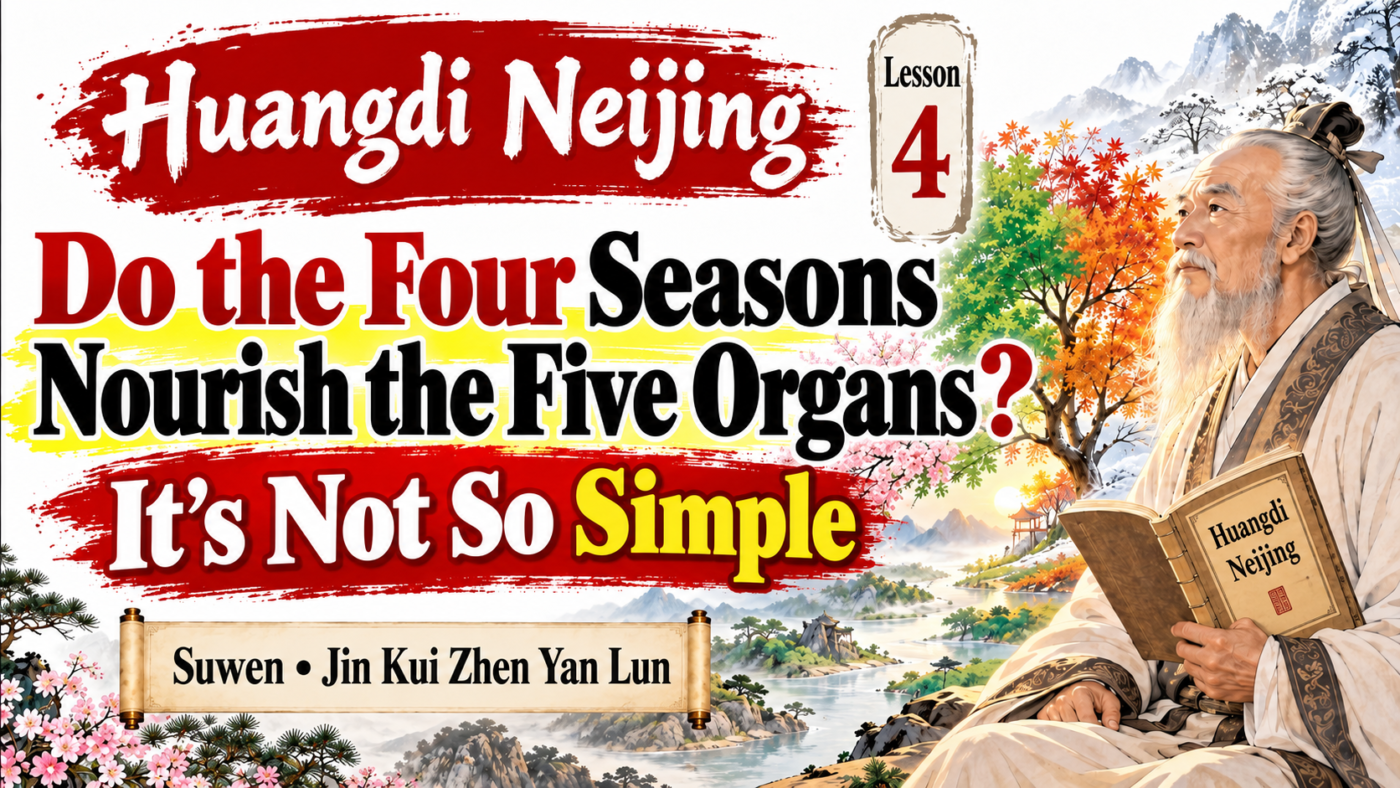
Jin Kui Zhen Yan Lun, one of the foundational discussions in the Huangdi Neijing, connects seasonal change with yin and yang, the five organs, the Five Elements, colors, flavors, and patterns of daily life. Rather than asking readers to memorize a rigid chart, the chapter presents a traditional framework for understanding how human life was viewed in relation to changing seasons and the natural environment.Why do some people feel more head pressure or eye discomfort in spring, become irritable and sleep poorly in summer, notice greater sensitivity in the nose and skin during autumn, or feel especially vulnerable to cold in the lower back, legs, and joints in winter?
A modern answer might simply be: the seasons are changing.
The Huangdi Neijing, or Yellow Emperor’s Inner Classic, offers a much broader traditional explanation.
In the fourth lesson of this series, Jin Kui Zhen Yan Lun—the True Discourse on the Golden Cabinet—the text brings together several major ideas that have appeared in the earlier chapters:
- the seasons,
- yin and yang,
- the five zang organs,
- the five colors,
- the five flavors,
- and the Five Elements.
The purpose is not merely to memorize that spring corresponds to the liver, summer to the heart, late summer to the spleen, autumn to the lungs, and winter to the kidneys.
That would only be the surface.
The deeper purpose is to understand why ancient Chinese medicine tried to connect the human body with seasonal and environmental change. The source itself presents these organ-season relationships as part of a larger map linking seasons, yin-yang, organs, colors, flavors, and the Five Elements.
Begin With the Environment, Not the Organ Chart
At the beginning of the chapter, the discussion turns to wind.
Why would wind matter?
In the traditional framework of the Huangdi Neijing, human beings live within an environment shaped by wind, cold, summer heat, dampness, changing temperatures, and seasonal transitions.
The text therefore does not treat the body as completely separated from nature.
Traditional Chinese medicine gives wind a particularly important role. The familiar saying that “wind is the beginning of a hundred diseases” should not be interpreted literally to mean that every illness is caused by being exposed to a breeze.
Within the classical system, wind represents an external influence characterized by rapid change, movement, disturbance, and the ability to combine with other environmental factors.
The practical idea is simpler:
When the environment changes quickly, the body also has to adapt.
Seasonal transitions may bring large differences between day and night temperatures, changing humidity, stronger winds, greater heat, increasing dryness, or colder conditions.
This is why Jin Kui Zhen Yan Lun begins by asking us to observe the seasons before memorizing the organs.
The original lesson explicitly warns against interpreting “wind” as meaning that all illness comes from catching a breeze and instead presents it as a traditional category for rapidly changing external influences.
Why Does the Body Feel Different in Different Seasons?
The seasonal examples are familiar.
In early spring, temperatures may rise during the day while mornings and evenings remain cold.
Some people remove heavy clothing too quickly and then feel uncomfortable when the temperature drops.
In summer, greater heat can mean more sweating, lighter sleep, and greater irritability.
During humid late-summer conditions, some people may notice poor appetite, sleepiness, sluggishness, or a heavy feeling in the body.
Autumn often becomes cooler and drier, and some people notice dryness of the nose, throat, or skin.
Winter brings cold, shorter days, and often less outdoor activity. Older adults may become more aware of stiffness, cold hands and feet, or discomfort in the back and joints.
Ancient physicians did not have modern physiology, laboratory testing, imaging, or contemporary environmental medicine.
They therefore organized repeated observations into a traditional correspondence system.
That system gradually connected:
season → direction → color → element → organ → flavor
The system is historical and theoretical rather than a direct equivalent of modern physiology.
But understanding how it was constructed helps explain much of traditional Chinese medicine.
Spring: Wood, Green, Liver, and Sour
In the traditional correspondence system:
Spring → Wood → Green → Liver → Sour
Why did the ancients connect spring with the liver?
Spring represents growth and expansion.
Trees begin to bud.
Branches extend.
Vegetation becomes active again.
Nature moves from winter storage toward outward development.
Within traditional Chinese medicine, the liver was also associated with a quality often translated as free coursing, soothing, or regulation.
In practical terms, this chapter connects spring with avoiding excessive constraint.
The body should gradually become more active.
The mind should not remain constantly tense.
The point is not:
“What supplement should I take for my liver in spring?”
A better first set of questions is:
Have I been sitting too much?
Have I spent very little time outdoors?
Am I constantly tense?
Am I sleeping too late?
Am I trying to change my activity level too aggressively?
The lesson repeatedly emphasizes that spring wellness is more about gradually opening and moving than obsessing over a specific “liver-nourishing” food.
A Practical Spring Approach
When weather conditions are suitable:
Walk more.
Spend reasonable time outdoors.
Practice gentle Tai Chi or mobility exercises.
Enjoy moderate sunlight.
Increase physical activity gradually.
Avoid suddenly turning the first warm day of spring into an exhausting training session.
For a middle-aged or older adult who has been relatively inactive all winter, going immediately from very little activity to 10,000 steps or strenuous exercise is unnecessary.
Gradual expansion is different from overexertion.
What About the Eyes, Head, and Tendons?
Traditional Chinese medicine states that the liver “opens into the eyes” and is related to the tendons.
This does not mean that every spring headache, eye symptom, or muscle cramp is a liver disorder.
Headaches, visual changes, cramps, and musculoskeletal symptoms have many possible causes in modern medicine.
The organ relationships discussed here belong to a traditional correspondence system.
That distinction should remain clear.
The source explicitly cautions against reducing spring headaches, dry eyes, or cramps to a simple “liver problem.”
Summer: Fire, Red, Heart, and Bitter
The traditional system associates:
Summer → Fire → Red → Heart → Bitter
Summer represents heat, expansion, activity, and outward movement.
People often spend more time outside, sweat more, and experience the effects of higher temperatures.
Traditional Chinese medicine also connects the heart with shen, often translated as spirit or mental-emotional activity.
For this reason, summer wellness in the classical framework is not only about avoiding physical overheating.
It is also about avoiding excessive mental agitation.
Do Not Let the Mind Overheat Before the Body
Many people notice that intense heat affects patience and sleep.
A hot night may disrupt rest.
Poor sleep can make the following day more irritable.
Small problems can suddenly feel much larger.
The traditional advice to keep the spirit from excessive anger should not be interpreted as “never become angry.”
It is better understood as:
When the body is already dealing with heat, do not continually add another layer of unnecessary emotional strain.
The original lesson makes this distinction clearly: the summer principle is not emotional suppression, but avoiding persistent agitation when heat is already placing a burden on the body.
A Practical Summer Approach
Exercise during cooler parts of the day when possible.
Morning and evening are often more comfortable.
Avoid prolonged strenuous activity under intense sun.
Maintain appropriate hydration.
Keep the sleeping environment reasonably cool.
Reduce unnecessary mental stimulation and prolonged emotional conflict.
Summer activity is appropriate.
Summer exhaustion is not the goal.
Late Summer: Earth, Yellow, Spleen, and Sweet
Within the framework used in this lesson:
Late Summer → Earth → Yellow → Spleen → Sweet
Late summer is presented as a hot, humid transitional period.
Traditional Chinese medicine connects the spleen with digestion, nourishment, and the muscles.
This was used to explain why humid, oppressive weather was often associated with:
poor appetite,
sleepiness,
a heavy feeling,
and digestive discomfort.
Again, this is a traditional theoretical relationship, not a modern biomedical diagnosis.
Late Summer Does Not Require Random Supplements
The practical advice is much less complicated than many wellness products suggest.
Eat regularly.
Avoid overeating.
Do not allow one missed meal to become a huge late-night meal.
Keep food reasonably balanced.
Avoid excessive greasy foods.
Do not rely heavily on ice-cold drinks simply because the weather is hot.
Maintain moderate activity.
Take a gentle walk after meals when appropriate.
Keep sleep regular.
The underlying principle returns to something already emphasized in the earlier chapters:
食饮有节 — eat and drink with moderation.
Autumn: Metal, White, Lung, and Pungent
The traditional system associates:
Autumn → Metal → White → Lung → Pungent
Autumn brings a different movement.
Heat begins to decline.
Air may become cooler.
Humidity may fall.
Dryness may become more noticeable.
Nature begins to shift from outward expansion toward gathering and restraint.
Traditional Chinese medicine associates the lungs with the nose, skin, and body surface.
Ancient observers therefore linked many autumn complaints involving dryness of the nose, throat, or skin with the lung system.
This should not be turned into a modern medical rule.
Dry nose, sore throat, cough, or skin symptoms can have many different causes.
The classical correspondence is best understood historically.
Autumn Wellness Is More Than “Taking Tonics”
The most practical autumn habits are often ordinary:
Add clothing when temperatures fall.
Drink enough fluids when the air is dry.
Maintain a regular sleep schedule.
Avoid standing in cold wind while sweaty after exercise.
Continue moving, but do not make every workout an attempt to sweat excessively.
The key autumn principle is:
Gather without becoming inactive.
The original lesson emphasizes restraint, regular sleep, appropriate warmth, continued moderate movement, and hydration rather than simply beginning a seasonal supplement routine.
Winter: Water, Black, Kidney, and Salty
The traditional correspondence is:
Winter → Water → Black → Kidney → Salty
Winter represents storage.
Days are shorter.
Temperatures are lower.
Outdoor activity may decrease.
The traditional kidney system is associated with storage, bones, the lower back, and other functions within Chinese medical theory.
That helps explain why classical winter health discussions frequently focus on conservation and why lower-back and joint complaints were included in traditional kidney correspondences.
Again, this does not mean that modern back pain or knee pain automatically indicates a kidney disorder.
Winter Is for Storage, Not Exhaustion
People sometimes move to one of two extremes in winter.
One extreme is almost complete inactivity.
The other is strenuous exercise in the coldest part of the morning.
Neither extreme reflects the balance emphasized in the text.
A more moderate approach is:
Wait until temperatures become more comfortable when possible.
Warm up gradually.
Walk.
Practice gentle Tai Chi.
Move enough to become comfortably warm.
Do not deliberately chase heavy sweating in cold conditions.
The core principle is:
Store rather than exhaust.
The source explicitly contrasts complete inactivity with intense predawn exercise and recommends gentler movement after temperatures have risen.
Why Does One Season Affect the Next?
The Huangdi Neijing repeatedly describes seasonal health as continuous rather than isolated.
Spring affects summer.
Summer affects autumn.
Autumn affects winter.
Winter influences the following spring.
Traditional Chinese medicine sometimes explained this through the idea that pathogenic influences could remain hidden and appear later.
That traditional theory should not simply be equated with the modern concept of an infectious disease incubation period.
Modern incubation periods have specific definitions involving particular pathogens, mechanisms, and diseases.
But the broader lifestyle observation remains useful:
The body does not reset every midnight.
Sleep habits accumulate.
Dietary habits accumulate.
Physical inactivity accumulates.
Overtraining accumulates.
Recovery accumulates.
What happens today may shape how well we cope with the next period of life.
The source itself explicitly warns not to equate the traditional idea of delayed seasonal illness with a modern “incubation period.”
Relationships, Not Fixed Objects
One of the most important developments in Jin Kui Zhen Yan Lun is its treatment of yin and yang.
Yin and yang are not presented simply as two substances.
They are relative relationships.
Light and darkness.
Movement and stillness.
Day and night.
Exterior and interior.
Front and back.
Activity and rest.
These relationships can be divided further.
Day is considered yang, but the movement from morning toward noon differs from the movement from noon toward evening.
Night is considered yin, but midnight differs from the gradual approach toward dawn.
This leads to the traditional expressions:
Yang within yang
Yin within yang
Yin within yin
Yang within yin
The important point is not memorizing labels.
It is understanding that change never stops.
What Does This Mean in Daily Life?
Morning is a time to gradually become active.
Daytime is generally oriented toward activity.
Later in the day, intensity begins to decline.
Evening should gradually move toward quiet.
Night favors rest and sleep.
Many modern lifestyles reverse the pattern:
difficulty waking,
very little activity during the day,
then sudden mental stimulation late at night.
The lesson does not ask us to copy an ancient clock.
It asks us to understand when activity is appropriate and when recovery is appropriate.
The Body Can Also Be Divided Into Yin and Yang
The classical text extends the same framework to the body.
The exterior is described as yang.
The interior is yin.
The back is yang.
The front is yin.
The five zang organs are categorized as yin.
The six fu organs are categorized as yang.
The classifications become increasingly detailed.
For a general wellness reader, memorizing every subdivision is unnecessary.
The real lesson is more important:
Yin and yang are relative, layered, and capable of further subdivision.
No state is absolutely permanent.
That is why the text repeatedly discourages extremes.
Health Is Not About Maximizing One Side
If yin and yang are relative, then wellness cannot be based on pushing everything in one direction.
Hotter is not always better.
Colder is not always better.
More exercise is not always better.
More rest is not always better.
More tonics are not always better.
Eating an extremely plain diet is not automatically better either.
The desired state is appropriateness.
Appropriate movement.
Appropriate rest.
Appropriate warmth.
Appropriate cooling.
Appropriate food.
Appropriate timing.
This principle is one of the most useful ways to understand the entire early section of the Huangdi Neijing.
The Five-Element Correspondence Map
The chapter brings the traditional system together in a memorable pattern:
| Season | Element | Color | Zang Organ | Flavor |
|---|---|---|---|---|
| Spring | Wood | Green/Blue-Green | Liver | Sour |
| Summer | Fire | Red | Heart | Bitter |
| Late Summer | Earth | Yellow | Spleen | Sweet |
| Autumn | Metal | White | Lung | Pungent |
| Winter | Water | Black | Kidney | Salty |
This traditional correspondence system became highly influential in later Chinese medicine.
But it can easily be misunderstood.
If liver corresponds to sour, that does not mean eating large amounts of sour food “nourishes the liver.”
If the heart corresponds to bitter, it does not mean everyone should deliberately eat large quantities of bitter foods.
If the kidney corresponds to salty, it certainly does not mean that high salt intake is a kidney health strategy.
The table is a classification system, not a shopping list.
The value lies in understanding how ancient physicians tried to connect seasons, colors, tastes, organs, and environmental patterns within one conceptual framework.
Why Did Ancient Medicine Build Such a Complex System?
Ancient physicians did not have:
CT scans,
laboratory tests,
blood pressure monitors,
modern medical imaging,
or biochemical markers.
Clinical judgment relied heavily on observation.
They looked.
They listened.
They asked questions.
They examined the tongue.
They listened to the voice.
They asked about food.
Sleep.
Bowel movements.
Pain.
Seasonal patterns.
Then they interpreted this information through frameworks such as yin-yang, the Five Elements, and the zang-fu system.
The value of Jin Kui Zhen Yan Lun is therefore not that every modern reader should learn to diagnose disease using ancient correspondences.
Its value is that it shows why traditional Chinese medicine developed such a strongly holistic way of organizing observations.
What Should We Actually Remember?
Most readers do not need to memorize every traditional correspondence involving tones, grains, directions, stars, numbers, organs, colors, and flavors.
Three ideas matter much more.
1. Lifestyle Should Change When the Seasons Change
What feels appropriate in summer may not be appropriate in winter.
Activity, clothing, hydration, sleep, and recovery may all need adjustment.
2. Yin and Yang Represent Balance and Change
Do not turn health into a pursuit of one extreme.
More is not always better.
Less is not always better.
The question is what is appropriate for the situation.
3. The Body Is Not a Collection of Completely Separate Parts
Diet, sleep, emotions, physical activity, environment, and bodily experience interact.
The ancient system tried to understand these relationships as one connected whole.
A Practical Five-Season Lifestyle Guide
Spring
Gradually increase activity.
Walk more.
Spend time outdoors.
Avoid suddenly beginning very strenuous exercise.
Allow both body and mind to become less constrained.
Summer
Choose cooler times for activity.
Avoid prolonged strenuous exercise in intense heat.
Stay appropriately hydrated.
Protect sleep.
Reduce unnecessary emotional agitation.
Late Summer
Keep meals regular.
Avoid overeating.
Reduce excessive greasy foods.
Maintain moderate movement.
Keep sleep consistent.
Autumn
Allow routines to become steadier.
Adjust clothing as temperatures fall.
Maintain hydration in dry conditions.
Continue exercising without continually chasing heavy sweating.
Winter
Protect yourself from excessive cold.
Avoid the coldest times of day for intense exercise when possible.
Warm up gradually.
Choose walking, Tai Chi, or other moderate movement.
Recover adequately.
Remember:
Winter is for conservation, not depletion.
How the First Four Chapters Fit Together
The first four chapters now begin to form one coherent foundation.
Lesson 1 — Shang Gu Tian Zhen Lun
Eat with moderation.
Maintain regular routines.
Avoid reckless exhaustion.
Protect both body and mind.
Lesson 2 — Si Qi Tiao Shen Da Lun
Spring — birth and emergence.
Summer — growth.
Autumn — gathering.
Winter — storage.
Lesson 3 — Sheng Qi Tong Tian Lun
Human life exists within heaven and earth.
Yin and yang require balance.
Lesson 4 — Jin Kui Zhen Yan Lun
Time, seasonal change, yin-yang, the five organs, the Five Elements, colors, and flavors begin to form an integrated traditional map.
The first four chapters are therefore not rushing to tell us how to treat a particular disease.
They are building a way of understanding:
life,
aging,
day and night,
the seasons,
activity and recovery,
the organs,
and the human relationship with nature.
The Most Important Lesson Is Simpler Than the Five-Element Chart
It is easy to reduce seasonal wellness to products.
Spring arrives: find something to “nourish the liver.”
Summer arrives: look for something for the heart.
Autumn arrives: buy something to “moisten the lungs.”
Winter arrives: search for something to “tonify the kidneys.”
But the Huangdi Neijing repeatedly returns to much more ordinary behavior.
Sleep when it is time to sleep.
Move when movement is appropriate.
Add clothing when it becomes cold.
Seek shade when the heat is intense.
Become more active gradually in spring.
Conserve more carefully in winter.
Eat moderately.
Exercise appropriately.
Avoid turning every emotional reaction into prolonged exhaustion.
These principles are far less dramatic than a new supplement or health trend.
They are also much closer to the central message of this lesson.
Final Perspective
If all of the complicated tables are removed from Jin Kui Zhen Yan Lun, one idea remains:
Human life and the natural environment are not treated as completely separate.
When climate changes, daily life changes.
When day becomes night, activity should gradually change.
When seasons shift, clothing, movement, rest, and food may also need to shift.
Inside the body, the ancient physicians did not view each organ as an isolated machine.
They tried to understand patterns as relationships.
That is why the chapter connects:
time, seasons, yin-yang, organs, colors, flavors, and the Five Elements.
The goal is not to memorize a complicated diagram.
The goal is to learn how to observe change without becoming trapped by rigid rules.
Health, in this classical framework, is not about chasing a different method every day.
It is about learning to observe the environment, understand your own condition, avoid unnecessary extremes, and live with greater awareness of natural rhythm.
5 Practical Lessons From Jin Kui Zhen Yan Lun
- Seasonal change calls for adaptation, not rigid routines.
Clothing, movement, hydration, rest, and daily activity can change as environmental conditions change. - Yin and yang describe relationships and change rather than fixed substances.
Activity and rest, day and night, warmth and coolness all exist in changing relationships. - The Five-Element map is a traditional classification system, not a literal biomedical chart.
Spring–liver, summer–heart, autumn–lung, and winter–kidney correspondences belong to the classical Chinese medical framework. - More is not automatically better.
More exercise, more rest, more warmth, more cooling, or more supplements can all become excessive. - Long-term health reflects accumulated habits.
Sleep, movement, diet, recovery, and environmental exposure build on one another over time.
FAQ
What is Jin Kui Zhen Yan Lun?
Jin Kui Zhen Yan Lun is an important chapter of the Suwen section of the Huangdi Neijing. It brings together traditional ideas involving seasonal change, yin and yang, the five zang organs, the Five Elements, colors, flavors, and environmental influences.
How does Jin Kui Zhen Yan Lun connect the seasons with the five organs?
Within its traditional correspondence framework, spring is associated with the liver, summer with the heart, late summer with the spleen, autumn with the lungs, and winter with the kidneys. These are classical Chinese medical correspondences rather than direct statements about modern organ physiology.
What are the Five Elements in traditional Chinese medicine?
The Five Elements—or Five Phases—are Wood, Fire, Earth, Metal, and Water. Classical Chinese medicine uses them as part of a larger system for organizing relationships among seasons, organs, colors, flavors, directions, and other phenomena.
Does spring literally affect the liver?
The Huangdi Neijing traditionally associates spring with the liver, but this should not be interpreted to mean that every spring symptom is caused by liver disease. Modern symptoms such as headache, eye discomfort, or muscle cramps can have many different causes.
Does the five-flavor system mean we should eat more sour, bitter, sweet, pungent, or salty foods in certain seasons?
No. The correspondence system is not a prescription to consume large quantities of a particular flavor. Dietary excess can itself be unhealthy. Seasonal eating should remain balanced and appropriate to individual needs.
Is yin-yang the same as modern physiology?
No. Yin and yang belong to a traditional philosophical and medical framework. They are useful for understanding how classical Chinese medicine described relationships, balance, and change, but they are not direct equivalents of specific modern physiological structures or processes.
Why does the Huangdi Neijing connect human health with the seasons?
Ancient Chinese medicine developed through observation of how weather, temperature, daylight, food, activity, and seasonal conditions appeared to relate to human experience. These observations were organized into traditional frameworks such as yin-yang and the Five Elements.
Can Jin Kui Zhen Yan Lun replace modern medical advice?
No. It is valuable as a historical and traditional medical text, but persistent, severe, or concerning symptoms require appropriate modern medical assessment.
Medical Disclaimer: This article discusses concepts from the Huangdi Neijing for educational, historical, and cultural purposes. Traditional correspondences involving yin-yang, the Five Elements, zang-fu organs, colors, flavors, wind, heat, dampness, and seasonal influences belong to a traditional Chinese medical framework and should not be interpreted as direct equivalents of modern anatomy, physiology, pathology, or medical diagnosis. Symptoms such as persistent headache, visual changes, chest discomfort, breathing difficulty, swelling, severe joint pain, or other concerning problems should be evaluated by an appropriately qualified healthcare professional. This content is not a substitute for medical diagnosis or treatment.
This article is for general education and does not replace individualized care from a qualified health professional. Seek appropriate advice for persistent, severe, or concerning symptoms.
Read the full medical disclaimer