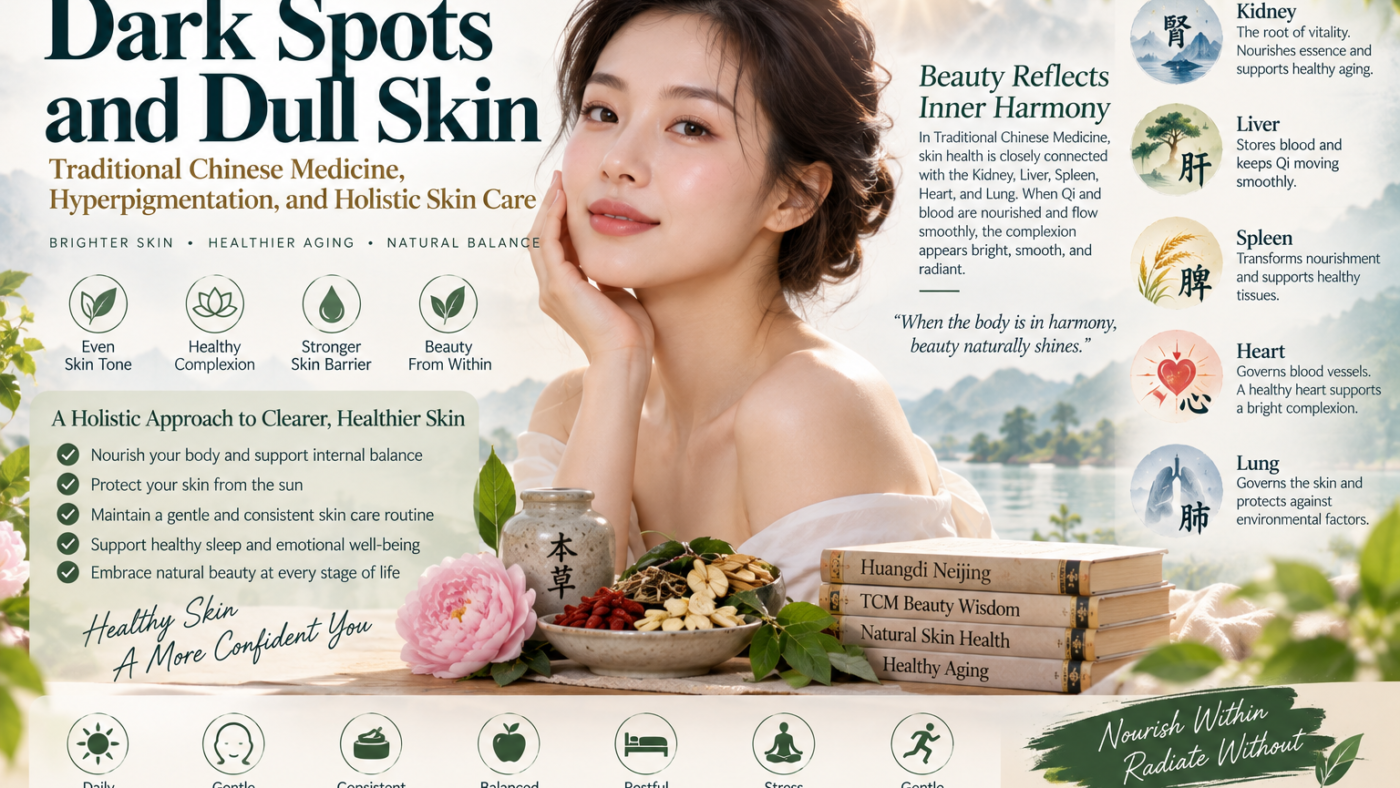
Dark Spots and Dull Skin: Understanding Hyperpigmentation and Skin Health
Dark spots and dull skin are common skin care concerns that can influence complexion, confidence, and overall well-being. Whether they appear as uneven pigmentation, melasma, post-acne marks, or a gradual loss of radiance, changes in skin appearance can result from multiple biological and environmental factors.
Understanding dark spots and dull skin requires more than choosing a brightening cream. Sun exposure, hormonal changes, inflammation, skin barrier function, genetics, and aging can all influence the skin’s appearance.
Traditional Chinese Medicine offers a historical perspective on beauty through internal nourishment, Qi and blood, and the functional relationships among the Kidney, Liver, Spleen, Heart, and Lung systems. Modern dermatology provides a scientific understanding of melanin production, hyperpigmentation, skin inflammation, and healthy skin care.
A holistic approach combines gentle daily care, consistent sun protection, balanced nutrition, restorative sleep, and appropriate professional treatment to support healthy skin at every stage of life.Dark spots and dull skin are among the most common concerns in modern skin care. Whether they appear as uneven pigmentation, persistent discoloration, post-acne marks, or a gradual loss of radiance, changes in skin appearance can influence how people feel about their overall well-being.
Healthy skin, however, is not defined by a particular shade or an absence of every visible imperfection.
Skin naturally varies in color, texture, and appearance according to genetics, age, environment, hormonal influences, and individual characteristics.
A healthy complexion is better understood through the skin’s ability to maintain moisture, protect against environmental stressors, recover from irritation, and perform its essential biological functions.
Traditional Chinese Medicine (TCM) approaches skin health through a historical philosophy of internal nourishment and functional balance.
Rather than considering the skin as an isolated surface, classical Chinese medical theory describes relationships among the Kidney, Liver, Spleen, Heart, Lung, Qi, and blood.
Modern dermatology offers a different explanation based on melanin production, skin barrier function, inflammation, ultraviolet radiation, hormonal changes, and the biology of skin aging.
Understanding these perspectives can provide a broader foundation for thoughtful skin care while preserving the distinction between traditional wellness concepts and established medical knowledge.
The Traditional Chinese Medicine Philosophy of Beauty From Within
One of the defining principles of traditional Chinese health preservation is that outward appearance reflects the body’s broader state of well-being.
Classical Chinese medicine emphasizes the nourishment of Qi and blood, the preservation of foundational vitality, and the harmonious interaction of the traditional organ systems.
Within this framework, skin appearance is associated with more than external cleansing or cosmetic treatment.
Rest, nourishment, emotional well-being, and the movement of Qi and blood are traditionally considered important aspects of maintaining a healthy complexion.
The concept of Tiao Yang (调养), or nurturing and regulating health, expresses this broader philosophy.
Rather than focusing exclusively on correcting a visible concern, it encourages attention to the habits and conditions believed to support long-term vitality.
The related principle of Fu Zheng Tiao Ping (扶正调平) describes supporting foundational vitality while encouraging functional balance.
These ideas belong to a historical medical system and should not be interpreted as evidence that every pigmentation disorder originates from an internal organ imbalance.
Nevertheless, the philosophy of caring for the whole person can complement modern approaches to skin health.
A sustainable skin care routine works best when it is supported by appropriate nutrition, sleep, stress management, environmental protection, and medical care when necessary.
What Causes Dark Spots and Uneven Skin Tone?
To understand pigmentation, it is helpful to begin with melanin.
Melanin is the natural pigment responsible for much of the color of human skin, hair, and eyes.
It is produced by specialized cells called melanocytes.
Melanin also contributes to the skin’s natural response to ultraviolet radiation, although naturally occurring pigmentation does not eliminate the need for sun protection.
When melanin production or distribution increases in certain areas, darker patches or spots may become visible.
This process is known as hyperpigmentation.
Different forms of hyperpigmentation have different causes.
Some are associated with sunlight and accumulated environmental exposure.
Others develop after inflammation, acne, skin injury, or hormonal changes.
Genetic factors and certain medications may also contribute.
The location, appearance, timing, and progression of pigmentation can provide important clues about its underlying cause.
This is why effective skin care should begin with understanding the specific concern rather than assuming that every dark spot requires the same treatment.
Melasma: Understanding Hormonal Pigmentation
Melasma is a common pigmentation disorder characterized by patches that are darker than the surrounding natural skin tone.
It frequently affects the cheeks, forehead, nose, upper lip, and other sun-exposed facial areas.
The patches may appear brown, gray-brown, or, in some skin tones, bluish gray.
Melasma is particularly common among women, although men can also develop it.
Hormonal influences are important in some cases.
Pregnancy, certain hormonal medications, and individual susceptibility may contribute to its development.
Sunlight is another major factor.
Ultraviolet radiation and visible light can stimulate pigmentation and make existing melasma more noticeable.
Some people find that their melasma becomes more apparent during sunnier seasons or after prolonged outdoor exposure.
This seasonal pattern should not automatically be interpreted as evidence of a traditional Kidney Yang deficiency.
Modern skin science provides a more direct explanation through light exposure and pigment-cell activity.
Melasma may fade when a triggering factor changes, but it can also persist or recur.
Consistent sun protection is therefore an essential part of long-term management.
The Kidney and Skin Beauty in Traditional Chinese Medicine
Traditional Chinese Medicine describes the Kidney as the foundation of inherited vitality.
Within this historical framework, Kidney Essence is associated with growth, development, reproductive vitality, and aging.
The Kidney is also traditionally described as governing the bones and contributing to the body’s foundational Yin and Yang.
Classical beauty cultivation often emphasizes the preservation of Kidney vitality as people move through different stages of life.
Traditional practitioners may interpret combinations of fatigue, cold sensitivity, lower back discomfort, reproductive changes, or other symptoms through patterns involving Kidney deficiency.
Some classical explanations associate changes in facial appearance with the broader concept of declining foundational vitality.
However, these traditional patterns should not be confused with anatomical kidney disease or measured kidney function.
There is no established scientific basis for concluding that all facial pigmentation is caused by Kidney Qi deficiency.
Similarly, improving a traditional Kidney Yang pattern has not been demonstrated to guarantee the disappearance of melasma or prevent its recurrence.
A more appropriate modern interpretation of the classical philosophy is the importance of protecting overall health throughout the aging process.
Balanced nutrition, regular activity, restorative sleep, and preventive healthcare can support well-being while evidence-based skin care addresses specific pigmentation concerns.
The Liver, Qi, and Emotional Well-Being
The Liver occupies an important position in traditional Chinese medical discussions of beauty and vitality.
Classical theory describes the Liver as storing blood and supporting the smooth movement of Qi.
When this process is considered harmonious, the traditional framework associates it with balanced bodily function and emotional well-being.
A pattern known as Liver Qi stagnation may be considered when a person experiences emotional tension, frustration, or symptoms that appear to change during stressful periods.
Traditional beauty cultivation sometimes associates such patterns with changes in complexion.
Modern medicine does not equate Liver Qi stagnation with an anatomical liver disorder or a specific pigmentation mechanism.
However, stress can influence several aspects of skin health.
It may affect sleep, skin care habits, inflammatory conditions, and the perception of appearance-related concerns.
Some people also experience worsening acne or other skin symptoms during demanding periods.
The relationship between stress and pigmentation is complex, and stress should not automatically be identified as the cause of an individual person’s melasma.
A balanced approach may include regular movement, relaxation, adequate sleep, and professional care for persistent skin concerns.
Practices such as Tai Chi, Qigong, mindful breathing, and walking may provide comfortable opportunities to support emotional well-being.
The Spleen and the Traditional Concept of Nourishing the Skin
Traditional Chinese Medicine describes the Spleen as the foundation of acquired nourishment.
Within this framework, the Spleen is associated with transforming food and fluids into substances that sustain the body.
The classical expression “the Spleen governs the muscles” reflects its traditional relationship with physical nourishment and vitality.
In historical beauty cultivation, supporting the Spleen is sometimes emphasized as a way of encouraging the body’s overall capacity to nourish its tissues.
Modern dermatology explains skin nutrition through established physiological processes involving digestion, absorption, circulation, cellular metabolism, and tissue maintenance.
The skin requires sufficient energy, protein, essential fatty acids, vitamins, and minerals to maintain normal function.
Nutritional deficiencies can affect skin health, but excessive supplementation does not necessarily improve the appearance of otherwise healthy skin.
A varied, balanced diet is generally more useful than relying on a single food, herbal preparation, or beauty supplement.
The traditional principle of nourishment can therefore be understood as an encouragement to maintain adequate nutrition rather than as proof that Spleen tonification eliminates pigmentation.
The Heart, Circulation, and Facial Appearance
Classical Chinese Medicine states that the Heart governs blood vessels and that its outward expression is reflected in the face.
Within this traditional framework, the appearance of the complexion is associated with the nourishment and movement of blood.
Historical descriptions may connect facial pallor, reduced vitality, or a dull appearance with traditional Heart or blood-related patterns.
Modern medicine recognizes that the skin’s appearance can be influenced by circulation, hydration, inflammation, oxygenation, and other physiological factors.
However, an uneven complexion or facial pigmentation does not establish a diagnosis of cardiovascular disease.
Likewise, visible dark spots are not necessarily deposits of stagnant blood.
Melasma and post-inflammatory hyperpigmentation involve changes in skin pigmentation rather than an accumulation of unhealthy blood beneath the surface.
A persistently pale or unusually discolored complexion may sometimes warrant medical assessment, especially when accompanied by fatigue, dizziness, shortness of breath, or other symptoms.
The traditional connection between the Heart and facial appearance can be appreciated as part of classical health philosophy without treating it as a modern diagnostic method.
The Lung and Skin: A Classical Relationship
Traditional Chinese Medicine describes the Lung as governing the skin and body hair.
The Lung is also associated with the distribution of Qi and the body’s traditional protective functions.
Within this framework, supporting Lung Qi is sometimes discussed as part of maintaining healthy skin and resistance to environmental influences.
Modern dermatology explains the skin’s protective role through the epidermis, skin barrier lipids, immune activity, and other biological mechanisms.
The outermost layer of the skin helps reduce excessive water loss and protects against environmental irritants.
When this barrier becomes compromised, the skin may feel dry, tight, sensitive, or irritated.
Repeated irritation can also contribute to post-inflammatory discoloration in susceptible individuals.
A healthy skin care routine should therefore support the barrier rather than repeatedly strip or aggressively exfoliate the skin.
The traditional phrase “the Lung governs the skin” is best understood as a historical functional relationship, not as evidence that treating the anatomical lungs can directly remove facial pigmentation.
Post-Inflammatory Hyperpigmentation: Why Acne Leaves Dark Marks
One of the most common causes of lingering dark spots is post-inflammatory hyperpigmentation, often abbreviated as PIH.
This occurs when skin inflammation or injury triggers increased pigment production.
Acne, eczema, insect bites, burns, scratches, and irritating cosmetic procedures can all contribute.
A person may notice that a pimple disappears but leaves behind a flat brown or grayish mark.
The discoloration may remain visible for months, even after the original inflammation has resolved.
Post-inflammatory hyperpigmentation can be particularly noticeable in people with medium or darker skin tones.
The most important principle is to address the cause of ongoing inflammation.
If acne continues to develop, new pigmentation may continue to appear.
Similarly, repeatedly applying irritating products in an attempt to remove dark spots can worsen the problem.
A gentle, consistent routine is often more appropriate than aggressive exfoliation or frequent changes between strong active ingredients.
Pregnancy, Postpartum Changes, and Skin Pigmentation
Pregnancy can produce several noticeable changes in the skin.
Hormonal changes may influence pigment production, oiliness, sensitivity, and other aspects of skin appearance.
Some women develop melasma during pregnancy, sometimes referred to as the “mask of pregnancy.”
Darkening may occur across the cheeks, forehead, upper lip, or other facial areas.
Pigmentation can also become more noticeable on the nipples, inner thighs, or along the abdomen.
These changes are not automatically evidence of blood deficiency or damage to foundational vitality.
Modern medical explanations include hormonal influences, increased melanocyte activity, and individual susceptibility.
After childbirth, pigmentation may gradually fade as hormonal conditions change.
However, some patches persist and require ongoing management.
Pregnancy and postpartum experiences differ considerably, and not every woman develops melasma or other visible pigmentation changes.
The idea that childbirth inevitably damages a woman’s complexion should therefore be avoided.
Supporting Skin Health During Pregnancy and Postpartum Recovery
Pregnancy and the postpartum period are important times to prioritize gentle, practical skin care.
Daily sun protection is particularly relevant for people who develop melasma.
A simple routine may include gentle cleansing, an appropriate moisturizer, and broad-spectrum sunscreen.
Strong depigmenting treatments should not be started without checking their suitability during pregnancy or breastfeeding.
Certain prescription ingredients and cosmetic procedures may need to be postponed or modified.
Adequate nutrition, rest, and access to postpartum healthcare are also important for overall recovery.
The goal is to support a woman’s health and comfort rather than impose unrealistic expectations about quickly restoring a particular appearance after childbirth.
Why Some Dark Spots Become More Noticeable With Age
Skin changes naturally throughout life.
With age, the skin may become thinner, drier, or less resilient.
Long-term environmental exposure can also contribute to visible changes in pigmentation and texture.
Areas repeatedly exposed to sunlight, such as the face, hands, neck, and forearms, may gradually develop more noticeable pigment irregularities.
Some people also experience reduced skin hydration or changes in surface texture that make their complexion appear less radiant.
However, skin aging does not follow one universal pattern.
Genetics, sun exposure, lifestyle habits, health conditions, and skin care practices influence individual experiences.
The traditional concept of preserving vitality with age can encourage consistent self-care.
Modern dermatology provides practical methods for protecting the skin barrier, reducing ultraviolet damage, and managing specific pigmentation concerns.
Healthy aging should emphasize skin health and comfort rather than the pursuit of permanently youthful or unusually pale skin.
7 Healthy Habits for Dark Spots and Dull Skin
A thoughtful skin care routine does not need to be complicated.
The most useful habits are often those that can be maintained consistently without irritation or unnecessary expense.
1. Protect Your Skin From the Sun Every Day
Sun protection is one of the most important steps in managing pigmentation.
Choose a broad-spectrum sunscreen with SPF 30 or higher.
Apply it to exposed skin and reapply approximately every two hours when outdoors, or sooner after swimming or sweating.
Shade, wide-brimmed hats, and protective clothing can provide additional protection.
For individuals with melasma or persistent hyperpigmentation, a tinted sunscreen containing iron oxides may help protect against visible light that contributes to pigmentation.
2. Choose a Gentle Cleanser
Cleansing should remove excess oil, dirt, and other surface impurities without leaving the skin uncomfortable.
Harsh scrubbing and excessive cleansing can irritate the skin.
People with dry or sensitive skin may benefit from mild, fragrance-free products.
The goal is to maintain cleanliness while preserving the skin’s natural barrier.
3. Moisturize Consistently
Moisturizing helps reduce water loss and supports the skin barrier.
Choose a product suited to your skin type.
Dry skin may benefit from richer creams, while oily or acne-prone skin may respond better to lighter, non-comedogenic formulations.
Consistent moisturizing can improve the appearance of dryness and surface texture, although it does not directly eliminate every type of pigmentation.
4. Address Acne and Inflammation Early
Untreated or repeatedly irritated acne may leave persistent dark marks.
Avoid squeezing pimples or using aggressive home treatments.
If breakouts continue despite an appropriate routine, a dermatologist can recommend treatment that addresses both acne and pigmentation.
5. Support Skin Health Through Balanced Nutrition
A varied diet provides nutrients needed for normal skin function.
Include appropriate sources of protein, vegetables, fruits, whole grains, and healthy fats.
There is no single food that guarantees the removal of facial pigmentation.
Likewise, herbal teas and beauty supplements should not be assumed to reverse melasma or replace established treatment.
6. Maintain Sleep and Emotional Well-Being
Sleep and stress management contribute to overall health and can influence how well a person maintains daily self-care.
Develop a consistent sleep routine and make time for comfortable physical activity.
Walking, Tai Chi, Qigong, and gentle stretching may provide opportunities for relaxation.
7. Avoid Irritating Skin-Lightening Practices
Products that promise dramatic whitening or instant pigmentation removal deserve caution.
Some unregulated products may contain potentially harmful ingredients.
Excessive exfoliation, inappropriate chemical peels, and aggressive treatment combinations can worsen irritation and pigmentation.
Choose products appropriate for your skin type and consult a qualified dermatologist before using strong prescription treatments or undergoing cosmetic procedures.
Can Traditional Chinese Medicine Help With Skin Pigmentation?
Traditional Chinese Medicine has a long history of discussing the relationship between complexion, nourishment, vitality, and functional balance.
Traditional practitioners may consider patterns involving the Kidney, Liver, Spleen, Heart, Lung, Qi, and blood when discussing skin-related concerns.
These interpretations provide cultural and historical context.
However, the effectiveness of specific herbal preparations for melasma or other pigmentation disorders cannot be assumed from traditional theory alone.
Clinical evidence varies among preparations, and the safety of herbal products depends on ingredients, dosage, manufacturing quality, and individual medical circumstances.
Some herbal products may interact with medications or be unsuitable during pregnancy and breastfeeding.
Traditional wellness practices may support general well-being, but they should not replace appropriate dermatological diagnosis or treatment.
The principle of “beauty from within” is most useful when understood as a reminder that skin care belongs within a broader commitment to health.
Modern Dermatological Treatments for Hyperpigmentation
When dark spots persist despite gentle care and sun protection, professional assessment may help identify appropriate treatment options.
Treatment depends on the type and depth of pigmentation, skin tone, underlying causes, and individual preferences.
Dermatologists may recommend topical ingredients that help regulate pigmentation or improve skin renewal.
Options may include azelaic acid, selected retinoids, prescription hydroquinone, or other treatments depending on the diagnosis.
Procedures such as chemical peels and certain laser treatments may be considered in selected cases.
However, these treatments are not appropriate for everyone.
Aggressive procedures can sometimes worsen pigmentation, particularly in susceptible skin types.
Melasma may also recur after apparently successful treatment, making ongoing sun protection and maintenance care important.
Treatment decisions should be individualized rather than based on the assumption that stronger products always produce better results.
When Dark Spots Require Medical Attention
Most ordinary pigment changes are not medical emergencies.
However, a new or changing dark spot should not automatically be dismissed as melasma, aging, or a traditional internal imbalance.
A dermatologist should evaluate a lesion that changes in size, shape, or color, develops irregular borders, bleeds, becomes persistently irritated, or looks noticeably different from surrounding spots.
The ABCDE warning signs of melanoma provide a useful framework for recognizing potentially concerning pigmented lesions.
A sudden or unexplained widespread change in skin color may also require medical evaluation, particularly when accompanied by other symptoms.
Early assessment helps distinguish common cosmetic concerns from conditions that require medical attention.
Dark Spots and Dull Skin: Supporting Natural Beauty and Healthy Aging
Traditional Chinese Medicine offers a historical philosophy in which the skin reflects the broader relationship between nourishment, vitality, and functional balance.
The classical concepts of Kidney Essence, Liver blood, Spleen nourishment, Heart circulation, and Lung governance of the skin illustrate the importance placed on caring for the whole person.
Modern dermatology provides a scientific understanding of pigmentation, skin barrier function, hormonal influences, inflammation, environmental exposure, and skin aging.
These perspectives can coexist when their different purposes and limitations are clearly understood.
A healthy complexion does not require flawless skin, an artificially lighter shade, or the absence of every sign of aging.
It is supported by gentle care, consistent sun protection, adequate nutrition, restorative sleep, and appropriate medical treatment when necessary.
The deeper lesson of traditional health cultivation is that beauty should not be separated from well-being.
By protecting the skin, respecting natural differences in appearance, and developing sustainable self-care habits, individuals can support healthier, more comfortable skin throughout life.
FAQ
What causes dark spots and dull skin?
Dark spots and dull skin may be associated with sun exposure, hormonal changes, inflammation, aging, dehydration, skin barrier problems, and certain medical conditions. The underlying cause should be identified before selecting treatment.
What is the difference between melasma and hyperpigmentation?
Hyperpigmentation is a broad term describing areas of skin that become darker than the surrounding skin. Melasma is a specific pigmentation condition commonly associated with sun exposure, hormonal influences, and individual susceptibility.
Can Traditional Chinese Medicine remove dark spots?
Traditional Chinese Medicine provides historical concepts of skin nourishment and internal balance. However, there is insufficient reliable evidence that traditional organ tonification can consistently remove melasma or other forms of hyperpigmentation. Evidence-based skin care and appropriate dermatological treatment remain important.
Does pregnancy cause facial pigmentation?
Pregnancy-related hormonal changes can contribute to melasma and other pigmentation changes. These changes may fade after childbirth, although some dark patches can persist and require further management.
What sunscreen is suitable for melasma?
Dermatologists generally recommend broad-spectrum sunscreen with SPF 30 or higher. Tinted sunscreens containing iron oxides may provide additional protection against visible light, which can worsen melasma in susceptible individuals.
Can acne cause dark spots?
Yes. Acne-related inflammation can cause post-inflammatory hyperpigmentation. Treating active acne and avoiding unnecessary skin irritation may help prevent additional dark marks.
How long does it take for dark spots to fade?
The time required depends on the type, depth, and cause of pigmentation. Some marks fade gradually after the underlying inflammation resolves, while melasma may require several months of treatment and ongoing sun protection.
When should someone see a dermatologist for dark spots?
A dermatologist should evaluate new or changing pigmented lesions, particularly those with irregular borders, unusual color variation, bleeding, persistent irritation, or noticeable changes in size or appearance.
Medical Disclaimer
This article is intended for educational and informational purposes only and does not constitute medical advice, diagnosis, or treatment. Traditional Chinese Medicine concepts are presented for historical and educational understanding and should not be considered equivalent to established medical diagnoses. Hyperpigmentation, melasma, acne, and other skin conditions may require professional dermatological evaluation and individualized treatment. Consult a qualified healthcare professional before using herbal products, prescription skin-lightening treatments, supplements, or cosmetic procedures, particularly during pregnancy or breastfeeding. New or changing pigmented lesions should be evaluated by a dermatologist.
This article is for general education and does not replace individualized care from a qualified health professional. Seek appropriate advice for persistent, severe, or concerning symptoms.
Read the full medical disclaimer