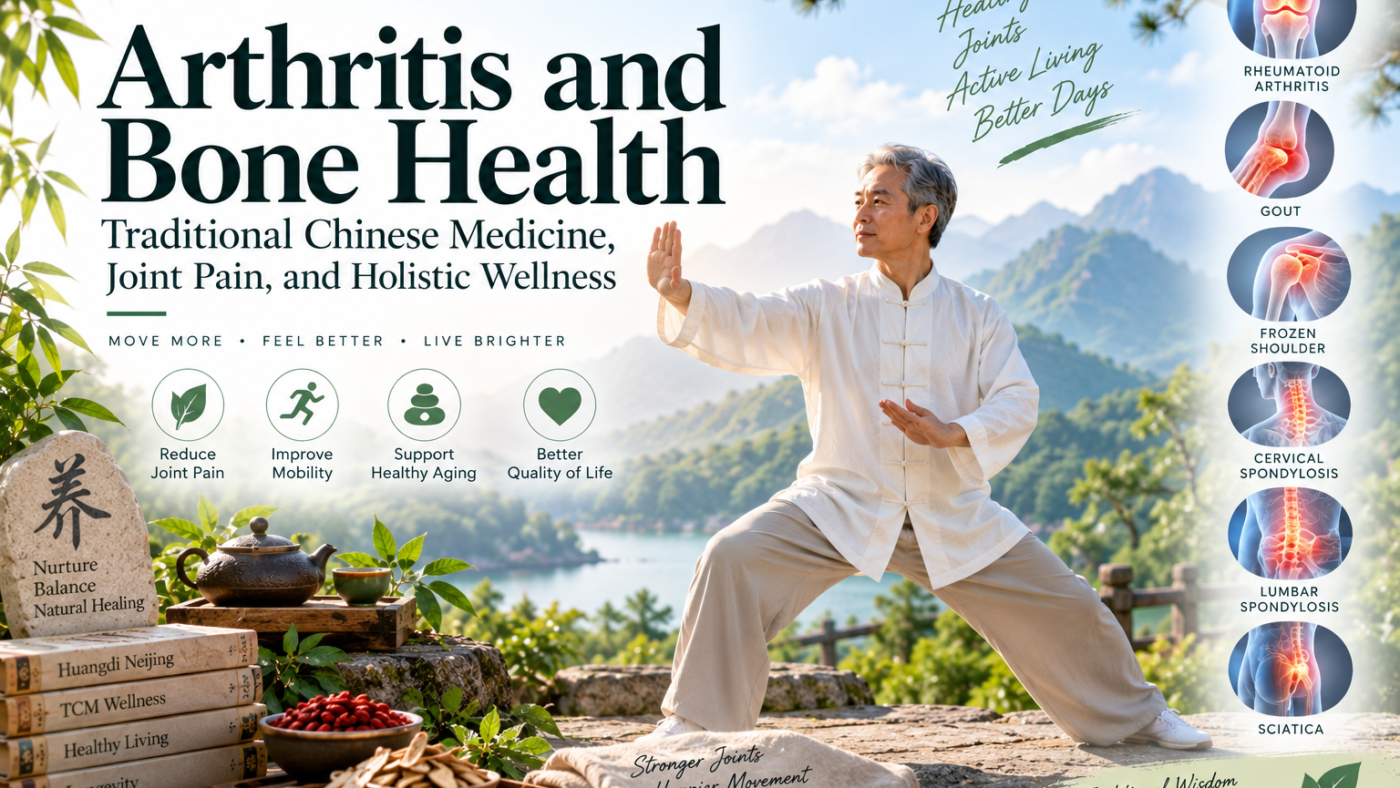
Understanding Arthritis and Bone Health Beyond Joint Pain
Arthritis and bone health are essential components of healthy aging, physical independence, and long-term quality of life. The ability to walk comfortably, move the shoulders, turn the neck, bend the knees, and maintain spinal mobility depends on the coordinated functions of joints, bones, muscles, tendons, ligaments, and the nervous system.
When these structures become affected by inflammation, degeneration, injury, or other medical conditions, everyday activities may become increasingly difficult.
Traditional Chinese Medicine approaches many of these complaints through the concept of Bi Syndrome, a classical framework for understanding painful obstruction and impaired movement. Modern medicine provides a different perspective based on anatomy, inflammation, autoimmune mechanisms, metabolic disorders, neurological function, and structural changes in the musculoskeletal system.
A comprehensive approach to arthritis and bone health combines appropriate medical care with balanced nutrition, gentle movement, physical strengthening, restorative sleep, and sustainable lifestyle habits.Arthritis and bone health are essential components of healthy aging, physical independence, and long-term quality of life. The ability to walk comfortably, move the shoulders, turn the neck, bend the knees, and maintain spinal mobility depends on the coordinated functions of joints, bones, muscles, tendons, ligaments, and the nervous system.
When these structures become affected by inflammation, degeneration, injury, or other medical conditions, everyday activities may become increasingly difficult.
Some people experience persistent joint stiffness after waking. Others develop sudden episodes of severe pain, reduced shoulder mobility, neck discomfort, lower back pain, or numbness extending into the arms and legs.
Traditional Chinese Medicine (TCM) approaches many of these complaints through the concept of Bi Syndrome (痹证), a classical framework for understanding painful obstruction and impaired movement.
Within this traditional system, joint discomfort is often discussed in relation to Qi, blood circulation, environmental influences, and the functional relationships among the body’s traditional organ systems.
Modern medicine provides a different approach based on anatomy, inflammation, autoimmune mechanisms, metabolic disorders, neurological function, and structural changes in the musculoskeletal system.
A comprehensive discussion of arthritis and bone health can incorporate both perspectives while clearly distinguishing traditional health philosophy from established medical diagnosis and treatment.
Bi Syndrome: The Traditional Chinese Medicine Perspective on Joint Pain
The Chinese character Bi (痹) conveys the concept of obstruction.
In classical Chinese medicine, Bi Syndrome describes patterns involving pain, stiffness, heaviness, numbness, or restricted movement.
Traditional explanations associate these symptoms with disturbances in the movement of Qi and blood through the meridians.
The Huangdi Neijing, or Yellow Emperor’s Inner Classic, discusses the combined influence of wind, cold, and dampness in the development of Bi Syndrome.
Within this historical framework, these factors are understood as traditional pathogenic influences rather than direct equivalents of modern weather measurements, microbial infections, or anatomical abnormalities.
Different patterns are traditionally associated with different presentations.
Wind Bi may describe pain that appears to move between locations.
Cold Bi is traditionally associated with pronounced pain and discomfort that may worsen with cold exposure.
Damp Bi may involve heaviness, swelling, and persistent discomfort.
Other traditional patterns may involve heat, blood stasis, or deficiencies in foundational vitality.
These classifications provide a historical framework for understanding symptom patterns. However, they cannot independently establish whether someone has rheumatoid arthritis, gout, osteoarthritis, or another musculoskeletal condition.
Modern diagnosis remains necessary because diseases that produce similar pain can have very different causes and require different treatments.
The Traditional Principle of Supporting Vitality and Restoring Balance
Traditional Chinese Medicine places considerable emphasis on Fu Zheng (扶正), commonly translated as supporting foundational vitality.
Another important concept is Qu Xie (祛邪), traditionally understood as addressing factors believed to disturb the body’s functional balance.
Together, these ideas form the classical principle of supporting the body’s resources while addressing patterns associated with illness.
In discussions of Bi Syndrome, traditional practitioners may emphasize warming Yang, promoting the movement of Qi and blood, supporting the Kidney system, or addressing patterns described as wind, cold, and dampness.
These concepts belong to the traditional Chinese medical framework.
They should not be interpreted as evidence that all arthritis is caused by Yang deficiency or that improved circulation alone can reverse autoimmune inflammation, urate crystal deposits, or structural joint damage.
The broader philosophy of nurturing health can nevertheless encourage attention to physical activity, nutrition, sleep, emotional well-being, and long-term functional independence.
These supportive habits can complement appropriate medical treatment when adapted to the individual’s condition.
Rheumatoid Arthritis: Understanding Autoimmune Joint Inflammation
Rheumatoid arthritis (RA) is a chronic autoimmune and inflammatory disease.
It develops when the immune system mistakenly attacks tissues lining the joints, producing inflammation that can damage cartilage and bone over time.
The condition often affects the hands, wrists, and feet, although other joints may also become involved.
Common symptoms include persistent joint pain, swelling, tenderness, fatigue, and morning stiffness.
Rheumatoid arthritis frequently affects corresponding joints on both sides of the body, although the pattern can vary.
Unlike ordinary temporary joint discomfort, uncontrolled rheumatoid inflammation can cause lasting structural damage and reduced physical function.
The disease may also affect tissues and organs beyond the joints.
Modern treatment has changed the outlook for many people living with rheumatoid arthritis.
Disease-modifying antirheumatic drugs, commonly known as DMARDs, are used to control disease activity and reduce the risk of joint damage. Biologic medicines and other targeted treatments may be considered when appropriate.
Early diagnosis and treatment are particularly important because established joint damage may be difficult or impossible to reverse.
Rheumatoid Arthritis in Traditional Chinese Medicine
Traditional Chinese Medicine may interpret certain rheumatoid arthritis presentations through Bi Syndrome patterns involving cold, dampness, heat, blood stasis, or deficiencies in Qi and blood.
Some traditional practitioners also consider the Kidney and Liver systems when discussing long-standing musculoskeletal symptoms.
These concepts can provide cultural context for a person’s experience of chronic illness.
However, traditional pattern classifications should not replace autoimmune testing, clinical examination, imaging, or established rheumatology treatment.
Complementary practices such as gentle movement, relaxation, and appropriately adapted Tai Chi may help some individuals maintain physical function and well-being.
Herbal preparations require particular caution because some products can cause serious adverse effects or interact with prescription medication.
Traditional approaches should not be substituted for disease-modifying treatment when rheumatoid arthritis has been diagnosed.
Gout: Understanding Uric Acid and Joint Inflammation
Gout is a form of inflammatory arthritis associated with the accumulation of monosodium urate crystals in and around joints.
Urate is produced when the body breaks down purines, substances naturally present in human tissues and many foods.
Normally, urate is removed through the kidneys and eliminated in urine.
When urate levels become elevated, crystals may form in susceptible individuals.
These crystals can trigger sudden and intense inflammatory reactions.
A gout flare may cause severe pain, redness, swelling, warmth, and pronounced sensitivity in an affected joint.
The big toe is a familiar location, but gout can also involve the ankles, knees, wrists, fingers, and other joints.
Not everyone with elevated blood urate develops gout.
Genetic susceptibility, kidney function, medications, metabolic conditions, alcohol consumption, and dietary patterns can contribute to individual risk.
Persistent or recurrent gout may eventually lead to joint damage or the formation of tophi, which are deposits of urate crystals.
Gout is also associated with conditions such as chronic kidney disease, kidney stones, hypertension, and cardiovascular disease.
The Traditional Concept of Dampness and Turbid Accumulation
Traditional Chinese Medicine sometimes interprets gout-related symptoms through patterns involving dampness, heat, blood stasis, or impaired fluid transformation.
Classical discussions may associate these patterns with the functional relationships among the Spleen, Kidney, and meridians.
However, uric acid is a measurable biochemical substance. It should not be treated as medically equivalent to the traditional concept of dampness.
Modern gout management focuses on controlling inflammation during acute attacks and lowering urate levels when clinically indicated.
Medications such as colchicine, appropriate anti-inflammatory treatments, and corticosteroids may be used for acute flares.
Long-term urate-lowering treatment may be necessary for individuals with recurrent attacks, tophi, or other relevant clinical indications.
Dietary adjustments can support gout management, but they cannot always replace medication.
Gout and Diet: What Should Be Limited?
Diet is one of the most misunderstood aspects of gout management.
Traditional dietary advice sometimes recommends extensive restrictions involving seafood, beans, fermented foods, vinegar, sour fruits, and stimulating beverages.
However, these foods do not all have the same effects on urate metabolism.
Modern dietary guidance focuses on specific risk factors rather than broadly classifying foods according to acidity, temperature, or traditional energetic properties.
Certain animal-derived foods contain relatively high amounts of purines.
Organ meats, some red meats, anchovies, sardines, and certain shellfish may contribute to elevated urate levels in susceptible individuals.
Alcohol, particularly beer, may also increase the risk of gout flares.
Sugar-sweetened beverages containing substantial amounts of fructose are another relevant consideration.
By contrast, many vegetables and plant-based foods can remain part of a balanced eating pattern.
Beans and other plant-based protein sources do not generally require blanket exclusion.
The acidic taste of vinegar or fruit does not mean that those foods necessarily increase urate crystal formation.
A sustainable eating plan should emphasize individual medical needs, appropriate portions, balanced nutrition, and long-term adherence.
The American College of Rheumatology recommends considering reductions in alcohol, purine-rich foods, and high-fructose corn syrup while recognizing that dietary changes alone may have limited effects on serum urate.
Frozen Shoulder: When Shoulder Movement Becomes Restricted
Frozen shoulder, medically known as adhesive capsulitis, is characterized by pain and progressive restriction of shoulder movement.
The condition affects the shoulder capsule, the connective tissue surrounding the joint.
As the capsule becomes inflamed and stiff, ordinary movements may become increasingly difficult.
Reaching overhead, fastening clothing, washing the hair, or reaching behind the back may cause considerable discomfort.
Frozen shoulder most commonly occurs in middle age, although it can develop at other ages.
People with diabetes and certain thyroid conditions have an increased risk.
The condition is sometimes called “fifty-year shoulder” in traditional East Asian health literature.
However, it should not be regarded as an inevitable consequence of turning fifty.
Frozen Shoulder in Traditional Chinese Medicine
Traditional Chinese Medicine may interpret frozen shoulder through patterns involving Bi Syndrome, impaired Qi and blood movement, or traditional deficiencies associated with aging.
Some individuals find that gentle warmth or comfortable movement helps relieve their sense of stiffness.
However, warmth does not reverse the underlying changes in the shoulder capsule.
Modern treatment generally emphasizes pain management and appropriately guided rehabilitation.
Physical therapy may help restore shoulder mobility and function.
Some patients may benefit from injections or other interventions depending on symptom severity and disease stage.
Recovery can take many months and sometimes considerably longer. A promise of complete recovery within one week would therefore be misleading.
Cervical Spondylosis: Understanding Neck Pain and Bone Spurs
Cervical spondylosis describes degenerative changes affecting the neck portion of the spine.
As people age, intervertebral discs may gradually lose water content and height.
The joints of the cervical spine may also undergo structural changes.
Small bony projections known as osteophytes, or bone spurs, can develop along the edges of vertebrae.
These changes are common in middle-aged and older adults.
Importantly, imaging findings do not always correspond directly to symptoms.
Some individuals have visible spinal degeneration but experience little or no pain.
Others develop stiffness, restricted movement, or symptoms associated with irritation or compression of nearby nerves.
Cervical radiculopathy occurs when a nerve root in the neck becomes irritated or compressed.
It may produce pain, tingling, numbness, or weakness extending into the shoulder, arm, or hand.
More serious spinal cord compression can affect balance, walking, coordination, and limb strength.
The Traditional Concept of Kidney Governing Bone
One of the classical principles of Traditional Chinese Medicine is that the Kidney governs the bones.
Within this framework, Kidney Essence is associated with growth, development, aging, and the maintenance of the skeletal system.
This concept reflects a historical understanding of the relationship between constitutional vitality and physical structure.
Modern medicine explains bone health and spinal degeneration through different mechanisms.
Age, genetics, previous injury, disc changes, mechanical loading, and other factors may contribute to musculoskeletal changes.
A traditional diagnosis of Kidney deficiency cannot establish the cause of cervical spondylosis.
Likewise, herbal tonification has not been established as a method for reliably removing osteophytes or reversing spinal degeneration.
Management depends on symptoms, neurological findings, functional limitations, and the presence or absence of significant nerve or spinal cord compression.
Lumbar Spondylosis and Lower Back Health
The lumbar spine supports much of the body’s weight and allows bending, twisting, walking, and other essential movements.
Over time, the intervertebral discs and spinal joints may undergo degenerative changes.
Some individuals develop lower back pain, stiffness, or reduced flexibility.
Others experience symptoms associated with nerve irritation or spinal narrowing.
However, not every person with lumbar degeneration experiences chronic pain.
A visible abnormality on an X-ray or MRI does not automatically establish the cause of a person’s symptoms.
Modern management of uncomplicated lower back pain often emphasizes maintaining appropriate activity, individualized exercise, and avoiding unnecessary prolonged bed rest.
Physical therapy may be useful for improving movement confidence, strength, and functional capacity.
Imaging is generally considered when clinical findings suggest that the results may change management or when serious underlying conditions are suspected.
Sciatica: Understanding Pain Along the Sciatic Nerve
Sciatica refers to pain or other symptoms associated with irritation of nerve structures that contribute to the sciatic nerve.
Pain may begin in the lower back or buttock and extend down the back or side of the leg.
Some people experience tingling, numbness, burning sensations, or weakness.
Common causes include lumbar disc herniation and degenerative changes that narrow the space available for nerve roots.
Traditional Chinese Medicine may interpret some sciatica presentations through Bi Syndrome or disturbances in the movement of Qi and blood.
However, sciatica should not automatically be attributed to cold exposure or Kidney deficiency.
Medical assessment is important when symptoms persist, become severe, or are accompanied by neurological changes.
Management may include appropriate activity modification, exercise, physical therapy, medication, or other treatments based on the underlying condition.
Not every person with sciatica requires surgery.
However, certain symptoms indicate the possibility of serious neurological compression and require urgent assessment.
Gentle Movement, Tai Chi, and Joint-Friendly Exercise
Supporting musculoskeletal health requires a balance between movement, recovery, and appropriate treatment.
Too much inactivity may contribute to reduced strength, stiffness, and physical deconditioning.
Excessive activity, particularly during an acute inflammatory episode or significant injury, may aggravate symptoms.
The goal is to find an appropriate level of movement that maintains function without placing unnecessary stress on affected tissues.
Tai Chi and Qigong are traditional Chinese mind-body practices that combine gentle movement, postural control, coordinated breathing, and attention.
For some people with chronic musculoskeletal conditions, these practices may provide an enjoyable way to remain physically active.
Research suggests that Tai Chi may offer benefits for certain aspects of osteoarthritis management, including physical function and pain-related outcomes.
Evidence for specific benefits in rheumatoid arthritis remains more limited.
Exercise programs should be adapted when someone has active joint inflammation, severe pain, significant spinal problems, or impaired balance.
7 Healthy Habits for Arthritis and Bone Health
Long-term musculoskeletal wellness depends on consistent habits that support movement, strength, and overall health.
1. Maintain Appropriate Physical Activity
Regular movement helps preserve mobility, physical conditioning, and functional independence.
Walking, swimming, cycling, and appropriately modified Tai Chi may be useful options.
Activity should be adapted to individual symptoms and medical needs.
2. Build and Preserve Muscle Strength
Muscles help support joints and maintain stability during everyday movement.
Appropriately guided resistance training can support strength and physical function.
People with severe arthritis or spinal symptoms may benefit from professional exercise guidance.
3. Maintain a Balanced Diet
Adequate nutrition supports general health, muscle maintenance, and normal bodily functions.
A varied diet containing vegetables, fruits, suitable protein sources, whole grains, and healthy fats can form the foundation of long-term wellness.
People with gout or specific metabolic conditions may require additional dietary guidance.
4. Avoid Smoking
Smoking is associated with several adverse health outcomes, including increased risk of rheumatoid arthritis and poorer musculoskeletal health.
Stopping smoking can support broader cardiovascular, respiratory, and physical well-being.
5. Protect Joints Without Avoiding All Movement
Joint protection may involve adjusting difficult movements, using suitable equipment, taking breaks, and avoiding repetitive excessive strain.
However, avoiding all activity can contribute to weakness and reduced mobility.
The appropriate balance depends on the condition and its severity.
6. Pay Attention to Sleep and Recovery
Persistent pain may interfere with sleep, while inadequate rest can make daily functioning more difficult.
Consistent sleep routines, comfortable positioning, and appropriate pain management may support overall well-being.
7. Follow an Individualized Treatment Plan
Rheumatoid arthritis, gout, frozen shoulder, and spinal disorders require different approaches.
A treatment plan should reflect the actual diagnosis rather than relying on a generalized explanation of joint pain.
Regular medical follow-up is especially important when symptoms are progressive or when medication is needed to prevent long-term complications.
Sexual Activity, Physical Energy, and Musculoskeletal Health
Traditional health literature sometimes recommends restricting sexual activity during periods of illness or physical weakness.
However, there is no established medical basis for requiring all people with arthritis or spinal conditions to abstain from sexual activity or follow a universal monthly frequency limit.
Comfort and safety depend on the person’s symptoms, physical capacity, and specific medical condition.
Someone with severe back pain, an acute injury, or significant neurological symptoms may need temporary activity modifications.
A person with well-controlled arthritis may be able to maintain ordinary intimate relationships without special restrictions.
The appropriate approach is individualized rather than based on a fixed traditional rule.
When Joint Pain or Spinal Symptoms Require Urgent Medical Attention
Not every episode of pain is caused by ordinary degeneration or chronic inflammation.
A suddenly swollen, hot, intensely painful joint, particularly when accompanied by fever or feeling seriously unwell, requires prompt medical assessment.
Joint infection can resemble gout or another inflammatory condition and may require urgent treatment.
Progressive limb weakness, difficulty walking, or worsening coordination can indicate significant neurological involvement.
New loss of bladder or bowel control, numbness around the groin or saddle region, or rapidly worsening leg weakness may indicate serious spinal nerve compression and require emergency evaluation.
Persistent unexplained pain, fever, weight loss, or symptoms following significant trauma should also be medically assessed.
Early diagnosis is especially important for conditions in which delayed treatment may result in irreversible damage.
Arthritis and Bone Health: Supporting Mobility and Healthy Aging
Traditional Chinese Medicine offers a historical philosophy that emphasizes the relationships among movement, nourishment, vitality, and the body’s functional systems.
The classical concepts of Bi Syndrome, Kidney governing bone, and supporting foundational vitality reflect a long-standing interest in preserving mobility and physical well-being.
Modern medicine provides the scientific foundation for distinguishing autoimmune arthritis, metabolic joint disease, degenerative spinal conditions, nerve compression, and other causes of musculoskeletal symptoms.
These perspectives can coexist when their different purposes and limitations are clearly understood.
For people living with rheumatoid arthritis, appropriate disease-modifying treatment can help prevent joint damage.
For individuals with gout, sustained urate management may reduce future attacks and protect joints.
For those experiencing frozen shoulder, cervical spondylosis, lower back pain, or sciatica, individualized rehabilitation and medical care can support mobility and everyday functioning.
Traditional movement practices, balanced nutrition, adequate rest, and sustainable physical activity may complement these approaches.
The central goal of musculoskeletal health preservation is not to promise that every chronic condition can be permanently eliminated.
It is to support comfortable movement, maintain physical independence, recognize serious symptoms early, and preserve quality of life throughout the aging process.
FAQ
What is arthritis?
Arthritis is a broad term used to describe conditions affecting joints. Different forms of arthritis have different causes, including autoimmune inflammation, urate crystal accumulation, and degenerative changes. Appropriate diagnosis is important because treatment varies by condition.
What is Bi Syndrome in Traditional Chinese Medicine?
Bi Syndrome is a traditional Chinese medical concept associated with pain, stiffness, numbness, heaviness, and restricted movement. Classical explanations often involve wind, cold, dampness, and disturbances in Qi and blood circulation. These traditional patterns are not equivalent to modern medical diagnoses.
Can Traditional Chinese Medicine cure rheumatoid arthritis?
Traditional Chinese Medicine has not been established as a cure for rheumatoid arthritis. Modern disease-modifying treatments can help control inflammation and reduce the risk of joint damage. Complementary wellness practices should not replace prescribed rheumatology treatment.
What foods should people with gout avoid?
People with gout may benefit from limiting alcohol, sugar-sweetened beverages, organ meats, and certain purine-rich seafood. Plant-based protein sources such as beans and lentils generally do not require blanket exclusion. Dietary recommendations should be individualized.
Can Tai Chi help people with arthritis?
Tai Chi may support physical function, balance, and aspects of pain management in some people with osteoarthritis. Exercises should be adapted to individual mobility, pain levels, and medical conditions.
What causes frozen shoulder?
Frozen shoulder involves painful stiffness associated with changes in the shoulder capsule. It may develop without an obvious cause and is more common in people with certain conditions, including diabetes. Recovery can take months or longer.
Are cervical spondylosis and sciatica the same condition?
No. Cervical spondylosis describes degenerative changes in the neck portion of the spine, while sciatica refers to pain or other symptoms involving nerve structures that contribute to the sciatic nerve, usually affecting the lower back, buttock, or leg.
When should someone seek medical attention for joint or back pain?
Persistent joint swelling, unexplained pain, progressive weakness, or worsening neurological symptoms require medical assessment. New bladder or bowel dysfunction, saddle-area numbness, or severe progressive leg weakness may indicate serious spinal nerve compression and require emergency care.
Medical Disclaimer
This article is intended for educational and informational purposes only and does not constitute medical advice, diagnosis, or treatment. Traditional Chinese Medicine concepts are presented for historical and educational understanding and should not be considered equivalent to established medical diagnoses. Rheumatoid arthritis, gout, frozen shoulder, cervical spondylosis, lumbar disorders, and sciatica may require different forms of medical evaluation and treatment. Do not discontinue prescribed medication or replace necessary medical care with herbal remedies, massage, acupuncture, or movement practices. Consult a qualified healthcare professional before beginning herbal supplementation or a new exercise program, particularly if you have active inflammation, significant spinal disease, neurological symptoms, or other chronic medical conditions.
This article is for general education and does not replace individualized care from a qualified health professional. Seek appropriate advice for persistent, severe, or concerning symptoms.
Read the full medical disclaimer