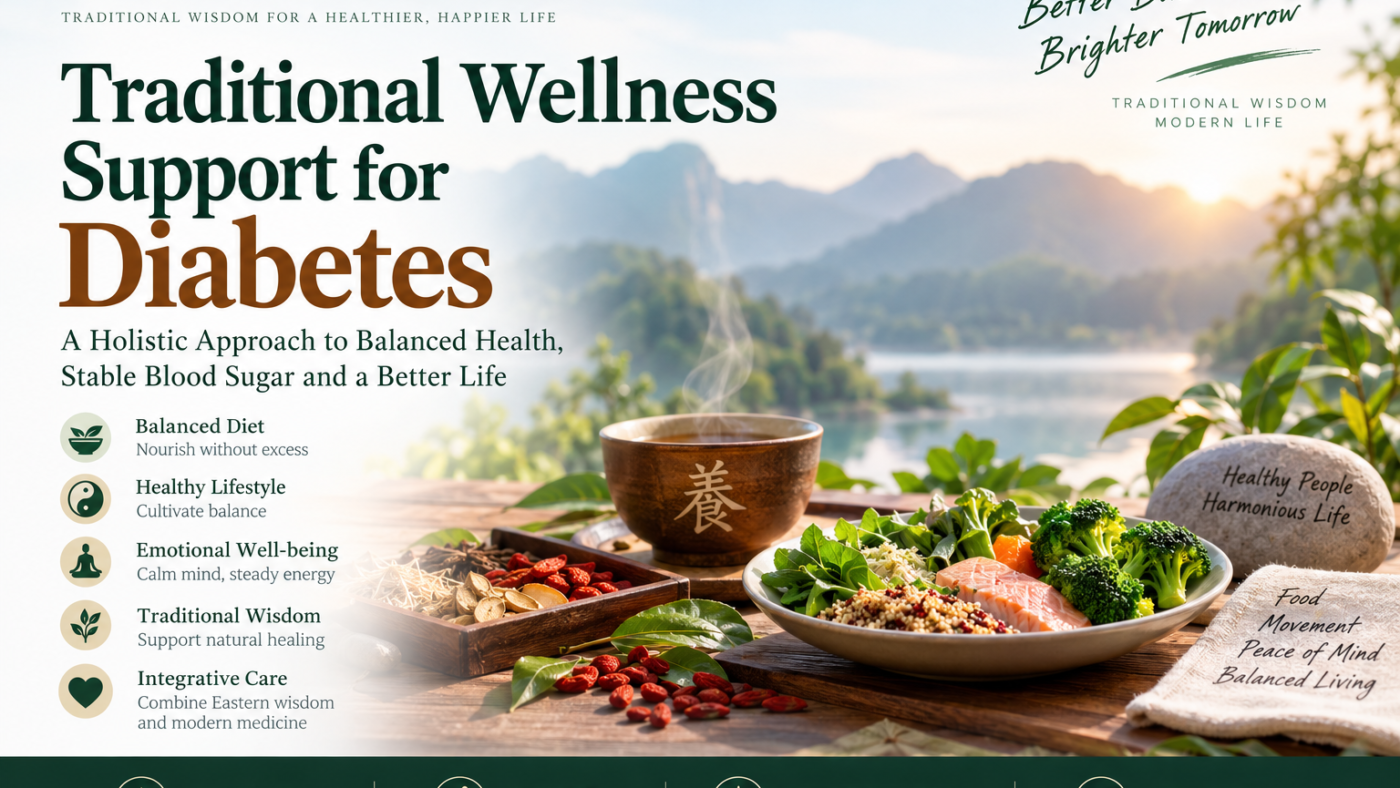
Diabetes and traditional Chinese medicine are often discussed together because traditional Chinese health systems have described diabetes-like symptoms for centuries. Ancient Chinese medicine approached these patterns through ideas of balance, body fluids, diet, vitality, and whole-body regulation rather than focusing only on a single symptom.
This traditional perspective should not be confused with modern biomedical treatment. Diabetes is a medically defined metabolic disease that requires appropriate diagnosis, monitoring, and, when indicated, medication or insulin. Traditional wellness practices may complement modern care, but they should never replace essential diabetes treatment.
Traditional Chinese medicine has long emphasized the idea of regulating and nourishing the body rather than focusing only on isolated symptoms. Within this framework, health is viewed as a dynamic state of balance involving vitality, nourishment, circulation, organ-system relationships, rest, movement, and adaptation to the environment.
This traditional perspective should not be confused with modern biomedical treatment. Diabetes is a medically defined metabolic disease that requires appropriate diagnosis, monitoring, and, when indicated, medication or insulin. Traditional wellness practices may be explored as complementary approaches, but they should never replace essential diabetes care.
From “Xiaoke” to Modern Diabetes
Ancient Chinese medical texts did not use the modern term “diabetes mellitus.” However, classical writings described patterns known collectively as xiaoke, often translated as “wasting-thirst.”
Understanding diabetes and traditional Chinese medicine requires distinguishing historical concepts such as Xiaoke from the modern biomedical definition of diabetes.
Descriptions associated with xiaoke included excessive thirst, unusual hunger, frequent urination, weight loss, and weakness—features that can overlap with symptoms seen in uncontrolled diabetes.
The Huangdi Neijing, or Yellow Emperor’s Inner Classic, discussed patterns related to thirst, urination, internal heat, diet, constitutional weakness, and disturbances in the movement of body fluids. These historical observations are important for understanding the development of traditional Chinese medical thought.
They should not, however, be interpreted as proof that ancient physicians understood diabetes in the modern biomedical sense. Today, diabetes is understood through glucose metabolism, insulin secretion, insulin resistance, pancreatic function, genetics, body composition, lifestyle, and numerous metabolic and cardiovascular factors.
The Traditional Chinese Medicine View of Balance
Traditional Chinese medicine interprets illness through concepts such as yin and yang, qi, blood, body fluids, and functional organ systems.
In this framework, symptoms resembling diabetes may be discussed in relation to several traditional patterns rather than a single cause.
Classical theory sometimes divides xiaoke into three broad patterns.
Upper xiaoke is traditionally associated with pronounced thirst and dryness.
Middle xiaoke is associated with excessive appetite, digestive disturbance, and internal heat.
Lower xiaoke is associated with frequent urination, weakness, and disturbances traditionally connected with the Kidney system.
These categories belong to the diagnostic language of traditional Chinese medicine. They are not equivalent to modern classifications such as type 1 diabetes, type 2 diabetes, gestational diabetes, or other specific forms of diabetes.
That distinction is essential.
Yin, Yang, and Body Fluids
One of the central themes in classical discussions of xiaoke is the regulation of body fluids.
Traditional texts describe thirst and dryness through the language of depleted fluids, impaired transformation, internal heat, and weakness of the body’s functional systems. Some schools emphasize yin deficiency, while others also consider weakness of yang, qi, or digestive function depending on the individual pattern.
The Huangdi Neijing describes the Bladder as being involved in the storage and transformation of fluids, reflecting the ancient view that normal fluid metabolism depends on coordinated functional activity throughout the body.
From a traditional perspective, therefore, treatment was not intended simply to suppress thirst or urination. Practitioners attempted to identify the broader pattern behind the symptoms and restore what they regarded as systemic balance.
Modern physiology explains these processes differently. Excessive thirst and frequent urination in diabetes commonly occur when blood glucose becomes sufficiently elevated to increase urinary glucose and fluid loss.
The two explanations come from fundamentally different medical systems and should not be treated as interchangeable.
Why Modern Diabetes Management Must Be Comprehensive
Diabetes management is much broader than lowering a single glucose reading.
Long-term elevated blood glucose can contribute to damage involving the blood vessels, nerves, kidneys, eyes, heart, and other organs. Blood pressure, cholesterol, smoking, body weight, kidney function, sleep, nutrition, physical activity, and medication adherence can therefore all influence long-term health.
For this reason, modern diabetes care focuses on reducing overall risk rather than chasing one number.
A comprehensive plan may include blood-glucose monitoring, HbA1c testing, blood-pressure management, cholesterol management, kidney screening, eye examinations, foot care, nutrition, physical activity, weight management, smoking cessation, appropriate medication, and regular clinical follow-up.
The exact plan varies considerably from person to person.
Food as a Foundation of Daily Care
Traditional Chinese health culture has always placed considerable importance on food.
That principle remains highly relevant today, although modern diabetes nutrition does not require a single rigid “diabetic diet.”
A practical eating pattern generally emphasizes minimally processed foods, vegetables, appropriate portions of whole grains or other carbohydrate sources, adequate protein, legumes, nuts and seeds when suitable, and foods rich in dietary fiber.
Sugary beverages and foods containing large quantities of refined carbohydrates are best limited.
Portion size also matters. Even nutritious carbohydrate-containing foods can raise blood glucose when consumed in large quantities.
Rather than attempting to eliminate all carbohydrates or all fats, a more sustainable approach is to consider the amount, quality, timing, and overall composition of meals.
For some people, carbohydrate counting can be useful. Others may find a plate-based method easier to maintain.
The most appropriate strategy depends on medication use, glucose patterns, body weight, kidney function, activity level, personal preferences, and other health conditions.
Physical Activity Is Usually Part of Diabetes Care
Traditional health cultivation does not necessarily mean avoiding movement.
Gentle walking, tai chi, qigong, mobility exercises, resistance training, and other forms of appropriate physical activity may all have a place in a healthy lifestyle.
Modern research also supports regular physical activity as an important component of diabetes management. Activity can improve glucose regulation, cardiovascular health, blood pressure, physical function, mood, sleep, and weight management.
The appropriate intensity should be individualized.
Someone who has been inactive for years should not necessarily begin with strenuous exercise. People with cardiovascular disease, severe neuropathy, advanced eye disease, foot ulcers, recurrent hypoglycemia, or other complications may require specific precautions.
The goal is therefore not “exercise at all costs,” nor is it “avoid exercise because it consumes vitality.”
The goal is safe, progressive, individualized movement.
When discussing diabetes and traditional Chinese medicine, herbal therapies should be viewed as complementary approaches rather than replacements for established medical treatment.
Medication and Insulin Should Not Be Stopped Without Medical Guidance
Traditional wellness practices and modern medication do not need to be framed as opponents.
For many people with type 2 diabetes, lifestyle improvement is extremely important, but medication may still be necessary.
For people with type 1 diabetes, insulin is essential for survival.
Modern diabetes medications also differ greatly in how they work. Some primarily lower glucose, while others may provide additional cardiovascular, kidney, or weight-related benefits in appropriate patients.
Medication choices therefore need to be individualized.
Anyone interested in acupuncture, Chinese herbal medicine, supplements, fasting, or major dietary changes should discuss these approaches with a qualified healthcare professional, particularly when taking insulin or glucose-lowering medications.
This is important because combining therapies can sometimes cause hypoglycemia, medication interactions, or other adverse effects.
Traditional Herbal Medicine: Potential Role and Important Limits
Chinese herbal medicine has a long history, and many plants traditionally used for metabolic or digestive complaints continue to be studied.
Some compounds have shown potentially interesting metabolic effects in clinical research. However, evidence is inconsistent, product quality varies, and an herbal preparation should not automatically be assumed to be safe simply because it is traditional or natural.
Herbs can interact with prescription medicines. Some products may also contain contaminants, undeclared pharmaceutical substances, heavy metals, pesticides, or incorrectly identified plant species.
For these reasons, herbal medicine should be considered carefully and used, when appropriate, as a complementary strategy rather than an automatic substitute for established diabetes treatment.
Supporting the Whole Person
One valuable principle that can be drawn from traditional Chinese wellness culture is that chronic illness affects the whole person.
Food, movement, sleep, emotional stress, social connection, daily routine, and long-term habits all matter.
This broader perspective is also compatible with contemporary chronic-disease management.
Good diabetes care is not simply about achieving a perfect glucose value. It is about preserving vision, kidney function, cardiovascular health, nerve health, mobility, independence, energy, and quality of life over many years.
Adequate sleep, stress management, regular meals, appropriate physical activity, maintaining a healthy body weight when needed, avoiding tobacco, and keeping regular medical appointments can all contribute to this goal.
A Balanced Way to Integrate Traditional and Modern Approaches
The most constructive approach is not to ask whether traditional Chinese medicine or modern medicine must “win.”
They answer different kinds of questions.
Modern medicine provides diagnostic criteria, laboratory monitoring, medications, insulin, complication screening, and treatments supported by clinical evidence.
Traditional Chinese wellness offers a historical framework emphasizing individualized patterns, moderation, seasonal awareness, diet, movement, rest, and the cultivation of overall wellbeing.
When these traditions are discussed responsibly, people can appreciate the cultural wisdom of Chinese health practices without abandoning effective medical care.
For someone living with diabetes, the safest approach is therefore an integrated one:
Maintain appropriate medical monitoring.
Take prescribed medication or insulin as directed.
Build a sustainable eating pattern.
Stay physically active according to individual ability and medical circumstances.
Protect cardiovascular, kidney, eye, nerve, and foot health.
Discuss herbs and supplements with a qualified healthcare professional before using them.
And use traditional practices such as tai chi, qigong, mindful breathing, gentle mobility, and culturally meaningful dietary habits as supportive tools when they are safe and appropriate.
Diabetes is not simply a matter of one symptom, one organ, or one blood-glucose reading. Effective long-term management requires attention to the whole person.
In that sense, the ancient ideal of cultivating balance still has something valuable to offer—provided it is combined with the knowledge, monitoring, and treatment options available through modern medicine.
A responsible approach to diabetes and traditional Chinese medicine combines respect for traditional wellness practices with evidence-based monitoring and medical care.
FAQ
What is Xiaoke in traditional Chinese medicine?
Xiaoke is a traditional Chinese medical term often translated as “wasting-thirst.” Classical descriptions include excessive thirst, frequent urination, increased hunger, dryness, and weakness. Some of these symptoms overlap with diabetes, although Xiaoke is a historical traditional medicine concept rather than a modern medical diagnosis.
Can traditional Chinese medicine cure diabetes?
There is currently no reliable evidence that traditional Chinese medicine can cure diabetes. Traditional practices may be used as complementary wellness strategies in some situations, but they should not replace prescribed medication, insulin, glucose monitoring, or professional medical care.
Can Chinese herbal medicine lower blood sugar?
Some herbs and plant compounds are being studied for possible effects on glucose metabolism, but evidence varies and herbal products can interact with diabetes medications. Anyone considering herbal medicine should discuss it with a qualified healthcare professional.
Should people with diabetes exercise?
For most people with diabetes, regular physical activity is an important part of long-term management. Walking, resistance exercise, tai chi, and other appropriate forms of movement can support metabolic and cardiovascular health. Exercise should be individualized for people with complications or other medical conditions.
What foods are best for diabetes management?
There is no single diet suitable for everyone with diabetes. A balanced eating pattern generally emphasizes vegetables, fiber-rich foods, appropriate portions of minimally processed carbohydrates, adequate protein, and reduced intake of sugary drinks and highly refined foods.
Can I stop diabetes medication if my blood sugar improves?
Diabetes medications or insulin should not be stopped or reduced without professional medical guidance. Blood glucose may improve because treatment is working, and suddenly stopping medication can cause dangerous increases in blood sugar.
Can traditional Chinese wellness be combined with modern diabetes care?
Potentially, yes. Practices such as tai chi, qigong, appropriate dietary habits, relaxation, and sleep improvement may complement standard care when they are safe for the individual. They should be viewed as supportive strategies rather than replacements for evidence-based medical treatment.
Medical Disclaimer
This article is for educational purposes only and is not intended to diagnose, treat, cure, or prevent diabetes or any other medical condition. Traditional Chinese medicine concepts discussed here describe a historical medical framework and should not be interpreted as substitutes for modern medical diagnosis or treatment. Never stop insulin, diabetes medication, or other prescribed treatment without consulting a qualified healthcare professional.
This article is for general education and does not replace individualized care from a qualified health professional. Seek appropriate advice for persistent, severe, or concerning symptoms.
Read the full medical disclaimer