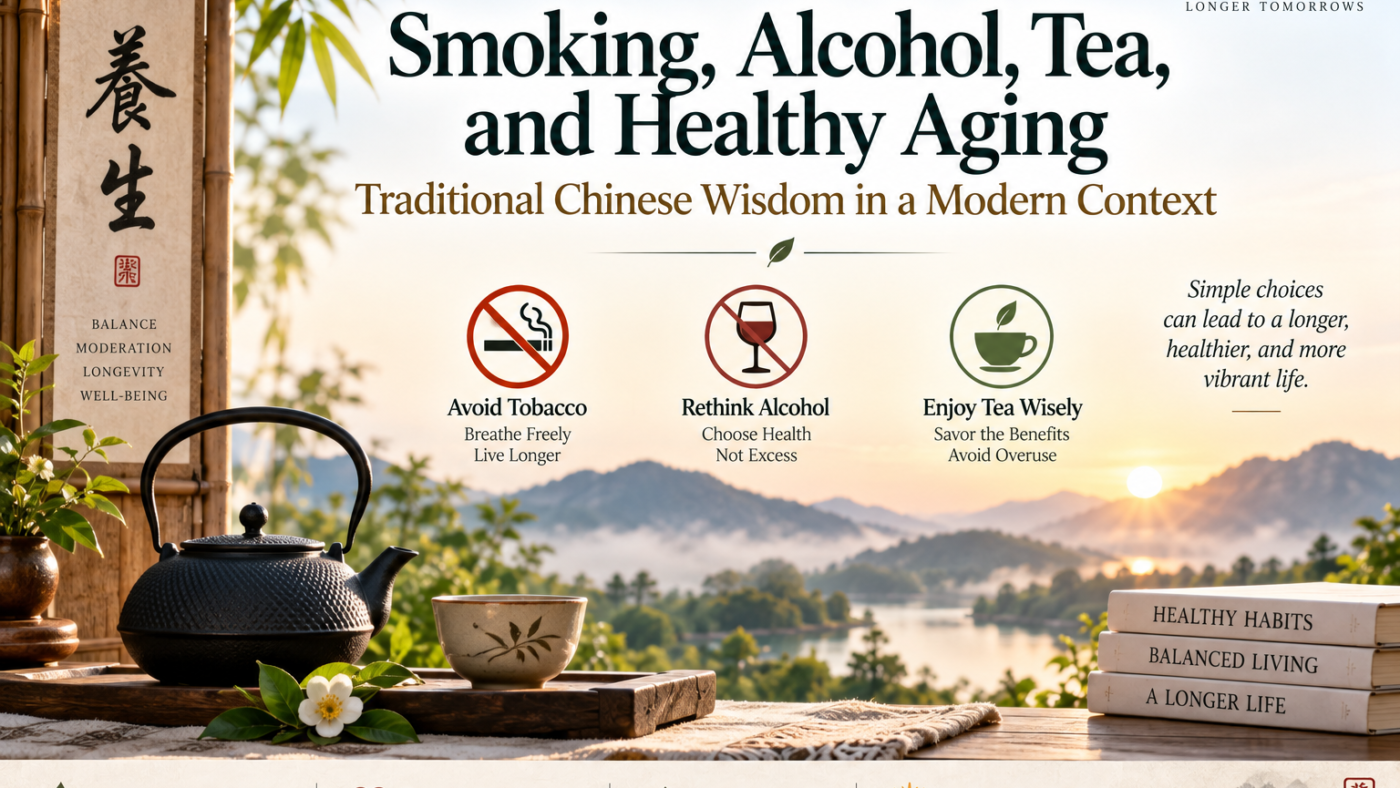
Smoking, alcohol and tea have long been part of everyday social life, but their effects on health are very different. Traditional Chinese Yangsheng interpreted these habits through concepts such as Yin, body fluids, moderation, and organ balance, while modern health science focuses on tobacco exposure, alcohol-related risk, caffeine, hydration, sleep, and long-term healthy aging.Smoking, alcohol, and tea have all played important roles in social life, hospitality, ritual, and personal habit. In Chinese culture, tea in particular has long been associated with refinement, conversation, hospitality, and contemplation, while alcohol has appeared in poetry, celebration, medicine, and ceremony. Tobacco arrived much later, but eventually became deeply embedded in social interaction as well.
Traditional Chinese health-preservation teachings approached these habits through the broader framework of yangsheng—the art of nourishing life. Classical discussions often focused on protecting Yin, preserving body fluids, maintaining harmony among the organ systems, avoiding excess, and adapting daily habits to the individual.
Modern medicine uses very different concepts. It evaluates tobacco, alcohol, caffeine, hydration, cardiovascular health, cancer risk, liver function, sleep, and mental well-being through measurable biological evidence.
A useful modern interpretation is therefore not to treat every historical statement as literal physiology, but to preserve the deeper traditional principle:
What we repeatedly consume can influence how we age.
Yin, Body Fluids, and the Traditional Idea of Preservation
Traditional Chinese Medicine frequently emphasizes the importance of Yin and body fluids.
Within this framework, Yin is associated with nourishment, moisture, cooling, restoration, and structural support. Classical writers sometimes described habits such as smoking, excessive alcohol use, very strong tea, chronic sleep deprivation, and overwork as behaviors that could “consume Yin.”
This language should not be confused with modern concepts such as blood volume, cellular hydration, hormones, or specific biochemical substances.
However, the broader idea still has practical relevance.
A lifestyle dominated by tobacco, heavy drinking, poor sleep, dehydration, and chronic stress can accelerate visible and internal signs of poor health.
Traditional language describes this as depletion.
Modern medicine may describe it in terms of oxidative stress, inflammation, vascular damage, sleep disruption, metabolic strain, dehydration, or organ toxicity.
The explanations differ, but both perspectives warn against chronic excess.
Smoking: The Clearest Risk
Among smoking, alcohol, and tea, tobacco presents the least ambiguity from a modern health perspective.
Smoking damages nearly every organ system and increases the risk of cancer, cardiovascular disease, stroke, chronic lung disease, and many other health problems.
Traditional Chinese descriptions often associated smoking with injury to the Lung system and depletion of Lung Yin.
Although “Lung Yin” is not a modern anatomical concept, the traditional warning against smoke exposure aligns broadly with what is now known about the harmful effects of tobacco.
The most important modern message is simple:
If you do not smoke, do not start.
If you currently smoke, quitting is one of the most powerful steps you can take to improve long-term health.
Is It Dangerous to Quit Smoking Suddenly?
Some older health writings suggested that people who had smoked for many years might become ill if they stopped abruptly because the body had become accustomed to tobacco.
This should not be treated as modern medical advice.
Nicotine dependence can produce withdrawal symptoms such as irritability, restlessness, cravings, difficulty concentrating, sleep disturbance, anxiety, or increased appetite.
These symptoms can be uncomfortable, but they do not mean the body needs continued smoking to remain “balanced.”
Stopping smoking is beneficial at any age.
People with strong nicotine dependence may find quitting easier with structured support, behavioral counseling, nicotine-replacement therapy, or other evidence-based treatments when appropriate.
The goal is not to preserve a so-called pathological balance.
The goal is to reduce exposure to tobacco while managing withdrawal safely and realistically.
Alcohol: Tradition, Social Life, and Health
Alcohol has a long cultural history in China and many other societies.
Classical Chinese medicine sometimes described alcohol as warming, stimulating, and capable of moving Blood or assisting the action of certain herbs.
Historically, alcohol was also used as a solvent in medicinal preparations.
But cultural use and medicinal history should not be confused with a general recommendation to drink for health.
Modern evidence shows that alcohol can affect the liver, brain, cardiovascular system, digestive system, sleep, judgment, and cancer risk.
The health risks increase with greater consumption.
For this reason, people who do not drink alcohol do not need to begin drinking for supposed health benefits.
“Moderate Drinking” Does Not Mean “Health Treatment”
Traditional discussions often tried to distinguish moderate drinking from excessive drinking.
That distinction remains useful, but the modern interpretation is more cautious.
Lower consumption generally carries less risk than heavier consumption, but alcohol is not a necessary component of a healthy lifestyle.
It should not be prescribed as a way to improve circulation, digestion, sleep, mood, or longevity.
Some people should avoid alcohol entirely, including those who are pregnant or trying to avoid pregnancy-related alcohol exposure, people with certain liver or pancreatic diseases, people taking medications that interact with alcohol, people with a history of alcohol-use disorder, and anyone who needs to drive or operate machinery.
Individual medical circumstances matter.
Alcohol and Sleep
Alcohol may make a person feel sleepy, but sedation is not the same as healthy sleep.
Alcohol can disrupt sleep architecture, increase nighttime awakenings, worsen snoring or sleep-disordered breathing in some people, and reduce sleep quality later in the night.
This is an important place where traditional and modern perspectives overlap.
Traditional yangsheng values restorative nighttime rest.
Modern sleep science reaches a similar practical conclusion: relying on alcohol as a sleep aid is not a good long-term strategy.
Alcohol and Emotional Control
Classical writings also warned that excessive drinking could impair judgment and disturb behavior.
That observation remains highly relevant.
Alcohol can reduce inhibition, impair decision-making, increase accident risk, and contribute to conflict or unsafe behavior.
The traditional idea that alcohol can cause “disorder of the Shen” can be understood today as a cultural description of impaired judgment, emotional instability, and reduced self-control.
Moderation is therefore not simply about avoiding a hangover.
It is also about preserving clarity.
Tea: A Different Category
Tea deserves to be treated differently from tobacco and alcohol.
Traditional Chinese culture has celebrated tea for centuries, and modern research has identified many biologically active compounds in tea, including polyphenols and caffeine.
Tea can be part of a healthy diet for many people.
The main issue is not whether tea is inherently “good” or “bad,” but how much is consumed, how strong it is, when it is consumed, and how the individual responds.
Traditional Chinese health literature often warned against using strong tea excessively, especially in people who were considered deficient in Yin or easily overstimulated.
Modern interpretation points to a familiar culprit:
Caffeine.
Smoking, alcohol and tea should not be treated as equally harmful or equally beneficial, because their long-term health effects differ substantially.
Tea, Caffeine, and Individual Tolerance
Caffeine can improve alertness and concentration, but sensitivity varies greatly between individuals.
Too much caffeine may contribute to:
Restlessness.
Palpitations.
Anxiety.
Tremor.
Difficulty falling asleep.
More frequent urination.
Headaches in some individuals.
Digestive discomfort.
People who metabolize caffeine slowly or are particularly sensitive may experience symptoms even at relatively modest doses.
Others may tolerate several cups of tea without difficulty.
There is no need to force everyone into the same rule.
Can Tea Count Toward Hydration?
Traditional writings sometimes advised that tea should be “tasted” rather than used to replace water.
As a cultural principle, this encouraged moderation and appreciation.
From a modern hydration perspective, ordinary tea can contribute to daily fluid intake.
The mild diuretic effect of caffeine does not usually cancel out the fluid provided by the beverage in habitual tea drinkers.
That said, very strong tea or large amounts of caffeinated drinks may not be ideal for everyone.
Plain water remains an excellent primary beverage.
Tea can complement hydration rather than becoming an excuse to consume excessive caffeine throughout the day.
Strong Tea and Sleep
One of the most practical reasons to limit strong tea is its effect on sleep.
Caffeine can remain active in the body for many hours.
People who are sensitive to caffeine may sleep better if they avoid strong tea in the late afternoon or evening.
Poor sleep itself can affect mood, blood pressure, glucose regulation, appetite, concentration, and long-term health.
From the perspective of yangsheng, this matters greatly.
A beverage that makes you feel temporarily alert but repeatedly disrupts restorative sleep is not serving your health.
Green Tea
Green tea is minimally oxidized and is valued for its fresh aroma, lighter taste, and polyphenol content.
It is widely consumed in many parts of China and around the world.
For most healthy adults, moderate green-tea consumption can fit comfortably within a balanced diet.
People sensitive to caffeine may prefer lighter infusions, smaller servings, or earlier consumption.
Very concentrated tea extracts or supplements should not automatically be treated as equivalent to brewed tea.
Concentrated products can deliver much higher amounts of certain compounds and may carry different risks.
Black Tea
Black tea is more fully oxidized than green tea, producing a darker color and deeper flavor.
Traditional discussions sometimes describe black tea as more warming.
Modern nutrition does not classify foods in exactly the same way, but black tea remains a widely consumed beverage that can be enjoyed in moderation.
Its caffeine content varies according to tea variety, brewing time, temperature, and serving size.
People with sleep problems, palpitations, or caffeine sensitivity may benefit from weaker brewing or earlier timing.
Oolong Tea
Oolong tea lies between green and black tea in its degree of oxidation.
It is especially associated with tea traditions in Fujian, Guangdong, and Taiwan.
Its aromatic complexity makes it well suited to the traditional practice of slowly appreciating tea rather than drinking large volumes quickly.
From a modern health perspective, the same basic principles apply:
Moderation.
Attention to caffeine.
Awareness of sleep.
Avoiding excessive sugar.
And choosing preparation methods that fit the individual.
Scented and Flower Teas
Jasmine tea and other scented teas have long been appreciated for their fragrance.
Their aroma is an important part of the sensory experience of tea drinking.
Traditional writers sometimes described fragrant teas as refreshing or capable of clearing heaviness.
Modern interpretation does not require assigning medicinal properties to every aroma.
A pleasant scent may enhance relaxation, enjoyment, and ritual.
That alone can make tea meaningful.
However, fragrance should not be confused with proven treatment for digestive, respiratory, or neurological disease.
Herbal Teas Are Not Always “Just Tea”
Traditional Chinese culture also includes dai cha yin—herbal preparations consumed in a tea-like form.
These can contain flowers, roots, fruits, seeds, leaves, or medicinal herbs.
Because they are consumed as beverages, people sometimes assume they are automatically safe.
That assumption can be misleading.
Herbs can have pharmacological effects.
Some may interact with medications.
Some may affect blood pressure, blood sugar, bleeding risk, liver function, or kidney function.
Some may be inappropriate during pregnancy or for people with particular health conditions.
Herbal tea should therefore be approached with more caution than ordinary brewed tea.
“Natural” does not automatically mean “risk-free.”
Tea and Oral Health
Tea has long been used culturally as a refreshing beverage after meals and sometimes as a mouth rinse.
Unsweetened tea may be preferable to sugary beverages for oral health.
However, tea is not a substitute for brushing with fluoride toothpaste, flossing or interdental cleaning, and routine dental care.
Dark teas may also stain teeth over time.
The practical approach is balance rather than treating tea as dental medicine.
A modern understanding of smoking, alcohol and tea allows traditional ideas about moderation to coexist with evidence-based approaches to healthy aging.
Social Culture Matters Too
Smoking, alcohol, and tea are not only substances.
They are social behaviors.
A cigarette may accompany conversation.
Alcohol may be used in celebration or business settings.
Tea may be offered to guests as a sign of hospitality and respect.
This helps explain why these habits can become deeply embedded in daily life.
Traditional Chinese culture understood this clearly.
Tea especially became a medium of social connection, refinement, patience, and ceremony.
The challenge is to preserve the beneficial social function without preserving unnecessary health risks.
Hospitality does not require tobacco.
Friendship does not require intoxication.
Conversation does not require overconsumption.
Tea can remain a meaningful social ritual without becoming excessive.
The Aging Question
The original health-preservation concern behind this topic is aging.
Do smoking, alcohol, and tea make people age faster?
The answer differs for each.
Smoking clearly contributes to premature skin aging and major chronic disease risk.
Heavy alcohol consumption can damage multiple organ systems and worsen nutrition, sleep, and overall health.
Tea, when consumed in reasonable amounts, does not belong in the same risk category and can be part of a healthy lifestyle.
The traditional warning against excess remains valuable, but the three substances should not be treated as equivalent.
A Modern Yangsheng Approach
A modern approach to smoking, alcohol, and tea can be summarized without rigid rules.
Do not start smoking.
If you smoke, seek an effective way to quit.
Do not begin drinking alcohol for health reasons.
If you drink, keep consumption low and pay attention to individual risks.
Treat tea as a beverage to enjoy rather than a cure-all.
Adjust caffeine according to sleep, anxiety, heart rhythm, pregnancy, medications, and personal tolerance.
Use water as a reliable foundation for hydration.
Be cautious with herbal teas and concentrated extracts.
Protect sleep.
Avoid turning social habits into compulsions.
And remember that yangsheng is ultimately about sustaining life rather than defending tradition for tradition’s sake.
The Deeper Lesson
The most valuable lesson from traditional Chinese health preservation is not that every cup of tea “damages Yin,” or that one type of alcohol should be consumed in one season and another type in another.
Its deeper message is restraint.
The body has limits.
Repeated habits accumulate.
What feels stimulating in the moment may not always support long-term health.
This applies not only to tobacco, alcohol, and caffeine, but also to food, work, exercise, stress, and sleep.
A thoughtful life does not require rejecting every pleasure.
It requires knowing which pleasures carry serious risks, which can be enjoyed in moderation, and which habits quietly become harmful when repeated too often.
From that perspective, traditional yangsheng and modern preventive medicine meet on common ground:
Protect the lungs.
Protect the liver.
Protect sleep.
Protect clarity.
Choose moderation where moderation is appropriate.
And eliminate avoidable harm where the evidence is clear.
FAQ
How does smoking affect healthy aging?
Smoking increases the risk of cancer, cardiovascular disease, stroke, chronic lung disease, and premature skin aging. Avoiding tobacco or quitting smoking is one of the most important steps for protecting long-term health.
Is it dangerous to stop smoking suddenly?
Nicotine withdrawal can cause cravings, irritability, restlessness, sleep problems, and difficulty concentrating, but this does not mean continued smoking is necessary to keep the body in balance. People who need help quitting can use appropriate cessation support.
Is moderate alcohol consumption good for health?
Alcohol should not be started for health benefits. Lower intake generally carries less risk than heavier consumption, but alcohol can still affect cancer risk, liver health, sleep, judgment, and other aspects of health.
Can alcohol help you sleep?
Alcohol may make a person feel sleepy initially, but it can disrupt normal sleep patterns and reduce sleep quality later in the night. It should not be relied upon as a sleep aid.
Is tea healthy?
Tea can be part of a healthy diet for many people. Individual effects depend on the type of tea, caffeine content, strength, quantity, timing, and personal tolerance.
Does tea cause dehydration?
Ordinary tea can contribute to daily fluid intake. The caffeine in tea may have a mild diuretic effect, but moderate tea consumption generally still contributes to hydration.
Is strong tea harmful?
Strong tea contains more caffeine and may cause sleep problems, palpitations, restlessness, anxiety, or digestive discomfort in sensitive individuals. Moderate strength and appropriate timing are better choices for many people.
Which is healthier: green tea, black tea, or oolong tea?
All three can fit within a healthy diet. Their composition, caffeine content, flavor, and degree of oxidation differ, but there is no single tea that is universally best for everyone.
Are herbal teas always safe?
No. Herbal teas may contain biologically active substances that can interact with medications or affect blood pressure, blood sugar, liver function, kidney function, pregnancy, or other health conditions.
Medical Disclaimer: This article is for educational and informational purposes only. Traditional Chinese concepts such as Yin, organ systems, and yangsheng reflect historical health theories and should not be interpreted as established biomedical mechanisms. Tobacco cessation, alcohol use, caffeine intake, herbal products, and medication interactions should be considered according to individual health circumstances and, when necessary, discussed with an appropriate healthcare professional.
This article is for general education and does not replace individualized care from a qualified health professional. Seek appropriate advice for persistent, severe, or concerning symptoms.
Read the full medical disclaimer